
PBS Wisconsin Music & Arts
Wisconsin violinist Julian Rhee returns
Clip: Special | 5m 31sVideo has Closed Captions
Violinist Julian Rhee returns to the orchestra where he first played at age 11.
Violinist Julian Rhee, a Brookfield native, returns to the Madison Symphony Orchestra for its 100th season. Rhee reflects on his four previous appearances with the MSO, beginning at age 11, and describes the 1699 Lady Tennant Stradivarius he plays, valued at nearly $10 million.
Problems playing video? | Closed Captioning Feedback
Problems playing video? | Closed Captioning Feedback
PBS Wisconsin Music & Arts is a local public television program presented by PBS Wisconsin
PBS Wisconsin Music & Arts
Wisconsin violinist Julian Rhee returns
Clip: Special | 5m 31sVideo has Closed Captions
Violinist Julian Rhee, a Brookfield native, returns to the Madison Symphony Orchestra for its 100th season. Rhee reflects on his four previous appearances with the MSO, beginning at age 11, and describes the 1699 Lady Tennant Stradivarius he plays, valued at nearly $10 million.
Problems playing video? | Closed Captioning Feedback
Where to Watch PBS Wisconsin Music & Arts
PBS Wisconsin Music & Arts is available to stream on pbs.org and the PBS app.
[bright violin music] - Julian Rhee: My name is Julian Rhee.
I am a violinist.
And I'm mostly based in New York these days, but was born and raised in Brookfield, Wisconsin.
I'm now 25 years old.
Playing the violin ends up looking different for me every single week.
Some weeks, it'll be soloing with orchestras, like the Madison Symphony, or playing chamber music with colleagues, or in some cases, I love teaching.
Otherwise, it'll be running my own projects or festivals and things on the side.
So, it ends up being some kind of combination of performing and work off stage too.
I was born and raised in Wisconsin all the way until I was 18 and went to school.
So, my parents still live in the same place that I grew up in.
I was probably about five when I started, but it wasn't my own choice by any stretch of the imagination.
I often wish that I had some kind of very inspiring story of hearing a performer and that I just chose violin, but no, it was my mom putting the violin in my hand and telling me to practice.
So, it became a kind of love over time, if you will.
Now it feels like a intentional choice that I went into music.
It was something I wanted to do.
I had time to think about it and really make sure it was for me.
I went to New England Conservatory for my bachelor's and master's.
I spent a full six years in Boston.
When you finish those initial degrees, sometimes knowing what the next step is is a little less clear.
I ended up going the route of studying in Europe.
And so, there's a wonderful academy in Germany called the Kronberg Academy.
So, I go back to Germany maybe every couple months.
So, I have an apartment in Germany.
I spend part of my time during the year there, have concerts, lessons, master classes, chamber music, and then the other part of the time, I'm in New York.
The instrument I've had the immense pleasure to be playing the last four years now has been the 1699 Lady Tennant Stradivarius, probably somewhere nearing $10 million probably at this point.
So, it's not something certainly a 25-year-old just fresh out of school can afford.
Well, maybe some can, but certainly not this one.
[chuckles] There's a wonderful organization in Chicago called the Stradivari Society.
So, this organization pairs players with donors and those who can afford owning these instruments and putting them together so that artists can play them while donors get to enjoy their instruments being played.
And so, they were incredibly generous to let me now be able to play on this instrument.
I just remember being so timid, too, the first week 'cause I was, I felt everything I was playing was on eggshells.
There was a kind of pressure.
I don't know if I was gonna drop it, or I was gonna lose it, or I was gonna crush it or scratch it.
What made it special though is the work you do over time.
There is an infinite amount of colors and possibly layers, textures, little changes in speed and weight can create a very, very different color.
So, it gives you the full palette and range to be able to express a lot.
I think I first soloed with an orchestra when I was around eight.
I've performed with Maestro DeMain now four times.
So, I did the Fall Youth Concerto Competition twice, and then did the Bolz Young Artist Competition twice.
- John DeMain: In high school, he played a movement of a Brahms violin concerto, and we don't expect teenagers to have the emotional maturity and the musical imagination that he had.
The string players in the orchestra were in awe.
- I remember those experiences very, very vividly.
Maestro DeMain, there was a graciousness to his spirit and especially being in his position, I thought he approached things with a lot of elegance and patience.
This kind of bringing me in, the kind of flexibility he had and he exhibited throughout the years I got to play with him.
Those still stick with me.
And I try in my very, very best to embody those characteristics moving forward when I have new experiences with other people, when I am being tough on myself.
Experiences like what I had here at Madison, they still are very, very highlighted in my mind.
It's an unbelievable privilege, I would say, and certainly a humbling honor to be here and to be able to celebrate something that's much bigger than me and is celebrating something incredibly communal.
- And he's gonna play Sarasate, a version of the Carmen Fantasy.
So, it's themes from the opera Carmen.
So, it shows off all the, you know, it's a big display of wild stuff on the violin.
- This wasn't part of the plan, actually, when we discussed the repertoire, but it ended up this way that this was the first piece I ever played with the Madison Symphony back when I was 11 years old for the Fall Youth Concerto Competition.
Maestro DeMain is, he embodies a kind of communal and generous spirit, a kind excitement to bring people into the fro.
And I think being able to then come back and be a part of that, celebrate that legacy, and what's to come in that spirit, it's fitting and it reminds me of everything I remember of being here.
[ending note] [cheers and applause]
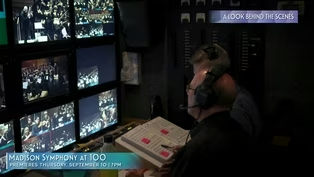
Behind the Scenes: Madison Symphony at 100
Cue the lights. Madison Symphony's 100 year anniversary performance is coming soon. (15s)
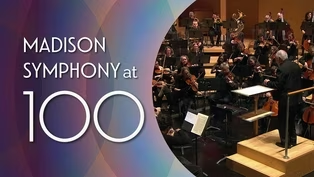
Video has Closed Captions
Madison Symphony Orchestra performs Mars, Venus, Mercury and Jupiter from "The Planets." (29m 19s)
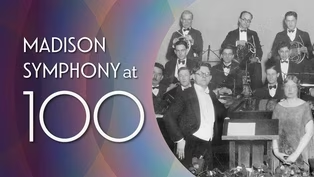
Video has Closed Captions
Executive Director Robert Reed on what reaching 100 years means for the Madison Symphony. (3m 49s)
Preview - Madison Symphony at 100
John DeMain leads a performance of classics celebrating Madison Symphony's 100 years. (15s)
Video has Closed Captions
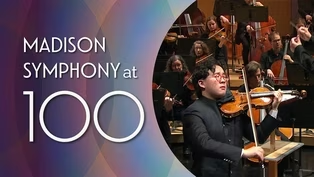
Guest violin soloist Julian Rhee performs with the orchestra in their centennial concert. (9m 24s)
Through the years with John DeMain
Video has Closed Captions
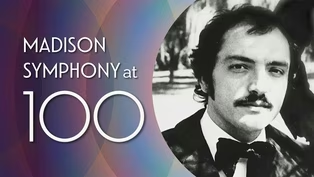
Maestro DeMain reflects on 32 years leading the Madison Symphony as he passes the baton. (5m 15s)
Providing Support for PBS.org
Learn Moreabout PBS online sponsorship New Episode
- Arts and Music

Innovative musicians from every genre perform live in the longest-running music series.
 Recently Added









 New Episode

Support for PBS provided by:
PBS Wisconsin Music & Arts is a local public television program presented by PBS Wisconsin