
Vance: U.S., Iran make progress, but Trump’s backing unclear
Clip: 5/28/2026 | 4m 21sVideo has Closed Captions
Vance says U.S. and Iran make progress, but Trump’s backing unclear
Vice President Vance said the U.S. and Iran have made “a lot of progress” in their negotiations, but that it wasn’t clear “when or if” President Trump was going to sign. Iran said no agreement has been made. The latest back-and-forth comes as the U.S. and Iranian militaries again traded fire, and Iran launched a ballistic missile at Kuwait. Nick Schifrin reports.
Problems playing video? | Closed Captioning Feedback
Problems playing video? | Closed Captioning Feedback
Major corporate funding for the PBS News Hour is provided by BDO, BNSF, Consumer Cellular, American Cruise Lines, and Raymond James. Funding for the PBS NewsHour Weekend is provided by...
Vance: U.S., Iran make progress, but Trump’s backing unclear
Clip: 5/28/2026 | 4m 21sVideo has Closed Captions
Vice President Vance said the U.S. and Iran have made “a lot of progress” in their negotiations, but that it wasn’t clear “when or if” President Trump was going to sign. Iran said no agreement has been made. The latest back-and-forth comes as the U.S. and Iranian militaries again traded fire, and Iran launched a ballistic missile at Kuwait. Nick Schifrin reports.
Problems playing video? | Closed Captioning Feedback
Where to Watch PBS News Hour
PBS News Hour is available to stream on pbs.org and the PBS app.
Providing Support for PBS.org
Learn Moreabout PBS online sponsorshipGEOFF BENNETT: Welcome to the "News Hour."
Tonight, Vice President J.D.
Vance said the U.S.
and Iran have made what he calls a lot of progress in their talks to end the war, but that it wasn't clear when or if President Trump was going to sign off.
Those comments come after a White House official told the "News Hour" and other outlets that U.S.
and Iranian negotiators had agreed to a framework.
Iran today said no agreement had been made, while Iran fired a ballistic missile at Kuwait and as the U.S.
and Iranian militaries again traded fire.
Nick Schifrin is tracking all of this for us.
So, Nick, let's start with this talk about a deal.
What at this point is President Trump demanding?
NICK SCHIFRIN: Well, before we get to what he's demanding exactly, because it's going back and forth, I think let's examine these conflicting statements that we have got.
The White House told me earlier today that, yes, there was a deal between the U.S.
and Iran.
They agreed on a 60-day cease-fire in order to basically open the Strait of Hormuz and kick-start nuclear negotiations.
But, as you said, the vice president tonight not saying that.
He not only said what you mentioned that it's not clear when or if the president was going to sign, but he added: "That requires us to make a little bit more progress, and I can't guarantee that we're going to get there."
So that is not the same at all as what the White House was saying earlier today, that there wasn't a deal.
But, regardless of all the posturing, perhaps, the core of your question is, what are we looking at?
What kind of deal are we looking at?
What is the president holding out for?
European, U.S.
and Arab officials all confirm that this is the deal on the table.
It's a two-phase deal.
The first phase would open up the Strait of Hormuz, including no tolls, and the U.S.
would end its blockade.
The war would end, including in Lebanon.
And then there are in-principle agreements that Iran would limit its nuclear program and the U.S.
would lift sanctions.
And that brings us to the second phase.
Iran would freeze uranium enrichment, uranium enrichment for TBD years.
U.S.
and Iranian officials tell me the U.S.
is pushing for 20 years.
Iran has offered five to 10 years.
Number two, Iran would export or destroy its 1,000 pounds of highly enriched uranium.
The president recently softened his position on that.
And, thirdly, the core of the U.S.
offer, lifting sanctions and unfreezing assets.
Earlier this week, a senior administration official put it this way, "No dust, no dollars," as in, if there's no highly enriched uranium export, Iran gets nothing.
So what the officials around the president are really emphasizing is that, until Iran agrees on highly enriched uranium and really limiting its nuclear program, there is no deal.
And so that's where we think the rub is tonight.
And that's what Scott Bessent said, that there will be no deal until Iran agrees to what the president's demanding.
SCOTT BESSENT, U.S.
Treasury Secretary: Nothing is going to be on the table until we see the Strait of Hormuz open and the Iranians agree that they have to turn over the highly enriched uranium and that they can't have a nuclear program.
NICK SCHIFRIN: So, despite the apparent progress, Geoff, Iran has still not publicly confirmed that it's willing to restrict its nuclear program in any way.
And a reminder, U.S.
and Iranian officials say that this would not restrict in any way Iran's ballistic missile program, or at least in writing its support for proxies.
GEOFF BENNETT: And there is still military activity between the U.S.
and Iran.
What happened today?
NICK SCHIFRIN: Today, U.S.
and Kuwait said that Iran had fired drones and at least one ballistic missile at Kuwait.
A U.S.
official told me it was intercepted, but -- quote -- "fragments of the interception" did make impact.
The official said there was no one seriously injured.
The U.S.
military called it a dangerous, egregious violation of the cease-fire.
It also said that it intercepted five Iranian attack drones.
This follows another exchange of fire on Monday.
Now, Iran hasn't confirmed any of these details, but it did release this video today, posting posters on a missile and firing a missile.
And, today, Iran's deputy foreign minister blamed the U.S.
for violating the cease-fire.
KAZEM GHARIBABADI, Iranian Deputy Foreign Minister (through translator): What the United States did was meant with a decisive response from the armed forces and the Islamic Revolutionary Guard Corps.
And it was certainly a violation of the cease-fire.
And Iran will respond to any violation of the cease-fire.
NICK SCHIFRIN: So, bottom line, Geoff, where we are tonight, U.S.
and Iran bickering over what's happening, disputing statements by - - within the U.S.
of how far progress is, but all sides saying there is progress.
There's clearly no deal yet.
GEOFF BENNETT: All right, Nick Schifrin, our thanks to you, as always.
NICK SCHIFRIN: Thank you.
How renaming PCOS to PMOS could improve care for millions
Video has Closed Captions
How renaming PCOS to PMOS could improve care for millions of women (6m 58s)
News Wrap: Treasury pushes for $250 bill featuring Trump
Video has Closed Captions
News Wrap: Treasury taking steps for $250 bill featuring Trump's image (4m 44s)
Palestinian detained after protesting Gaza describes ordeal
Video has Closed Captions
Palestinian woman detained for a year after protesting war in Gaza describes experience (7m 39s)

A rare look at the Strait of Hormuz from both land and water
Video has Closed Captions
An up-close look at the Strait of Hormuz from both land and water (6m 46s)
Trump trades fuel accusations of profiting off presidency
Video has Closed Captions
Trump stock trades fuel accusations of corruption and profiting off presidency (8m 8s)
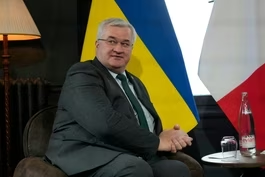
Ukrainian FM says attacks in Russia could pressure Putin
Video has Closed Captions
Ukraine’s foreign minister says drone attacks in Russia could pressure Putin to end war (6m 43s)

What to expect from the U.S. as the World Cup approaches
Video has Closed Captions
What to expect from the U.S. team as the World Cup approaches (7m 17s)
Providing Support for PBS.org
Learn Moreabout PBS online sponsorship New Episode
- News and Public Affairs

Today's top journalists discuss Washington's current political events and public affairs.
 New Episode
- News and Public Affairs

FRONTLINE is investigative journalism that questions, explains and changes our world.
Urban Consulate Presents
 New Episode
 New Episode
 New Episode
 New Episode
 New Episode
 New Episode
 New Episode
 New Episode
Support for PBS provided by:
Major corporate funding for the PBS News Hour is provided by BDO, BNSF, Consumer Cellular, American Cruise Lines, and Raymond James. Funding for the PBS NewsHour Weekend is provided by...