
How the vote to oust Orbán could have global implications
Clip: 4/13/2026 | 10m 8sVideo has Closed Captions
How Hungary’s vote to oust Viktor Orbán could have global implications
The incoming prime minister of Hungary struck a hopeful tone on Monday. Peter Magyar called for a swift transition of power and began to chart an ambitious course to reverse central pillars of Viktor Orbán’s rule. Stephanie Sy discussed how the results could reverberate around the globe with Kim Lane Scheppele, a professor at Princeton University who lived and worked in Hungary.
Problems playing video? | Closed Captioning Feedback
Problems playing video? | Closed Captioning Feedback
Major corporate funding for the PBS News Hour is provided by BDO, BNSF, Consumer Cellular, American Cruise Lines, and Raymond James. Funding for the PBS NewsHour Weekend is provided by...
How the vote to oust Orbán could have global implications
Clip: 4/13/2026 | 10m 8sVideo has Closed Captions
The incoming prime minister of Hungary struck a hopeful tone on Monday. Peter Magyar called for a swift transition of power and began to chart an ambitious course to reverse central pillars of Viktor Orbán’s rule. Stephanie Sy discussed how the results could reverberate around the globe with Kim Lane Scheppele, a professor at Princeton University who lived and worked in Hungary.
Problems playing video? | Closed Captioning Feedback
Where to Watch PBS News Hour
PBS News Hour is available to stream on pbs.org and the PBS app.
Providing Support for PBS.org
Learn Moreabout PBS online sponsorshipAMNA NAWAZ: The incoming prime minister of Hungary struck a hopeful tune today, and for the first time since 2010, it was not Viktor Orban.
Peter Magyar has called for a swift transition of power.
And, as Stephanie Sy tells us, he began to chart an ambitious course to reverse central pillars of Orban's rule.
STEPHANIE SY: In Hungary today, a Budapest street musician sounds notes of jubilance and hope.
He's one of the millions of Hungarians celebrating the weekend's election defeat of Viktor Orban and his 16-year grip on power in this parliamentary republic.
With nearly 80 percent voter participation, 5.9 million Hungarians delivered a clear verdict, overwhelmingly choosing the opposition party Tisza led by Peter Magyar.
Tens of thousands celebrated the results on the torchlit streets of Budapest last night.
The incoming prime minister promises to lead Hungary back to its European alliances.
PETER MAGYAR, Hungarian Prime Minister-Elect (through translator): Yesterday, the Hungarian people made many decisions, perhaps one of the most important being that Hungary's place in Europe was, is and will be a country that is a member of the two most important and largest alliance systems, the European Union and NATO.
STEPHANIE SY: A former Orban loyalist, he ran on an anti-corruption platform.
PETER MAGYAR (through translator): Hungary is in trouble in every respect.
It's been plundered, looted, betrayed, saddled with debt and ruined.
It's been turned into the poorest and most corrupt country in the European Union.
A systemic change is needed, since ours has been effectively controlled by an organized criminal group.
STEPHANIE SY: Prime Minister Orban's hard-line nationalist government eroded democratic norms and institutions, helping him stay in power, from stifling and co-opting independent media to weakening the judiciary's independence.
The nation slid toward what the European Union labeled electoral autocracy.
Magyar's Tisza Party, which won an astounding two-thirds majority in Parliament over the weekend, has vowed to undo Orban's institutional overhaul.
PETER MAGYAR (through translator): We have everything in our power to ensure that this truly marks the beginning of a new era, because the Hungarian people did not vote for a simple change of government, but for a complete transformation of the system.
STEPHANIE SY: Magyar's win was praised by European leaders, including Germany's Friedrich Merz.
FRIEDRICH MERZ, German Chancellor (through translator): As for Hungary and Ukraine, yes, things will be easier now.
This shows that our democratic societies are evidently much more resilient against Russian propaganda.
STEPHANIE SY: Orban was sympathetic to Russian President Vladimir Putin and just last month blocked a $103 billion E.U.
loan package to Ukraine.
At a news conference following his win, Magyar described what he would say to President Putin.
PETER MAGYAR (through translator): If Vladimir Putin calls, I will pick up the phone.
I don't believe that will happen and I won't call him myself.
But if we were to speak, I would tell him, please, after four years, end the killing and stop that war.
STEPHANIE SY: Kremlin spokesperson Dmitry Peskov downplayed the impact of Orban's loss.
DMITRY PESKOV, Spokesman for Vladimir Putin (through translator): We expect to continue our very pragmatic contacts with the new Hungarian leadership.
We have heard statements about a willingness to conduct a dialogue.
I don't think this has anything to do with the future of the Russian-Ukrainian conflict.
STEPHANIE SY: But Hungary's return to the European fold and further from Russia fueled hopes today.
IMRE VEGH, Budapest, Hungary, Resident: I feel very happy.
I have been waiting for 16 years this morning to beat Mr.
Orban.
He had an illiberal system which was against our fundamentals.
We are Europeans and we want to stay in Europe.
STEPHANIE SY: For more now on the Hungarian election and how the results could reverberate around the globe, we turn to Kim Lane Scheppele, a professor of international affairs at Princeton University who lived and worked extensively in Hungary.
Just a few years ago, Magyar was an Orban supporter.
How did his positions win the people during this campaign, Kim, and lead to such a seismic victory?
KIM LANE SCHEPPELE, Princeton University: Yes.
Well, Peter Magyar sprung out of the Orban machine.
He had spent about 20 years being part of the Fidesz Party as a loyalist, as someone who came up through the ranks, as someone who benefited a lot from actually his association with Orban.
And so there were a couple of events that I think caused him to pop out of the woodwork, so to speak, and take on Orban as a challenger.
One was that his ex-wife, Judit Varga, had just been fired as prime minister in a scandal that was probably Orban's fault, but that he blamed on her, and he kind of came to her defense very publicly.
But the second thing was that the European Union, having gotten really fed up with Orban, had cut most of the funds that the E.U.
gave to Hungary, putting Hungary in a financially precarious position.
And so everyone could see that the system was cracking under the strain, and Peter Magyar jumped out ahead.
So he came out of the woodwork.
He didn't really have much of a prior profile.
And he came out as a critic of Orban, and particularly as a critic of Orban's corruption, because he knew where all the bodies were buried, and he was a very credible source on exactly what that corruption was.
And he took that corruption beam right up through his victory this week.
STEPHANIE SY: So now there's this expected turn back toward Europe.
But when it comes to Ukraine, Orban has been blocking billions of dollars of aid that the E.U.
wants delivered to Ukraine.
What should we expect moving forward on Hungary's role in the war?
KIM LANE SCHEPPELE: Well, I think that Peter Magyar will stop being an irritant to the E.U., and my guess is that he will probably not exercise the Hungarian veto on this giant loan to Ukraine.
That said, I don't think he is going to sort of cuddle up to Ukraine very much, because over the years Orban has really whipped up a kind of anti-Ukrainian sentiment in Hungary.
And I think this whole foreign policy issue about the war next door is not really where Magyar wants to spend his time.
So I think he will get out of the way of Europe.
He won't block it, but he's not going to be there as a giant supporter cheering on Ukrainian - - on the Ukrainian fight against Russia.
He has promised quite starkly, I think, to cut the Russian ties that Orban had cultivated.
And so I think the -- insofar as the Ukrainian veto on Ukraine was part of Orban's making nice with Russia, that reason will be gone.
STEPHANIE SY: Orban's 16-year-old hold on power helped write a playbook that populist leaders, including critics say, our own President Trump have used.
What does Orban's loss mean for this type of strongman leadership in other Western democracies?
KIM LANE SCHEPPELE: A lot of Orban's machinery that has supported the far right across Europe, and, for that matter, has helped the far right in the United States, a lot of that machinery is going to remain intact, because the funding that holds up this huge operation called the Mathias Corvinus Collegium and its various think tanks like the Danube Institute, has been buffered from change by an incoming government.
And it's going to go on operating even without having a state behind it.
So it's a mixed story on all that.
And I might say that this Danube Institute, which is Viktor Orban's English-language think tank, was a partner with The Heritage Foundation in drafting Project 2025.
And the way that you can see that is that Trump's opening salvo months exactly duplicated what Viktor Orban had done when he came to power in 2010.
So, I think the Trump administration has lost a friend and an ally.
STEPHANIE SY: And yet, even with this playbook, Orban lost with almost 80 percent of the populists turning out.
Does Magyar's rapid ascent potentially offer a playbook for Trump's political opponents?
KIM LANE SCHEPPELE: Yes, so the way that Magyar won I think is very instructive to other oppositions trying to fight back against autocracy.
The first thing is that autocrats do try to rig the rules in their favor.
So when a pro-democratic candidate runs, he's got to figure out how to get around the rigged rules in the system.
And Peter Magyar had figured out that the way Orban's system was set up was that a rural voter would have roughly three times the weight in the parliamentary elections as an urban voter.
All of the oppositions had previously cultivated the cities, more cosmopolitan, more anti-authoritarian, you might say.
Peter Magyar went out to every single village in person to persuade Orban's base, actually, that Orban was not acting in their interests.
He also built this huge big tent so that people who voted for him probably agree on very little else than that Orban has to go and that democratic institutions have to be rebuilt.
So -- and that the corruption all has to stop.
So, very cleverly, Magyar played the issues that appealed to the broadest group.
And he ignored all of the pleas to deal with issues that only dealt with part of his base.
So, big tent, figuring out the election rules, figuring out a path to victory, all of that matters.
STEPHANIE SY: And the world is watching.
Kim Lane Scheppele of Princeton University, thank you.
KIM LANE SCHEPPELE: Thank you.
Evan Shapiro and Geoff Bennett on the future of media
Video has Closed Captions
Evan Shapiro and Geoff Bennett explore the future of media on 'Settle In' (3m 39s)

How the U.S. blockade could pressure the Iranian regime
Video has Closed Captions
Mideast experts discuss how the U.S. blockade could pressure the Iranian regime (8m 58s)
News Wrap: Judge dismisses Trump's lawsuit against WSJ
Video has Closed Captions
News Wrap: Judge dismisses Trump's lawsuit against WSJ for story on Epstein ties (3m 13s)
Pope Leo vows to continue speaking out after Trump clash
Video has Closed Captions
Trump clashes with Pope Leo, who vows to continue speaking out against war (4m 59s)
Rep. Swalwell resigning after sexual assault accusations
Video has Closed Captions
Swalwell resigning from Congress after sexual assault accusations (7m 52s)
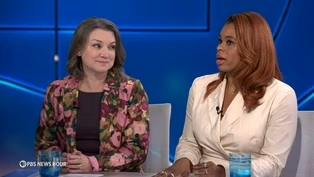
Tamara Keith and Jasmine Wright on Trump, Pope Leo feud
Video has Closed Captions
Tamara Keith and Jasmine Wright on Trump's feud with Pope Leo (8m 48s)
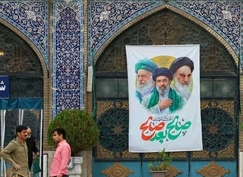
U.S. begins naval blockade after Iran peace talks fail
Video has Closed Captions
U.S. begins Strait of Hormuz naval blockade after Iran peace talks fail (5m 15s)
Providing Support for PBS.org
Learn Moreabout PBS online sponsorship New Episode
- News and Public Affairs

Today's top journalists discuss Washington's current political events and public affairs.
 New Episode
- News and Public Affairs

FRONTLINE is investigative journalism that questions, explains and changes our world.
Urban Consulate Presents
 New Episode
 New Episode
 New Episode
 New Episode
 New Episode
 New Episode
 New Episode
 New Episode
Support for PBS provided by:
Major corporate funding for the PBS News Hour is provided by BDO, BNSF, Consumer Cellular, American Cruise Lines, and Raymond James. Funding for the PBS NewsHour Weekend is provided by...