Oregon Field Guide
Downhill Mountain Bike Racing, Earthquakes and Fossils, A Rare Geese Pairing
Season 37 Episode 7 | 29m 19sVideo has Closed Captions
An aspiring young mountain bike racer. Tiny fossils reveal big earthquakes. A rare avian pairing.
Alyana Van Horn chases pro downhill mountain bike glory, backed by family, grit and hard-earned racing scars. How scientists are using tiny fossils, called diatoms, to better understand the risks that face the Pacific Northwest when the “Big One” hits. Two species of geese overcome their differences to form a rare pairing in a public park.
Problems playing video? | Closed Captioning Feedback
Problems playing video? | Closed Captioning Feedback
Oregon Field Guide is a local public television program presented by OPB
Oregon Field Guide
Downhill Mountain Bike Racing, Earthquakes and Fossils, A Rare Geese Pairing
Season 37 Episode 7 | 29m 19sVideo has Closed Captions
Alyana Van Horn chases pro downhill mountain bike glory, backed by family, grit and hard-earned racing scars. How scientists are using tiny fossils, called diatoms, to better understand the risks that face the Pacific Northwest when the “Big One” hits. Two species of geese overcome their differences to form a rare pairing in a public park.
Problems playing video? | Closed Captioning Feedback
How to Watch Oregon Field Guide
Oregon Field Guide is available to stream on pbs.org and the free PBS App, available on iPhone, Apple TV, Android TV, Android smartphones, Amazon Fire TV, Amazon Fire Tablet, Roku, Samsung Smart TV, and Vizio.
Providing Support for PBS.org
Learn Moreabout PBS online sponsorshipMajor support for Oregon Field Guide is provided by... [ ♪♪♪ ] WOMAN: Come on!
There he is, there he is, there he is.
[ exclaims ] Get him out of there, buddy!
Good boy!
[ laughing ] WOMAN: Whoo, high five!
Yeah!
AARON: Tonight on Oregon Field Guide: WOMAN: Dave's in there, becoming one with the mud.
What if tiny fossils can help us prepare for big earthquakes?
MAN: Ready?
One, two, three.
The Oregon coast is one of the best places in the world, with the longest record of marsh history, which makes it a great candidate to study old tsunamis.
And then, an unlikely avian love story.
WOMAN: Most people think that two different species can't breed and produce viable offspring, but we're wrong, and I love that about science, is that we learn something every day.
But first... Oregon has a bike culture like nowhere else.
It's woven into who we are.
But most of us pedal on flat ground, maybe a few light trails.
Alyana Van Horn does something different.
[ timer beeping ] --two, three, go, go!
[ person exclaiming ] ALYANA: Downhill mountain bike racing is just super intense.
My heart just goes pumping.
I have to really focus on my breathing.
But when you're coming through and you're hitting jumps, just floating through the air... you're flying, and there's nothing that's attached to you besides your bike.
Aw, it's just super fun.
[ birds chirping ] Alyana Van Horn and her dad, Isaak, just made the six-hour drive from Medford to Fern Hill.
They're headed to the first race in the Northwest Cup, a series of mountain bike competitions and a proving ground for the most talented riders in the region.
She likes to go fast.
She's a competitor.
And so now I'm part of the mix.
At 17 years old, Aly's competing as a junior pro.
How she performs at events like the Northwest Cup will decide whether she can turn pro next year and make mountain biking a full-time job.
I think I was around 7 years old when I was-- started riding.
WOMAN: Whoo-hoo.
Good job, Alyana!
ALYANA: I just remember it was for me.
I liked it.
Somewhere along the line, a fire was lit in that kid and she did one of her first downhill races and won.
Over the next three years, Aly kept competing and winning.
What started as a hobby was suddenly looking like a realistic career path.
ISAAK: Aly wants to win.
[ Alyana yells indistinctly ] She's got some kind of drive in her that she's a competitive athlete.
And as it turns out, she has the skills and the fitness to back it up.
Come give us some hugs and we'll hit the road.
Their eight-hour drive to northern Washington always includes a stop at grandma's.
Grandma!
Ohhh!
Oh, my amazing young lady.
Mwah!
Oh!
Kiss me.
You have fun, okay?
Okay.
And be safe.
You know, I'm scared to death, but that's life, you know.
You have to take the risk.
Otherwise, you will never learn, never find out.
That's what life is all about, right?
[ laughs ] ALYANA: My family is my biggest support.
Like, my dad and my mom take the time off their work to help me travel, but they also help make me sane while I'm traveling, because sometimes they're really long flights or drives.
ISAAK: This is kind of the tip of the iceberg, because if she does well in this season, she could get to go race on a world stage.
You never know.
[ birds chirping ] Port Angeles is the first stop in the Pacific Northwest's largest downhill race series.
And strong results can be the difference between mountain biking as a hobby or a career.
ISAAK: Pro/Cat 1.
Where you going?
[ giggles ] Before every race, Aly and Isaak do a track walk, studying the course and learning its nuances.
This will be interesting, the off-camber of this turn.
And there's already a hole there.
Yeah.
Tires coming through will develop... ALYANA: A path.
And you'll use this for traction.
She always goes inside.
Yeah, I always go... [ imitates bike speeding by ] ISAAK: She knows most of this course, whereas somebody like me, I'm like, "Have I been here before?
I don't know."
Isaak isn't just here for moral support.
He also plans on racing this weekend.
Racing old man intermediate class.
If I can put together a clean, fast run, I think this year I might be competitive.
I don't know.
We'll see how it goes.
Now that she's outpaced her dad's riding skills, Aly doesn't hold back her critiques.
So I'll see him at the bottom and I'll be like, "Hey, why'd you take that line?"
[ gasps, then chuckles ] A tough coach.
I used to coach her.
[ both chuckle ] ISAAK: The Padawan's become the master.
[ chuckles ] [ racers chattering indistinctly ] Mountain bike competitions split racers into categories based on age and skill level.
Aly's racing in the top junior category: Cat 1 for girls age 17 and 18.
And Isaak is in Cat 2 for men ages 50 to 59.
ALYANA: Today's the first day of practice.
It's really about learning the lines and getting used to going fast again.
Downhill racing is simple... in theory.
Start at the top and ride to the bottom as fast as you can.
But in practice, it's a lot more complicated, especially on slopes tipping past 50 degrees, massive jumps, deep drops, and a maze of rocks and roots.
And it's all up to me to remember places on the trail to look out for.
There's just little things that could go wrong and end my run real quick.
ISAAK: Downhill mountain bike racing, I don't know anybody that mountain bikes that hasn't had wrecks.
It's got to be one of the most dangerous sports you could do.
[ onlookers gasping ] WOMAN: You okay?
Yeah.
ALYANA: Crashing, it's gnarly.
There's rocks.
The dirt is hard.
You're inhaling dust.
And it's really knowing how to roll out of a crash and get back up.
MAN: Go, go, go!
[ crowd cheering ] This rider wiped out near the finish line.
Fortunately for him, the organizers keep an ambulance on standby.
ALYANA: Whether it's scrapes or bruises or broken bones, everyone's going to get hurt on a bike.
Aly would know.
And if you're squeamish, now might be a good time to look away.
[ heart monitor beeping ] A crash at Mount Bachelor in 2022 fractured her orbital and cheekbone.
My bones will never be 100% again.
I have three metal plates and a handful of screws in my face, like a handful, as in, like, over 15 screws.
ISAAK: When we're at a race, I see a lot of parental anxiety, and if I have that, it's no longer fun.
And I just have to trust in her strength and her skill and her decision-making through experience.
Let's go, Aly!
Get it, get it!
For her to earn a good living racing her bike, it's the dream of a lot of mountain bikers, but a very small percentage can actually make that happen.
What do you usually do there?
It's a tough road... That looks fast, Aly.
...but having a family that loves riding as much as she does makes the journey a lot easier.
ALYANA: My whole family's happiness was, like, around mountain biking.
Whenever my dad has a day off, he wants to go riding.
ISAAK: I don't know how many parents get to enjoy children that still want to hang out with their dad and go skiing with me and go mountain biking with me and going camping with me.
I honestly couldn't have written this any better.
[ people chattering, cheering ] My goal for the season is to get two to three podiums in Cat 2 so I can move up to Cat 1 and then be on Alyana's schedule, but Dad's got to have goals.
Okay, pedal gear?
Chin strap?
Yes.
Yes.
Goggles?
Yes.
Isaak's race run is first.
He'll be riding on a different course than Aly, one that's less treacherous.
[ horn squeaks ] Line up, beep, beep, go.
And then have a clean race run and then I just go into dad mode and cheer on Alyana.
[ laughs ] [ timer beeping ] --two, three.
Go, go.
ANNOUNCER: And there you have it.
Solid run there.
The 483 of Izaak Van Horn.
And Van Horn with a 317.35 slides into third place.
Nice run there from Van Horn.
At third place, Isaak just made the podium.
Yeah!
--Hammond, Van Horn, 1, 2, and 3.
ISAAK: Well, it started raining in the last hour.
The diagonal roots like that one, that becomes far more treacherous.
Any of the rock faces like you see right there, that becomes more slick.
Watch out for that root!
Downhill racing is unique.
No single win makes you a pro.
It takes several victories across an entire season.
A win here would bring Aly one step closer.
ALYANA: This is it.
This is the race of the weekend.
But when I come down, my time will either be first or I'll end up somewhere else.
[ timer beeping ] [ Alyana breathing heavily ] [ onlookers cheering ] [ cheering continues ] ISAAK: Oh, is this Aly?
Let's go, Aly!
ANNOUNCER: --301.18, and Victoria goes to sixth place as our first rider in seeding yesterday.
Time today, 248.84, and it's enough to take the win.
[ whoops ] You got it, kid!
ANNOUNCER: Alyana Van Horn going 1 and 1 on the weekend.
Yeah!
That's your top five Cat 1 women U 18.
ISAAK: Yeah!
[ laughs ] That's amazing!
[ laughing ] How are your legs, dude?
[ Alyana sighs ] I know that feeling from like two hours ago.
ALYANA: I'm going to be an up-and-coming pro next year.
So to rack up points in series and be a top name in top competition and to be on podium, that's what gets people's attention.
ANNOUNCER: Give it up for Alyana Van Horn.
[ crowd cheering ] Aly went on to win 5 out of 13 races this season.
Her final victory came here at Stevens Pass, Washington.
PHUONG: Yay!
[ laughs ] This time she brought one of her biggest fans.
Oh, that's her right there!
It's the first time grandma has seen Aly race in person.
ISAAK: Hey, Mom, what do you think about all this?
It's really awesome.
I'm so glad I'm up here now.
At least I see what you guys up to.
[ bell ringing ] ISAAK: Yeah, Aly!
Whoo!
PHUONG: Go, Aly!
ISAAK: Yeah!
ANNOUNCER: Taking the win today, Alyana Van Horn!
[ crowd cheering ] ALYANA: I really depend on my family to be my backup and my support, and they give me a lot of their time and a lot of their money.
And they're there for me when I'm at my lows.
They help bring me back up and we just enjoy the sport and they want to be a part of it.
[ birds chirping ] [ man whoops ] MAN: One, two, three, go.
Next up, we're going to bring you a story from All Science.
No Fiction., which is OPB's show all about cool, cutting-edge research in the Pacific Northwest, but through a really creative lens... like this.
What are we working on, Jes?
Well, we're using this set to show what'll happen during the Cascadia earthquake when the soil beneath our feet turns to quicksand.
We're going to bring you that story down the road.
For right now, it's another story about earthquakes and little, tiny fossils.
JES: When the next Cascadia earthquake happens, coastal communities in the Pacific Northwest are in trouble.
Intense shaking, a massive tsunami, but also a near-instantaneous drop in elevation.
Yet it's been so long since the last big earthquake, it's hard to know exactly what we should expect.
Well, what if we could look back in time to learn from past earthquakes, using tiny fossils from hundreds, even thousands of years ago?
They could tell us a story about how our coast will be forever changed when the next big one hits.
And that's All Science.
No Fiction.
[ ♪♪♪ ] You'd be surprised what you can find lurking under the surface of an Oregon salt marsh.
So should we core?
Yeah.
Let's do it.
Yeah.
One way of learning what's there is by taking a core.
[ water bubbling ] One, two, three.
The Oregon coast is one of the best places in the world, with the longest record of marsh history, which makes it a great candidate to study old tsunamis.
A core sample reveals the history of a place in layers of sediment.
WOMAN: Nice.
Yeah, that's a nice sand.
Generally, the deeper you go, the further back in time you travel.
Dave's in there, becoming one with the mud.
Yeah, that smells nice and decomposed too.
David Bruce will do more than just smell the dirt for his PhD project.
Whew!
Decomposed peat.
He'll use what he finds to help coastal communities prepare for when the next big Cascadia Subduction Zone earthquake hits the Pacific Northwest.
Subduction zone earthquakes can be devastating.
FILM REEL NARRATOR: Out in the Gulf of Alaska, the ocean bottom seems to sink.
In Anchorage, Alaska's largest city, buildings collapse, streets and homes slip into the earth.
JES: In Alaska in 1964, a 9.2 magnitude quake caused tsunamis and parts of the coast to drop in elevation more than 5 feet, a phenomenon called subsidence.
With good information, Northwest communities could plan for the worst by bolstering infrastructure where they can and not building in low areas.
One, two, three, go.
What separates these seismologists from other earthquake scientists is that they're looking for tiny fossilized algae entombed in the sediment.
They're called diatoms.
WOMAN: Diatoms are a unicellular photosynthetic algae, and they are in all aquatic environments.
So freshwater, brackish, and marine.
You can find them anywhere where there's water, anywhere where it's even damp.
Diatoms have shells made of silica.
They're tough.
When they die, they can stick around intact in the sediment for thousands of years, just waiting to be captured in a core sample.
Ooh!
Oh, yeah.
This core sample is a thing of beauty.
TINA: That's what it should look like.
Mike's gonna pass out.
[ mock gasps ] I've got the vapors.
It perfectly shows the tsunami from the last Cascadia earthquake, more than 300 years ago.
The evidence is this thick layer of sand, which was washed inland by the wave.
DAVE: That's the trinity right there.
The soil, the tsunami, the mud.
TINA: I'm going to take a picture.
This one's going viral.
[ all laugh ] Okay, we got it.
DAVE: That takes away all your questions.
Land-level change, tsunami, land-level change.
[ ♪♪♪ ] The Cascadia subduction fault runs north-south about 100 miles off the Pacific Northwest coast.
Here the Juan de Fuca plate and North American plate collide, with Juan de Fuca being forced down, or subducted, underneath the continent.
But the plates don't slide past each other easily.
They lock together where they meet, causing the top plate to bend up.
Our coast rises out of the ocean.
But at some point, the pressure at the fault becomes too much.
The plates grind past each other, triggering the Cascadia earthquake and a tsunami.
On the coast, in the span of just a few minutes, the land drops, or subsides, raising relative sea level as much as 6 feet or maybe even more, which makes tsunamis all the more powerful.
It's not a hypothetical.
[ warning horns bellowing ] We've seen this happen, and recently.
[ people clamoring ] The 2011 earthquake and tsunami in Japan left around 20,000 people dead.
It destroyed coastal communities, and the subsidence left some low-lying areas permanently flooded.
Evidence of this up-and-down motion on the coast is what the geologists are looking for in the core.
DAVE: Specifically, we're looking for the tidal wetland signature of subduction-zone earthquakes.
And that's land-level change where you see this old marsh, that's peat kind of.
And then on top of that is sand, which is a tsunami that came in.
Then right above that is tidal muds.
Not only does the type of sediment change as the land rises and falls with the Cascadia earthquake cycle, but so do the tiny fossil diatoms connected with those environments.
This is the key: different species of diatoms like different areas of the marsh.
The diatoms that like lots of saltwater won't live in the high marsh where groups of freshwater diatoms live.
And there are other communities that live in the more brackish spaces in between.
The communities are distinct.
There we go.
We can see some diatoms there.
You just get on the microscope and you start looking at who's there.
The diatom species they find in the core samples are as diverse as they are beautiful.
It's really fun.
I get lost on the-- on the microscope.
Yeah.
You really can.
They're different sizes and shapes.
The lemon.
The croissant.
The football.
How about a round of golf?
The snow tire.
And they use the intricate patterns on their surfaces to help tell one diatom hot dog from another.
The team will identify and count 3- to 600 diatoms from each sediment layer and then compare the communities of fossil diatoms to what's living in the marsh now.
This is how they convert a bunch of fossils to knowing the actual elevation change from the earthquake.
If the diatom communities found right below the tsunami sand match modern diatoms living in the high marsh, say 4 feet above sea level, they know that was the elevation right before the earthquake.
Then they look at the diatoms in the sediment after the earthquake.
Let's say those match diatom groups that now live 2 feet below sea level.
From 4 feet above to 2 feet below, they can conclude that the earthquake caused the land to drop 6 feet in elevation.
Yep.
Ready?
One, two, three.
And the beauty of taking core samples is that if you find the right spot... Here we go.
Here we go.
...and go deep enough, you can figure out how much the land dropped with earthquakes that happened thousands of years ago.
TINA: Boom.
Okay.
One of the things I really want to do is take that record back and say, like, how does this change over time?
[ straining ] Does it drop 1 meter every time?
Or is it different?
Or, like, what's causing the change?
Based on what these researchers have found in the cores, they know the area around Oregon's Salmon River estuary dropped more than 4 feet during the last Cascadia earthquake.
And, of course, that's not the only sea-level change that coastal communities need to plan for.
Climate change is causing ocean levels to rise around the world.
And it's important we're planning for both.
TINA: We think about sea-level rise on the Oregon Coast, but we don't think about it in the context of the earthquake cycle where we could have 2 meters of sea-level rise tomorrow.
Add all that sea-level rise together and you get more erosion, crumbling roads, and saltwater in places it definitely shouldn't be.
And these tiny, beautiful fossils from the past may be one of our best clues to understanding how to safeguard the future of the Pacific Northwest coast.
AARON: You can find more stories from All Science.
No Fiction.
on the PBS app, opb.org, and YouTube.
[ birds chirping ] "Birds of a feather flock together."
That's usually how it works.
Every spring, pairs of Canada geese nest at this park and raise goslings.
But sometimes nature surprises us.
[ geese honking ] MAN: We get a fair amount of visitors.
We like to bring nature and humans together in this park, so we kind of facilitate that as best as we can.
Geese will be basically everywhere in this park.
It's not our park, it's the geese's park.
They will forage in the grass.
They will lounge around, swimming in the water.
But mainly reproducing and nesting are why they come to this park.
They have their hatchlings and then they go on their way.
So last week, I walked down to swim beach and I happened to see that there was a Canada goose on one corner of the point there and there was a greater white-fronted goose that was kind of acting as a barrier between myself and the goose.
It piqued my interest.
I started paying a little more attention, noticed that the Canada goose was nesting, and I sent an email to the Metro senior biologist Katy Weil and I explained to her the situation.
So right now on the right, the female Canada goose is on a nest, incubating eggs.
The mate is a greater white-fronted goose, and he's the one that's been defending the nest.
So he's been not going very far from her at all.
But it's interesting to see a Canada goose and a greater white-fronted goose, which are completely different genus and species, cohabitating, nesting.
Most people think that two different species can't breed and produce viable offspring, but we're wrong, and I love that about science, is that we learn something every day.
So I think these two are going to have eggs that are of both species, so it's going to be a genetic hybrid.
We have had photographs of geese that are hybridized.
They look really interesting.
They have aspects of both parents.
I know it's happened in the Willamette Valley a few times, but I've not seen it happen here.
So it's possible that the only available mate happened to be a Canada goose, and she was receptive to the concept.
[ chuckles ] In many situations, birds will be a pair that travels around together for life.
Sometimes the goslings don't make it and sometimes they do.
These sorts of stories, they make the natural world more interesting but also feel more, like, special and personal.
You know, we see a Canada goose every day, but seeing a greater white-fronted is something rare, and then seeing the interaction between the two is really special, I think.
KATY: This particular situation is unique to me, and I want to keep an eye on them and see how they're doing.
Why I study nature is that I will always be pleasantly surprised, and the concept of these different species breeding, what comes after that, we tend to want to make sense of things in a logical order, but embracing that entropy, that chaos, that uniqueness is understanding that it's something not to be afraid of but to be excited by.
You can now find many Oregon Field Guide stories and episodes online.
And to be part of the conversation about nature and the outdoors here in the Northwest, join us on Facebook.
Major support for Oregon Field Guide is provided by... Additional support provided by... and the following... and contributing members of OPB and viewers like you.
 New
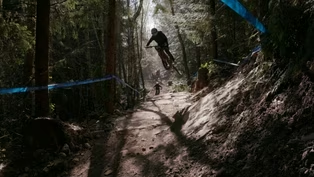
NewMedford teen chases pro downhill mountain biking
Video has Closed Captions
Clip: S37 Ep7 | 12m 48s | At 18, Alyana Van Horn is chasing a pro career in downhill mountain bike racing. (12m 48s)
 New
NewVideo has Closed Captions
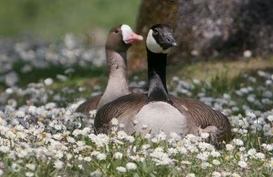
Clip: S37 Ep7 | 3m 7s | Two species of geese overcome their differences to form a rare pairing in a public park. (3m 7s)
Providing Support for PBS.org
Learn Moreabout PBS online sponsorship















Support for PBS provided by:
Oregon Field Guide is a local public television program presented by OPB