
The Sky's the Limit: Breathitt County Farming, Joyland Park, 65th Kentucky Shakespeare Festival
Season 31 Episode 11 | 26m 26sVideo has Closed Captions
Progressive agricultural practices, Joyland Amusement Park, and the Kentucky Shakespeare Festival.
Progressive agricultural practices and community efforts are helping farmers and agriculture thrive in Breathitt County; the complex legacy of Joyland Amusement Park, a once-prominent landmark on the outskirts of Lexington; a group in Louisville is making theatre accessible to everyone in the state, using Shakespeare.
Problems playing video? | Closed Captioning Feedback
Problems playing video? | Closed Captioning Feedback
Kentucky Life is a local public television program presented by KET
You give every Kentuckian the opportunity to explore new ideas and new worlds through KET. Visit the Kentucky Life website.
The Sky's the Limit: Breathitt County Farming, Joyland Park, 65th Kentucky Shakespeare Festival
Season 31 Episode 11 | 26m 26sVideo has Closed Captions
Progressive agricultural practices and community efforts are helping farmers and agriculture thrive in Breathitt County; the complex legacy of Joyland Amusement Park, a once-prominent landmark on the outskirts of Lexington; a group in Louisville is making theatre accessible to everyone in the state, using Shakespeare.
Problems playing video? | Closed Captioning Feedback
How to Watch Kentucky Life
Kentucky Life is available to stream on pbs.org and the free PBS App, available on iPhone, Apple TV, Android TV, Android smartphones, Amazon Fire TV, Amazon Fire Tablet, Roku, Samsung Smart TV, and Vizio.
Providing Support for PBS.org
Learn Moreabout PBS online sponsorshipProduction of Kentucky Life is made possible in part by the KET Millennium Fund.
This week on Kentucky Life, we go to Breathitt County to explore how agriculture is evolving in eastern Kentucky.
We explore Liberty Hall and Frankfort, the setting for this week's show that has a remarkable place in our state's history.
We'll tell you about a long-gone Lexington amusement park that was home to both joy and hurt of the times.
And we'll travel to Louisville to experience Shakespeare in Central Park.
All that's next on Kentucky Life.
[music playing] Hey, folks, and welcome to Kentucky Life.
I'm your host, Chip Polston.
It's good to see you again.
This week, we're here in Frankfort, the seat of Kentucky's democracy, as we celebrate America's 250th birthday this year.
Our setting is Liberty Hall, the home of John Brown, who introduced the bill in Congress to make Kentucky a state.
The home was a marvel of its time.
It was only the third structure in Frankfort to be made of brick, and one of the first in the city to have glass windows.
As John Brown was a major player in American politics, the guests here were a who's who of history.
In fact, just one breakfast here had three presidents on the guest list.
At that 1819 event were the incumbent president, James Monroe, and two future presidents, Andrew Jackson and Zachary Taylor.
And for you Hamilton fans, Aaron Burr played chess here.
The actual set he used is on display, with some of the pieces showing damage from where Burr was said to have lost the game, at which point he sent the chessboard flying.
The home offers a remarkable glimpse of what life was like when Kentucky was just becoming a state.
And we look forward to exploring it.
But first, from rough terrain to strip mines, to floods, farming in eastern Kentucky has always been a tough undertaking.
And that's why agriculture in Breathitt County is quickly becoming a model for the rest of Appalachia.
In and around Jackson, Kentucky, my family's hometown, farming is a community effort, and the movement is growing.
When you think about agriculture in the beautiful mountains of eastern Kentucky, it's hard not to focus on the challenges.
But if you spend some time in Breathitt County, you're going to meet farmers who are turning those challenges into opportunities.
Breathitt County is very mountainous in areas.
Most of the farmland in those areas of the county are reclaimed strip mine, grazing operations is about all that we've got there.
Other areas of the county, the more fertile areas, cropland, are prone to flooding.
Dealing with floods is nothing new for Breathitt County, but the frequency and severity of these events are increasing.
With these challenges, local farmers must find progressive ways to maximize their resources.
Farmers here, [cow mooing] they have to add as much value to their product on their farm as they can.
And we've got some really good examples of that going on with freezer beef sales, with, you know, direct sales at farmers markets or at schools.
That's how farmers can make a living here, is by adding value to their product on their farm.
[people chatting] Eric and Amy Holbrook run a state-of-the-art beef cattle operation on one of those reclaimed strip mines.
They add value by offering direct sales options for their grain-finished beef.
But like most successful businesses, it all starts with having something people want to buy.
Our cattle are born and raised on our farm, so they've never left the farm except to be processed at the end.
We take pride in that because people know what these cows, if they've been given medicine, what they've been fed, that's really important to us.
We feed them until they're finished.
We feed them grain, like I said, three times a day, and they have free choice of hay.
So, it gives them that really good marbling in the meat, which makes them delicious, of course.
Like a lot of Breathitt County farmers, Amy and Eric have full-time jobs off the farm, so they have to leverage technology for their intensive operation.
We have solar feeders that feed our cattle three times a day, so we don't have to go back there and feed the cattle three times a day.
We also harvest rainwater off of the roof of the barn, into cisterns, and then we use a solar pump to pump that into the water for the cattle in the pens.
Across the county, technology also plays a key role at Jeff and Sue Howard's hydroponic vegetable operation.
UK Cooperative Extension Services helped them apply for a grant, and that's how they bought their first high tunnel.
Since then, they've just kept growing.
We can see that there's a potential here to grow stuff that you just can't grow in the garden.
The main deal for growing in something like a high tunnel or something is when you go to a Farmer's Market to sell, you can have something in there before everybody's got the same thing.
It gives you a little advantage.
Not cheating, it just gives you an advantage.
And when you're trying to maximize yields on small pieces of land, you take any advantage you can get.
But our little spot, if we don't make this spot produce something now and then produce again and maybe again in the same year, we're not gonna - we may be wondering what we're gonna have for supper tomorrow.
[chuckles] To keep production moving throughout an expanded growing season, the Howards rely on high tunnels and hydroponics.
You're seeing that tank is full of water with nutrient in it.
You've got a pump, submersible pump in that tank, and it comes up through that black line, and it just runs down through here across the roots of the lettuce and back in the return tube that takes it back to the tank.
It keeps circulating.
All that's missing from the equation now is the consumer.
And that's where the local community and a proactive extension agent come into play.
What's good about here in Breathitt County is there's a lot of local people that want to support agriculture.
You just have to make it easy for them.
You have to give them that access.
So, that's why I work so hard with the farm to school program and with the Farmer's Market here is so that people can have that access to fresh local food.
[people chattering] In addition to the Breathitt County Farmer's Market, Reed has helped grow the local farm-to-school program with Jackson Independent Schools, and that has had a major impact on local agriculture.
I think the impact of the farm-to-school program is so beneficial to local farmers.
They buy any ground beef that we will sell them, which is great because when it comes to beef, you get more ground beef than you do anything else.
You get a small amount of steaks and a huge amount of ground beef.
So, that helps us control the ground beef inventory.
And then we can harvest more beef each month because that ground beef is being moved each month as well.
Jackson City School, they help us extremely.
They are over half of our farm income.
And the good thing about that is that is we know when it goes there, when we pick it, it's sold.
And you know, you take it to the Farmer's Market, you might sell it, and you might end up bringing a lot of it home.
So, it's good to have something that is guaranteed.
The school is key in the fact that they're able to take larger amounts of meat and produce at a time.
Most of the time, when farmers go to a Farmer's Market, you're not going to sell out.
[children chattering] But by working with the school, they are able to take larger quantities.
I mean, they're feeding hundreds of kids a day.
And then the kids are loving the ground beef.
I mean, the flavor and the texture is so different than what they were getting that the school is like, now we can't ever go back [chuckles] to the ground beef we were buying before.
Me and Jeff were just talking the other day that we wish all the schools, even our grandchildren, we wish they had this fresh food because it's more nutritious for you.
The incredible work being done at Jackson City Schools benefits both the kids and the farmers in Breathitt County.
And it's part of a broader community effort that could be a model for the rest of Eastern Kentucky.
The food supply chain can break so easily, and coming to a local farmer, I'm here.
Even if all the trucks break down, they can still come to Highway 30 East and get beef from me.
And they can go to Jeff and get lettuce or berries, and they go to Farmer's Market, and we have lots of other farmers that come there.
But I think just fostering that relationship between the farmers and the community is the best thing that Breathitt County has done.
That is something any community can do.
Just be involved with your farmers because when you don't have farmers, you may not have food, and that's really important.
I wish more communities were doing what Breathitt County is doing.
I think Breathitt County is setting a really good example for all of Eastern Kentucky.
I mean, the topography here isn't what it is in farm country in Central Kentucky, in Western Kentucky, but there's still a lot of agriculture here.
If you've got a community that supports agriculture, the sky's the limit.
You can do anything.
[music playing] Our next story revisits a place that once lit up summers for families across Kentucky, Joyland Amusement Park in Lexington.
Now for decades, Joyland was a hub of rides, music, swimming and memories, but it was also a place shaped by the segregation of its time.
Let's meet some of those who remember firsthand the joy, the hurt and the legacy that still lingers to this day.
[music playing] There was a time when summer joy had an address.
Just beyond the city's edge, where laughter echoed through the trees and carousel music drifted on the breeze, stood Joyland Amusement Park.
From the 1920s to the 1960s, it was Lexington's playground, filled with rides, rhythm and memories that never faded.
[music playing] [splashing] The first official day was May 30th, 1923.
So, Memorial Day, right?
That typical opening of the summer season.
And it was a huge attraction for family outings, that you'd have a picnic, the kids could swim, they would get a few tokens and be able to go on rides or play in the arcade.
[music playing] I was very young the first time we went, but I loved Joyland.
Our family would go, I know at least once every summer.
It was a packed day when we were there.
We stayed busy going all the time.
[music playing] My sister was older when we got there, she disappeared and went to the pool.
I never went to the pool.
And it was a huge, what the first public pool in Fayette County, but it was a huge, almost like a lake.
[children chattering] Right as you would park and walk in, of course, you'd see the roller coaster, and then there was the space thing that you would ride, but then you would walk on, and it would be like the kiddie park, and the boats were in water, and they would go around in a circle.
[music playing] You also had the carousel.
That was a big part of Joyland.
It was a very classic carousel with horses that go up and down and other animals.
The kiddie roller coaster or the kiddie railroad and the carousel, and then the wildcat are sort of the big attractions that were rides.
The park itself was unique because of the club, and it became sort of the place to be in the 30s and 40s.
My mother would talk about it all the time.
She had gone as a teenager, as a child, and her mother, my grandmother, had gone.
And it had been this big concert place where the big bands had played and big dance place.
And our family, going back two generations, had all enjoyed that for years.
And the whole time it all being segregated just for White people.
[music playing] But while Joyland delivered carefree summer days to many families, it also stood as a painful reminder of who was left outside the gate.
Segregation was the rule, not just in policy, but in practice.
And for Black Kentuckians, Joyland wasn't a place of joy.
It was a symbol of exclusion.
I remember in that time in my life, I was pretty naive and I really thought people would do the right thing and for the right reasons, as we see nowadays.
So, this particular 4th of July, and I think I was in the perhaps the 8th grade, my brother and I persuaded our parents to take us to Joyland.
Now that the presumption was that we could go to Joyland.
So, we get over there, get to the gate, there's a nice young lady.
She said, “I'm sorry, but I can't sell you any tickets.
You will need to go to the office.” Good old naive, unsuspecting me.
Oh, they sell them in the office.
So, we went to the office, and when my mother asked there, there was again a reasonably nice lady who said, “I'm sorry, but you can't use the park.” That was understatement, that was a downer.
For some Black families, the heartbreak wasn't just being shut out.
It was discovering they'd never been let in to begin with.
Many children believed they could go, that the gates were open to all.
Unfortunately, the truth of segregation often revealed itself through silence.
So, for a lot of folks, it was just what was expected.
For African-American individuals, it was very frustrating.
I think what the ensuing conversation is going to say is that we didn't know what was going on racially about who could come and who couldn't.
It was just a nice park.
And I think a bit of that naivete also, that it goes both ways.
I just assumed we could go.
My friend just assumed that we could go because he was going and his family, and so on.
And I tell you, this is a big moment in my life because I was crushed that this park was segregated, that Black people, Black children were not allowed.
And of course, when we were going there, we didn't think about people.
We thought about rides and seeing things, and then you stop, and you piece that together, and you realize, yes, it was just White people.
And then when you research it the park suddenly burns down when integration, the Civil Rights Act is passed.
And so, I believe, and many people in the area believe that it was burned down intentionally so that Black families could never come.
And so, it killed and destroyed the whole park for everybody.
And that really is the end to that moment and that period of Lexington's amusement, and in shapes and pushes sort of the development of that neighborhood.
Some still drive by the old spot searching for signs.
Others feel its shadow even with nothing left to see.
Oh, yeah.
Drive by and try and find anything that was a remnant of it.
But there was nothing except the bowling alley.
And then we would try and in our mind place things this is where this was, and this was where.
And yet you couldn't really figure it out because there was nothing left.
Even now [clears throat] when I'm headed to Paris and go that way, I get this eerie feeling as I go through.
[music playing] Folks come in and talk about Joyland still every day, their memories of it and how much they enjoyed being there and how much it was a part of their childhood or conversely, how frustrating it was that that park was there and because they weren't allowed to be a part of the joy that they could hear.
[music playing] This is what interests me, though, too, about this whole dynamic.
I want to hold on to this memory of it being fun.
[people chattering] But how can it be fun and how can it be good when you realize that it's excluding other people?
There's a context for that thing.
And the context was in those early 60s that that kind of public accommodation wasn't available, wasn't open to Blacks.
That was the context.
That was the setting at that time.
It's not like the nice little girl up front or even the lady in the office.
It's not that they were really out to do anything.
That was the way it was at that time.
Joyland is long gone now, its laughter turned to ash, but echoes remain both joyful and unjust, carried in memory and passed on through story.
[music playing] As Shakespeare himself once wrote, one touch of nature makes the whole world kin.
Now, this is especially true in the heart of Louisville, where a local theater group is bringing his works to life.
In Central Park, neighbors and strangers alike gather on summer evenings where something remarkable happens.
Let's check it out.
[music playing] [music playing] [music playing] Shakespeare understood the human condition like few others, and some of the themes and the stories are things that still resonate today.
There are a lot of benefits and ways we use Shakespeare that people might not think of.
They might just think in a literary sense.
We do lots of things with Shakespeare.
Kentucky Shakespeare is a not-for-profit theater company based here in Louisville, but we serve the whole state and beyond through education and outreach programming.
And our flagship program is the Kentucky Shakespeare Festival in Central Park.
In 1984, Kentucky Shakespeare Festival was designated the official Shakespeare Festival of the Commonwealth by the state legislature.
For Kentuckians, I really hope that this is a point of pride.
Here we are in season 65 as the longest free non-ticketed Shakespeare Festival in the country.
And that's something pretty special.
Kentucky Shakespeare is the largest in-school touring arts provider in Kentucky.
We go everywhere.
Historically, we've been to all 120 counties in Kentucky and beyond, we're seeing a lot of students.
And for many of them, it's not only their first theatrical experience being with Kentucky Shakespeare, it's their first arts experience.
And when we think about that in an educational setting, we know that the arts are doing everything that we want in the 21st century workforce, right?
It's building collaboration.
It's building teamwork, problem solving skills.
It's building empathy.
So, all of those things that we're looking for in productive citizens, happy citizens, quality of life, the arts are doing that for everyone.
So, these exposures and participation experiences are invaluable.
Accessibility is in everything that we do.
Accessibility from the way that we approach the work.
But we're really about breaking down those barriers to art accessibility.
So, taking away the financial aspect of coming to see art, the geographic aspect.
We're going to be here every night.
There's no barrier for entry whatsoever.
It's important to us that everyone, everyone, everyone gets to experience great art done well.
And Shakespeare is just a part of that.
But it's our part.
So, we try to spread Shakespeare as far as we can.
We do performances, we do education outreach, and we do community programs.
The program that I do spend a lot of time with is our Shakespeare with Veterans program, where we work with military veterans here in Louisville.
Any veteran in the area can come attend this program for free.
We meet weekly.
Again, any veteran, any age, any branch, any gender, everybody can come on in, and we talk to each other.
Sometimes we play some theater games, and we look at Shakespeare text, stories, characters, poetry, all of it.
What they tell me is that they find a lot of power in the universality of the stories Shakespeare tells about human truths.
You know what it feels like to be angry, you know what it feels like to be in love, to want revenge, to want power.
All those things are in Shakespeare.
It's in the text, it's in the characters, it's in the stories.
There's also this absolutely beautiful language using this to really increase empathy, work on conflict resolution skills, expand your vocabulary, expand your emotional vocabulary.
My experiences here and the directors here and the other actors here have always kind of focused on a understanding of the text and then letting the text come through the medium, which is yourself.
Right.
So, that if I'm saying these words to you, I would want you to understand it because I'm trying to convey something to you.
So, as much as I can capture the present in the speech as we're talking is the goal.
When Shakespeare was performing and writing, they didn't have directors.
So, a lot of the stage business is written into the dialogue.
So, it's really learning to pick up on the hints that Shakespeare left because, really, he or they, whoever wrote it, was an excellent orchestrator of dialogue and of drama.
Usually, I try to get to know the character.
I try to think if I were in their shoes, how would I be feeling?
I try to scan the text for any clues that I can find, create, given circumstances that make sense to me.
As far as Shakespeare in a modern age, hopefully, we've done all of our work and the artists and the actors and the directors to really unpack what it means, bring relevance and resonance to it to make it accessible for the audience.
And when you see the breadth of the community here, we have people coming from all over the state and they're all sharing that one common experience together.
There's like you said before, no barriers whatsoever.
It's really a beautiful thing.
I consider Shakespeare's work to be as close to the soul as possible.
You know, it feels really rooted and connected to the human experience and the vastness of the human experience.
This emotion fuels this soul connection that we are able to have the audience, the final cast member, as they say.
So, being able to like have that and communicate with them in a way that is beyond words, it's beautiful.
[music playing] We've really enjoyed our time here at Liberty Hall in Frankfort.
Within just a few blocks is the old state capitol, as well as the Thomas D. Clark Center for Kentucky History.
The amount of our state's history within walking distance here makes this area a must-see for those of you who are interested in how Kentucky came to be.
So make sure you check it out if you haven't been here before.
Now, if you've enjoyed our show, be sure to like the Kentucky Life Facebook page and subscribe to the KET YouTube channel for more of what we like to call Kentucky Life Extras, where you'll have access to lots of other great videos.
Until next time, I'll leave you with this moment.
I'm Chip Polston, cherishing this Kentucky life.
[music playing] [music playing]
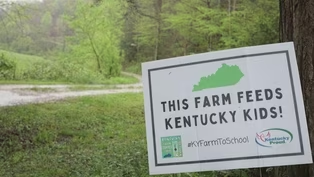
Video has Closed Captions
Clip: S31 Ep11 | 7m 30s | Breathitt County farmers are finding success through progressive practices. (7m 30s)
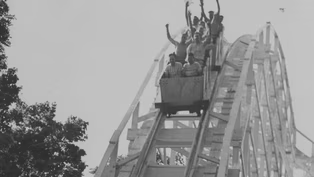
The Joy and Injustice of Joyland
Video has Closed Captions
Clip: S31 Ep11 | 8m 59s | Joyland was a hub of amusement park memories…but it was also shaped by segregation. (8m 59s)
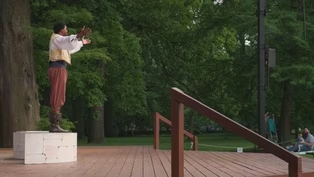
Video has Closed Captions
Clip: S31 Ep11 | 5m 58s | A Shakespeare in the Park tradition. (5m 58s)
Providing Support for PBS.org
Learn Moreabout PBS online sponsorship










Support for PBS provided by:
Kentucky Life is a local public television program presented by KET
You give every Kentuckian the opportunity to explore new ideas and new worlds through KET. Visit the Kentucky Life website.