
May 7, 2026 - PBS News Hour full episode
5/7/2026 | 57m 46sVideo has Closed Captions
May 7, 2026 - PBS News Hour full episode
Thursday on the News Hour, the U.S. and Iran trade fire near the Strait of Hormuz. Rubio tries to mend relations with Pope Leo after Trump’s criticism. A look inside Louisiana, where the Supreme Court upended a congressional map months before the midterms. Plus, how European nations’ efforts to thwart asylum seekers from Africa affect a dangerous migration route to the Canary Islands.
Problems playing video? | Closed Captioning Feedback
Problems playing video? | Closed Captioning Feedback
Major corporate funding for the PBS News Hour is provided by BDO, BNSF, Consumer Cellular, American Cruise Lines, and Raymond James. Funding for the PBS NewsHour Weekend is provided by...
May 7, 2026 - PBS News Hour full episode
5/7/2026 | 57m 46sVideo has Closed Captions
Thursday on the News Hour, the U.S. and Iran trade fire near the Strait of Hormuz. Rubio tries to mend relations with Pope Leo after Trump’s criticism. A look inside Louisiana, where the Supreme Court upended a congressional map months before the midterms. Plus, how European nations’ efforts to thwart asylum seekers from Africa affect a dangerous migration route to the Canary Islands.
Problems playing video? | Closed Captioning Feedback
How to Watch PBS News Hour
PBS News Hour is available to stream on pbs.org and the free PBS App, available on iPhone, Apple TV, Android TV, Android smartphones, Amazon Fire TV, Amazon Fire Tablet, Roku, Samsung Smart TV, LG TV, and Vizio.
Providing Support for PBS.org
Learn Moreabout PBS online sponsorshipAMNA NAWAZ: Good evening.
I'm Amna Nawaz.
Geoff Bennett is on assignment.
On the "News Hour" tonight: The United States and Iran trade fire near the Strait of Hormuz.
What it could mean for the cease-fire.
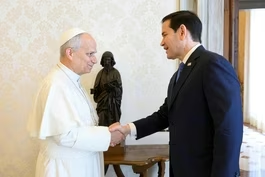
Secretary of State Marco Rubio tries to mend relations with Pope Leo after President Trump's criticism.
We report from Louisiana, where a congressional map has been upended by a Supreme Court decision months before the midterms.
And how European nations' efforts to thwart asylum seekers from Africa is playing out along a dangerous migration route to the Canary Islands.
SANA DA SILVA, El Hierro Resident (through translator): Everyone has their own way of existing.
It's their decision to make.
But I would never advise anyone to go down this path.
(BREAK) AMNA NAWAZ: Welcome to the "News Hour."
The U.S.
and Iran have exchanged fire in the Strait of Hormuz, with the top Iranian military command accusing the Americans of violating the now month-old cease-fire.
The U.S.
says the truce remains in effect.
Nick Schifrin's reporting out this late-breaking story and he joins me now.
So Nick, there's a lot we don't yet know, but what are your sources telling you?
NICK SCHIFRIN: The U.S.
military now says an Iranian official is confirming to me tonight what is perhaps the most serious exchange of fire since the cease-fire.
But U.S.
officials tell me, an Iranian official says that he believes this is true also, that this is not designed to end the cease-fire.
This is not the restarting of the war.
So a U.S.
official tells me that, earlier, two U.S.
destroyers were transiting through the Strait of Hormuz and that's when, according to this statement released by the military's Middle East command, CENTCOM eliminated inbound threats and targeted Iranian military facilities responsible for attacking U.S.
forces, including missile and drone launch sites, command-and-control locations and intelligence surveillance and reconnaissance nodes."
Now, that is important.
That list at the end there is important, because that's a relatively long list of targets that the U.S.
targeted in response to this attack.
Those areas that the U.S.
targeted include Bandar Abbas, where an Iranian official tells me the strikes hit the port, the loading dock and a garrison.
Also targeted right across from Bandar Abbas, Qeshm, and just across from there Minab.
A U.S.
official insists that this is not the restarting of the war, that this is a response to Iranian attacks at those two destroyers that were transiting the strait, which, by the way, was not a normal occasion.
Those destroyers did not transit that strait during the war.
In fact, they only started to transit earlier this week.
But, tonight, Iran is accusing the U.S.
of violating the cease-fire, the command in Iran saying -- quote -- they will "respond powerfully."
Iran has used that kind of language before.
So, clearly a moment of tension, but, again, U.S.
officials and Iranian official confirming to me they do not think this is the end of the cease-fire.
AMNA NAWAZ: As we say, a late-breaking story you're going to continue to report out.
Nick Schifrin, thank you so much.
NICK SCHIFRIN: Thank you.
AMNA NAWAZ: Secretary of State Marco Rubio today tried to smooth over another conflict sparked by the Iran war, this one with the pope.
A meeting between Rubio and Pope Leo came after President Trump repeatedly accused the pontiff of wanting Iran to have a nuclear weapon and of being -- quote -- "weak on crime."
The pope has responded in turn.
Stephanie Sy reports.
STEPHANIE SY: Today, the U.S.
dispatched its chief diplomat on a unique mission, to the Vatican... POPE LEO XIV, Leader of Catholic Church (through translator): Mr.
Secretary.
MARCO RUBIO, U.S.
Secretary of State: It's great to see you.
STEPHANIE SY: ... holding a meeting with the pontiff himself in a bid to ease tensions between Washington and the Holy See amid President Trump's repeated attacks against Pope Leo, chiefly on the Iran war.
They exchanged pleasantries, as well as gifts, in the pope's private library.
MARCO RUBIO: It has the seal of the State Department.
STEPHANIE SY: But the meeting was not all breaking bread.
Rubio, a practicing Catholic and the pope, sat down to discuss, as the Vatican put it, "countries affected by war, political tensions and difficult humanitarian conditions, as well as on the need to work tirelessly in favor of peace."
The direct dialogue follows President Trump's war of words with the pope on the Iran conflict and other issues, like immigration, outside the Oval Office last month.
DONALD TRUMP, President of the United States: You cannot have a nuclear Iran.
Pope Leo would not be happy with the end result.
You would have hundreds of millions of people dead, and it's not going to happen -- So I can't -- I think he's very weak on crime.
STEPHANIE SY: And earlier this week.
DONALD TRUMP: The pope would rather talk about the fact that it's OK for Iran to have a nuclear weapon.
And I don't think that's very good.
I think he's endangering a lot of Catholics and a lot of people.
But I guess, if it's up to the pope, he thinks it's just fine for Iran to have a nuclear weapon.
STEPHANIE SY: But Pope Leo on Tuesday denied that accusation.
POPE LEO XIV (through translator): If anyone wishes to criticize me for proclaiming the Gospel, let them do so with truth.
The church has for years spoken out against all nuclear weapons, so there is no doubt about that.
And so I simply hope to be heard for the sake of the word of God.
STEPHANIE SY: The pope has also continued to call out Trump's policy of mass deportations, citing the New Testament in his repeated criticisms.
POPE LEO XIV: I have no fear of either the Trump administration nor speaking out loudly about the message of the Gospel.
And that's what I believe I am called to do, what the church is called to do.
STEPHANIE SY: Rubio's visit aside, that calling continues to put the Vatican at odds with Washington, even as support for President Trump among America's 53 million Catholics is on the decline.
For the "PBS News Hour," I'm Stephanie Sy.
AMNA NAWAZ: For more, I'm joined now by Miguel Diaz.
He's former ambassador to the Vatican under the Obama administration and a theology professor at Loyola University Chicago.
Ambassador Diaz, thank you so much for joining us.
I will begin by asking you what you took away from today's meeting.
Do you think Secretary Rubio smoothed over relations with Pope Leo?
MIGUEL DIAZ, Former U.S.
Ambassador to the Vatican: First of all, thank you for -- it's such an honor to be here and to be able to speak with you.
So, the secretary went to the Vatican to speak to the Holy Father, who is both the head of a sovereign entity and also the head of the 1.4 billion Catholics.
Throughout our history of diplomatic relations with the Holy See, we, the United States, has related to the Holy See as a sovereign entity, as a global humanitarian actor and as a moral voice that has consistently defended the dignity of all human persons.
This post, we call it a great listening post, because it has eyes and ears everywhere.
And so it is an incredibly productive and valuable post, not only in times of peace, but clearly in times of war.
And so, when the secretary of state stepped into the Vatican today, I hope that there -- was in the spirit of what the church has since Pope Francis called synodality, that there has been an authentic listening to the kind of wisdom that emerges in any effort, any authentic effort to build bridges.
And so we won't know until -- actions speak louder than words.
We won't know until some weeks evolve here whether the secretary will be able to bring back some good news in terms of the human family in those conversations.
But we remain hopeful.
Diplomacy always should be given the last -- the first and the last word in that violence.
AMNA NAWAZ: Can I just ask you what you make of this moment?
I mean, the fact that Vatican officials said the U.S.
had requested this meeting, there was a clear intention there by the secretary to go and try to reduce some of the tensions we have seen.
But then you saw President Trump just this week accusing Pope Leo of endangering a lot of Catholics by opposing the war.
What do you make of the fact that we are where we are right now?
MIGUEL DIAZ: Yes, I think -- I do think it's not wise and certainly not diplomatically wise to call the pope that he's terrible on foreign policy.
And, as your earlier report, the pope has already said that, if you're going to -- in terms of the pope favoring nuclear weapon, well, that has not been the case.
It's been the tradition of popes, of people teaching to oppose, in fact, nuclear weapons.
And so this is in many ways unpresidential and is unprecedented in the sense that you would call out a pope like this, especially when it is something that is benefiting the common good.
And we are talking about someone who recognizes that there is tremendous polarization in the world, polarization within our own nation.
But there's tremendous polarization in the world and, in the words of Pope Francis, who said there's this horrific globalization of indifference.
And that needs to be countered by not violence, but by peace.
And so I think this is where you see this first American pope, a pope from the United States, saying, enough.
Enough to the idolatry of the self and money, enough to the abuse of power, and enough really to war and violence as the means or the ends to resolving conflict.
AMNA NAWAZ: We have a minute or so left, but I have to ask you, because the Vatican says in their statement that they did discuss the need for peace in that meeting.
Do you believe that this pope, Pope Leo, can influence U.S.
foreign policy in any way?
MIGUEL DIAZ: Well, the pope has called for unarmed and a disarming peace.
I -- we look at the two -- the statements from the State Department and the Vatican, and it's interesting.
Yes, there -- the two statements are very similar in terms of affirming the bilateral nature and the importance of that.
They both affirm peace and they both affirm human dignity.
But it's interesting that the statement from the Vatican goes a little bit more in detail, because I quote here.
It says "with particular attention to countries affected by war, political tensions and difficult humanitarian situations."
So it is a concretization of issues that affect the issues that affect human dignity.
As to whether or not the pope can bring about some impact in terms of our foreign policy, that remains to be seen.
But, again, we hope that the better angels have prevailed today at the Vatican and that Secretary Rubio can come back to the White House and have an honest conversation with our president and acknowledge that the way forward, it's not violence, but bridge-building.
AMNA NAWAZ: That is Miguel Diaz, former U.S.
ambassador to the Holy See, joining us tonight.
Mr.
Ambassador, thank you so much for your time.
MIGUEL DIAZ: Thank you so much.
AMNA NAWAZ: We start the day's other headlines in Tennessee.
Lawmakers there passed a new congressional map that could help Republicans win all nine congressional seats in this year's midterm elections.
(CHANTING) AMNA NAWAZ: Prior to the vote, protesters gathered outside the state's House and Senate chambers to voice their anger at the plan.
The new map slices up Memphis, a majority-Black city that makes up most of the state's lone Democratic stronghold.
Tennessee's governor has now signed the bill, making it the first state to adopt a new map since a U.S.
Supreme Court ruling last week that significantly weakened the landmark Voting Rights Act.
In Colorado, the man accused of last year's firebomb attack at a pro-Israel rally was sentenced to life in prison today.
Mohamed Sabry Soliman has pleaded not guilty to dozens of state charges, including first-degree murder.
Authorities say he threw two Molotov cocktails during a demonstration in support of Israeli hostages in Gaza.
At least 13 people were hurt and an 82-year-old woman later died from her injuries.
The Egyptian national still faces federal hate crime charges, to which he has pleaded not guilty.
Health authorities on at least four continents are tracking over two dozen passengers who left the cruise ship at the center of a hantavirus outbreak.
The passengers from at least 12 different countries left the ship two weeks after the first passenger died on board.
The vessel itself is now en route to Spain's Canary Islands, where officials are debating whether it will dock or anchor offshore.
Officials at the World Health Organization said today that it's everyone's -- quote -- "moral duty" to care for those still on board and acknowledge the efforts of the crew.
TEDROS ADHANOM GHEBREYESUS, Director General, World Health Organization: And I would also like to thank the ship's operator for its cooperation and the passengers and crew, who are going through a very difficult and frightening situation.
Morale has improved significantly since the ship started moving again.
AMNA NAWAZ: Three passengers have died in the outbreak and several others are sick.
But the Netherlands-based operator of the cruise ship says none of those still on board are currently showing signs of symptoms.
In Mississippi, local officials say at least 17 people were injured after powerful storms and at least three tornadoes tore through the state last night.
By sunrise today, the damage was in full view.
Most of the injuries happened in this trailer park about an hour's drive south of the state capital of Jackson.
All told, nearly 500 homes were damaged across Mississippi.
National weather officials are warning that the region could see even more storms tonight.
In Washington, D.C., today, the National Capital Planning Commission held a hearing to consider a White House plan to paint the Eisenhower Executive Office Building white.
In presenting an alternative vision for the 19th century building, officials argue that it currently -- quote -- "does not align visually with the surrounding architecture."
At today's hearing, they said the project is as much about restoration as it is aesthetics.
RYAN ERB, Executive Office of the President: Right now, it's kind of just been a maintaining.
But, as we can see, that maintaining has kind of resulted in somewhat of a disrepair state.
AMNA NAWAZ: But preservationists and architects have expressed alarm, saying that painting the building's gray granite could damage the stone.
Voters in the U.K.
have been casting ballots in local elections seen as a referendum on the leadership of Prime Minister Keir Starmer.
QUESTION: How are you feeling, Prime Minister?
AMNA NAWAZ: After voting earlier today, Starmer declined to speak with reporters.
His center-left Labor Party is facing significant losses, with the Reform U.K.
Party led by Nigel Farage and the Green Party expected to make gains.
Voters are deciding some 5,000 council seats across England Scotland and Wales.
A poor showing by Labor would add further pressure on Starmer to step down.
Results will start coming in overnight, with most due by tomorrow afternoon.
On Wall Street today, stocks pulled back from recent records amid uncertainty over the Iran war.
The Dow Jones industrial average fell more than 300 points.
The Nasdaq ended about 30 points lower.
The S&P 500 also closed in negative territory.
And a bit of Supreme Court history was made today.
Clarence Thomas became the second longest-serving justice in U.S.
history.
He was confirmed in late 1991 following a contentious process that included sexual harassment allegations, which he denied.
For years, he was an outlier on the court, known for his conservatism and his near silence during oral arguments.
But the 77-year-old is now a towering figure, helping secure rulings on abortion, voting rights and the Second Amendment.
Should he stay on the bench, Thomas will become the longest-serving justice in 2028.
That's a record currently held by the late William O. Douglas.
Still to come on the "News Hour": proposed changes to FEMA raise questions about the future of disaster response; the ongoing war with Iran escalates the already dire humanitarian situation in Somalia; and a new memoir traces one woman's unlikely journey into the culinary world.
On several fronts today, the Department of Justice pressed forward on President Trump's top legal and political priorities.
That includes relitigating the 2020 election by investigating voting records in Georgia and legally targeting lawmakers and groups seen as hostile to the president's agenda.
Our justice correspondent, Ali Rogin, joins me now with the latest.
Ali, it's good to see you.
ALI ROGIN: Thanks for having me.
AMNA NAWAZ: So let's start now with the news from Fulton County, Georgia.
All of this stems from an FBI raid of election records back in January.
What do we need to know?
ALI ROGIN: That's right, Amna.
President Trump has long had grievances against the state of Georgia, which he wrongly insists that he won.
Earlier this year, the FBI raided the offices of Fulton County to seize more than 600 boxes of election records from 2020.
They say they want to investigate irregularities.
Fulton County then sued to get those voting records back.
But, yesterday, a judge ruled that the FBI can keep the records and continue this investigation.
This is a big boon for the administration's efforts to relitigate the 2020 election.
AMNA NAWAZ: OK, moving on to a federal appeals court today that heard arguments over whether Defense Secretary Pete Hegseth can punish Democratic Senator Mark Kelly over his past comments that were critical of the administration.
Prior courts have sided with Kelly.
Did the judges seem to do so today?
ALI ROGIN: They did.
And, of course, this is yet another front in the administration's efforts to extract retribution against the president's adversaries.
This one is led by Secretary Hegseth.
He tried to demote Senator Mark Kelly, who is a retired Navy captain, after Kelly appeared in a video reminding service members that they can and should refuse illegal orders.
Kelly then sued Secretary Hegseth.
And the first federal judge to hear the case did indeed side with Kelly.
The parties were back again today in front of a second appeals court.
And the three-judge panel in that court also seemed skeptical of the administration's claims.
And, Amna, Senator Kelly spoke to reporters after the proceedings outside the courtroom.
SEN.
MARK KELLY (D-AZ): We all understand that this is not about me.
They're trying to send a message to other retired veterans and really to all of us.
If you say something that the president or this administration does not like, they're going to come after you.
AMNA NAWAZ: And Kelly's point there brings us to another case, Ali, this one against the Southern Poverty Law Center, specifically their past practice of paying confidential informants inside extremist groups.
What's the latest there?
ALI ROGIN: Yes, the Southern Poverty Law Center investigates all sorts of extremist groups, but they have long drawn the ire of conservatives, who say they focus too much on the political right.
Last month, the DOJ announced that it had secured indictments of fraud against the SPLC for what they say is lying to its donors about where that money, about $3 million in donations, was going and that they -- in paying these informants, they also bankrolled the extremist activities.
The SPLC denies all of this and says that, while they no longer pay informants, those practices allowed them to share critical information with law enforcement.
They also criticize acting Attorney General Todd Blanche for making comments in public suggesting that the SPLC did not share the information they got from informants with the government.
And now the SPLC is asking the court to unseal the closed grand jury proceedings that led to this indictment being returned to see if the DOJ misrepresented their practices there as well.
AMNA NAWAZ: All right, our justice correspondent, Ali Rogin.
Ali, thank you so much.
ALI ROGIN: You bet.
AMNA NAWAZ: Well, for years there's been a debate over what role FEMA, the Federal Emergency Management Agency, should play when disaster strikes American communities.
President Trump argues that states should shoulder much more of the responsibility.
And now a review council appointed by the president is making new recommendations.
Our William Brangham has more.
WILLIAM BRANGHAM: That's right, Amna.
This review council made a series of recommendations that would reform the essential mission of FEMA.
Among the proposed changes, states would take the lead role in disaster assistance within their own borders while FEMA shifts to a supporting secondary role.
It recommends changes in how immediate assistance is delivered.
That's the aid given out in the first hours and days following a disaster.
And establishing new metrics to measure how states perform.
Those metrics could then affect how much money a state receives from the federal government.
And it recommends streamlining direct individual assistance, often for housing, and to focus FEMA's efforts on emergency and temporary housing, instead of long-term housing help.
The new DHS secretary, Markwayne Mullin, made his priorities clear during a trip to North Carolina last month.
MARKWAYNE MULLIN, U.S.
Homeland Security Secretary: When we're looking at reform, the president wants to -- like I said, we want to make sure we get it to the state faster and not look at FEMA as being the first responder, but look at FEMA as supporting the first responders.
WILLIAM BRANGHAM: If implemented, the council's recommendations would amount to the biggest overhaul of FEMA in many years.
So, for more on this, we are joined again by someone who has had to wrestle with these exact issues.
Deanne Criswell was the head of FEMA for four years under the Biden administration and now helps states and cities plan for disasters.
Deanne Criswell, thank you so much for being back here.
Could you just give me your initial reaction to this set of recommendations?
DEANNE CRISWELL, Former FEMA Administrator: William, I haven't had a chance to fully read the whole document yet, but I did read the slides that were put out and some of the feedback that I have gotten from others.
And it doesn't look like much has changed from the December report.
And there was a lot in that report that I agreed with.
I think the devil's going to be in the details in how they roll it out and how they implement it.
But one thing that you mentioned, and I just want to make sure that it's clear.
And it's come up in this report.
It's come up in a lot of the conversations about shifting the responsibility back to the state and locals.
I was a local emergency manager.
It has always been the responsibility of the state and locals to manage their response, and FEMA has always served in a supporting role.
I think where the challenge is and some of the goals that are trying to be achieved here is, how do we make that happen faster and how do we allow the states to have more ownership in how that is done when they're asking for reimbursements from the federal government, which means we're also going to shift some of the risk for making sure you're following all the appropriate guidelines down to the state and the locals as well.
So I always just like to make sure that that point is clear because I think it gets lost in this conversation sometimes.
And if you talk to any of my colleagues that are emergency managers, state emergency managers, I think that they would say the same thing.
But, overall, I think that change is needed.
I have said that openly many times.
I think some of the recommendations in there make a lot of sense.
I think it's really going to depend on how well they're implemented and how they do that.
WILLIAM BRANGHAM: I want to pick up on a point you were making there, which is the argument that the administration and some state leaders have made that is that FEMA is too slow and too bureaucratic.
I want to play a little bit of sound that we heard from one of the members of this review council.
This is from Michael Whatley.
He used to run the RNC.
Now he's running for the Senate in North Carolina.
Here's how he described FEMA.
MICHAEL WHATLEY, FEMA Review Council: Republican National Committee: We had an agency that had clearly lost its mission focus, inefficient use of federal funds because of bureaucratic stasis and redundancies, centralized and bloated headquarters, and states which were unprepared to respond to a significant disaster.
WILLIAM BRANGHAM: Do you think that is a fair assessment?
DEANNE CRISWELL: Not in its entirety.
I would say that states that are not prepared to respond to disasters, is that the state responsibility or is that FEMA's responsibility?
FEMA provides opportunities.
They provide training.
They provide programs.
They do provide some grant funding.
The grant funding comes from Congress, but states still have that responsibility, as I said earlier, right, that they own the disasters within their states.
I would also agree, though, that it has become a little bit bloated that headquarters, and one of the initiatives while I was there was, how do we take and shift some of those personnel from headquarters out into our regional offices, so those regional teams, regional staff members can work directly with their states?
They're the ones that know them the best.
They have built those relationships.
Let's give them the resources to actually build those relationships and help those states grow their own capability.
And we did a lot of that through different programs to put people right in the state offices.
And that program had grown through the first Trump administration, as well as during my administration.
And I think it made a real difference.
And so, while I agree with some of what he said, I think it's very generalized and politically driven on some of the comments the way he framed them.
But, overall, there's definitely room for improvement on all ends, right, from the federal end, as well as from the state and local end.
WILLIAM BRANGHAM: What do you make of this particular idea of creating performance metrics, and then the states get measured on those metrics on how they are delivering aid, and there's an incentive for those that do well and punishment for those that are considered to be found wanting?
DEANNE CRISWELL: Well, the first thing that comes to mind for me is, are we creating a metric system that's going to be this one-size-fits-all approach?
Because you're going to have a state like Florida or Texas that has a lot of disasters and has built a lot of capability that's going to be able to meet certain metrics, but you're going to have states that maybe don't even have a disaster every year, but, once they get one, they don't have that built-in structure to be able to support that.
And so are they going to be held at the same standard as someone who's using these kinds of tools each and every day?
And so I think, as long as the metrics recognize that no two states are alike and they develop them in a way that's going to understand the states that don't see a lot versus the states that do have this repetitive nature.
And I also think as we go through this, one of the things that I really fought for -- and I think it's kind of implied in this final document -- is, we really need states to focus on pre-disaster long-term recovery plans.
They're very good at response.
We focus a lot of time on response.
But when you when you get into the meat of it, the hardest part is recovery.
And so I think it would be great to have a metric or something, an incentive tied to states that have done that work ahead of time to know how they're going to recover and know how they're going to bring in the rest of their other state agencies to be able to support that.
That will make a big difference in the speed.
And then that would, I think, help flow up some of the federal funding even without the incentives.
WILLIAM BRANGHAM: That is Deanne Criswell, the former head of FEMA.
Thank you so much as always for being here.
DEANNE CRISWELL: Thanks, William.
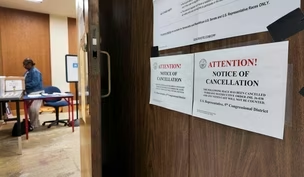
AMNA NAWAZ: Early voting continues in Louisiana today, even as the status of the state's primary elections remains in flux.
Last week, the U.S.
Supreme Court struck down Louisiana's congressional map, and the state's Republican governor suspended primary elections for the U.S.
House, so new districts could be set.
But voting for the U.S.
senate race is proceeding.
Liz Landers is in Baton Rouge tonight and joins us now with more.
So, Liz, just remind us, how did we get here in the first place, and what is the latest with those efforts to redraw Louisiana's congressional maps?
LIZ LANDERS: Amna, the Supreme Court struck down the existing map here in Louisiana, calling it an illegal racial gerrymander.
Louisiana has six congressional districts.
Two of them are majority-minority districts represented by two, black congressmen, Troy Carter and also Cleo Fields; 30-something percent of Louisianians are black residents.
And Governor Jeff Landry announced last week that he was going to redraw the congressional maps here, and he has suspended for now those House primaries, which were set for May 16.
Tomorrow, the Louisiana Statehouse, just a few steps away from where we are here in Baton Rouge, is going to start that process of redrawing the maps.
The Senate and Governmental Affairs committee is going to meet at 9:00 a.m.
They're going to have public testimony as part of that.
And the chairman of that committee told The Louisiana Illuminator that he is considering a map that will have only one majority-black district, instead the current two, and that will likely preserve the district of Congressman Fields.
AMNA NAWAZ: Liz, all of this has to be very confusing for people in Louisiana.
You were at the polls talking to voters today.
What did they tell you?
LIZ LANDERS: We were at early voting locations last night and this morning, and voters are confused.
Actually, one woman that I spoke with this morning did not know about this redistricting process and didn't realize that she may have to cast another ballot in those House primaries here.
Adding to this confusion too, there are 40,000 people that already voted by mail, and those ballots have already been accepted by the secretary of state.
So, right now, the ballots have those house races on them, but the secretary of state has said that the results in those contests will not be counted.
We spoke with one voter, Baton Rouge resident Eric Johnson, last night.
He's an accountant, and he reacted to the Supreme Court decision and said that he felt that it was rushed.
Listen.
ERIC JOHNSON, Louisiana Voter: Just to make things work in a certain way or to get a certain outcome, a more certain outcome.
I don't -- I just don't think that's fair.
That's not for the people.
That's self-serving.
LIZ LANDERS: Another woman that I spoke with earlier this morning said that she was really mad about this redistricting.
She thought that the decision from the Supreme Court was racist.
She's a Democratic voter.
But a Republican voter, an older gentleman, said that he thought that that decision from the Supreme Court was the right one and that districts should not be decided by race, Amna.
AMNA NAWAZ: So, Liz, all of this will undoubtedly have an impact on the House races.
I know you spoke with one of the congressmen who may be impacted by this redistricting.
What did he have to say?
LIZ LANDERS: Congressman Cleo Fields has been having several town halls in the last few days throughout his district.
He said he's hearing the same kind of confusion from voters about whether they should go cast their ballots or not.
He is encouraging people to vote still at this moment.
But, for him personally, he said that he was devastated by the Supreme Court decision and that he's worried about the broader impacts of it.
REP.
CLEO FIELDS (D-LA): Tough decision.
Tough decision, because of the implications, not on the Sixth District, but nationwide, not just on congressional districts, legislative districts, city council, school board, judges, and that's the real disappointment today.
LIZ LANDERS: Congressman Fields told us that he is not interested in running against the other majority-minority congressman here, Troy Carter.
So we will see if he ends up running for reelection here and how these maps are redrawn.
But as these House primaries are on hold, there is still a Senate Republican primary that is under way here that is getting quite a bit of attention.
Senator Bill Cassidy is running, and his -- he has two opponents that he's running against right now.
One of them has been endorsed by President Trump, and there is no clear winner in that field.
We will have more reporting on that in the coming days -- Amna.
AMNA NAWAZ: All right, that is Liz Landers reporting from Baton Rouge, Louisiana.
Liz, thank you.
LIZ LANDERS: Of course.
AMNA NAWAZ: The Vatican has announced that Pope Leo will visit Spain's Canary Islands in the Atlantic this June.
The islands are destinations for thousands of migrants seeking asylum in Europe.
And it's a dangerous, desperate journey.
Many have died trying to reach European shores.
Special correspondent Malcolm Brabant reports.
This is the Spanish island of El Hierro in the Atlantic Ocean off the coast of West Africa, one of the most southwesterly points of European Union territory.
It's a sight that will raise the spirits of thousands of migrants who dream of reaching Europe, proof that, despite the massive risks, it's possible to make it from West Africa to Spain's Canary Island archipelago.
This Spanish Coast Guard vessel is helping a traditional boat called a cayuco reach shore after a hellish journey.
LAUREN SEIBERT, Human Rights Watch: When you're crossing the Atlantic and you're departing from Mauritania's shores or Senegal, which is even further, the journey can be anywhere from five to 10 days sometimes.
MALCOLM BRABANT: Lauren Seibert is a researcher for Human Rights Watch, a nonprofit with a global reach.
LAUREN SEIBERT: And then, if they get lost, which does happen, then your supplies run out and water runs out, the engine can break down, and you can be drifting at sea for weeks, and it just can be really horrific with the lives that are lost.
MALCOLM BRABANT: Funerals of migrants who've died during the crossing are a common occurrence in the Canary Islands.
These graveyards contain just a handful of the thousands who've succumbed to the waves in recent years.
Alpido Armas is the president of El Hierro Island Council.
ALPIDO ARMAS, President, El Hierro Island Council (through translator): We're talking about people who've been found on the American coast mummified.
Yes, if they drift off course and don't find El Hierro, they end up in South America, so it is one of the most dangerous and deadly routes.
MALCOLM BRABANT: Despite the dangers, migrants keep coming; 57 Africans aboard this cayuco were rescued off the island of Gran Canaria, last November.
Official statistics reveal that nearly 17,000 migrants reached the Canaries in 2025.
That's 40 percent of the previous year's record influx.
The numbers show that the European Union's policy of paying African nations to thwart asylum seekers is working.
Last year, Human Rights Watch accused Mauritanian law enforcement agencies of a campaign of torture, rape and violence against migrants such as this man who gave his name as Gibson.
GIBSON, Asylum Seeker: The pain that is inside is too much.
I don't able to walk of the beating I had.
MALCOLM BRABANT: This is Mauritanian's president, Mohamed Ould Ghazouani, meeting Spain's Prime Minister Pedro Sanchez to discuss immigration.
In total, the E.U.
has given Mauritania $250 million for what is labeled migration management.
LAUREN SEIBERT: And this is being done in the context of cracking down on irregular migration, particularly towards Spain's Canary Islands.
And it's being supported and fueled by the E.U.
and Spain, bilaterally, who have been really encouraging Mauritania to get tough on migration and have been funding Mauritanian security forces, providing equipment, the same playbook that we have seen in other countries across North Africa, particularly Tunisia, for example.
MALCOLM BRABANT: Mauritania denies the allegations and insists it has implemented reforms.
The E.U.
has also given Mauritania's southern neighbor Senegal $35 million to stem the flow of would-be migrants.
Last September, Senegalese authorities intercepted 112 migrants after their vessel lost its motor and began drifting in the Atlantic.
All those aboard were taken into custody.
Nonprofits are increasingly concerned about the harsh treatment migrants face in Africa.
So, in essence, are you saying that the European Union is turning a blind eye to these human rights abuses?
LAUREN SEIBERT: I think it has been, and it has always prioritized enforcing the borders over human lives.
Just look at the deaths in the Atlantic.
Why not put more resources into search-and-rescue?
That really, really needs to be supported and bolstered and expanded.
Why not pour more resources into development without strings attached of migration control?
MALCOLM BRABANT: European attitudes have changed dramatically in the years following the continent's refugee crisis, which began in 2015, with waves of predominantly Syrians landing in rubber boats on the Greek islands after setting off from nearby Turkey.
In the early months of the influx, there was widespread sympathy for the asylum seekers.
But more than a decade later, several European member states have adopted anti-immigrant measures.
As these recent images show, however, Spain's Socialist-led government has broken ranks with a surprised reversal of policy.
It's offered amnesty to at least half-a-million illegal migrants in a bid to fill holes in the labor market.
These people are queuing outside their consulate in Barcelona to obtain a document stating they have no criminal record at home, an essential for those wishing to stay.
ABDOURAHMAN, Asylum Seeker: There will be a lot of difference.
Like, I can travel to my home country and meet my parents, and work here legally, so I can pay my tax.
And, further, I can apply for my permanent residency MALCOLM BRABANT: But there's widespread concern across Europe that Spain's decision to legalize so many asylum seekers will lead to more scenes like this, with migrants waiting in the shallows to claim their $1,500 dollars on board a rubber dinghy.
The location, Northern France, destination, Southern Britain.
Such images are fueling growing anti-immigrant hostility across Europe.
Back in Spain's El Hierro, footballer Sana Da Silva, who took a boat from Senegal 4.5 years ago, urges his fellow travelers to think twice about boarding one of those wooden fishing canoes.
SANA DA SILVA, El Hierro Resident (through translator): No, really, I wouldn't advise anyone to take this route.
But, yes, everyone has their own way of existing.
It's their decision to make.
But I would never advise anyone to go down this path.
But it's hard to tell someone they're making a bad choice.
MALCOLM BRABANT: Recent history suggests many more will ignore that advice, but for everyone who reaches the Canary Islands, many more will fail and drown.
For the "PBS News Hour," with the Global Reporting Center, I'm Malcolm Brabant.
AMNA NAWAZ: The closure of the Strait of Hormuz is not only driving up the price at the pump in the United States.
It's driving up the cost of delivering humanitarian aid around the world.
That is particularly acute for Somalia, which is facing one of the most complex hunger crises in recent years.
Nick Schifrin is back now with that report.
NICK SCHIFRIN: For more than a year, Somalia's children have suffered from a looming famine and deep cuts to foreign aid, and now the war in Iran for them has become a matter of life and death.
Iran's choke hold over the Strait of Hormuz has led to shortages of lifesaving foods and delays on deliveries by humanitarian groups.
It's just one example of the war's impact well beyond the strait.
To discuss that is Matthew Hollingworth, assistant executive director for program operations at the World Food Program, who joins me from Mogadishu.
Thanks very much, Matthew Hollingworth.
Welcome to the "News Hour."
Just how much has the war, this choke hold over the strait affected your operations in Somalia?
MATTHEW HOLLINGWORTH, Assistant Executive Director, World Food Program: We're seeing already significant increases in food costs across the country.
We're seeing as much as a 150 percent increase in fuel costs across Somalia.
And it's slowing things down when it comes to deliveries.
We have just received in the last days a shipment that was due to come in 30 days ago and was 30 days delayed.
That means that, during that period, we simply didn't have enough assistance, but it comes at a time when the country is already facing the impact of three consecutive failed rainy seasons and drought throughout vast parts of the country, where very significant numbers of people, more than two million, are facing very serious levels of hunger.
This all adds together and brings us the perfect storm in terms of the impact on Somalis around the country.
NICK SCHIFRIN: During your trip, you visited a village in Puntland, which has experienced, as you said, three failed rainy seasons in a row.
What did you see there?
MATTHEW HOLLINGWORTH: I mean, across Puntland, you see water reservoirs completely dried up.
So there is no water available for their pastureland, no water available for their animals.
So you see a lot of skeletons of dead animals, dead farm animals.
You see families that have lost all of their assets.
This is a malnutrition hot spot in the world already, and it's just getting worse and worse.
NICK SCHIFRIN: You visited a site for the internally displaced, where you're providing emergency assistance and nutrition services.
How much increase is there in the need, in demand since the war in Iran began?
MATTHEW HOLLINGWORTH: I mean, it was frightening to go to a mother and child health care center and speak to mothers of four or five children who know that in the months ahead we will no longer be able to help their children.
In this circumstances, when we don't have the resources, we don't have the stocks, we don't have the food, we're having to take tough, tough choices.
But we can only actually help about one in 10 who we would typically want to assist.
And that's down to yes, increased prices, yes, slowing supply chains and global supply chains around the world.
But it's also just a resource gap, because we don't have the funds to help the most needy.
And this is a crisis that is growing, particularly when it comes to nutrition or malnutrition in the under-5's.
NICK SCHIFRIN: Talk about those people who you will not be able to help.
What will happen to them?
MATTHEW HOLLINGWORTH: They're taking very difficult choices as families themselves.
They're deciding what to sell, if they have got something to sell, what to keep, which child goes to school, which child doesn't go to school, who gets fed that meal today and who doesn't.
And I have three children, I know I would do anything to make sure that they stay healthy and well.
And when you think yourself how many days you could go without food, mothers are taking the decision, which child doesn't eat today?
It's really not easy.
We need to be calling for a cease-fire or a more permanent cease-fire for a more permanent opening of the Strait of Hormuz, so that we can get past this issue of food becoming prohibitively expensive for the poorest around the world.
NICK SCHIFRIN: Explain why it's important for the region for Somalis and Somalia to have what it needs in order to maintain stability in a key region?
MATTHEW HOLLINGWORTH: More suffering, more displacement inside Somalia raises the concern of more displacement of people coming from Somalia outside, South Sudan, Sudan, Somalia, Ethiopia, Eritrea.
These are all countries that need stability moving forward.
Without that stability, we know what that means for the rest of the world when we see countries where people are so desperate they're willing to find a better situation for their children, for their families.
NICK SCHIFRIN: Matthew Hollingworth is the World Food Program's assistant executive director from program operations.
Thank you very much.
MATTHEW HOLLINGWORTH: Thank you.
AMNA NAWAZ: Food can be about comfort, craft or even culture, but, in Brigid Washington's new memoir, it's about survival.
Her book traces her unlikely journey into the culinary world, one marked by loss, uncertainty and questions of identity.
Geoff Bennett recently spoke with Washington about that book, "Salt, Sweat and Steam."
It's part of our arts and culture series, Canvas.
GEOFF BENNETT: Brigid Washington, welcome to the "News Hour."
BRIGID WASHINGTON, Author: Thank you for having me.
GEOFF BENNETT: This memoir, it starts with this high-stakes cooking exam, a real trial by fire.
Why start there?
What did that moment reveal about who you were becoming?
BRIGID WASHINGTON: I started there because it really honed in on why I was there.
And at the time, it was a bad breakup and a leap first, look second decision to attend the nation's top culinary school.
And I didn't recognize myself.
Like many other young people in my 20s, I felt adrift professionally.
And food has always been my anchor and also held me accountable.
And so I decided this would be a good decision to pursue something that I have loved for a very long time professionally, until I actually had to be there.
(LAUGHTER) GEOFF BENNETT: Well, right.
You said in the book that the decision to go to culinary school, it followed right after a breakup.
And you wrote: "The only way to take myself out of this emotional fire was to walk directly into a physical one."
What did the kitchen offer you that your life in that moment could not?
BRIGID WASHINGTON: That's a good question, because the kitchen was -- has always been that safe space, as a child growing up in Trinidad, cooking at my mother's side, helping her pick herbs outside, cilantro, cilantro, Spanish thyme.
That was always my second language.
And I was looking for more of what felt natural, what felt like me, even though it was, like I said, a fire.
GEOFF BENNETT: Well, you write that: "It's not enough for something to taste good.
It also must reflect discipline, integrity."
How did you learn that?
How hard is that to internalize as a chef?
BRIGID WASHINGTON: I learned that the hard way, because, naturally, I am freewheeling and messy and not given to rules.
Don't let the blazer fool you.
(LAUGHTER) BRIGID WASHINGTON: And so being in the kitchen, and especially being at the CIA, with its strictures and its rules and regulations and brigade system and exacting standards for excellence, that is what I needed most.
And I think that is also what most good cooks understand, is that there is room for both, both the creativity and constraints.
They have the space to breathe when you're cooking.
GEOFF BENNETT: You refer to yourself as an accidental chef.
BRIGID WASHINGTON: Absolutely.
GEOFF BENNETT: What about it felt accidental, and when did it start to feel inevitable for you?
BRIGID WASHINGTON: I think the genesis was accidental.
At the time, I had a job that I did not enjoy, office job.
And I remember just walking into a professional kitchen that I have never eaten in a white-table cloth establishment in Raleigh.
And I said, I don't know anything about cooking.
I don't know anything about food.
But I am a hard and happy worker and I will work for free.
Teach me how to do this.
And that was, that was the beginning.
And that... GEOFF BENNETT: Work for free.
BRIGID WASHINGTON: I said, yes, I will volunteer after my 9:00-to-5:00.
I went to that kitchen and they said, just stand and do not touch.
(LAUGHTER) BRIGID WASHINGTON: And I said, what will I get to -- they're like, never.
(LAUGHTER) BRIGID WASHINGTON: And that was - - that was the accidental part, because I didn't -- I didn't think anything would come from that.
And I think it started to feel inevitable when I started to appreciate the discipline and what I was really -- the lessons behind the lessons that cooking taught me.
GEOFF BENNETT: There's something else in the book that you wrote about that really struck me.
And it was holding on to your accent.
And you write that: "A country gives you an accent, but it is courage that allows you to keep it."
In a kitchen, a place with its own, as you said, hard codes of authority, what did it mean to walk in as a proud Trinidadian woman and refuse to flatten that?
BRIGID WASHINGTON: Well, it has gotten flattened.
(LAUGHTER) GEOFF BENNETT: In what ways?
BRIGID WASHINGTON: Well, I mean, my mother would say that, like how I talk.
GEOFF BENNETT: Your accent has been flattened?
BRIGID WASHINGTON: Yes.
Yes.
GEOFF BENNETT: Oh, OK.
Yes.
BRIGID WASHINGTON: Yes, my accent has been flattened.
That's what -- I would say something and she would kind of -- I could hear her thinking over the phone.
(LAUGHTER) BRIGID WASHINGTON: That's not the way that's pronounced.
(LAUGHTER) BRIGID WASHINGTON: But I think that it was important for me to always be tethered to home.
That is the core anchor.
And how that presents is by having and keeping an accent and paying attention to when it is slowly dissipating.
GEOFF BENNETT: You have been very candid about being afraid not just of failure, but of success.
What did success represent to you throughout your journey and why was it so unsettling early on?
BRIGID WASHINGTON: Well, at the time, I didn't even know what success meant.
I didn't know how to quantify it.
It was -- I know what I didn't want.
I wanted a relationally rich life, and I didn't want a life where success is having a thriving restaurant, and that's grossing eight figures, but no one to share that with.
So success for me now, it means being able to cook dinner for my family every night, teaching my children these are the foods that's important.
This is why.
Here is why I am telling you this, even though they're kind of rolling their eyes at me.
(LAUGHTER) BRIGID WASHINGTON: And those moments are formative.
And that's what I was always angling towards.
GEOFF BENNETT: Does it still feel accidental or do you claim the title of chef now?
BRIGID WASHINGTON: Honestly, it still feels a little accidental.
It does.
(LAUGHTER) GEOFF BENNETT: Well, the memoir is terrific, "Salt, Sweat and Steam: The Fiery Education of an Accidental Chef."
Brigid Washington, a real pleasure to speak with you.
BRIGID WASHINGTON: Thank you.
Thank you so much, Geoff.
Thank you for having me.
AMNA NAWAZ: And that is the "News Hour" for tonight.
I'm Amna Nawaz.
On behalf of the entire "News Hour" team, thank you for joining us.
 New
NewChef’s memoir traces unlikely path into the culinary world
Video has Closed Captions
An ‘accidental’ chef traces her unlikely journey into the culinary world in new memoir (6m 58s)
 New
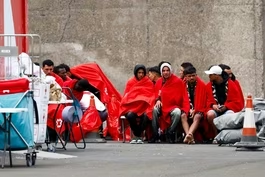
NewHow EU efforts to stem migration affect dangerous sea route
Video has Closed Captions
How EU efforts to stem migration affect a dangerous sea route to the Canary Islands (7m 8s)
 New
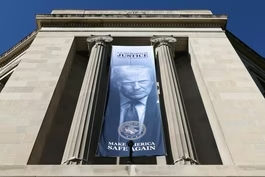
NewHow the Justice Department is advancing Trump’s agenda
Video has Closed Captions
From 2020 election to retribution, how the Justice Department is advancing Trump’s agenda (4m 5s)
 New
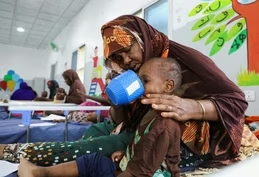
NewIran war escalates Somalia’s dire humanitarian situation
Video has Closed Captions
Somalia’s dire humanitarian situation escalates amid Iran war and Strait of Hormuz closure (5m 25s)
 New
NewNews Wrap: Tennessee’s new congressional map sparks protest
Video has Closed Captions
News Wrap: Tennessee passes new congressional map, sparking protest (5m 27s)
 New
NewRubio tries to mend relations with pope in Vatican meeting
Video has Closed Captions
Rubio attempts to mend relations with Pope Leo in Vatican meeting after Trump’s criticisms (8m 31s)
 New
NewSupreme Court ruling creates confusion in Louisiana voting
Video has Closed Captions
Supreme Court districting ruling creates confusion in Louisiana early voting (4m 41s)
 New
NewU.S. destroyers and Iran trade fire in Strait of Hormuz
Video has Closed Captions
U.S. destroyers and Iran trade fire in Strait of Hormuz in serious test of ceasefire (2m 14s)
 New
NewWhat proposed FEMA changes mean for disaster response
Video has Closed Captions
Proposed FEMA changes raise questions about the future of disaster response (7m 35s)
Providing Support for PBS.org
Learn Moreabout PBS online sponsorship
- News and Public Affairs

Today's top journalists discuss Washington's current political events and public affairs.

- News and Public Affairs

FRONTLINE is investigative journalism that questions, explains and changes our world.
Urban Consulate Presents











Support for PBS provided by:
Major corporate funding for the PBS News Hour is provided by BDO, BNSF, Consumer Cellular, American Cruise Lines, and Raymond James. Funding for the PBS NewsHour Weekend is provided by...