
What proposed FEMA changes mean for disaster response
Clip: 5/7/2026 | 7m 35sVideo has Closed Captions
Proposed FEMA changes raise questions about the future of disaster response
For years, there’s been a debate over what role the Federal Emergency Management Agency should play when disaster strikes American communities. Trump argues that states should shoulder much more of the responsibility, and now a review council appointed by the president is making a series of recommendations. William Brangham speaks with former FEMA head Deanne Criswell for more.
Problems playing video? | Closed Captioning Feedback
Problems playing video? | Closed Captioning Feedback
Major corporate funding for the PBS News Hour is provided by BDO, BNSF, Consumer Cellular, American Cruise Lines, and Raymond James. Funding for the PBS NewsHour Weekend is provided by...
What proposed FEMA changes mean for disaster response
Clip: 5/7/2026 | 7m 35sVideo has Closed Captions
For years, there’s been a debate over what role the Federal Emergency Management Agency should play when disaster strikes American communities. Trump argues that states should shoulder much more of the responsibility, and now a review council appointed by the president is making a series of recommendations. William Brangham speaks with former FEMA head Deanne Criswell for more.
Problems playing video? | Closed Captioning Feedback
How to Watch PBS News Hour
PBS News Hour is available to stream on pbs.org and the free PBS App, available on iPhone, Apple TV, Android TV, Android smartphones, Amazon Fire TV, Amazon Fire Tablet, Roku, Samsung Smart TV, LG TV, and Vizio.
Providing Support for PBS.org
Learn Moreabout PBS online sponsorshipAMNA NAWAZ: Well, for years there's been a debate over what role FEMA, the Federal Emergency Management Agency, should play when disaster strikes American communities.
President Trump argues that states should shoulder much more of the responsibility.
And now a review council appointed by the president is making new recommendations.
Our William Brangham has more.
WILLIAM BRANGHAM: That's right, Amna.
This review council made a series of recommendations that would reform the essential mission of FEMA.
Among the proposed changes, states would take the lead role in disaster assistance within their own borders while FEMA shifts to a supporting secondary role.
It recommends changes in how immediate assistance is delivered.
That's the aid given out in the first hours and days following a disaster.
And establishing new metrics to measure how states perform.
Those metrics could then affect how much money a state receives from the federal government.
And it recommends streamlining direct individual assistance, often for housing, and to focus FEMA's efforts on emergency and temporary housing, instead of long-term housing help.
The new DHS secretary, Markwayne Mullin, made his priorities clear during a trip to North Carolina last month.
MARKWAYNE MULLIN, U.S.
Homeland Security Secretary: When we're looking at reform, the president wants to -- like I said, we want to make sure we get it to the state faster and not look at FEMA as being the first responder, but look at FEMA as supporting the first responders.
WILLIAM BRANGHAM: If implemented, the council's recommendations would amount to the biggest overhaul of FEMA in many years.
So, for more on this, we are joined again by someone who has had to wrestle with these exact issues.
Deanne Criswell was the head of FEMA for four years under the Biden administration and now helps states and cities plan for disasters.
Deanne Criswell, thank you so much for being back here.
Could you just give me your initial reaction to this set of recommendations?
DEANNE CRISWELL, Former FEMA Administrator: William, I haven't had a chance to fully read the whole document yet, but I did read the slides that were put out and some of the feedback that I have gotten from others.
And it doesn't look like much has changed from the December report.
And there was a lot in that report that I agreed with.
I think the devil's going to be in the details in how they roll it out and how they implement it.
But one thing that you mentioned, and I just want to make sure that it's clear.
And it's come up in this report.
It's come up in a lot of the conversations about shifting the responsibility back to the state and locals.
I was a local emergency manager.
It has always been the responsibility of the state and locals to manage their response, and FEMA has always served in a supporting role.
I think where the challenge is and some of the goals that are trying to be achieved here is, how do we make that happen faster and how do we allow the states to have more ownership in how that is done when they're asking for reimbursements from the federal government, which means we're also going to shift some of the risk for making sure you're following all the appropriate guidelines down to the state and the locals as well.
So I always just like to make sure that that point is clear because I think it gets lost in this conversation sometimes.
And if you talk to any of my colleagues that are emergency managers, state emergency managers, I think that they would say the same thing.
But, overall, I think that change is needed.
I have said that openly many times.
I think some of the recommendations in there make a lot of sense.
I think it's really going to depend on how well they're implemented and how they do that.
WILLIAM BRANGHAM: I want to pick up on a point you were making there, which is the argument that the administration and some state leaders have made that is that FEMA is too slow and too bureaucratic.
I want to play a little bit of sound that we heard from one of the members of this review council.
This is from Michael Whatley.
He used to run the RNC.
Now he's running for the Senate in North Carolina.
Here's how he described FEMA.
MICHAEL WHATLEY, FEMA Review Council: Republican National Committee: We had an agency that had clearly lost its mission focus, inefficient use of federal funds because of bureaucratic stasis and redundancies, centralized and bloated headquarters, and states which were unprepared to respond to a significant disaster.
WILLIAM BRANGHAM: Do you think that is a fair assessment?
DEANNE CRISWELL: Not in its entirety.
I would say that states that are not prepared to respond to disasters, is that the state responsibility or is that FEMA's responsibility?
FEMA provides opportunities.
They provide training.
They provide programs.
They do provide some grant funding.
The grant funding comes from Congress, but states still have that responsibility, as I said earlier, right, that they own the disasters within their states.
I would also agree, though, that it has become a little bit bloated that headquarters, and one of the initiatives while I was there was, how do we take and shift some of those personnel from headquarters out into our regional offices, so those regional teams, regional staff members can work directly with their states?
They're the ones that know them the best.
They have built those relationships.
Let's give them the resources to actually build those relationships and help those states grow their own capability.
And we did a lot of that through different programs to put people right in the state offices.
And that program had grown through the first Trump administration, as well as during my administration.
And I think it made a real difference.
And so, while I agree with some of what he said, I think it's very generalized and politically driven on some of the comments the way he framed them.
But, overall, there's definitely room for improvement on all ends, right, from the federal end, as well as from the state and local end.
WILLIAM BRANGHAM: What do you make of this particular idea of creating performance metrics, and then the states get measured on those metrics on how they are delivering aid, and there's an incentive for those that do well and punishment for those that are considered to be found wanting?
DEANNE CRISWELL: Well, the first thing that comes to mind for me is, are we creating a metric system that's going to be this one-size-fits-all approach?
Because you're going to have a state like Florida or Texas that has a lot of disasters and has built a lot of capability that's going to be able to meet certain metrics, but you're going to have states that maybe don't even have a disaster every year, but, once they get one, they don't have that built-in structure to be able to support that.
And so are they going to be held at the same standard as someone who's using these kinds of tools each and every day?
And so I think, as long as the metrics recognize that no two states are alike and they develop them in a way that's going to understand the states that don't see a lot versus the states that do have this repetitive nature.
And I also think as we go through this, one of the things that I really fought for -- and I think it's kind of implied in this final document -- is, we really need states to focus on pre-disaster long-term recovery plans.
They're very good at response.
We focus a lot of time on response.
But when you when you get into the meat of it, the hardest part is recovery.
And so I think it would be great to have a metric or something, an incentive tied to states that have done that work ahead of time to know how they're going to recover and know how they're going to bring in the rest of their other state agencies to be able to support that.
That will make a big difference in the speed.
And then that would, I think, help flow up some of the federal funding even without the incentives.
WILLIAM BRANGHAM: That is Deanne Criswell, the former head of FEMA.
Thank you so much as always for being here.
DEANNE CRISWELL: Thanks, William.
 New
NewChef’s memoir traces unlikely path into the culinary world
Video has Closed Captions
An ‘accidental’ chef traces her unlikely journey into the culinary world in new memoir (6m 58s)
 New
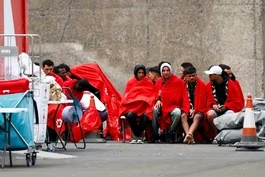
NewHow EU efforts to stem migration affect dangerous sea route
Video has Closed Captions
How EU efforts to stem migration affect a dangerous sea route to the Canary Islands (7m 8s)
 New
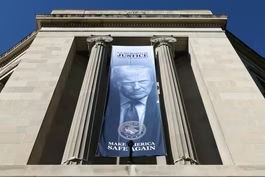
NewHow the Justice Department is advancing Trump’s agenda
Video has Closed Captions
From 2020 election to retribution, how the Justice Department is advancing Trump’s agenda (4m 5s)
 New
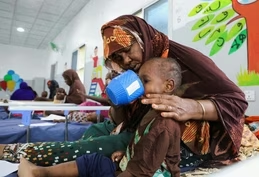
NewIran war escalates Somalia’s dire humanitarian situation
Video has Closed Captions
Somalia’s dire humanitarian situation escalates amid Iran war and Strait of Hormuz closure (5m 25s)
 New
NewNews Wrap: Tennessee’s new congressional map sparks protest
Video has Closed Captions
News Wrap: Tennessee passes new congressional map, sparking protest (5m 27s)
 New
NewRubio tries to mend relations with pope in Vatican meeting
Video has Closed Captions
Rubio attempts to mend relations with Pope Leo in Vatican meeting after Trump’s criticisms (8m 31s)
 New
NewSupreme Court ruling creates confusion in Louisiana voting
Video has Closed Captions
Supreme Court districting ruling creates confusion in Louisiana early voting (4m 41s)
 New
NewU.S. destroyers and Iran trade fire in Strait of Hormuz
Video has Closed Captions
U.S. destroyers and Iran trade fire in Strait of Hormuz in serious test of ceasefire (2m 14s)
Providing Support for PBS.org
Learn Moreabout PBS online sponsorship
- News and Public Affairs

Today's top journalists discuss Washington's current political events and public affairs.

- News and Public Affairs

FRONTLINE is investigative journalism that questions, explains and changes our world.
Urban Consulate Presents











Support for PBS provided by:
Major corporate funding for the PBS News Hour is provided by BDO, BNSF, Consumer Cellular, American Cruise Lines, and Raymond James. Funding for the PBS NewsHour Weekend is provided by...