
May 20, 2026 - PBS News Hour full episode
5/20/2026 | 57m 46sVideo has Closed Captions
May 20, 2026 - PBS News Hour full episode
May 20, 2026 - PBS News Hour full episode
Problems playing video? | Closed Captioning Feedback
Problems playing video? | Closed Captioning Feedback
Major corporate funding for the PBS News Hour is provided by BDO, BNSF, Consumer Cellular, American Cruise Lines, and Raymond James. Funding for the PBS NewsHour Weekend is provided by...
May 20, 2026 - PBS News Hour full episode
5/20/2026 | 57m 46sVideo has Closed Captions
May 20, 2026 - PBS News Hour full episode
Problems playing video? | Closed Captioning Feedback
How to Watch PBS News Hour
PBS News Hour is available to stream on pbs.org and the free PBS App, available on iPhone, Apple TV, Android TV, Android smartphones, Amazon Fire TV, Amazon Fire Tablet, Roku, Samsung Smart TV, LG TV, and Vizio.
Providing Support for PBS.org
Learn Moreabout PBS online sponsorshipGEOFF BENNETT: Good evening.
I'm Geoff Bennett.
AMNA NAWAZ: And I'm Amna Nawaz.
On the "NewsHour" tonight: The Justice Department indicts former Cuban President Raul Castro in the latest escalation of tensions with the island nation.
GEOFF BENNETT: Another congressman who stood up to Donald Trump is ousted, underscoring the president's hold on the Republican Party.
AMNA NAWAZ: And Xi Jinping hosts Vladimir Putin in China, cementing their alliance only one week after President Trump's visit.
ANDREW WEISS, Carnegie Endowment for International Peace: They are demonstrating in the rhetoric and in the imagery of today's visit deep apprehension about Donald Trump.
(BREAK) AMNA NAWAZ: Welcome to the "News Hour."
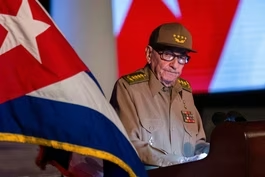
Raul Castro, the younger brother of the late Cuban dictator Fidel Castro, was indicted by the U.S.
Justice Department today in Miami.
GEOFF BENNETT: The 96-year-old is still a major power behind the scenes in Cuba.
He's held many senior positions in Cuba's government since the 1959 revolution, including the presidency.
He and four other regimes officials were charged in the 1996 killings of Americans seeking to aid Cubans at sea.
Ali Rogin starts our coverage.
ALI ROGIN: Today, in Miami, a cheer that is also a hope.
WOMAN: Today, it's going to start that Cuba is going to be free.
ALI ROGIN: After the oldest, most powerful surviving member of one of Cuba's most infamous families is indicted.
The Justice Department today charged Raul Castro with murder and conspiracy to kill U.S.
nationals.
Acting Attorney General Todd Blanche: TODD BLANCHE, Acting U.S.
Attorney General: If you kill Americans, we will pursue you, no matter who you are, no matter what title you hold, and in this case, no matter how much time has passed.
ALI ROGIN: The charges against Castro stem from his alleged role in the shoot-down of planes carrying three Americans and a Cuban exile in 1996.
Operated by Miami-based humanitarian organization Brothers to the Rescue, the planes were on the lookout to spot and save Cubans fleeing their homes in makeshift boats and rafts.
The organization was long a thorn in the side of the Cuban government, as founder Jose Basulto once told the "News Hour."
JOSE BASULTO, Founder, Brothers to the Rescue: Fly our mission always beginning 12 miles north of the shores of the island, which is the waters that are considered international waters.
Besides, if we find them any closer, I'm sure Castro will get them before we do.
ALI ROGIN: The Justice Department said it was then-Defense Minister Raul Castro who gave the go-ahead to shoot down the planes after the Cuban government claimed the planes violated its airspace.
While the charges were decades in the making, for those who remember the tragedy, it was past time.
OSCAR FERNANDEZ SOLSONA, Cuban Expat: The Castro communist regime in my country has driven us back to the Middle Ages.
There is no energy, there is no electricity, there is no food, there is no respect, there is no democracy.
There is a lot of repression.
ALI ROGIN: Today's indictment timed in recognition of Cuban Independence Day and as the Trump administration ramps up its rhetoric against the country's 66-year communist regime.
DONALD TRUMP, President of the United States: It's a failing nation.
You see that it's falling apart.
ALI ROGIN: The president hinted today at possible intervention in the near future.
DONALD TRUMP: It's not going to be like the biggest thing we have ever done, but I will tell you to a lot of people it's going to be one of the most important.
They have been looking for this moment for 65 years, so we will see what happens.
ALI ROGIN: And, this morning, Secretary of State Marco Rubio offered hope for a different way forward.
MARCO RUBIO, U.S.
Secretary of State (through translator): Cubans have reached the top of virtually all industries in all countries except one, Cuba.
Today, in Cuba, only those close to the elite or who are part of it can have profitable businesses.
But President Trump is offering a new path between the U.S.
and a new Cuba.
ALI ROGIN: But not all Cubans find that offer enticing.
SEFERINO CASALLES, Havana Resident (through translator): I don't agree with any country intervening here in Cuba, not the United States nor anybody else.
I don't think we should be holding Raul Castro accountable for something that happened 30 years ago.
What if the small plane had crashed here in the city or if there had been an accident for some other reason?
I don't think we should be judging Raul for any of that.
ALI ROGIN: Back in South Florida's Little Havana, the cheers for a free Cuba continue, even as that reality remains uncertain.
For the "PBS News Hour," I'm Ali Rogin.
GEOFF BENNETT: Late today, the Cuban government issued a statement saying it condemns what it called the despicable accusation against the leader of the revolution.
The statement also says the indictment was -- quote -- "based on the dishonest manipulation of the incident that led to the downing of two aircraft over Cuban airspace."
For perspective now, we turn to Michael Bustamante, chair of Cuban and Cuban American studies at the University of Miami.
Thank you for being with us.
MICHAEL BUSTAMANTE, University of Miami: Thanks for having me.
GEOFF BENNETT: I want to start with the timing.
What should we take from the fact that the U.S.
government is moving forward with this indictment now, given that the actions involving Raul Castro date back decades?
MICHAEL BUSTAMANTE: It's a great question.
And I think the answer has to do with everything else that's been happening in the U.S.-Cuba relationship in recent months and weeks.
It's impossible to separate the timing of this announcement from the broader campaign of economic pressure that the administration has been piling on Cuba since January.
The administration has been throwing new kinds of sanctions and pressure at Cuba for the past few months, in the hopes that they can pressure the Cuban government to cede on political and economic issues.
And this is just one other piece of that strategy.
GEOFF BENNETT: Does this effectively freeze any possibility of the near-term easing of tensions between Washington and Havana?
MICHAEL BUSTAMANTE: You know, I don't know.
It's a very strange reality because just -- not too long ago, a couple weeks ago, members of the secretary of state's team were sitting down with Raul Castro's grandson, and now we're indicting the grandfather.
So there's kind of two tracks here.
There's a lot of stick, not necessarily much carrot, but there is a channel open.
And the United States has continued to emphasize that they would like to see a negotiated outcome, but they want the Cuban government to cede on things that they have never been willing to cede on.
And they have been holding that line.
The question is, as the economic pain increases as we get into the summer months in particular, when demands on the energy grid are high, will some -- will something change, or will the administration decide to escalate further?
GEOFF BENNETT: Is there any clarity - - I hear you say there potentially isn't -- on what the administration's goal is, whether it's behavioral change from the Cuban government or broader regime pressure and isolation?
MICHAEL BUSTAMANTE: It's been hard to read the tea leaves on this one.
And I think the best answer I can offer is that perhaps the administration's feelings here have evolved somewhat.
A few weeks back on the margins of a Caribbean state summit in Saint Kitts, the secretary of state seemed to be striking a rather pragmatic tone, firm against the Cuban government, but intimating that, look, change doesn't have to have to have to happen overnight.
It could start with economic issues.
Obviously, people in South Florida want to see political change too.
But I think the administration seems to have grown frustrated in recent weeks that even that what they would consider more pragmatic offer, that Havana hasn't taken them up with, that Havana hasn't really announced very significant economic reforms.
They have done some things, but not enough from the administration's point of view.
So I think the question is whether they are using pressure to try to get to a deal or whether they don't think a deal is really possible anymore, and this is just going to be the beginning of a path to escalation and potentially even military action.
GEOFF BENNETT: You mentioned the desires of the Cubans in South Florida.
How are Cuban Americans, generally speaking -- understanding no group is a monolith, but, generally speaking, how are they reacting to this renewed pressure campaign?
MICHAEL BUSTAMANTE: I think there's a lot of anticipation and, in some corners, excitement and hope, I think matched also with some caution that we have been here before.
We have heard predictions of the government's imminent fall many times, and it hasn't happened.
I also think that all the reporting that potentially a deal might be done that focuses more on economic issues and not political change was giving some folks reason for pause in the community.
And there was some pushback.
But the administration has set expectations very high.
They have talked about 2026 as the year of big change in Cuba.
And I think one question is, if that doesn't happen and we're a few months down the line, how is the community going to react?
GEOFF BENNETT: What about Cubans on the island?
Do they see stepped-up U.S.
pressure as leverage against the government there or is something that ultimately makes daily life even harder?
MICHAEL BUSTAMANTE: I think they could think both things at once.
My interactions with folks on the island tell me that folks, A, are so focused on just trying to get by day to day, minute to minute that they don't necessarily have a lot of time to think about the broader geopolitical stakes here.
But I also know that people are so desperate for some kind of relief to these 20-plus-hour blackouts that they would take that relief wherever it's coming from.
As one friend in Havana told me, look, if the United States is going to act militarily, I just hope they get it over quickly.
That kind of fatalism, I think, is quite tragic.
It's quite sad.
I don't think most Cubans I know on the ground want to see their country intervene by a foreign power, but they also want change.
And I think they're all on standby and hoping for, as I said, some relief.
GEOFF BENNETT: Michael Bustamante with the University of Miami, thank you for being with us.
MICHAEL BUSTAMANTE: Thank you.
AMNA NAWAZ: In the day's other headlines: Two police officers who defended the Capitol on January 6 filed a lawsuit today to try to block the government's so-called anti-weaponization fund.
Former Capitol Police Officer Harry Dunn and Officer Daniel Hodges of the Metropolitan Police Department say the Trump administration created the fund -- quote -- "to finance the insurrectionists and paramilitary groups that commit violence in his name."
The administration says it's meant to compensate those who believe they have been mistreated by the U.S.
legal system.
During congressional testimony yesterday, acting Attorney General Todd Blanche did not rule out whether that could include January 6 rioters.
More than 100 police officers were injured during that attack.
The World Health Organization says there are now more than 600 suspected cases from an Ebola outbreak in Central Africa and at least 139 suspected deaths.
But at their briefing today, officials said -- quote -- "The scale of the epidemic is much larger."
They also warned that a vaccine likely won't be available for up to nine months.
Meantime, on the ground, health workers say they're underprepared to deal with the outbreak.
Local communities continue to suffer and grieve, with one woman describing the symptoms of her dying son.
BOTWINE SWANZE, Mother of Ebola Victim (through translator): He told me his heart hurt.
And I thought it was his stomach.
Then he started crying because of the pain in his stomach.
After that, he started vomiting.
Then he started bleeding and vomiting a lot.
AMNA NAWAZ: In Germany today, the first American known to be infected from this latest outbreak arrived in Berlin for treatment.
The CDC says he's in stable condition.
Back in this country, a runway at New York's LaGuardia Airport was shut today after a sinkhole was discovered on the tarmac.
Ground crews found it this morning during a regular inspection of the airfield, seen here just a few yards from the runway.
New York's Port Authority warned passengers to expect delays and cancellations while emergency crews worked to repair the hole.
Arsenal fans around the world are still celebrating a victory decades in the making, the team's first Premier League title in 22 years.
AMNA NAWAZ: Crowds lit flares and led chants in the streets of north London as Arsenal clinched its 14th English title overall.
And they did so without even taking the field last night.
Second-place Manchester City needed a win to stay in the running, but could only manage a draw against Bournemouth.
Even far from London, fans in Addis Ababa, Ethiopia, stopped traffic to cheer in the streets and on top of cars, while, back home, a title parade is scheduled for May 31.
In corporate news, James Murdoch is buying roughly half of Vox Media in a deal worth of reported $300 million.
Murdoch will acquire the company's podcast operation and Vox.com, plus "New York Magazine," which was owned for years by James' father, Rupert Murdoch.
The two have gone their separate ways professionally amid disagreements over editorial content.
Meantime, on Wall Street today, stocks rallied amid some relief in oil and bond markets.
The Dow Jones industrial average climbed back above the 50,000-point level.
The Nasdaq added nearly 400 points, or more than one 1.5 percent.
The S&P 500 posted its first game in four days.
And former Congressman Barney Frank, the longtime liberal Democrat and a trailblazer for gay rights, has died.
Frank began his political career in the Boston mayor's office before winning a seat in the Massachusetts House.
He ran for Congress in 1980, where he stayed for more than three decades.
Frank was the first congressman to come out as gay on his own terms.
Others had been outed through scandal.
His biggest legislative achievement came after the 2008 financial crisis.
FMR.
REP.
BARNEY FRANK (D-MA): The American people, we're told, have said no more expansion of government.
Not in the area certainly of financial regulation.
AMNA NAWAZ: As chair of the House Financial Services Committee, Frank helped craft what came to be known as the Dodd-Frank Act, the most significant financial reform bill since the New Deal.
He retired in 2013.
And just before leaving office, he told the "News Hour"s Paul Solman, why he went into politics in the first place, delivered with his signature quick wit.
FMR.
REP.
BARNEY FRANK: It's to make it fairer, fairness in the sense of people not going hungry and being deprived through no fault of their own, or even if it was their fault, but not letting people sink to that level of misery, ending discrimination.
PAUL SOLMAN: What grade do you give yourself, one to 10?
FMR.
REP.
BARNEY FRANK: Oh, I give myself a 10 for being smart enough not to answer that question.
Either you sound humble in a way that is literally incredible, not credible, or you sound arrogant.
I will say none of the above.
AMNA NAWAZ: In April of this year, Frank entered hospice with congestive heart failure.
But he remained outspoken and opinionated, offering advice to his fellow Democrats up until his final days.
Barney Frank was 86 years old.
Still to come on the "News Hour": a Justice Department settlement with President Trump renews focus on his tax returns; we report from Denmark on the country's rapid transition to green energy; and author Sophia Nelson discusses her new book on living up to the United States' founding principles.
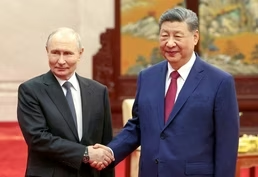
GEOFF BENNETT: Right on the heels of President Trump's state visit to China last week, Russia's Vladimir Putin stopped in Beijing for a meeting today with his chief ally, Xi Jinping.
As Nick Schifrin tells us, they focused on economic issues and criticizing U.S.
foreign policy.
NICK SCHIFRIN: Today in Beijing, fanfare and red carpets for two authoritarian leaders to trumpet their alliance.
At the Great Hall of the People, the ceremonial center of communist China, Xi Jinping met his closest ally, Russian President Vladimir Putin, for a synchronized show of power and celebration by China's youngest.
It was the exact same spot that Xi welcomed President Trump just six days ago, seemingly identical in its pomp and circumstance, although apparently not to President Trump.
DONALD TRUMP, President of the United States: I think it's good.
I don't know if the ceremony is quite as brilliant as mine.
I watched.
I think we topped him.
NICK SCHIFRIN: But even if the U.S.
and China pledge strategic stability, they remain rivals.
And China and Russia are strategically aligned, and today jointly criticized the U.S.... NARRATOR: Golden Dome for America.
NICK SCHIFRIN: ... for President Trump's proposed Golden Dome missile defense, which Russia and China today called a -- quote -- "obvious threat to strategic stability" for the expiration of the last U.S.-Russia arms control treaty, New START, and for the U.S.-Israel war on Iran.
XI JINPING, Chinese President (through translator): The world today is far from peaceful, with unilateralism and hegemonism posing profound dangers.
The world faces the risk of regressing to the law of the jungle.
VLADIMIR PUTIN, Russian President (through translator): Russian-Chinese relations have reached a truly unprecedented level.
ANDREW WEISS, Carnegie Endowment for International Peace: The split-screen image of chumminess between Vladimir Putin and Xi Jinping, and on the other hand Donald Trump's recent visit, could not be more stark.
NICK SCHIFRIN: Andrew Weiss is a former State Department official who's now with the Carnegie Endowment.
ANDREW WEISS: The Russians and the Chinese are absolutely essential partners to each other in the political sphere and in the economic sphere.
They are demonstrating in their rhetoric and in the imagery of today's visit deep apprehension about Donald Trump.
NICK SCHIFRIN: The day-to-day implications of that play out in Ukraine.
China provides what the U.S.
has said is 90 percent of Russia's microelectronic imports for weapons used in Ukraine and 70 percent of Russia's machine tool imports to make weapons for Ukraine.
ANDREW WEISS: Russia sees China as the key partner for what it's going to need to keep the war going, as well as for when it turns to rebuilding its military whenever the war ends.
NICK SCHIFRIN: But there are limits to what China and Russia have called their no-limits partnership.
Not announced today, a deal for a major pipeline that would take Russian natural gas to China.
ANDREW WEISS: China has tremendous negotiating leverage, and it's working to get the sweetest possible deal from the Russians.
And China, given the fact that this is a complex agreement that could last upwards of 30 years, is going to be extremely careful not to make impulsive, last-minute gestures just to score political points or to make Vladimir Putin feel good.
NICK SCHIFRIN: But Putin and Xi feel good about their alliance, which Putin called truly unprecedented and Xi called the highest level in history.
And so these two leaders, who maintain an axis of authoritarianism alongside Iran and North Korea, continue to confront the U.S., and Putin left China with a standing ovation.
For the "PBS News Hour," I'm Nick Schifrin.
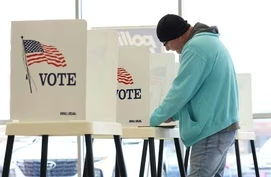
AMNA NAWAZ: President Trump's grip on the Republican Party was on display in high-profile primaries across the country last night, with several Trump critics losing after the president targeted their campaigns.
In Kentucky, Congressman Thomas Massie lost his bid for reelection by nearly 10 points to Ed Gallrein.
That's former Navy SEAL backed by the president.
Massie drew the ire of Mr.
Trump and his allies for his opposition to the war in Iran and leading efforts to release the Jeffrey Epstein files.
REP.
THOMAS MASSIE (R-KY): We weren't really running against Ed Gallrein.
We weren't running against Donald Trump.
We were running for what we believe in.
(CHEERING) AMNA NAWAZ: Meanwhile, in Georgia, secretary of state Brad Raffensperger, a key opponent of the president's attempts to overturn election results in the state, lost in the primary for governor.
And two Republican candidates for Senate are heading to a run-off, setting up another closely watched test of the party's direction under Trump.
Joining me now to discuss last night's results is Melik Abdul.
He's a Republican strategist and media consultant.
He served as a Black Americans for Trump Coalition leader during the president's 2024 campaign, and he started his career in congressional affairs during the George W. Bush administration.
Welcome.
Thanks for being here.
MELIK ABDUL, Republican Strategist: Thanks for having me.
AMNA NAWAZ: Let's start in Kentucky, Thomas Massie's primary loss there after President Trump called him yesterday the worst congressman in the history of our country.
The race was a key test for the president's hold on the party.
What did it tell you?
MELIK ABDUL: Well, it was a big question, because what happened in Indiana was a bit different than what happened in Louisiana with Cassidy.
Cassidy always had the vote for impeachment hanging over his head.
So we were really looking to see whether or not you have a race where Thomas Massie is extremely popular.
What would that mean?
And it's hard to now not argue that Donald Trump has complete control over the political apparatus of the Republican Party.
The question is, what does that mean for midterms, when Republicans actually need independents to vote for them?
AMNA NAWAZ: The question also is what happens in Texas, right?
We talked a little bit about the president now endorsing the attorney general there.
That's Ken Paxton.
He's challenging the incumbent Senator John Cornyn, who served in the Senate for over two decades.
The run-off is on Tuesday.
I think it's fair to say Paxton has political baggage, right?
There's concerns about his electability.
He's had professional and personal scandals.
Is there concern the president is prioritizing loyalty over electability?
MELIK ABDUL: Absolutely.
And I think that for, like, a Cassidy or even Massie, for that case, you could argue the loyalty question.
But the loyalty question is really not there with Cornyn.
Cornyn has voted for Donald Trump overwhelmingly.
He voted to confirm all of his nominees.
So he's a little different there.
I think that the Cornyn race, what's happening in Texas, this is more of an appeal to MAGA,because MAGA was saying all along over and over again, you heard many people telling Donald Trump, we do not want Cornyn.
So I think it seems as if that this was more of a gift for MAGA more so than the Republicans themselves, because they are not happy, because now we're having to invest more money in a state like Texas, as opposed to Georgia or even Maine, for that matter.
AMNA NAWAZ: Yes.
Well, sticking in Texas for a moment, is it also a gift to Democrats?
I mean, they are eager to run against Ken Paxton.
Are Republicans now imperiling their chance there to beat the Democratic nominee, James Talarico?
MELIK ABDUL: I think you said something about Paxton having some challenges.
That's an understatement.
I have said over and over again that Talarico is a more palatable, more likable candidate than Beto O'Rourke.
Beto O'Rourke actually lost to Ted Cruz by 2.6 percentage points.
If Talarico -- if Paxton ends up winning, there is a possibility that Texas ends up in play.
I know we have said this over and over again when it comes to Texas, but it is a real possibility.
AMNA NAWAZ: I do want to ask you what you mentioned now, because this does mean that the NRSC has to spend probably more money in Texas than they would like to spend, money they'd rather be spending in a place like Georgia.
You have two Republicans there heading to a run-off.
That's representative Mike Collins and former football coach Derek Dooley.
There's another intraparty fight looming here, right?
MELIK ABDUL: Yes.
AMNA NAWAZ: How much does this hurt their chances of beating Jon Ossoff and flipping Georgia?
MELIK ABDUL: I think that, for me -- and I know many people, we would love to say that we have a chance in Georgia.
I honestly believe -- and you listen to many people in Georgia.
Once Brian Kemp, Governor Brian Kemp decided not to run, we kind of wrote Georgia off.
Yes, we hope that we could win, but I don't see us really beating Jon Ossoff.
But if Brian Kemp had run, he would have beat him.
AMNA NAWAZ: You talked a little bit about Senator Bill Cassidy from Louisiana, lost in his primary this weekend.
This is a man who voted to convict President Trump in his impeachment trial back in 2021, then spent years, it seems, like trying to get back into Trump's good graces.
What does all of that tell you about room in the Republican Party right now to criticize the president, to disagree with him at all?
MELIK ABDUL: I think that you already had many people who were really kind of hesitant to criticize Donald Trump, very apprehensive.
And we're seeing now that Donald Trump is able to wield that power and essentially make sure that you don't have another congressional career.
I think that we should wait to see what happens after midterms.
If past is prologue and we end up losing, Republicans end up losing the House, you may see more Republican started to buck Donald Trump, because, for one, he will be a lame-duck president at that point.
So you may see more if we end up losing the midterms.
I think that, if we don't, though, you will see party-line loyalty for Donald Trump, with the exception of our senators like Cassidy and others who are leaving the Senate.
And we saw what happened with that Iran vote where Cassidy flipped over.
AMNA NAWAZ: He did.
He switched his vote on the Iran War Powers Act.
It's also not dissimilar to what we saw from Senator Thom Tillis, right, after announcing his retirement has become more outspoken.
So I hear you saying basically until we know what happens in the midterms, the only people who are going to speak out against the president for within his own party are people on their way out of the party.
Is that right?
MELIK ABDUL: That's a very fair assessment.
And we have seen what Donald Trump has been able to do with pouring money - - pouring money into the races, even in the Indiana race.
That was a state-level race.
Donald Trump jumped in there.
They were outspent and they weren't able to actually win that race.
I think that you're going to see a lot of people still apprehensive, but really waiting.
And I'm hearing from Republicans all around, we're waiting to turn the page from Donald Trump.
It's just a matter of timing when that happens.
AMNA NAWAZ: We will wait and we will see.
Melik Abdul, thank you so much for being here.
MELIK ABDUL: Thanks for having me.
GEOFF BENNETT: In the span of 48 hours, the U.S.
government, acting on orders from the Trump Justice Department, did something no administration in American history has ever done before.
It created a nearly $1.8 billion fund drawn from taxpayer money designed to compensate allies of the president who claim they were mistreated by the Biden Justice Department.
Then the administration permanently banned the IRS from ever examining President Trump's prior tax returns or those of his sons, his company, or any affiliated trust.
That move was quietly announced a day later tucked into a DOJ press release.
And there is a third development.
New federal ethics disclosures reveal more than 3,700 stock trades made under President Trump's name in companies like Meta, Amazon, and Disney, among others, worth up to around $750 million in just the first three months of this year.
That's on top of crypto ventures tied to the Trump family that have reportedly made more than $1 billion in profits so far.
We're going to focus now squarely on that IRS settlement with former IRS Commissioner John Koskinen, who ran the agency in the Obama and first Trump administrations.
Thank you for being with us.
JOHN KOSKINEN, Former IRS Commissioner: Happy to be here.
GEOFF BENNETT: So let's back up a bit.
And we should say that this original grievance stemmed from a leak.
An IRS contractor stole President Trump's tax returns during his first term, leaked them to reporters.
That contractor was caught.
He went to prison for it.
Given that he was caught and punished, what would the normal legal remedy have looked like and how does that compare to this settlement?
JOHN KOSKINEN: Normally, what you would do in the Justice Department and prior cases had maintained was the suit should be against, if you have a claim, for damages against Booz Allen and the contractor who stole the information.
So, the Justice Department, up until this settlement, had taken the position that the IRS was not an appropriate defendant.
GEOFF BENNETT: I imagine you have seen a lot of settlement agreements over the course of your career.
I read the addendum we referenced in the introduction here.
You have the acting attorney general, Todd Blanche.
He signed it.
There's no IRS representative who cosigned it.
And the way it was sort of slipped out a day after the main announcement about this so-called anti-weaponization fund, how does all of that strike you?
JOHN KOSKINEN: I was surprised.
Originally, while the case was pending, assuming it was a case, the administration seemed to be floating possible settlements.
And one was immunity for the president from review of his taxes.
And then later they proposed and floated the possibility of a settlement fund.
And so I thought they were going to pick one or the other.
Both of them were obviously a little off the beaten track.
And so to sort of look like sneaked second settlement through on Tuesday after Monday laying out in some detail the settlement fund, on Tuesday, there was almost no detail.
It was just a paragraph, very complicated to read, as if it was meant to obscure the issue, although ultimately, when you read it, it does say that there will be no future reviews at all of any of the tax returns filed up until the settlement on Monday.
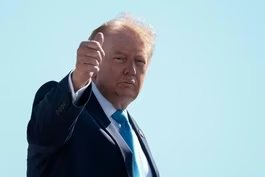
GEOFF BENNETT: Critics, as you well know, they're calling this a pardon on steroids, because, unlike a presidential pardon, this covers not just Trump himself, but his family, his businesses.
It covers any tax-related conduct before Monday, in fact, whether prosecutors were aware of misconduct or not.
What questions does that raise for you, the substance of it?
JOHN KOSKINEN: Well, first of all, as a process, I'm never aware of the IRS ever telling a taxpayer, we will just won't audit you as part of any settlement.
I mean, there are audits that get closed.
There are settlements reached.
But I have never heard of the IRS in the future saying whatever you filed in the past, we're not going to take a look at.
You do have to wonder what's in those returns that makes it so important for them not to be audited.
GEOFF BENNETT: I want to pick up on something you just said, because the optics of this are so extraordinarily problematic, the appearance of self-dealing, the compensation fund, this addendum, the way that it was sort of, to use your word, sneaked out.
It's hard to imagine any president accepting that kind of scrutiny and political blowback unless there was something significant at stake.
Given your role as commissioner of the IRS, what does all of that suggest to you?
JOHN KOSKINEN: Well, first of all, audits take time and money.
So if you didn't have to have an audit, that would be helpful.
The IRS does not audit people just for the fun of it, although it regularly reviews the president's returns.
The IRS is just looking for problems, not trying to harass taxpayers or make life difficult for them.
So to have this kind of a sweeping immunity, as it were, it just seems to me, raised questions of what's behind it, what's in those returns that make this so important, in a situation where the basic case that was filed had a lot of holes in it.
First of all, as I said, the Justice Department's position historically was, he was serving the wrong person.
He filed that case after the statute had run.
And it just seemed to me that there were significant issues as to how that was done.
And the fact that nobody ever filed any papers beyond the case, the Justice Department never put in an appearance -- the court required them to show up today answering the question of whether this really was a case.
Was there a case in controversy since the president in effect is negotiating with himself, which he acknowledged along the way?
And so it's almost a sham case giving cover to first provide this what some people are calling a slush fund to reward the president's friends and anybody that he thinks needs money.
But then adding on to it, this immunity from review of your taxes and your children's taxes and your company's taxes, and I don't know who the affiliates are, but there's never been anything in history that I know of that comes close to this.
GEOFF BENNETT: A future administration, a future IRS commissioner will walk in on January 20, 2029.
Could they tear this up?
Or has the Trump Justice Department permanently bound the U.S.
government on behalf of all future presidents?
JOHN KOSKINEN: Well, they probably have.
I mean, this is -- as the court said when they - - she closed the case after nobody showed up, obviously, the day to explain themselves, there was no -- the case had been withdrawn.
She closed the case and said there is no settlement on this case.
So, normally, you have a court settlement, and it's hard to undo it unless you go to court and the court changes its mind.
In this kind of agreement by the president and his former defense attorney, I suppose somebody could -- in the government could say that was a fraud on the public and the money should be returned or not spent.
But by the time a new IRS commissioner shows up, the money will be gone and tracking it down will be difficult.
And I would note, the way the settlement fund is set up, we may never know who got paid and how much they got paid, because there's no provision for oversight or public disclosure of the operation of the fund.
So I think a new commissioner would have difficulty sorting his way through trying to figure out how to unwind this.
And so the concern for many of us is, it's a really dangerous precedent if the president can pressure the IRS to overlook returns either from the president or friends of the president or anyone the president is trying to do a favor for.
GEOFF BENNETT: Former IRS Commissioner John Koskinen, thank you again for your time and your insights this evening.
JOHN KOSKINEN: Happy to be here.
Thank you.
AMNA NAWAZ: The European Union's climate commissioner has told the 27-country bloc that the only way out of energy crises fueled by the wars in Iran and Ukraine is homegrown energy and that the E.U.
must accelerate its transition away from fossil fuels.
As special correspondent Malcolm Brabant tells us, one country leading the charge towards Korean energy is Denmark.
It's part of our ongoing series Tipping Point.
MALCOLM BRABANT: Wind turbines are a pet presidential peeve.
DONALD TRUMP, President of the United States: They kill the birds, they ruin your landscapes.
Other than that, I think they're fabulous, by the way.
(LAUGHTER) DONALD TRUMP: Stupid people buy them.
MALCOLM BRABANT: At the Davos Economic Forum in January, the president doubled down.
DONALD TRUMP: There are windmills all over Europe.
There are windmills all over the place and they are losers.
One thing I have noticed is that the more windmills a country has, the more money that country loses and the worst that country is doing.
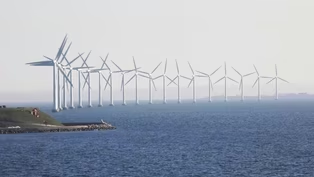
MALCOLM BRABANT: Ready to be exported, these enormous wind turbine blades are a tangible fact-check of President Trump's claims.
Denmark is consistently ranked in the world's top 10 economies, thanks in part to its expertise in exploiting green energy.
The industry employs 107,000 people and earns about $17 billion a year.
So what is Denmark's response to the president's "stupid" jibe?
KRISTIAN JENSEN, CEO, Green Power Denmark: Well, then there must be a lot of stupid people in the U.S., because there are a lot of states, companies and utilities in the U.S.
that is actually buying wind turbines right now, because the price has come down.
The price of power coming out of a wind turbine is cheaper than that of natural gas.
MALCOLM BRABANT: Providing a human scale for these giant blades is Kristian Jensen, who was formerly Denmark's foreign minister.
Now he runs a lobbying organization working to accelerate the fossil-free revolution.
KRISTIAN JENSEN: So this is not a question of saving the polar bears.
Don't look at the ideology.
Look at the facts on the table.
Solar is cheaper.
Wind is cheaper.
Electricity is more efficient than fossil energy.
And if you look at that, it's a no-brainer to go into electrification of your businesses and your homes.
MALCOLM BRABANT: The picturesque island of Aero in the Baltic Sea is a microcosm of what Denmark projects as its sustainable future.
An hour's ferry ride from the mainland, Aero hosts 6,000 permanent residents and a quarter-of-a-million tourists in the summer.
Denmark is at the cutting edge of green technology because it's been pushing the boundaries for more than half-a-century.
After two major oil crises in the 1970s, the Danes decided that self-sufficiency and energy security were top priorities.
Now that foresight is paying dividends, especially in Aero, which, thanks to its wind farm and other green projects, is reasonably insulated against shortages and price rises caused by the conflict in the Persian Gulf.
Rune Schmidt leads Aero's initiatives on sustainability and environmental conservation.
So how much do you think that the - - this conflict in the Middle East has actually highlighted the need for self-sufficiency?
RUNE SCHMIDT, Manager, Aero Energy and Environmental Office: I think the conflict has made it more important than ever.
On an annual basis, we are a net exporter of electricity.
We produce much more than we can consume.
DONALD TRUMP: Perhaps the greatest hoax in history, the green new scam, windmills all over the place destroy your land, destroy your land.
Every time that goes around, you lose $1,000.
You're supposed to make money with energy, not lose money.
MALCOLM BRABANT: Another pioneering Danish island, Samso, fact-checked the president during this past particularly windy winter.
Samso exported excess electricity, to the value of $39,000 a day, or a quarter-of-a-million dollars a week.
Back on Aero, Social Democrat Mayor Peter Hansted acknowledges that windmills aren't always productive, but he insists they're still turning a profit for their island owners.
PETER HANSTED, Mayor of Aero, Denmark (through translator): It is clear that on days when there is not so much wind, there's not as much money, and if the turbines are completely still, they do not give any money either.
But the surplus is definitely there on an annual basis.
It is paid out four times a year.
Then you get a little check through the door.
MALCOLM BRABANT: Now that spring has sprung, Aero's local grid turns to solar farms to harvest the bounty of the sun.
Solar energy provides islanders with power to either heat or cool their houses, as well as a never-ending supply of hot water.
Peter Graversen runs the district heating plant in Aero's main town.
PETER GRAVERSEN, Engineer, Aero, Denmark: The solar panels is only producing heat, of course, when the sun is shining, but they overproduce.
They produce more when the sun is shining than the consumption.
And the overproduction, we keep in a storage tank, which actually works like a battery.
When the sun goes down, we simply use the stored hot water from the storage tank.
MALCOLM BRABANT: The diesel-powered ship linking Aero with the mainland is temporarily spoiling the island's carbon footprint, while Ellen, its regular all-electric ferry, is in dock having new batteries fitted.
Henrik Hagbarth Mikkelsen designed the power system and hopes that other ferries will follow in Ellen's wake.
HENRIK HAGBARTH MIKKELSEN, Marstal Naval Academy: We do not have any emergency generators here.
We only have the batteries, and we have now been sailing for almost seven years without any blackouts or any incidents.
MALCOLM BRABANT: Meanwhile, car owners are among the worst affected by spiraling fuel prices caused by the Iran conflict.
Danish drivers' displeasure surfaced in last month's sales figures.
Electric vehicles accounted for 96.3 percent of all new car purchases.
Jonathan Nielsen is deputy director of Mobility, Denmark's automotive trade association.
JONATHAN NIELSEN, Deputy Director, Mobility: It's not a short-term thing.
This is a permanent shift in Denmark.
This issue with Iran is one of the factors driving it, but also the whole fact that infrastructure is being built for this, making it the easy choice.
MALCOLM BRABANT: While Europe is steadily reducing its fossil fuel dependency, the Trump administration is reversing previous American commitments about becoming carbon-neutral.
Most recently, it offered two electricity companies a billion dollars each in return for scrapping wind farm projects.
One administration argument is that wind turbines are a security risk because they can interfere with radar and allow hostile aircraft or missiles to penetrate national defenses.
But Martin Couet, a vice president with a major Danish defense company, insists that wind farms and radar can successfully coexist.
MARTIN COUET, Vice President, Terma: Radar today is a lot about software, so wind farms are creating a lot of clutter, a lot of echoes when you send the signals.
And what we have been working on is to see through these echoes, through this clutter, to be able to identify what we call targets, whatever, it's an aircraft, a ship, a drone, and make the difference between those and a bird and see through the wind farm.
MALCOLM BRABANT: Given the instability in the Persian Gulf, former Foreign Minister Kristian Jensen believes that it's foolish to reject green energy, as President Trump has done.
KRISTIAN JENSEN: With my experience as minister of foreign affairs, we see that this is a conflict that will go on for quite some time.
I believe that whether there is a truce or not, the situation around the Strait of Hormuz and the oil and gas production in the Arab country will be totally different for years and years to come.
MALCOLM BRABANT: With nearly 90 percent of its energy coming from renewable sources, Denmark is better positioned than most nations to ride out the storm taking place nearly 3,000 miles away.
For the "PBS News Hour," I'm Malcolm Brabant in Aero, Denmark.
GEOFF BENNETT: Two-and-a-half centuries ago, America's founders forged the nation through fierce debate and compromise.
Now, as the country approaches its 250th birthday, many Americans are again questioning whether the nation still lives up to its founding ideals and whether its citizens are upholding theirs.
As Ali Rogin explains, a new book argues the answer may depend on how we define freedom.
ALI ROGIN: When asked what sort of government the United States had, Benjamin Franklin famously said "a republic, if you can keep it."
Like many Americans, "Forbes" columnist Sophia Nelson has been wondering, how well have we kept it?
As the founder of the Redefining Freedom Center of Virginia, Nelson seeks to answer that question and provide recommendations for how we can all help adapt America's founding principles to a new century.
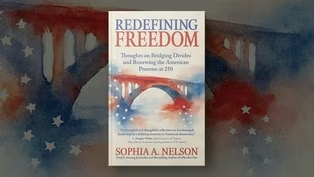
Her new book is called "Redefining Freedom: Thoughts on Bridging Divides and Renewing the American Promise at 250."
And Sophia Nelson joins me now.
Welcome back to the "News Hour."
SOPHIA A. NELSON, Author, "Redefining Freedom: Thoughts on Bridging Divides and Renewing the American Promise at 250": Thank you for having me.
ALI ROGIN: Thank you so much for being here.
Why do we need to redefine freedom?
SOPHIA A. NELSON: Well, I think that the natural instinct at a 250-year celebration is to commemorate, to have a big party, for everybody to be jovial and think about all the things we do well.
We should do that.
However, we're in a unique moment.
We have a divided country in a way that I have not seen in my lifetime.
Governing ourselves in the 21st century with an 18th century document is a little tricky.
And I don't want to throw it away.
I want to refresh it.
I want to do what Jefferson said.
I want to refresh the tree of liberty from time to time.
And I think that's what I'm talking about.
ALI ROGIN: You break it down into four pillars.
And they are personal freedom, shared freedom, lived freedom and protected freedom.
Why is it important to name those and define them?
SOPHIA A. NELSON: Well, I think freedom is the best word in the American vocabulary.
We all love it.
It's a great word, right?
But we got to define it, because I think my freedom and your freedom could be very different notions of what that is.
And so when I say shared freedom, my favorite of all, that means that Sophia's freedom should not impinge on yours or mine shouldn't be greater than yours.
We live in a community.
We have a civic heart and government that is supposed to be of, by, and for the people.
And that means that we actually look out for each other.
And so when I get into personal freedom, that's the individual right you have to go where you want, marry who you want, think what you want, worship how you want.
versus other people may have a very different way of expressing themselves.
And in this country, the tension is, we tolerate that and we celebrate it, or at least we used to.
I name these freedoms because I'm saying let's put a stake in this and get back to our founding purpose.
Right now, we're seeing some things that are just things I have never seen in my lifetime before, and I'm concerned.
That's why I wrote the book.
ALI ROGIN: You diagnose civic apathy as the greatest threat to democracy.
Of course, we have seen a lot of people around the country in recent months get involved for the first time, attending things like the No Kings rallies, which you write about witnessing in your book.
But many of them have said that the reason they're there is because they have reached some personal point of no return.
But is that what it takes these days to achieve civic engagement?
SOPHIA A. NELSON: I was alive for the bicentennial.
I hate to admit it.
I was in second grade, but I remember with the flag behind us with the Spirit of 1776 and we had to dress a certain way.
That was civic formation, right, that your flag matters, your country matters, the mundane, going to the school board, showing up at the PTA, doing these things where you have your input and how your kids are being schooled, what your roads look like, the things that nobody seems to care about.
Data centers, right?
Showing up and having your voice heard, we don't want these things in our community.
That's what the founders had in mind when they wanted us to be a government of, by and for the people.
They expected us to vote.
They expected us to show up.
And when politicians are not virtuous and not ethical, you have a way to remove them and hold them accountable.
We don't do it anymore.
We have all just said, oh, well, this is just what it is, and, well, it doesn't have anything to do with me.
That's bad.
That's not good.
ALI ROGIN: What's your hope for the next 250 years?
SOPHIA A. NELSON: Wow.
Well, I dedicate the book to the next generation, millennials and younger, because I hope long after we're no longer here that this country is still here and that it's still the same country you and I love today.
I thought King Charles did a wonderful job with his speech to Congress.
Boy, a king came and lectured America, politely, but he schooled us, if you will, on, don't you know you don't have a king anymore, and that there is a check on the executive, and that the world community looks up to you, and that NATO matters, and you have got to pledge your support to Ukraine and helping other nations?
That's who you are.
I thought he reminded Congress very well of who America is to the rest of the world and who we should be.
ALI ROGIN: The book is "Redefining Freedom."
Sophia Nelson, thank you so much.
SOPHIA A. NELSON: Thank you for having me.
AMNA NAWAZ: Author Soman Chainani is best known for his hit young adult series "The School for Good and Evil," which went on to become a hugely popular movie on Netflix.
Chainani's latest book, "Young World," is a political thriller about a teenager who becomes president of the United States.
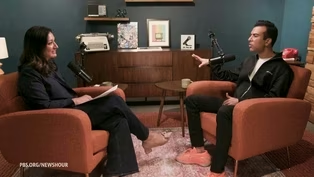
I spoke to Chainani for the latest episode of our PBS News podcast "Settle In" and we discussed the political realities for young people in America today.
Here's an excerpt of that conversation.
We have an 18-year mark for when you can cast ballots in this country.
Other countries have revisited this, right?
AMNA NAWAZ: In recent years, you have seen a number of countries in Europe and I think some in South America, I think Australia is considering it, lowering the voting age to 16 in a lot of these places.
Is that the kind of thing you would like to see happen here?
SOMAN CHAINANI: No.
I think it's the wrong solution, because, to me, it's about getting to run for president.
That to me is the more important thing than lowering the voting age to 16, because lowering the age to 16, it just makes a big gap between the 16-year-old and the average age.
The median age in the House is 58 and in the Senate 65.
So, lowering it from 18 to 16 just creates more of this kind of feeling of alienation, right?
Like, I think there was an NPR poll that came out that said 70 percent of young Americans 18 to 29 don't feel like they have anyone in politics that represents them.
And so, to me, it's more about allowing young people to fantasize about that leadership, because, when you're 18, think about all the things you can do.
You can take out a credit card, a mortgage, you can get married, you can vote, you can fight for your country, you can die for your country, but then you can't, like, ask your country in a democracy if you can lead it, right?
And so we allow -- we're getting to the point with life expectancy where 100-year-olds are going to be in the Senate, in the House, and potentially the presidency.
And yet we can't have an 18-year-old who's allowed to vote also run.
It doesn't make sense.
But then we rely on the 18-to-34s to energize the base and fill the rallies and volunteer and canvass and make the memes and content.
Like, they're running the campaigns.
SOMAN CHAINANI: I think when I went to see - - I was in New York the day Zohran won the Democratic primary.
And to see all the teenagers in the street and the way it felt like the book, it felt like the book.
It was the first time I felt like the revolting youth were real.
And yet Mamdani can't run for president for other reasons.
But he also would be age-gated from the presidency, which to me is ridiculous, because the two most powerful political forces we have had in the last 10 to 15 years were Zohran Mamdani and Charlie Kirk.
Both would be age-gated from the presidency.
If either one was allowed to run, you would see all the young people in this country come off the sidelines.
AMNA NAWAZ: You think more young people would vote for younger people?
SOMAN CHAINANI: Absolutely.
And it's when I go into schools and talk to kids, like we do this sort of simulation with some test questions as to what you would do if you were president.
And without fail, it becomes clear who in that group would run and then everybody's supporting them.
And you also see who they would pick as a -- it's just natural.
There's always going to -- not all young people should be president.
But... AMNA NAWAZ: Thank you for clarifying.
SOMAN CHAINANI: Not all young -- OK, but I will say, it's funny because I have gotten the question, do you actually think a teenager should be president, right?
AMNA NAWAZ: Yes.
SOMAN CHAINANI: But then I'm also thinking, I don't know if the 70- and 80-year-olds are crushing it.
You know what I mean?
So.. AMNA NAWAZ: Do the teenagers you talk to, do they believe the teenagers should be able to run for the highest office in the land?
SOMAN CHAINANI: There's always one who do -- yes, they do believe it should be.
AMNA NAWAZ: They do, that they -- yes.
SOMAN CHAINANI: Not necessarily them.
But there's always one who thinks they could do it.
And I think the one who could do it and having that conviction then creates this energy of, well, the other people being like, well, maybe I could run for office at my school.
Maybe I could run for school board.
Maybe I could run for town council.
So this idea of, if you just open up the presidency, I think you supercharge all the downstream races to young people.
And, essentially, I just want this upswell of young people.
And I also think it takes an outside voice to be able to say it who is not young, because if it was somebody in that teenage or 18-to-22-year-old space, no one would take them seriously.
AMNA NAWAZ: And you can watch that full episode of "Settle In" on our YouTube page or wherever you get your podcasts.
GEOFF BENNETT: And that's the "News Hour" for tonight.
I'm Geoff Bennett.
AMNA NAWAZ: And I'm Amna Nawaz.
On behalf of the entire "News Hour" team, thank you for joining us.
Denmark's green energy investments shield it from shock
Video has Closed Captions
How Denmark’s wind and solar investments shield it from global energy turmoil (8m 29s)
Ex-IRS chief: Trump tax settlement a 'dangerous precedent'
Video has Closed Captions
DOJ's tax settlement with Trump sets 'dangerous precedent,' former IRS commissioner says (7m 57s)

News Wrap: Jan. 6 officers sue to block $1.8B fund
Video has Closed Captions
News Wrap: Officers who defended Capitol on Jan. 6 sue to block $1.8B fund (5m 46s)
Soman Chainani joins Amna Nawaz on 'Settle In'
Video has Closed Captions
Soman Chainani and Amna Nawaz discuss politics for young Americans on 'Settle In' (4m 49s)
Sophia Nelson on living up to America's founding principles
Video has Closed Captions
Sophia Nelson on 'Redefining Freedom' and living up to America's founding principles (5m 29s)
Trump tightens grip on GOP as critics ousted in primaries
Video has Closed Captions
A look at Trump's grip on the GOP as his critics are ousted in primaries (6m 56s)
U.S. indicts Raúl Castro in latest escalation with Cuba
Video has Closed Captions
U.S. indicts Cuba's Raúl Castro in latest escalation of tensions (9m 20s)
Xi hosts Putin in Beijing, cementing China-Russia alliance
Video has Closed Captions
Xi hosts Putin in Beijing, cementing China-Russia alliance after Trump's visit (3m 49s)
Providing Support for PBS.org
Learn Moreabout PBS online sponsorship New Episode
- News and Public Affairs

Today's top journalists discuss Washington's current political events and public affairs.

- News and Public Affairs

FRONTLINE is investigative journalism that questions, explains and changes our world.
Urban Consulate Presents
 New Episode
 New Episode
 New Episode
 New Episode

 New Episode
 New Episode
 New Episode
 New Episode
Support for PBS provided by:
Major corporate funding for the PBS News Hour is provided by BDO, BNSF, Consumer Cellular, American Cruise Lines, and Raymond James. Funding for the PBS NewsHour Weekend is provided by...