
U.S. indicts Raúl Castro in latest escalation with Cuba
Clip: 5/20/2026 | 9m 20sVideo has Closed Captions
U.S. indicts Cuba's Raúl Castro in latest escalation of tensions
Raúl Castro, the brother of the late Cuban dictator Fidel Castro, was indicted by the U.S. Justice Department. The 96-year-old has held many senior positions, including the presidency. Castro and four others were charged in the 1996 killings of Americans seeking to aid Cubans at sea. Ali Rogin reports and Geoff Bennett discusses more with Michael Bustamante.
Problems playing video? | Closed Captioning Feedback
Problems playing video? | Closed Captioning Feedback
Major corporate funding for the PBS News Hour is provided by BDO, BNSF, Consumer Cellular, American Cruise Lines, and Raymond James. Funding for the PBS NewsHour Weekend is provided by...
U.S. indicts Raúl Castro in latest escalation with Cuba
Clip: 5/20/2026 | 9m 20sVideo has Closed Captions
Raúl Castro, the brother of the late Cuban dictator Fidel Castro, was indicted by the U.S. Justice Department. The 96-year-old has held many senior positions, including the presidency. Castro and four others were charged in the 1996 killings of Americans seeking to aid Cubans at sea. Ali Rogin reports and Geoff Bennett discusses more with Michael Bustamante.
Problems playing video? | Closed Captioning Feedback
How to Watch PBS News Hour
PBS News Hour is available to stream on pbs.org and the free PBS App, available on iPhone, Apple TV, Android TV, Android smartphones, Amazon Fire TV, Amazon Fire Tablet, Roku, Samsung Smart TV, LG TV, and Vizio.
Providing Support for PBS.org
Learn Moreabout PBS online sponsorshipAMNA NAWAZ: Welcome to the "News Hour."
Raul Castro, the younger brother of the late Cuban dictator Fidel Castro, was indicted by the U.S.
Justice Department today in Miami.
GEOFF BENNETT: The 96-year-old is still a major power behind the scenes in Cuba.
He's held many senior positions in Cuba's government since the 1959 revolution, including the presidency.
He and four other regimes officials were charged in the 1996 killings of Americans seeking to aid Cubans at sea.
Ali Rogin starts our coverage.
ALI ROGIN: Today, in Miami, a cheer that is also a hope.
WOMAN: Today, it's going to start that Cuba is going to be free.
ALI ROGIN: After the oldest, most powerful surviving member of one of Cuba's most infamous families is indicted.
The Justice Department today charged Raul Castro with murder and conspiracy to kill U.S.
nationals.
Acting Attorney General Todd Blanche: TODD BLANCHE, Acting U.S.
Attorney General: If you kill Americans, we will pursue you, no matter who you are, no matter what title you hold, and in this case, no matter how much time has passed.
ALI ROGIN: The charges against Castro stem from his alleged role in the shoot-down of planes carrying three Americans and a Cuban exile in 1996.
Operated by Miami-based humanitarian organization Brothers to the Rescue, the planes were on the lookout to spot and save Cubans fleeing their homes in makeshift boats and rafts.
The organization was long a thorn in the side of the Cuban government, as founder Jose Basulto once told the "News Hour."
JOSE BASULTO, Founder, Brothers to the Rescue: Fly our mission always beginning 12 miles north of the shores of the island, which is the waters that are considered international waters.
Besides, if we find them any closer, I'm sure Castro will get them before we do.
ALI ROGIN: The Justice Department said it was then-Defense Minister Raul Castro who gave the go-ahead to shoot down the planes after the Cuban government claimed the planes violated its airspace.
While the charges were decades in the making, for those who remember the tragedy, it was past time.
OSCAR FERNANDEZ SOLSONA, Cuban Expat: The Castro communist regime in my country has driven us back to the Middle Ages.
There is no energy, there is no electricity, there is no food, there is no respect, there is no democracy.
There is a lot of repression.
ALI ROGIN: Today's indictment timed in recognition of Cuban Independence Day and as the Trump administration ramps up its rhetoric against the country's 66-year communist regime.
DONALD TRUMP, President of the United States: It's a failing nation.
You see that it's falling apart.
ALI ROGIN: The president hinted today at possible intervention in the near future.
DONALD TRUMP: It's not going to be like the biggest thing we have ever done, but I will tell you to a lot of people it's going to be one of the most important.
They have been looking for this moment for 65 years, so we will see what happens.
ALI ROGIN: And, this morning, Secretary of State Marco Rubio offered hope for a different way forward.
MARCO RUBIO, U.S.
Secretary of State (through translator): Cubans have reached the top of virtually all industries in all countries except one, Cuba.
Today, in Cuba, only those close to the elite or who are part of it can have profitable businesses.
But President Trump is offering a new path between the U.S.
and a new Cuba.
ALI ROGIN: But not all Cubans find that offer enticing.
SEFERINO CASALLES, Havana Resident (through translator): I don't agree with any country intervening here in Cuba, not the United States nor anybody else.
I don't think we should be holding Raul Castro accountable for something that happened 30 years ago.
What if the small plane had crashed here in the city or if there had been an accident for some other reason?
I don't think we should be judging Raul for any of that.
ALI ROGIN: Back in South Florida's Little Havana, the cheers for a free Cuba continue, even as that reality remains uncertain.
For the "PBS News Hour," I'm Ali Rogin.
GEOFF BENNETT: Late today, the Cuban government issued a statement saying it condemns what it called the despicable accusation against the leader of the revolution.
The statement also says the indictment was -- quote -- "based on the dishonest manipulation of the incident that led to the downing of two aircraft over Cuban airspace."
For perspective now, we turn to Michael Bustamante, chair of Cuban and Cuban American studies at the University of Miami.
Thank you for being with us.
MICHAEL BUSTAMANTE, University of Miami: Thanks for having me.
GEOFF BENNETT: I want to start with the timing.
What should we take from the fact that the U.S.
government is moving forward with this indictment now, given that the actions involving Raul Castro date back decades?
MICHAEL BUSTAMANTE: It's a great question.
And I think the answer has to do with everything else that's been happening in the U.S.-Cuba relationship in recent months and weeks.
It's impossible to separate the timing of this announcement from the broader campaign of economic pressure that the administration has been piling on Cuba since January.
The administration has been throwing new kinds of sanctions and pressure at Cuba for the past few months, in the hopes that they can pressure the Cuban government to cede on political and economic issues.
And this is just one other piece of that strategy.
GEOFF BENNETT: Does this effectively freeze any possibility of the near-term easing of tensions between Washington and Havana?
MICHAEL BUSTAMANTE: You know, I don't know.
It's a very strange reality because just -- not too long ago, a couple weeks ago, members of the secretary of state's team were sitting down with Raul Castro's grandson, and now we're indicting the grandfather.
So there's kind of two tracks here.
There's a lot of stick, not necessarily much carrot, but there is a channel open.
And the United States has continued to emphasize that they would like to see a negotiated outcome, but they want the Cuban government to cede on things that they have never been willing to cede on.
And they have been holding that line.
The question is, as the economic pain increases as we get into the summer months in particular, when demands on the energy grid are high, will some -- will something change, or will the administration decide to escalate further?
GEOFF BENNETT: Is there any clarity - - I hear you say there potentially isn't -- on what the administration's goal is, whether it's behavioral change from the Cuban government or broader regime pressure and isolation?
MICHAEL BUSTAMANTE: It's been hard to read the tea leaves on this one.
And I think the best answer I can offer is that perhaps the administration's feelings here have evolved somewhat.
A few weeks back on the margins of a Caribbean state summit in Saint Kitts, the secretary of state seemed to be striking a rather pragmatic tone, firm against the Cuban government, but intimating that, look, change doesn't have to have to have to happen overnight.
It could start with economic issues.
Obviously, people in South Florida want to see political change too.
But I think the administration seems to have grown frustrated in recent weeks that even that what they would consider more pragmatic offer, that Havana hasn't taken them up with, that Havana hasn't really announced very significant economic reforms.
They have done some things, but not enough from the administration's point of view.
So I think the question is whether they are using pressure to try to get to a deal or whether they don't think a deal is really possible anymore, and this is just going to be the beginning of a path to escalation and potentially even military action.
GEOFF BENNETT: You mentioned the desires of the Cubans in South Florida.
How are Cuban Americans, generally speaking -- understanding no group is a monolith, but, generally speaking, how are they reacting to this renewed pressure campaign?
MICHAEL BUSTAMANTE: I think there's a lot of anticipation and, in some corners, excitement and hope, I think matched also with some caution that we have been here before.
We have heard predictions of the government's imminent fall many times, and it hasn't happened.
I also think that all the reporting that potentially a deal might be done that focuses more on economic issues and not political change was giving some folks reason for pause in the community.
And there was some pushback.
But the administration has set expectations very high.
They have talked about 2026 as the year of big change in Cuba.
And I think one question is, if that doesn't happen and we're a few months down the line, how is the community going to react?
GEOFF BENNETT: What about Cubans on the island?
Do they see stepped-up U.S.
pressure as leverage against the government there or is something that ultimately makes daily life even harder?
MICHAEL BUSTAMANTE: I think they could think both things at once.
My interactions with folks on the island tell me that folks, A, are so focused on just trying to get by day to day, minute to minute that they don't necessarily have a lot of time to think about the broader geopolitical stakes here.
But I also know that people are so desperate for some kind of relief to these 20-plus-hour blackouts that they would take that relief wherever it's coming from.
As one friend in Havana told me, look, if the United States is going to act militarily, I just hope they get it over quickly.
That kind of fatalism, I think, is quite tragic.
It's quite sad.
I don't think most Cubans I know on the ground want to see their country intervene by a foreign power, but they also want change.
And I think they're all on standby and hoping for, as I said, some relief.
GEOFF BENNETT: Michael Bustamante with the University of Miami, thank you for being with us.
MICHAEL BUSTAMANTE: Thank you.
Denmark's green energy investments shield it from shock
Video has Closed Captions
How Denmark’s wind and solar investments shield it from global energy turmoil (8m 29s)
Ex-IRS chief: Trump tax settlement a 'dangerous precedent'
Video has Closed Captions
DOJ's tax settlement with Trump sets 'dangerous precedent,' former IRS commissioner says (7m 57s)
News Wrap: Jan. 6 officers sue to block $1.8B fund
Video has Closed Captions
News Wrap: Officers who defended Capitol on Jan. 6 sue to block $1.8B fund (5m 46s)
Soman Chainani joins Amna Nawaz on 'Settle In'
Video has Closed Captions
Soman Chainani and Amna Nawaz discuss politics for young Americans on 'Settle In' (4m 49s)
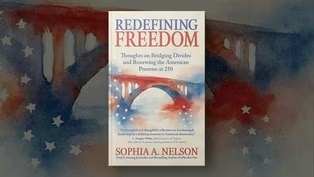
Sophia Nelson on living up to America's founding principles
Video has Closed Captions
Sophia Nelson on 'Redefining Freedom' and living up to America's founding principles (5m 29s)
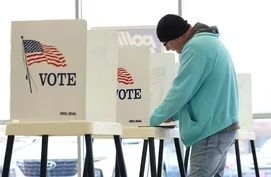
Trump tightens grip on GOP as critics ousted in primaries
Video has Closed Captions
A look at Trump's grip on the GOP as his critics are ousted in primaries (6m 56s)
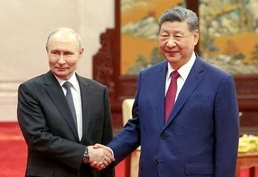
Xi hosts Putin in Beijing, cementing China-Russia alliance
Video has Closed Captions
Xi hosts Putin in Beijing, cementing China-Russia alliance after Trump's visit (3m 49s)
Providing Support for PBS.org
Learn Moreabout PBS online sponsorship New Episode
- News and Public Affairs

Today's top journalists discuss Washington's current political events and public affairs.

- News and Public Affairs

FRONTLINE is investigative journalism that questions, explains and changes our world.
Urban Consulate Presents
 New Episode
 New Episode
 New Episode
 New Episode

 New Episode
 New Episode
 New Episode
 New Episode
Support for PBS provided by:
Major corporate funding for the PBS News Hour is provided by BDO, BNSF, Consumer Cellular, American Cruise Lines, and Raymond James. Funding for the PBS NewsHour Weekend is provided by...