
Kentucky Shakespeare
Clip: Season 31 Episode 11 | 5m 58sVideo has Closed Captions
A Shakespeare in the Park tradition.
As Shakespeare himself once wrote, “One touch of nature makes the whole world kin,” and nowhere is that truer than here, in the heart of Louisville, where this local theater group is bringing his works to life. In Louisville's Central Park, neighbors and strangers alike gather on summer evenings, where something remarkable happens.
Problems playing video? | Closed Captioning Feedback
Problems playing video? | Closed Captioning Feedback
Kentucky Life is a local public television program presented by KET
You give every Kentuckian the opportunity to explore new ideas and new worlds through KET. Visit the Kentucky Life website.
Kentucky Shakespeare
Clip: Season 31 Episode 11 | 5m 58sVideo has Closed Captions
As Shakespeare himself once wrote, “One touch of nature makes the whole world kin,” and nowhere is that truer than here, in the heart of Louisville, where this local theater group is bringing his works to life. In Louisville's Central Park, neighbors and strangers alike gather on summer evenings, where something remarkable happens.
Problems playing video? | Closed Captioning Feedback
How to Watch Kentucky Life
Kentucky Life is available to stream on pbs.org and the free PBS App, available on iPhone, Apple TV, Android TV, Android smartphones, Amazon Fire TV, Amazon Fire Tablet, Roku, Samsung Smart TV, and Vizio.
Providing Support for PBS.org
Learn Moreabout PBS online sponsorship[music playing] As Shakespeare himself once wrote, one touch of nature makes the whole world kin.
Now, this is especially true in the heart of Louisville, where a local theater group is bringing his works to life.
In Central Park, neighbors and strangers alike gather on summer evenings where something remarkable happens.
Let's check it out.
[music playing] [music playing] [music playing] Shakespeare understood the human condition like few others, and some of the themes and the stories are things that still resonate today.
There are a lot of benefits and ways we use Shakespeare that people might not think of.
They might just think in a literary sense.
We do lots of things with Shakespeare.
Kentucky Shakespeare is a not-for-profit theater company based here in Louisville, but we serve the whole state and beyond through education and outreach programming.
And our flagship program is the Kentucky Shakespeare Festival in Central Park.
In 1984, Kentucky Shakespeare Festival was designated the official Shakespeare Festival of the Commonwealth by the state legislature.
For Kentuckians, I really hope that this is a point of pride.
Here we are in season 65 as the longest free non-ticketed Shakespeare Festival in the country.
And that's something pretty special.
Kentucky Shakespeare is the largest in-school touring arts provider in Kentucky.
We go everywhere.
Historically, we've been to all 120 counties in Kentucky and beyond, we're seeing a lot of students.
And for many of them, it's not only their first theatrical experience being with Kentucky Shakespeare, it's their first arts experience.
And when we think about that in an educational setting, we know that the arts are doing everything that we want in the 21st century workforce, right?
It's building collaboration.
It's building teamwork, problem solving skills.
It's building empathy.
So, all of those things that we're looking for in productive citizens, happy citizens, quality of life, the arts are doing that for everyone.
So, these exposures and participation experiences are invaluable.
Accessibility is in everything that we do.
Accessibility from the way that we approach the work.
But we're really about breaking down those barriers to art accessibility.
So, taking away the financial aspect of coming to see art, the geographic aspect.
We're going to be here every night.
There's no barrier for entry whatsoever.
It's important to us that everyone, everyone, everyone gets to experience great art done well.
And Shakespeare is just a part of that.
But it's our part.
So, we try to spread Shakespeare as far as we can.
We do performances, we do education outreach, and we do community programs.
The program that I do spend a lot of time with is our Shakespeare with Veterans program, where we work with military veterans here in Louisville.
Any veteran in the area can come attend this program for free.
We meet weekly.
Again, any veteran, any age, any branch, any gender, everybody can come on in, and we talk to each other.
Sometimes we play some theater games, and we look at Shakespeare text, stories, characters, poetry, all of it.
What they tell me is that they find a lot of power in the universality of the stories Shakespeare tells about human truths.
You know what it feels like to be angry, you know what it feels like to be in love, to want revenge, to want power.
All those things are in Shakespeare.
It's in the text, it's in the characters, it's in the stories.
There's also this absolutely beautiful language using this to really increase empathy, work on conflict resolution skills, expand your vocabulary, expand your emotional vocabulary.
My experiences here and the directors here and the other actors here have always kind of focused on a understanding of the text and then letting the text come through the medium, which is yourself.
Right.
So, that if I'm saying these words to you, I would want you to understand it because I'm trying to convey something to you.
So, as much as I can capture the present in the speech as we're talking is the goal.
When Shakespeare was performing and writing, they didn't have directors.
So, a lot of the stage business is written into the dialogue.
So, it's really learning to pick up on the hints that Shakespeare left because, really, he or they, whoever wrote it, was an excellent orchestrator of dialogue and of drama.
Usually, I try to get to know the character.
I try to think if I were in their shoes, how would I be feeling?
I try to scan the text for any clues that I can find, create, given circumstances that make sense to me.
As far as Shakespeare in a modern age, hopefully, we've done all of our work and the artists and the actors and the directors to really unpack what it means, bring relevance and resonance to it to make it accessible for the audience.
And when you see the breadth of the community here, we have people coming from all over the state and they're all sharing that one common experience together.
There's like you said before, no barriers whatsoever.
It's really a beautiful thing.
I consider Shakespeare's work to be as close to the soul as possible.
You know, it feels really rooted and connected to the human experience and the vastness of the human experience.
This emotion fuels this soul connection that we are able to have the audience, the final cast member, as they say.
So, being able to like have that and communicate with them in a way that is beyond words, it's beautiful.
[music playing]
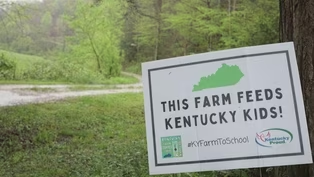
Video has Closed Captions
Clip: S31 Ep11 | 7m 30s | Breathitt County farmers are finding success through progressive practices. (7m 30s)
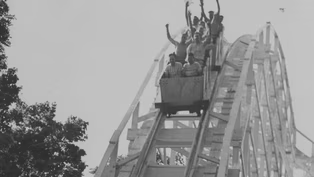
The Joy and Injustice of Joyland
Video has Closed Captions
Clip: S31 Ep11 | 8m 59s | Joyland was a hub of amusement park memories…but it was also shaped by segregation. (8m 59s)
Providing Support for PBS.org
Learn Moreabout PBS online sponsorship










Support for PBS provided by:
Kentucky Life is a local public television program presented by KET
You give every Kentuckian the opportunity to explore new ideas and new worlds through KET. Visit the Kentucky Life website.