
Be the Change: The O'dell Owens Story
Special | 55m 14sVideo has Closed Captions
O’dell Owens overcame adversity to become a pioneering physician and community champion.
Dr. O’dell Owens overcame poverty and personal tragedy to earn post-graduate degrees from Yale and Harvard and become a pioneering physician and a legendary community champion.
Problems playing video? | Closed Captioning Feedback
Problems playing video? | Closed Captioning Feedback
Be the Change: The O’dell Owens Story is a local public television program presented by CET and ThinkTV
Be the Change: The O'dell Owens Story
Special | 55m 14sVideo has Closed Captions
Dr. O’dell Owens overcame poverty and personal tragedy to earn post-graduate degrees from Yale and Harvard and become a pioneering physician and a legendary community champion.
Problems playing video? | Closed Captioning Feedback
Where to Watch Be the Change: The O’dell Owens Story
Be the Change: The O’dell Owens Story is available to stream on pbs.org and the PBS app.
(soft music) (soft music continues) (upbeat music) (upbeat music continues) - [Narrator] So this essay, it's quite a story.
'Bout a black kid, growing up in the ghetto.
Grades?
Not great.
Six siblings.
A mamma's boy.
But mamma dies.
28 years old.
The kid is 12.
Tough times.
So, too predictable?
Well, check this out.
Kid is adopted by family of black super-achievers.
I'm talkin' surgeons, PhD's.
Big brains.
Kid's grades shoot up.
He goes to Yale.
Harvard.
Becomes a medical pioneer.
(laughs) Whoa.
Ridiculous, right?
Urban fairy tale?
Well, truth can be stranger than fiction.
And truth, the truth can be powerful.
- I tell young people all the time, how can calculus or physics been tough when you live the life you've lived?
When you've gone days without eating.
You may not have electricity.
You may not have the best of clothes.
You had no love at your house.
You were teased.
You cried at night.
How can anything that the teacher put in front of you be hard when you've already had that?
I've always told young people, never let your past dictate your future.
But always make it a part of you.
And that's what I've used.
I've used my past to be a part of me.
So I have those tough times in Yale and Harvard.
Nah, can't be.
I've already been.
I already been there.
This isn't gonna be hard.
(upbeat music) (horn honking) - [Narrator] There's a thread that connects people.
That strengthens the fabric of community.
A thread that doesn't fray, snap or come undone.
In this story, trace that thread, you'll find it began in the most unlikely of places.
Here.
Cincinnati.
The West End.
In 1947, when O'dell Owens was born, over 67,000 people lived in the West End.
Most residents were poor and black.
Many of these families came north as part of the Great Migration.
- We lived at 1151 Poplar Street.
We were poor and we knew we were poor, but we still had a good life with my parents.
My mother was very adamant about a clean house.
We all had chores to do, and my mother was known that if anybody needed anything, if the kids were hungry, they would always come to our house for something to eat.
O'dell was a character.
He was always playing jokes.
I found a cigarette, and I lit the cigarette and I was in the kitchen, smoking the cigarette.
And who walks in but O'dell?
And he's just standing there, looking at me, and he's like, "You know I own you now, right?"
Because he was like, "You have to do everything that I tell you to do, or I'm telling mama that you were smoking."
And I was hysterical.
I mean, I was just like, "Please, O'dell.
I'll do whatever.
Please don't tell mama," 'cause I knew I would have been in trouble with both my parents.
And (laughs) he did keep it up for a minute, until I realized that he wasn't going to tell.
But he was always, he was a mama's boy.
Whatever he could do for my mother, he would always do for her.
- When you think about Dr.
O'dell Owens, you really can't just go straight to his accomplishments.
You have to go to where he began.
And for me, I really believe what makes a great leader is not what they achieve, but what they had to overcome to achieve it.
(soft music) - O'dell already had challenges to overcome, he didn't need another one.
But on a summer night in 1960, his world changed forever.
- O'dell had something of an argument, a tiff, a disagreement with his mother.
- [Narrator] He wanted to go see a friend.
His mom said, "No."
O'dell went anyway.
Uncharacteristic.
- And that was the last interaction that they had.
Because after the disagreement, O'dell was not at home when she had a heart attack.
(siren wailing) - Death hits people all in different ways, but it was really hard on O'dell.
He just always felt that, when my mom, when my mom, the night that my mom died he always felt that if he had been there, that he would have been able to save her.
- And it was something that weighed on him a lot, and something that inspired him to always be open about his emotions with people and tell them that he loved them in virtually every interaction, because he had an acute sense that any interaction with one of his loved ones could be the last one.
(water dripping) - We all went through things that we never would have gone through if my mother had still been alive, because she was the rock.
But that was hard times after that.
Hard times.
(soft music) - [Narrator] For people living in the West End, more hard times were coming.
These photographs document the death of a neighborhood.
Doomed homes.
Doomed businesses.
The interstate highway system was being built and Cincinnati needed to choose a corridor for I-75.
With heartbreaking predictably, the construction tore through the West End, breaking up the community.
- And that seems to be the story.
It's been hard for African Americans, Black Americans because once they start building community and think that they're able to move forward, then there's always some change that happens where they have to start over.
- [Narrator] So after losing their mother, they lost their home.
Displaced, the Owens family moved to a house in North Avendale.
That instability followed O'dell into the classroom.
(tense music) - Your mom is gone, your dad is going through stuff himself, and I knew his grades weren't good.
I knew that.
- [Narrator] And the people who were supposed to be helping, weren't.
- In the ninth grade I was told by a college counselor, after flunking out of Walnut Hills, that I was too poor and too dumb to go to college.
I need to take a class in shop.
That's what I want young kids to understand.
No one should put you in a box.
No one should write you off.
(car engines humming) - [Narrator] Life threw a lot at this kid, but O'dell didn't break.
In his new home, O'dell became close to family in the neighborhood.
A very special family.
- He was our favorite babysitter.
He developed a bond with, I would say, my mother in particular.
And he was actually very much inspired by my father who was a physician.
And my father took a lot of interest in O'dell.
It was obvious to my parents that he was very talented, very smart, energetic, and someone who clearly had ambition as well.
- [Narrator] Niecy Clement and her sister Linda Clement-Holmes are the Buford's cousins.
They both knew O'dell.
- The Buford family and the extended Clement family was all about education, and encouraging students like O'dell to continue their education.
So that was the environment that he came into, which is the environment that I grew up in.
- And it was education that literally rescued the entire family.
Both of my parents were survivors of Southern apartheid, particularly my mother who grew up in Paris, Texas, where her family were sharecroppers.
And segregation was particularly brutal, and brutally enforced to the point of lynchings.
She and all of her siblings, went on to college and postgraduate school.
And education was just a very important part of my family.
- [Narrator] Education as a means to escape violence and rise above circumstances.
That was a lesson O'dell would not forget.
His own high school experience started to take off.
Grades improved.
He became active in school.
But then, a change of plans.
- His father had become a single parent, raising a number of children.
- He realized that he needed help.
- And so my grandmother in Detroit told my father, "Why don't you move to Detroit with the kids.
O'dell can finish high school up here and get a good job with Ford on the line."
And that was my destiny.
But a family, a black family, that I had been their, I was their babysitter, their grass cutter, their snow removal, their caddy, said, "You got potential."
And told my father, "Let O'dell stay with us."
And he was a physician.
She was a social worker.
- [Narrator] Detroit would have to motor on without O'dell Owens.
- He was not coming.
He wasn't doing that, period.
It didn't cause any friction between O'dell and I, but I wanted to stay, but my father was like, "No.
You have to go."
I hated it.
I missed my brother, and I missed my friends and family that was here.
O'dell and I were always very close, always.
I didn't see him as much as I would have liked to, but he was a good, big brother.
- [Narrator] Having been welcomed into the Buford family, O'dell had two new brothers.
- I can recall a story where all the kids were racing and I guess I did pretty well racing and the teacher literally asked me, "Where did you learn to run so fast?"
And I can recall telling her that my brother taught me how to run on my toes and to run so that I could cut through the air.
And it was O'dell who had showed me one day that, "Here's how you can run faster than the other kids."
And it was very real and that was my advantage and that would be my superpower going forward.
In every sense of the word, he was my brother.
And that's how it was for the rest of our lives.
- [Narrator] O'dell's burgeoning interest in medicine was enthusiastically nurtured.
- He got to see the medical field from the inside with my uncles.
He could go on rounds with them, learn how they function as doctors.
He was encouraged to continue his education by my aunts and uncles.
- When you live in a house with the first black surgeon of Cincinnati, your stepmother is a community figure who's, one of her best friends was Coretta Scott King, and you have siblings who were excelling in school and going off to law school, it makes a great impact.
And he is a competitive type of guy, so he wanted to make sure that he wasn't kind of the runt of that family that he had to compete with the Calvin and Howards in that family.
- [Narrator] O'dell found another role model right on his street in North Avondale.
The "Big O", Oscar Robertson played at the University of Cincinnati and would go on to be a 12 time NBA All-Star.
- Oscar became a mentor to O'dell, someone who O'dell truly looked up to.
A lot of people looked up to Oscar, literally and figuratively, but O'dell was, he worshiped Oscar.
Let's just put it that way.
He worshiped Oscar.
(light music) - [Narrator] O'dell Owens was flourishing.
But in his senior year at Woodward High, he learned a lesson that wasn't in the textbooks.
A lesson about being black in 1960s America.
- He was invited to be in an advanced class in his senior year.
And there was a white student, a girl who came in and took a couple of steps, her eyes locked in on O'dell and she said, "I must be in the wrong class.
There's a Negro in here."
And she turned around and walked out.
And that really woke him up.
He said he was stunned.
And he said, "She's talking about me," because he was the only one in there.
And he sat up straight in his chair, he said, and that really turned him around.
I mean, that was a part of what drove him for many years afterwards.
So yeah, these are things that shape us.
♪ 'Cause you take me as I am ♪ (upbeat music) - [Narrator] In the fall of 1966, O'dell Owens was enrolled at Antioch College in Yellow Springs, Ohio.
- Freedom!
- O'dell came of age during the '60s.
He was shaped by the various movements that occurred at that time and an awakening among black youth.
- When I went to college, the first week, the biology department had a meeting with all the students that wanted to go to medical school to tell them what courses to take, when to take them, when to apply to medical school, what medical schools would take kids from Antioch, and what was your grade point average.
At that time they said, "Hey, from Antioch, if you have at least a 3.3, you're gonna get into medical school because they respect our curriculum."
So, as everybody was walking out, I was the only African American in the room, the professor grabbed my arm and pulled me back into the room and said, "Of course, you, are gonna need at least a 3.4 or higher and some of these schools are not going to take you."
It was really a part of our generation, as an African American, that you knew that you had to be a little bit better in order to get the same level of recognition.
And O'dell was motivated by that, so he did work twice as hard.
- Things like that lit a fire under him, and that's just what made him even more successful.
He would tell me at Antioch he lived in a shack and he just said, "I just worked hard and hard."
He wanted to be the best.
(keys clicking) Because he knew that there was people looking at him that probably said that he didn't belong there.
- [Narrator] That meant leaving nothing to chance.
And finding creative ways to stand out.
- I chose to go to Africa my third year of college because I knew that going to Africa, being a student there was going to help my resume.
Wasn't my great power of Africa or black power or any of that during that time period, it was I had to stand out just to be equal.
And indeed, when I went from my medical school interviews they all, "Oh, you lived in Africa.
Tell us about that."
And I had great stories.
- At the university where he studied, he actually became the star of that basketball team.
- He used to tell me all the time that he scored 63 points in a game.
And it was all from the three point range because he would tell me that Africans tend to hack you really bad if you go inside.
So he thought he was the Stephen Curry of Africa.
- [Narrator] The Ugandan National Team was next on the schedule.
Idi Amin, the notorious dictator of Uganda, was proud of his undefeated team.
- And he got a message from Idi Amin's people saying, "You better not win this game."
- They had to tell him that my father would be executed.
- He says, "You got to know when to hold them, when to fold them, when to walk away and when to run."
- [Narrator] The Ugandan National Team remained undefeated.
O'dell returned to Antioch for his senior year.
His hard work paid off.
Next stop: New Haven, Connecticut.
O'dell Owens had been accepted to Yale.
- So when I got to Yale, it was, "Oh, are you here because you're black?
Or are you here because you're smart?"
- [Narrator] O'dell answered that by earning two post graduate degrees at the same time.
One in Medicine and one in Public Health.
But, for O'dell, that wasn't enough.
- I was president of my class at Yale.
Captain of the medical school basketball team and I was on the board of trustees of Antioch College while I was a medical student.
So the attitude was now, okay, either your stuff is raggedy, if I can do all this.
Or maybe I do have some smarts.
- [Narrator] At Yale, O'dell did a four-year residency in obstetrics gynecology.
His performance earned him the Irving Freeman Award as the best chief resident.
Then, it was on to Harvard where he was awarded a fellowship in reproductive endocrinology.
What he did there is still talked about today.
- One day the residents came to me and said, "Hey, one of our fellow residents, a woman, has a pregnancy in her fallopian tube."
And that's where you have to operate very quickly, because if it bursts, she could die.
So they said, "Look, she's concerned that she's going to have an abdominal incision.
The tube is gonna remove.
It's gonna cut down her chances to future pregnancies with only one tube and she's gonna miss six to eight weeks of work.
But we know that at Yale you were taught how to do a procedure through the belly button.
That could save her tube and she only misses work for two days.
Will you operate?"
I said.
"I'll do it."
Had never been done in Boston.
Haven't been done at Harvard.
So I go, I operate, save the fallopian tube.
She's outta work two days.
10 weeks later we do a dye test, the tube is open.
No more questions about O'dell Owens.
(soft music) - [Narrator] This was the kid from the West End.
The kid who wasn't college material.
When he was at Yale, O'dell married Marchelle Kay Hall.
They started a family.
When the Harvard fellowship was completed, Dr.
O'dell Owens was one of the top in vitro fertilization specialists in the country.
He and Marchelle could have gone anywhere.
Instead, they came home, to Cincinnati.
He's fame was spreading, especially among black physicians.
- The first time I'd ever heard about Dr.
Owens was when I was doing my residency at Wayne State University in Detroit.
I knew that there was this sort of phenom by the name of O'dell Owens who was here who actually started the program at the University of Cincinnati.
And he was one of the first African American reproductive endocrinologists because there weren't that many.
He probably was one of four in the whole United States at that time.
- [Narrator] Dr.
Owens was a pioneer, and not just because he was black.
In 1982, in vitro fertilization was new and cutting edge science.
Very few people had the skills and training to make it work.
In fact, there were doctors in Cincinnati attempting IVF procedures who had no specialized training at all.
All their efforts failed.
And suddenly, Cincinnati was on the cutting edge.
- When he got the first one, the first successful in vitro fertilization in the city, we were so excited about that.
The city was excited.
And O'dell had the best sense of humor.
He said, "Yeah, I got the first test tube baby.
It's a womb with a view."
- [Narrator] Two years later and more headlines.
Cincinnati's first successful birth from a frozen embryo.
- I always thought my dad was a big deal.
But after he did that, he was on Sally Jessy Raphael and Donahue and all these talk shows.
And people coming to me saying, "I saw your dad on national TV."
- One of the things that patients wanted, especially after hearing about this breakthrough procedure was to try to find a way to find someone who had the skills and knowledge that they were reading about in Time Magazine and Life Magazine and Dr.
Owens was that person.
The best and brightest in Cincinnati at that time was this African American man and some people embraced that and some people were leery of that.
- I heard Dr.
Owens speak.
And I thought, "That is the person I want for my doctor."
And so we made an appointment and met Dr.
Owens.
And it ended up being almost a 10-year journey.
- My husband and I were married in 1985.
We had talked strongly about having a large family.
So we tried for two years and I had a miscarriage and my gynecologist suggested that I see Dr.
Owens.
The process took four years just because I had endometriosis and he had to do a total of seven operations.
- There's medications, there's procedures, there's surgeries, there's monthly ups and downs, which are very challenging.
And to the general public, you look like a well person.
It's not life-threatening or anything, but it's very emotional, and it is hard for people to understand that.
- Every time I would go to each appointment, Dr.
Owens would say, "I feel like we can get there.
I feel like we can get there."
So it was his confidence and that handshake held a lot of power.
- When I was growing up, our phone systems had to have a second line because these women would call him in the middle of the night.
(soft music) - I just always had him in my mind as this large teddy bear because he was so soft spoken and you never left his office without him shaking your hand and saying, "We've got this."
- He was very compassionate.
And I'll say that he helped me through some of the most significant events in my life.
Two of those were the two days, two different times, where he got to call me and tell me I was pregnant.
And that was such a thrill and so wonderful.
The pregnancies were four years apart.
But then I lost both pregnancies and it was devastating.
- [Narrator] Eventually, Julie and her husband, Chuck, decided to stop treatment and move forward with their lives.
- Despite all the sadness and hard times in going through treatments, there are some pluses about it, just meeting Dr.
Owens and remaining friends with him through the years.
- [Narrator] 30 years later and Dr.
Owens never stopped caring.
- Even through COVID, Dr.
Owens would call once in a while to check on Chuck, because he knew he had a compromised immune system.
"What are his numbers?
Tell me what's going on," and wanted to make sure that we followed protocol.
I think he's one of the most remarkable and inspiring and compassionate people I've ever met.
- My daughter's name is Allison Price.
She's 34 years old.
She ended up being a family life counselor.
Dr.
Owens was so talented.
He left a piece of him and his caring spirit with everyone he talked to.
He was just a special human.
- Losing his mother at that early age was a big impact on his life.
He went into medicine.
Of all the fields, he went into OB-GYN and infertility.
So he had a mission to enhance and better women's lives.
(bell ringing) - [Narrator] In the race to monetize championship genetics, in vitro fertilization actually started in the animal world.
But there were other less profit-driven applications.
(people chattering) - The Cincinnati Zoo's in the in vitro fertilization business.
We're one of the leading reproductive biology programs at any zoo anywhere.
- [Narrator] In the early 1980s, the Cincinnati Zoo launched their research department.
They called it the Center for Conservation and Research of Endangered Wildlife, or CREW.
O'dell was happy to be involved.
- I first met O'dell Owens in the early '80s when he was willing to help the Cincinnati Zoo and our early-on efforts in reproductive biology.
He helped a lot of people, including friends of mine, have babies who couldn't.
Well, the zoo does that same thing with endangered species.
He was more of an expert than the scientists from the zoo that ran that program, because he knew a lot of the hurdles we might face and help them prepare for that.
Beyond that, he was a great leader.
His voice, his swagger, and people follow swagger.
They do.
And when he would say, "I know we can accomplish this," it meant something.
- [Narrator] They did accomplish something.
And it was huge.
- We ended up having the world's first test tube gorilla born at the Cincinnati Zoo.
- And still the only lowland gorilla pregnancy through in vitro fertilization.
- [Narrator] O'dell's protégé, Dr.
Michael Thomas, assisted on the project.
- I have a picture of myself with that baby gorilla who ended up growing up in Omaha and having babies of her own.
- Just remarkable stuff.
And O'dell Owens helped us accomplish those things.
(soft music) - [Narrator] It had been a long time since that white student walked out of O'dell's high school class.
But the world had changed.
Or had it?
- So I come back home to Cincinnati.
All this training behind me, only to have whites walk into my office, see I was black and walk out.
I was the only reproductive endocrinologist in the city for three years.
You can't find many with three degrees from Yale and one from Harvard.
May not exist.
All those days of stayin' up.
All those surgeries.
All those readings.
All those passing of all those exams.
Ready to give back to my city and people walk in and say, "Oh, he's black."
And walk out.
But I told my staff, I said, "You know, don't get upset.
Let us rejoice in the patients who have faith in us.
I never let people try to pull me down.
Because I truly, truly embrace my oath as a physician, that I lead with empathy and compassion.
- [Narrator] O'dell Owens was about to try a new way to lead with empathy and compassion.
After serving Cincinnati for 20 years, he walked away from his medical practice.
Dr.
Owens was well known and well respected.
Rumors swirled about his next move.
- When O'dell decided to run for coroner, I was incredibly surprised, I was shocked, and I said, "Why?
(laughs) Why would you want to willingly do that?"
Odell explained to me he felt he could have an impact on what was going on in our community.
And that made total sense to me.
- And so he puts this campaign together.
And people really got behind him because of his reputation.
In typical Dr.
O'dell Owens fashion, he was able to bring people together, cross party lines.
- [Narrator] And that included physician, Iraqi War veteran and U.S.
Congressman, Dr.
Brad Wenstrup.
- Before I actually met Dr.
Owens, I admired him but I never really knew him until he ran for coroner and and I'm like, "You know, we're on different political parties, but I'm voting for this guy."
He's going to use this platform, not just to pronounce people dead and do autopsies, but actually to educate and improve our community.
- During his campaign for the coroner's office, his opponent put a billboard out of African American men who were violent ex-felons and put the caption, "You vote for him, this is who he's representing."
And it was eye-opening.
And unfortunately for that opponent, it was the wrong message and he got destroyed in the election.
He said, "There's always going to be people like that, but the good outweigh the bad and all you can do is just be the best at who you can be and keep moving forward."
(soft music) - [Narrator] Dr.
Owens didn't run for personal glory.
He ran because his city was in a bad place.
- In the 2000s, Cincinnati was coming out of very difficult racial tensions.
And as you've seen in other cities around the country, when you have those kinds of antagonisms it often results in years of higher crime rates, homicide rates, shootings, violence, which then creates a series of tragedies for families, a cycle of violence, reprisals.
And too often, especially in lower income and African American communities, the loss of life is not treated with the same importance as people from more affluent parts of our community.
And so having someone as famous and accomplished as O'dell Owens highlight the death and tragedy and the grieving mothers and siblings of people gunned down in the streets, elevated for all of us in elected office, the need to treat every life equally.
Now, we didn't always live up to that goal, but he was the prophet calling us to do so.
- [Narrator] And the prophet told some hard truths.
- [O'dell] I keep hearing people say, "Oh yes, we're going to deal with these issues with collective impact."
Cincinnati does not have collective impact.
You cannot have collective impact until you have collective will.
You talk for some of these inner city kids, they'll tell you, "By the time I'm 21, I will be dead or in jail.
(siren wailing) We haven't given them a reason.
We're always telling them to say no and we haven't given them a reason.
You're smart people.
Let's do something different.
It's on you, not the kids.
They're the future, but they have no future.
(siren wailing) - All of a sudden he brings the coroner's office to the people, and he starts to educate.
And then he does something that's so non-traditional.
I was the vice-mayor and he said, "Let's hit the streets.
Let's have a challenge.
We're going to do one day of no killing."
He said, "Let's have the press conference at the funeral home, and let's have everyone who lost someone, in honor of the person that you lost, we're going to have no killing on this day.
This is their memorial."
And so we went, we had the press conference, then we had to hit the streets.
And we would talk directly to them.
I will tell you that that day, there was no killing on that day.
- [Narrator] O'dell believed education could free people from violence.
It's the lesson he learned many years ago from the Buford family.
- The majority of the shooters didn't finish high school and the majority of the victims didn't finish high school.
And studies have shown that if you raise your graduation rate just 10%, you lower your felonious assaults, homicides by 20%.
- I believe he spoke at almost every high school in Cincinnati.
He would throw a body bag right at their feet and say, "This is what happens when you join a gang.
This is what happens when you deal drugs.
This is what happens when you drop out of school."
- He told me the first time he saw a young teenager, a 16-year-old who had been shot and killed, lying in the street and his body still twisted and showing the signs of that kind of violence.
He was very emotional about that.
He was really devastated by seeing that.
And I think he knew that that could have been him in a different circumstance.
(siren wailing) - I recall an occasion when he was coroner, there was a murder in Over the Rhine.
There was a 19-year-old young man who was shot in the middle of the afternoon, and O'dell shows up as the coroner.
Now, the traditional coroner would be interested in addressing that from a crime perspective.
What is my role as a medical scientist to help solve the crime?
O'dell saw it more holistically, and so, he said to a police officer, and I could remember him relating this story to me, "Well, what do the witnesses say?"
And there was 50 or 100 people gathered around.
Sunny day, nice day and the answer from the police were, "Nobody saw anything."
And O'dell, in his way, he flipped out, but that doesn't mean he lost control, but he was angry.
And so, he flashed out to the community and basically his message was... - We as a community must come together and put an end to this.
People that are harming our society must be put away.
And put away for long enough time that they can no longer be a danger to our community.
This has to stop.
- And the result of that was two or three people did come forward, identified the shooter who was arrested and then the criminal justice system took its place.
O'dell saw that as very frustrating.
He tried to bring to that role an element of healing to the community, and he tried as hard as any one human being could.
And I think he had an effect, but it's a very, very difficult job to change culture.
- No one had ever, in my knowledge, anywhere in this country, thought to use that role as a way to talk about reduction in gun violence.
- When you looked around the whole country, there was no coroner like Dr.
O'dell Owens.
- [Narrator] After two terms as County Coroner, Dr.
Owens was ready to try a new way to impact the community.
- You couldn't put him in one lane and expect that he was going to stay there.
- I thought O'dell should become mayor of Cincinnati because I could think of nobody who could do a better job, who would understand the economic issues, and most importantly, could gain the trust of people.
I said, "I'll tell you what.
I'll be your finance chair."
And he'd say, "You can't do that."
I said, "Why not?"
He said, "Because you're a Republican, and I'm a Democrat."
Now, back when we were having these conversations, that wasn't as vitriolic as it is today, people got along a little better, but he wanted no part of that.
- [Narrator] O'dell left politics and entered academia.
- I actually got to know Dr.
Owens personally when he interviewed for the presidency of Cincinnati State.
Right away, I saw that he was a bold leader.
He had a question for executive team.
He said, "If I become president, should I keep you?
How will I know if I should keep you in your jobs?"
And we all were silent.
- [Narrator] Dr.
Owens wanted to build an economic pipeline, that quickly moved students from the classroom to employment.
- He started looking at all the careers, because you had corporations that said, "We have a void.
We need people in these areas, but we don't have them ready to go."
So what he did was, I was president of the Ohio Legislative Black Caucus.
I was a state representative, and he says, "Reece, I'm coming up to Columbus and I need you to be in this meeting."
And the governor had invited me to this meeting, and he proposed to the governor that we need to change and put an emphasis on the two-year and technical colleges, and that we need to focus on the certificate programs so a person could come and get certified and get back in the marketplace.
It became the focus of the governor's initiative, and companies started testifying that, yes, this is what we need.
So he didn't just change it for Cincinnati State.
He changed it for technical college, two-year colleges across the whole state.
- I have nothing against a four-year degree.
I have three of them, and there's a lot I can do in the operating room.
But I can't build that operating room, I can't make the equipment, and I can't make the lights go on.
And really it's about creating opportunities for people that don't normally have them.
- He was passionate about helping people who were underemployed, unemployed, those living in poverty.
In the cafeteria, he would buy students lunch.
He even wanted to have a conversation at one of our executive team meetings about how to make the food and the cafeteria more filling and more affordable for students.
Not every president thinks in that manner.
(upbeat music) Dr.
Owens could connect with anyone.
He would wrap his message in a way you could understand and appreciate.
Whether that meant a song and dance video for university students... (upbeat music) - Go Cincinnati State.
- [Narrator] Or meeting with United States Congressmen.
(plane engine roaring) - When our team would go to Washington, DC to meet with legislators, typically you have to wait.
You're sitting in the hall or somewhere waiting for their assistants, their staff, to say, "Okay, your time."
But when Dr.
Owens went to DC, the legislators would come out in the hallway, find him, and greet him.
- Even while I was in Congress, we'd get together for breakfast on a pretty regular basis.
We were just two Americans trying to make things better for our country and our community and using our backgrounds in health to be able to do that.
- [Narrator] And for O'dell, making things better started with education.
- The vast majority of people who go to Cincinnati State are first generation college students learning a trade, learning a skill.
And with a degree from Cincinnati State, they're able to really break into the middle class, And O'dell Owens was the perfect inspirational leader of Cincinnati State to say, "Hey, if you want a piece of this American dream, this is a place for you, and this is a place where you will be welcomed."
- [Narrator] O'dell Owens was someone you wanted on your team.
Many organizations recruited him to join their Board of Directors.
- Preschool Promise, Cincinnati Zoo, Fine Arts Fund, I can't even name you all the boards that he's been on.
He was just sought after, not because of his name, but because of what he did for Cincinnati and his passion around building a better community for this city.
- [Narrator] For 29 years, O'dell Owens was on the Board of Directors for U.S.
Bank.
- It isn't too many board members that really stay on a board over 20 years in a public company.
It's got to be that you have something to offer and that your fellow board members see that of value and respect it and want you there.
Dr.
Owens and I both served on the U.S.
Bank board and we became very close friends over 25 or 30 years.
My first impression was, "Why is this guy here?"
I assumed he knew nothing about business, and he knew nothing about banking.
And what I learned was he's an incredible individual who could do anything he wanted.
He's very smart.
He was very studied.
And he was interested in the community.
O'dell was always looking at it from the standpoint of how it affected people.
(soft music) - O'dell was on the board of the Cincinnati Zoo for over 10 years and then later worked as an advisor in our science program.
So his direct involvement at the zoo on a steady basis was over three decades.
He loved to tell a story about when he was a boy growing up in the West End.
He couldn't go to Coney Island, because it was segregated in the '50s and '60s, but he could always go to the Cincinnati Zoo, and he held that up.
But he also was an honest guy, and he would call us out.
He'd sometimes call me and say, "Thane, why do I only see blonde people in your advertisements?
The zoo's for everybody.
It's the Cincinnati Zoo."
One of my favorite memories of O'dell was a serious one.
We were reworking our mission statement, from about 50 words down to just a few.
And we were talking about wildlife, and we were talking about conservation, and we were talking about education, and we're at a board meeting.
In his booming voices he says, "Wait a minute.
This is the Cincinnati Zoo.
I don't see anything about the community, and Cincinnati's right here in Avondale, and you need to do something with this community."
And that was calling us out.
The zoo's the biggest draw in the city.
It's the biggest draw in the county, but we are also right in an urban neighborhood.
So as a direct result of that, we included the word "serving community" in our mission.
And, the Cincinnati Zoo, since that time, has grown to be the most involved in the community of any zoo anywhere.
People come from other zoos from Cleveland to Seattle, and they're like, "I cannot believe you do everything you do in the community."
The secret is we're a botanical garden, so we can't let the animals out, but if you've not been to Rockdale Academy, which is right around the corner from the zoo, they have the most remarkable urban learning garden anywhere in the world at an elementary school.
It's a million-dollar garden.
Now, we didn't have the money, but Procter, Kroger, Cincinnati Children's, they provided the money.
O'dell Owens was a force.
There's no doubt about it.
- O'dell would say things like, "If you want to bring about change, you have to show up.
You have to be there."
- [Narrator] It seemed like O'dell was everywhere.
ALS Ice Bucket Challenge?
Of course.
O'dell's Bells rockin' the Salvation Army every December?
Check.
And his deep passion for childhood literacy led him to be the volunteer chair of the CET Action Auction for 12 running.
(upbeat music) - [Narrator] He knew a day would come when he couldn't be there.
He had to prepare others to carry the torch.
- He understood the road that they would have to travel, the ups and the downs.
And so he wanted to be there just to help push them.
To use his talent, his influence, his abilities to help them.
And a lot of times the people didn't necessarily go to him and say, "I need you.
I need you."
He would watch and watch.
And if he felt you were serious, you were committed, he would volunteer himself to help you.
O'dell Owens mentored people in many different organizations, but Cincinnati Preschool Promise was especially close to his heart.
He knew the challenges of growing up in poverty.
(soft music) - [O'dell] I read in The Enquirer week ago or so.
They talk about the attendance rate at Cincinnati public schools, a school system of 33,000 students.
A school system where 72% of the children are at poverty level, 72% at the poverty level.
And 50% of the black children at CPS are missing 10% of the year.
How many times we got to talk about this?
The true salvation right now is Chara and the Preschool Promise.
For those who don't know what the Preschool Promise is, the preschool promise is a program where we try, and I say we because I chair the board, where we try to get children three and four into quality preschool.
Not daycare, preschool.
- Dr.
Owens became a mentor for me when he stepped into the role of chairperson of the Cincinnati Preschool Promise.
We set up weekly meetings, where every week he would spend an hour with me, saying, "This is what we need to talk about, and this is what we need to do."
Every single one of those conversations started with first, "How is your family and how are you doing?"
I think it will be well attended.
It is our annual meeting... We would always get to the business, but he was very intentional about making sure I was okay as a person and a leader so that I was able to do the business.
That is not just someone who is your boss, who is your leader, who is your supervisor, that is someone who is invested in your leadership, and you as a person, and that's the best type of mentor you can have.
- [Narrator] Wrapped up inside that warm, caring attitude, were razor-sharp lessons, forged from decades of leadership.
- I can remember after my first year performance evaluation, he said, "You have too many goals.
I don't think you've ever met a goal you didn't like.
You can't be good at everything, so pull it back.
Think of five things that you want to accomplish that drive our mission and we will support you in doing that."
- [Narrator] O'dell's support and mentorship could be a game-changer.
- When I decided that I was running for county commission, and some said, "It can't be done."
Dr.
O'dell Owens was the first to come forward and said, "You're going to do it.
You're going to win, and I'm going to be the first person with a check now to get you started."
He was not my political advisor, he was like family to me.
He cared about me as a person.
Last message he ever sent me was that, "I'm proud of you," and, "Keep fighting!"
You have a lot in front of your name, a lot behind your name, but he said, "Listen to your mother when she told you, all you got is your name."
(baby babbling) - [Narrator] O'dell Owens brought life into this world.
But the mission never ended there.
- [O'dell] Last night a child went to bed because they were hungry.
Not food insecurity where people want to hide the issue, the child was hungry.
We have the money to feed the poor.
But as I said, for many years, that's not enough.
We need to feed them hope and encouragement.
Hold them in empathy and compassion, and shelter them against despair.
- [Narrator] O'dell loved his city.
And his city loved him back.
But beyond these outward displays, the truest love for Dr.
O'dell Owens can be found in the hearts of those who knew the man.
- O'dell never forgot, never forgot where he came from or what the struggle was.
So he always, he always looked back to take care of us.
- He just did so much to lift people up and accept them where they were.
He made everybody feel like somebody.
- He was planting seeds wherever he went.
- Observing him and how he moved in the world was just as valuable as anything that he told me directly on what to do and how to act.
- By him being that guy, it opened up the door for this guy.
- He was the most unselfish person I've ever known.
- I miss Dr.
Owens.
Boy, did he carry a baton for us.
O'dell Owens was there for Cincinnati when we needed him.
- A lot of times when you're in leadership, and particularly if you are a black woman or a black man, it's a lonely place.
But Dr.
O'dell Owens had been in these lonely spaces.
He went there and made a difference.
It can't end with Dr.
O'dell Owens.
(soft music) - You're right.
It can't end with Dr.
O'dell Owens.
No.
No it can't.
(traffic humming) (soft music) (upbeat music) (upbeat music continues) (upbeat music continues) (upbeat music continues) (upbeat music continues) (upbeat music continues) (upbeat music continues) (light music) (light music continues)
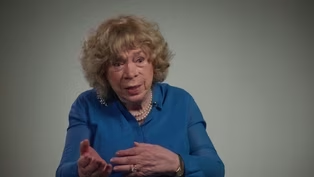
Featurette: Dr. O'dell Owens' Spirit of Giving Back
Video has Closed Captions
Friends and acquaintances of Dr. O'dell Owens recall his community contributions. (4m 39s)
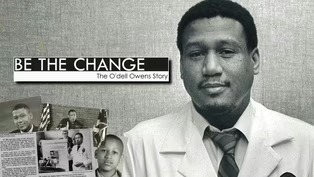
Be the Change: The O'dell Owens Story
Video has Closed Captions
O’dell Owens overcame adversity to become a pioneering physician and community champion. (30s)
Providing Support for PBS.org
Learn Moreabout PBS online sponsorship New Episode
- News and Public Affairs

Top journalists deliver compelling original analysis of the hour's headlines.
 New Episode
 New Episode
 New Episode






 New Episode

Support for PBS provided by:
Be the Change: The O’dell Owens Story is a local public television program presented by CET and ThinkTV