
August 4, 2026 - PBS News Hour full episode
8/4/2026 | 57m 46sVideo has Closed Captions
August 4, 2026 - PBS News Hour full episode
August 4, 2026 - PBS News Hour full episode
Problems playing video? | Closed Captioning Feedback
Problems playing video? | Closed Captioning Feedback
Major corporate funding for the PBS News Hour is provided by BDO, BNSF, Consumer Cellular, American Cruise Lines, and Raymond James. Funding for the PBS NewsHour Weekend is provided by...
August 4, 2026 - PBS News Hour full episode
8/4/2026 | 57m 46sVideo has Closed Captions
August 4, 2026 - PBS News Hour full episode
Problems playing video? | Closed Captioning Feedback
Where to Watch PBS News Hour
PBS News Hour is available to stream on pbs.org and the PBS app.
Providing Support for PBS.org
Learn Moreabout PBS online sponsorshipAMNA NAWAZ: Good evening.
I'm Amna Nawaz.
GEOFF BENNETT: And I'm Geoff Bennett.
On the "News Hour" tonight: A man suspected of starting a wildfire in Washington state is arrested as the blazes continue to rage.
AMNA NAWAZ: But, elsewhere, artificial intelligence is helping to stop fires before they get out of control.
BRENDAN FINNEGAN, West Metro, Colorado, Fire Rescue Assistant Chief: Having those eyes that can alert us well in advance of potentially a 911 call really make it a valuable tool for us.
GEOFF BENNETT: U.S.
attorney Jeanine Pirro and President Trump at odds over her decision to drop charges in the D.C.
Reflecting Pool case.
AMNA NAWAZ: And the president offers paid early access to his social media posts, raising questions of insider trading.
(BREAK) GEOFF BENNETT: Welcome to the "News Hour."
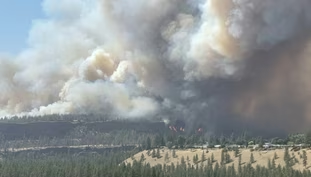
Firefighters in Eastern Washington are still struggling to gain the upper hand on the wildfires devastating the Spokane area.
The three blazes, collectively known as the Spokane Complex Fire, have forced tens of thousands of people to evacuate and destroyed more than 700 buildings.
AMNA NAWAZ: Last night, authorities arrested a 37-year-old man suspected of starting one of those fires, the Old Trails fire, considered to be the most destructive.
Police caught the suspect after a tip from a member in the community.
The suspect, who went to prison in 2010 for killing his father, has denied setting the fire.
Now, residents like Kami Fehlig who are now seeing the total loss of their homes, shared how quickly they had to get out.
KAMI FEHLIG, Fire Victim: About 30 minutes before it jumped the river, my husband and I were seeing how bad it was, and we told the kids, "We don't want to scare you, but we think you should start preparing, to grab some things."
And I grabbed my wedding album, I grabbed the kids' baby books, and within a few minutes, the power went out.
And it was, go now.
Go now.
AMNA NAWAZ: For more on this, we're joined now by Dave Upthegrove.
He's the commissioner of public lands for the state of Washington.
Commissioner, welcome to the "News Hour."
Thanks for joining us.
DAVE UPTHEGROVE, Washington State Commissioner of Public Lands: Thank you.
AMNA NAWAZ: So before we get into more details about the fires, is there anything else you can tell us about this arson arrest?
It's been reported the suspect here, a man named Aaron Farinacci, was contacted by law enforcement about two fires last year, was never charged in relation to either.
But had officials always suspected that this Old Trails fire was intentionally set?
DAVE UPTHEGROVE: The cause of the fire is still under investigation.
The Spokane County Sheriff's Office is leading that investigation, so I will let them speak to the facts of the case.
But what I can say is this.
If someone intentionally started a fire that endangers homes, lives, and firefighters, then that is an incredible betrayal of this community, and they absolutely need to be held accountable under the law.
But whether this fire proves to have been started intentionally or not, the story that I hope people remember are the thousands of community members who have responded with compassion and courage.
One individual doesn't define this community.
The way the community responded has.
AMNA NAWAZ: What can you tell us about the current status of the fires in and around Spokane?
Has there been any containment so far?
DAVE UPTHEGROVE: I have spent the last few days on the ground in Spokane meeting with firefighters on the front line and with impacted families.
And our instant command team is making meaningful progress, but there is a lot of work to do.
It's still a very dangerous situation.
It's also worth noting this is one of 16 major fires burning in Washington state right now.
We have about 250,000 acres currently on fire.
We have 5,000 people responding to these wildfires from more than a dozen states, from Florida to Alaska to the nation of Australia.
It really is a heroic effort, not just around the city of Spokane, but throughout the state.
AMNA NAWAZ: Can you put that number in context for us?
The 16 fires burning right now, the scale of the damage you have seen so far, how does that compare to years past?
DAVE UPTHEGROVE: This is one of the worst fire seasons in decades.
We have burned well over half-a-million acres of the state so far this year.
And this could go on to become a historic fire season in the Pacific Northwest.
We have some extraordinary weather conditions.
We have the confluence of fires in other parts of the country really putting strain on the resources.
But, at the end of the day, behind each of these fires, there are young firefighters running into the woods who are exhausted, working long hours.
There are community members coming and pulling together.
And we believe we can get through this.
I still have hope.
AMNA NAWAZ: Tell us more about some of the people who've been impacted.
We're showing now for your reference some aerial photos that show the very dramatic contrast between the before images of some of these neighborhoods and after the fires hit.
As we take a look at those, just tell us about the numbers of buildings destroyed, the number of people who've lost their homes.
What are you hearing?
DAVE UPTHEGROVE: It's heartbreaking.
We have at least 700 homes have been destroyed, perhaps more.
About 67,000 people had to be evacuated from their homes.
We have about 500 people at the Spokane Convention Center in shelters there.
And it is an extraordinary effort for people to pull together.
It's worth noting Spokane is Washington's second largest city after Seattle.
So having a wildfire reach a large city like this and have this kind of impact is really unprecedented in our state.
AMNA NAWAZ: And also remarkably, Commissioner, I want to note there have so far been no reports of deaths or serious injuries.
How have you managed that?
DAVE UPTHEGROVE: You know, I'd like to credit our first responders and the local emergency personnel.
The local sheriff departments and fire departments evacuated those areas efficiently and effectively and deserve a lot of credit to get 67,000 people out of their homes without major injuries.
It's early still.
There's always the risk as these fires get up fully under control and folks get into their homes.
This event is not over and there could still be injuries or loss of life.
But we feel very proud of the first responders who've worked so effectively to keep people safe.
AMNA NAWAZ: Meanwhile, we know earlier today the president authorized federal disaster relief for the Spokane area.
What does that mean and how could it help?
DAVE UPTHEGROVE: This is just the first round.
This will allow the state of Washington to access certain federal resources, whether it's search-and-rescue teams, whether it's generators needed to help keep water supply moving.
It's that immediate short-term assistance.
There will be a lot of work to do to rebuild this community moving forward in the long run.
But we're still fighting these fires right now, working on getting them out, and then there's a long road ahead for this community to rebuild.
AMNA NAWAZ: So look ahead for me if you can in the minute or so we have left.
It's supposed to get hotter in the region, but the winds do seem to be dying down.
What does that mean for officials' abilities to fight the fires and also the potential of more fires spreading?
DAVE UPTHEGROVE: The most important weather indicators, as you noted, number one is wind, and number two is the humidity, the moisture levels.
And we have seen improvements in both of those, but there is a risk that both of those will pick up as we get later into the week.
We're in our fourth consecutive year of emergency drought in Washington state.
We have El Nino in effect.
We're seeing some very challenging weather.
Weather systems and patterns that in the long term are not going away any time soon.
AMNA NAWAZ: We're thinking about you and everyone in the community and certainly everyone on the front lines fighting these fires.
That is Dave Upthegrove, commissioner of public lands for Washington state.
Thank you.
DAVE UPTHEGROVE: Thank you.
AMNA NAWAZ: Meanwhile, in other fire news in the country, California officials said today that the origin of the 2025 fire that killed 19 people and destroyed most of Altadena was tied to out-of-service equipment owned by a utility.
After an 18-month investigation, officials released a report that said sparks from a transmission tower owned by Southern California Edison ignited the blaze.
That turned into the Eaton Fire, which burned far and wide during extremely windy conditions.
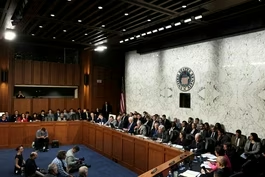
GEOFF BENNETT: In the day's other headlines: Acting Attorney General Todd Blanche is one step closer to securing the job permanently after the Senate Judiciary Committee narrowly approved his nomination earlier today.
SEN.
CHARLES GRASSLEY (R-IA): The nomination will be favorably reported.
GEOFF BENNETT: The nomination advanced along party lines after Blanche won over two Republican holdouts by rescinding the so-called anti-weaponization fund aimed at paying Trump allies, including January 6 rioters.
SEN.
THOM TILLIS (R-NC): It's done.
It's been rescinded, and I am satisfied.
GEOFF BENNETT: But Senate Democrats say they remain concerned the fund could be revived and that Mr.
Trump's tax immunity remains intact, raising broader questions about the nomination of the man who once served as President Trump's personal defense attorney.
SEN.
CORY BOOKER (D-NJ): He's about being Donald Trump's lawyer and not the people's lawyer.
This is so deeply wrong.
We will rue the day that we let this man have this much power under such a corrupt president.
GEOFF BENNETT: Blanche's nomination now heads to the Senate floor for a full vote, which could happen as early as this week.
In New Jersey, civil rights groups are demanding answers after a man from El Salvador died in ICE custody over the weekend.
PROTESTER: When I said ICE, you say out.
PROTESTER: ICE.
PROTESTERS: Out!
PROTESTER: ICE.
PROTESTERS: Out!
GEOFF BENNETT: Activists joined the family of Edwin Lopez-Cornejo today and called for an independent investigation.
His 12-year-old daughter fought back tears as she spoke about the loss of her father.
ASHLEY CORNEJO, Daughter of Edwin Lopez-Cornejo: We're both dead, but the only difference is that his heart stopped beating.
And I'm going to grow up without a father.
GEOFF BENNETT: Federal officials say the 41-year-old died following a medical emergency, though no official cause of death has been released.
It marks the second death in less than a year at Delaney Hall, the Newark detention center that has seen months of protests over its treatment of detainees.
Several European Union nations are calling for tougher action against migrant smuggling after last week's surge of people into the North African enclave of Ceuta.
Roughly 72,000 migrants entered the Spanish territory, sparking a humanitarian crisis, as well as a fierce debate over immigration policy within the E.U.
At least 80 people died in the crossing.
Spanish officials say most of the migrants have since returned to Morocco.
After a meeting of E.U.
ministers today in Brussels, Spain's interior minister defended what he called Madrid's immediate and efficient response.
FERNANDO GRANDE-MARLASKA, Spanish Interior Minister (through translator): There are things that happen where there does not necessarily need to be someone responsible.
Any other security department could also have foreseen this or another European Union country.
We are all involved in security, in intelligence, in gathering information on social media.
GEOFF BENNETT: Today's emergency meeting comes after 22 nations signed an open letter criticizing Spain's policy on the legal status of migrants within its borders.
Iran and Oman are reportedly nearing a potential deal that would reopen the Strait of Hormuz.
Iran's Foreign Ministry says the two sides are in talks about designating shipping lanes in the vital waterway.
Two regional officials tell the Associated Press that a possible plan would have ships enter the Persian Gulf through an Iranian-controlled route and exit through a passage controlled by Oman.
But any deal would require the U.S.
to end its blockade on Iran's ports.
At an unrelated event today, Secretary of State Marco Rubio said the U.S.
is involved in the talks and struck an optimistic tone.
MARCO RUBIO, U.S.
Secretary of State: Suffice it to say there's been progress made in those talks, but not finality yet.
We're hoping that will happen in a very short period.
GEOFF BENNETT: Any deal that would give Iran partial control of the strait would be a dramatic shift from before the war started, when the waterway was completely open to maritime traffic.
In Gaza, 112 Palestinians were laid to rest in a mass funeral today nearly three years after they died in an Israeli airstrike on a residential area shortly after the Hamas terror attacks on Israel.
Mourners gathered for the ceremony in Gaza City.
Each victim remains draped in a Palestinian flag.
Gaza's Civil Defense says it took more than two weeks to recover and identify the remains, which had been buried all this time beneath the rubble.
Officials say 157 additional bodies are still missing.
Relatives said the day was a mixture of closure and of grief.
TAYSIR AL-HASSAYNA, Relative of Victims (through translator): It has reopened our wounds three years after this massacre.
It has brought sorrow back to our children, women, and sons.
But our consolation is that we believe they are martyrs with God.
GEOFF BENNETT: Also, today Israeli Prime Minister Benjamin Netanyahu said that Israeli forces will not withdraw from their current positions in Gaza until Hamas has completely disarmed.
In his comments on social media, he suggested there were differences between Israel and the Trump administration over a recent deal announced to disarm the militant group.
In Guatemala, hundreds of people are being evacuated from villages near the Fuego volcano after it erupted yesterday.
Video from the site located just 20 miles or so from the country's capital shows a fountain of lava up to 1,000 feet high and ash reportedly spewing nearly four miles into the air.
Authorities issued a nationwide orange alert, one level below its most serious emergency, and closed a major highway nearby.
The volcano was part of the Pacific Ring of Fire, and is one of Guatemala's most active volcanoes.
After the closing bell on Wall Street, SpaceX posted a half-a-billion-dollar loss for the second quarter.
It was the rocket company's first such report since going public in June, but that loss was smaller than expected and revenues soared.
Meantime, Wall Street rallied to new records today amid strong corporate profits and cooling oil prices.
The Dow Jones industrial average jumped 900 points on the day.
The Nasdaq added more than 2.5 percent.
The S&P 500 beat its previous high set in June.
Still to come on the "News Hour": artificial intelligence proves a promising tool for stopping wildfires before they burn out of control; we examine the science behind how prescribing art helps combat loneliness; and the latest episode of our "Settle In" podcast explores the threats of biological warfare.
AMNA NAWAZ: U.S.
attorney Jeanine Pirro's job is reportedly safe for now, following a meeting with President Trump after she dropped charges related to the Lincoln Memorial Reflecting Pool.
Mr.
Trump publicly rebuked her over the weekend and again yesterday for determining that damage to the pool was not caused by vandalism.
That came in a motion to dismiss criminal charges against former U.S.
Olympian David Hearn.
He and several others were accused of ripping the lining of the pool.
In the motion, Pirro's office wrote the damage was actually the result of -- quote -- "flawed installation by the contractor and the rush to complete the project prior to events associated with the America 250 celebration."
But that was in stark contrast to what Pirro herself said just a few weeks ago.
JEANINE PIRRO, U.S.
Attorney for the District of Columbia: The evidence shows, and we will prove beyond a reasonable doubt, that Hearn willfully destroyed property at the Lincoln Memorial Reflecting Pool.
AMNA NAWAZ: That follows a pattern of disconnect between what the president and administration officials say in public versus what their lawyers say in court.
To discuss, I'm joined by Ankush Khardori.
He's a former federal prosecutor for the Justice Department.
Welcome to the "News Hour."
ANKUSH KHARDORI, Former Federal Prosecutor: Thanks for having me.
AMNA NAWAZ: So let's just start with Jeanine Pirro here.
From a legal perspective, how do you square what we heard from her in early July, right there, with the decision to drop those charges just under a month later?
ANKUSH KHARDORI: Well, it appears that they learned new facts that dramatically undermine their earlier assessment of the case.
Now, I happen to think that they probably should have gathered those facts before they charged the case.
But it appears that the facts that they gathered were so overwhelmingly at odds with the theory that Mr.
Hearn had committed a crime that they were forced to withdraw the case.
AMNA NAWAZ: And they did, in fact, say in that filing that it was newly discovered information that made it difficult to say the damage was due to vandalism.
As you point out, though, is that typically, especially at this level, the kind of information that comes before charges are filed?
ANKUSH KHARDORI: Yes, it does.
Particularly in a high-profile case, you want to make sure that you have all of your sort of T's crossed and I's dotted.
And there wasn't a need to rush this case, right?
It wasn't like they were running up against the statute of limitations issue.
And often within the government, the Justice Department, it's a little tricky getting information out of other agencies because it's just other folks trying to do their day-to-day jobs.
So you really have to be very careful with what you're getting and make sure you're asking all the questions you need to ask.
The Justice Department apparently didn't do that, and they have now sort of tried to shift the blame to the Department of Interior.
AMNA NAWAZ: So let me ask you about the larger pattern here that we reference.
You have the president and other officials publicly saying one thing, and then you have their lawyers in court having to qualify or walk back or even contradict what was publicly said.
We seen that again and again, whether it was the Pentagon and if they're banning transgender troops or who was actually in charge at DOGE, or who exactly is being deported in immigration raids.
Do you, from your perspective, see a strategy here, or is it a case of one hand not knowing what the other is doing?
ANKUSH KHARDORI: Look, I think I see incompetence at the Justice Department these days, because this is not the way the Justice Department's lawyers are supposed to be operating and is not the level of professionalism that we should expect from our prosecutors.
Now, we could diagnose that in a variety of different ways.
One issue may be political pressure, buckling to political pressure.
Another may be that their clients, so to speak, the agencies are not being fully forthright with them, they're having a difficult time managing their relationships with some of these clients.
And I think that is true in the case of ICE, for instance.
I think ICE is basically running the deportation show.
The Justice Department is following their lead.
But none of these are excuses.
They're just explanations.
The job of a good lawyer is to correct for all these things, and particularly the job of a prosecutor is to make sure that they have all their facts together before they make such a serious and life-changing accusation as to charge someone with a criminal case.
AMNA NAWAZ: Given that this is a president who's very comfortable applying public pressure to the Justice Department, you mentioned that pressure and the buckling that some lawyers may feel pressured to do, how far can those lawyers go in giving in to that?
Do they themselves face potential consequences for doing that in court?
ANKUSH KHARDORI: They do.
So, I mean, let's -- the legal standard for charging a criminal case, federal criminal case is probable cause.
It doesn't mean more likely than not.
It's a relatively low standard.
There are then ethical rules that lawyers have to follow.
You cannot falsely represent a fact to a judge.
You cannot charge a criminal case that doesn't have probable cause.
On top of that, there are DOJ policies that say the prosecutors are not supposed to charge criminal cases unless they think that it is more likely than not that they will obtain a conviction once the evidence all comes in.
Now, the upshot of this is if you file a case that is fundamentally unjust, where there wasn't probable cause or you're misrepresenting the facts, yes, you can face professional repercussions from bar association -- excuse me -- bars and the like, not bar associations, bars and the like.
As a practical matter, that happens quite rarely.
The principal deterrent to this sort of misconduct is actually just professional embarrassment and one would hope the moral sense that you should not really go around ruining people's lives if you know better.
AMNA NAWAZ: While I have you, I want to ask you about Todd Blanche.
As we reported earlier, Senate Judiciary Committee did vote to advance his nomination to be attorney general.
He's currently in an acting role.
We have seen Senator Susan Collins come out first and already say she will not vote yes on that.
But, of course, he's moving forward after he struck a deal with Senators Cornyn and Tillis, and he wrote down this plan that he would kill that anti-weaponization fund.
From your view -- and I know we have seen the president say he still likes that fund, I also want to play through what we heard from Senator Cornyn earlier today on that.
Take a listen.
SEN.
JOHN CORNYN (R-TX): Well, there's nothing we could do to rein in the president when he said he likes the fund and he wishes it still exists, but the fact of the matter, it's dead.
AMNA NAWAZ: Is that fund still dead, from what you have seen?
ANKUSH KHARDORI: Look, the fund may be dead, but that's not really the main issue here.
The government and the Justice Department still retain the ability to pay make payouts to, for instance, the January 6 defendants by settling claims that they have brought under the Federal -- excuse me - - the Federal Tort Claims Act.
Hundreds of January 6 defendants have already done this or are planning to do this, and the government can settle those sorts of claims outside of public view and without judicial oversight.
They have settled, for instance, litigation with Michael Flynn, right?
And we don't have to speculate really about whether this Justice Department might settle frivolous litigation.
We're actually here because the Justice Department settled frivolous litigation, Trump's lawsuit against the IRS.
So this is a very, very -- remains a very live issue.
I think the fund is one part of it, but really -- and I just have to respectfully disagree with Senator Cornyn -- it is not the case that they had no other way to block this from happening.
The Senate used to pass laws.
My very crude understanding of how the federal government works is that the Senate used to pass laws.
They could pass a law, if they wanted to, preventing the disbursement of federal funds, for instance, to anyone charged in connection with the January 6 investigation.
They may not want to do that.
I mean, they may feel not feel that the leader -- Republican leaders won't want to get sideways with Trump, but it's not the case that they just had to take Todd Blanche's signature and sort of call it a day.
AMNA NAWAZ: We have less than a minute left, but I have to ask you.
You see a confirmed Todd Blanche leading the department differently than the one who was in the acting role?
ANKUSH KHARDORI: I do.
I mean, as a confirmed attorney general, he will have better standing within the department.
I think he will be bolder and have more confidence.
And I think he will continue to do what he's largely done, which, as he's testified to the Judiciary Committee, he feels constitutionally obligated to take the president's instructions.
It's not just that he was his former lawyer.
His testimony under oath is that the executive branch and the head of the executive branch is entitled to dictate what the Justice Department does.
I strongly disagree with that view of the department, but he has told us what he thinks his job is.
AMNA NAWAZ: Former federal prosecutor Ankush Khardori, thank you so much for being here.
ANKUSH KHARDORI: Thank you.
GEOFF BENNETT: The U.S.
Senate is just days away from taking its monthlong August recess, but Congress is also rapidly running out of time to avoid a government shutdown this fall and handle a host of other items.
Lisa Desjardins is just back from Capitol Hill, as lawmakers are scrambling to take action on everything from funding the Iran war to regulating cryptocurrency in a matter of days.
Welcome back from the Hill, Lisa.
LISA DESJARDINS: Thank you.
GEOFF BENNETT: Always good to see you.
So, remind us what is on the plates of lawmakers this week, because, even by D.C.
standards, it's a lot.
LISA DESJARDINS: Right.
I'm a nerd, and this is a very long list.
So let's take a look at what people should be watching for and what Republicans are hoping to pass in just the next few days, as I said, a long list.
At the top you can see government funding.
That runs out September 30.
We have got a slew of nominations, including, as Amna just reported, Todd Blanche for attorney general, but also the head of the CDC, and 74 other nominations moving, Russia sanctions bill.
There is also a bill that would deal with the NIL or sort of the chaos in college sports and for athletes there.
There is Iran war funding that is on the table here, and also nothing less than crypto regulations.
Now, because Republicans have run out of time, they need Democrats to agree to speed things up.
So there are negotiations over what can go now and what can't.
And one source in the Republican leadership told me basically the Senate is trying to cram a month's work on major bills into one week.
GEOFF BENNETT: And with the spending bills, you have got one aimed at funding the government, another aimed at funding the war in Iran.
Why is one moving and another is not?
LISA DESJARDINS: That's right.
So, when you look at these bills, there really is a spectrum of what is going to move when and how.
When you talk about the funding for government in September, that ends on September 30, the issue is that neither party really wants a shutdown in the midterm elections right now.
So Senator Thune and Senator Schumer have cobbled together a bipartisan agreement that pushes that funding off until December 11.
They want that to move this week.
That does seem like it has traction.
It is caught up in these negotiations.
However, when you talk about the Iran war funding, which seemed to be on track when we last spoke about this even last week, there are a variety of problems now with it.
Some Republicans want more money for it.
Some are raising other issues to bring alongside it, including the SAVE Act, the election law.
That is getting tangled up.
And right now, talking to senators, they just think it cannot move at this time.
There are multiple problems with that, and I don't think we're going to see action now, and there could be problems farther down the road.
GEOFF BENNETT: So what's the plan then to get all of this done?
LISA DESJARDINS: OK.
I asked Republicans about this exact question, and the ever quotable Senator John Kennedy of Louisiana put it to me this way: SEN.
JOHN KENNEDY (R-LA): I am prepared to and will vote to stay here as long as it takes to get our work done.
Now, what is the plan for doing that?
I don't know.
I have no idea, absolutely none.
LISA DESJARDINS: So what is the plan?
Talking to sources, Republican sources, we're going to find out more tomorrow.
That Iran war funding bill, they haven't even put out the text yet.
So we could see text of that tomorrow.
That will tell us exactly a little bit about how they're planning to move forward.
But I want to talk about what this all means in terms of the calendar.
Let's take a look at why this is all such a big deal.
Here we are right now, the first week of August, all innocent, happy, looks easy.
But what happens next for the Senate?
Here's that recess that you mentioned earlier going right into the middle of September.
The House is gone most of that time as well.
Then here is that government funding deadline in red you see at the end of September.
So they just have those few weeks once they're gone after this week, Geoff, to figure out government funding.
That's not a lot of time.
And that's why we're talking about it tonight on the show.
GEOFF BENNETT: Yes.
On another matter, last night you reported on the abuse allegations facing Republican Congressman Max Miller, allegations he denies.
There's an update tonight?
LISA DESJARDINS: Right.
As we reported, he is facing allegations that he denies of domestic abuse.
Those are coming out of a custody dispute with his ex-wife.
Now, today, the House Ethics Committee announced it is investigating those allegations.
That came after Miller himself went on social media and said he wanted the committee to do so.
Now, also today, Max Miller went on CNN to defend himself.
He said he spoke with President Trump yesterday about this and that Trump told him over the phone -- quote -- "It's going to be a tough race" if he stays in it for the fall, and that he might not be able to pull this one out.
But Miller says he responded to Trump by pointing to Trump's own example in 2016 as a reason why he's staying in.
At the same time, multiple senators now are saying he should resign, in addition to Miller's father-in-law, who's a senator from Ohio.
Overall, if Miller stays in this race past next Monday, he will not be able to take his name off the ballot.
Republicans won't be able to do it.
And he says that is his plan.
He is not going to pull out of the race, and his name will be on the ballot.
GEOFF BENNETT: Lisa Desjardins, our thanks to you, as always.
LISA DESJARDINS: You're welcome.
AMNA NAWAZ: The catastrophic fires in Washington State underscore that 2026 is becoming one of the worst years for U.S.
wildfires in at least a decade.
There have now been more fires and more acreage burned at this point in the year compared to any year in the last 10.
And Europe is struggling with its worst wildfire season in recent history.
With fire seasons growing longer, early detection is critical to preventing small flames from turning into devastating infernos.
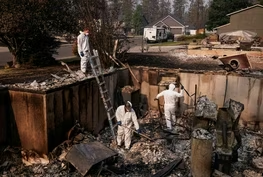
Special correspondent Ben Tracy of Climate Central shows us how artificial intelligence is now being used to spot fires faster, and sometimes before anyone even sees smoke.
It's part of our series Tipping Point.
MAN: Liftoff of Transporter 17.
BEN TRACY: When this rocket blasted off from the coast of California in July... MAN: Pitching downward.
BEN TRACY: ... it carried a new weapon against wildfires.
Minutes later, three new satellites began their mission.
MAN: FireSat 1 separation confirmed.
BEN TRACY: They're called FireSat, the first of a planned fleet of 50 satellites solely dedicated to detecting new wildfires anywhere on Earth within 20 minutes of ignition, even one as small as a beach bonfire.
MAN: Yes, just drop it a little bit so we can just check the gasket.
BEN TRACY: Down here on Earth, but still high in the mountains above Denver... MAN: Yes, moving out.
BEN TRACY: ... two technicians with no apparent fear of heights are checking a pair of eyes in the sky.
What are those things up there?
ARVIND SATYAM, Co-Founder, Pano AI: There are two Pano AI cameras.
They're sitting on top of that cell tower.
BEN TRACY: Arvind Satyam is co-founder of Pano AI, a San Francisco-based startup that's deployed more than 1,400 high-resolution cameras in 17 states across the country.
ARVIND SATYAM: So this is one of the cameras.
These are a six-megapixel.
They're on a swivel.
BEN TRACY: They're a powerful new tool for firefighters.
Using artificial intelligence to detect fire starts early so they can be contained.
What specifically is the A.I.
doing?
ARVIND SATYAM: The A.I.
algorithm is being run continuously on that imagery to say smoke, not smoke.
At nighttime, we're looking at heat signatures, so heat versus cold.
BEN TRACY: Once the system flags something, a human analyst reviews the image and alerts fire agencies in a matter of minutes.
Just outside Denver, West Metro Fire Assistant Chief Brendan Finnegan says these cameras give him a critical advantage, speed and a precise location.
BRENDAN FINNEGAN, West Metro, Colorado, Fire Rescue Assistant Chief: So having those eyes that can alert us well in advance of potentially a 911 call really make it a valuable tool for us.
BEN TRACY: Is this kind of a nice-to-have, or do you feel like this is a must-have, given the number of wildfires you're seeing?
BRENDAN FINNEGAN: I think it's a have-to-have in our toolbox now.
BEN TRACY: Climate change is fueling an increase in hotter, drier, windier days, creating a potent mix for wildfires.
According to Climate Central, some areas in the West now experience two additional months of fire weather each year compared to the 1970s.
PHILLIP SELEGUE, Cal Fire Chief: So this is all of our cameras.
BEN TRACY: Cal Fire Chief Phillip SeLegue oversees California's own system of more than 1,200 A.I.-enabled cameras called ALERTCalifornia.
PHILLIP SELEGUE: This is where the A.I.
had detected something.
BEN TRACY: He says, 50 percent of the time, these cameras have detected fires before anyone calls 911.
WOMAN: Engine 3168, outside fire, bravo, response.
BEN TRACY: One of them spotted this fire near Fresno 20 minutes before the first emergency call came in.
So you got a huge head start.
PHILLIP SELEGUE: Correct.
BEN TRACY: That fire was quickly contained.
PHILLIP SELEGUE: At Cal Fire, one of our missions is to suppress 95 percent of our fires at 10 acres or less.
This system helps us in accomplishing that goal.
BEN TRACY: How much do you trust this system and what it's telling you?
PHILLIP SELEGUE: We trust it enough that, when we receive that detection, we're already starting the process of sending resources to it.
The fires that the system has helped us dispatch resources to are the fires that you don't read about in the papers, the ones that you don't see.
BEN TRACY: Because the A.I.
eyes in the sky saw it first.
MAN: Yes, it looks like both the cameras are working good.
BEN TRACY: For the "PBS News Hour," I'm Ben Tracy with Climate Central.
GEOFF BENNETT: President Trump is selling early access to his social media posts.
His company recently launched Truth API, a subscription service giving businesses and trading firms a first look at posts from the president and other high-profile accounts, the price tag reportedly up to $100,000 a month.
Critics are raising alarms because that head start means paying customers see market-moving statements from a sitting president before the public does.
For more, we're joined now by Bobby Allyn, technology correspondent for NPR.
Bobby, it's always good to see you.
So break down how this actually works.
The service is already live.
How much sooner are subscribers seeing these posts from President Trump?
BOBBY ALLYN, Business and Technology Reporter, NPR: So it's called Truth API, and basically investment banks, hedge funds, and other investors can get a sneak peek at President Trump's posts on TRUTH Social maybe a couple milliseconds before the rest of the public.
But when we're talking about high frequency trading and other types of really fast Wall Street trading, I mean, Geoff, the difference of a few milliseconds could be tens of millions of dollars easily.
And, remember, I mean, Trump regularly turns to TRUTH Social to make announcements about the war in Iran, economic news, maybe announce some kind of big government contract with a private company.
So this is information Wall Street traders would really like to get before anyone else.
So potentially this is going to be a really lucrative new line of revenue for the Trump family.
GEOFF BENNETT: President Trump is the largest shareholder in TRUTH Social's parent company, which his son Don Jr.
controls through a through a trust.
So when the president's own posts can move markets, as we know they so often do, how is the company defending against the allegations of insider trading?
BOBBY ALLYN: What the Trump company says is that they are just sharing what they call public information with Wall Street, and they say, look, the president's posts and the posts of other high-profile users on TRUTH Social has a lot of value to Wall Street traders, and maybe some are even willing to pay the $1.2 million a year to get a jump-start, get a head-start, get early access to some of these posts.
So when -- I talked to the spokeswoman for the Trump Media Company, and she says all these accusations of insider trading, all these accusations that we're offering material nonprofit information to traders are completely false because it's public information.
But, again, Geoff, I talked to many people who study Wall Street and former SEC enforcers who said, no, this is not public information because the very service is offering it to people before the rest of the world.
I mean, that is the value add.
You can get Trump's posts before anyone else.
So experts told me that is the definition of material nonpublic information, and one executive at a very large Wall Street firm told me, if this was any other administration, this would be considered criminal.
And I put that to the Trump media spokesperson, and she said that is absurd.
GEOFF BENNETT: Based on your reporting, do you know which firms have signed up for this service?
BOBBY ALLYN: It's a great question, and we don't know just yet.
As far as I can tell, I mean, Citadel, Goldman Sachs, J.P.
Morgan, all of the big Wall Street players are staying mum on this.
And I asked one of my sources who is an executive on Wall Street why this might be.
And they said, look, no one is going to stick their neck out and potentially land in the crosshairs of President Trump right now.
But adopting this, if you're a big Wall Street bank, just really exposes you to potential law enforcement investigation or an SEC probe in the next administration if the next administration sees this a little differently.
So while this does fit into the larger narrative for Trump, the Trump Media Company, of trying to monetize access to power, access to the president, and they're hailing this as a huge win for Wall Street traders in terms of having a leg up, having an edge on everyone else, big Wall Street banks, as far as I can tell, are not widely adopting it just yet.
But it's a good question.
Who has signed up?
The company says they have customers, but they won't say who.
GEOFF BENNETT: When it comes to matters of precedent, clearly, we've never had a sitting president with his own social media company that he actively uses.
Have we ever seen a social media company sell early access like this before?
BOBBY ALLYN: Offering sort of API access, it's what is called, sort of back-end data, is something that all the major social media platforms offer.
Many of the big social media companies charge a sort of monthly or annual fee for this.
But the real difference here, Geoff, is, this isn't just data from a social media company.
These are posts from the sitting president of the United States.
There are some people, scholars, who say that every time Trump makes a TRUTH Social post, that is an official government record.
And because of that, it is being viewed by critics of the president as a type of insider trading, that he is basically monetizing the proprietary information of the U.S.
government.
If he was just a private citizen and he was offering early access to his and other posts, I think we wouldn't be having the same discussion.
But because he's a sitting president, this is just being examined under a very critical legal lens right now.
GEOFF BENNETT: Bobby Allyn of NPR.
Bobby, thank you for sharing your reporting with us tonight.
BOBBY ALLYN: Thanks, Geoff.
AMNA NAWAZ: Now for a look at a program using the arts to tackle loneliness and social isolation.
Located in Charlotte, North Carolina, it requires a prescription for art instead of medicine.
Paul Solman has the story for our series at the intersection of art and health, part of our Canvas coverage.
ALISHA BIGBY, Charlotte Art on Prescription Participant: I wouldn't go anywhere.
I stayed at home.
PAUL SOLMAN: Alisha Bigby was traumatized by family tragedy.
ALISHA BIGBY: I would get invited to things, and I would say I would go, and then I would kind of get a panic attack and wouldn't go.
And I would just sit in the dark at home or sit on the front porch.
PAUL SOLMAN: But now she's giving interviews to strangers, visiting museums.
ALISHA BIGBY: Growing up, my mom collected these little African American figurines.
PAUL SOLMAN: One of her favorite paintings at the moment, David McGee's Drum Call.
ALISHA BIGBY: When I came here and I saw this, I was like, oh, my goodness, this reminds me so much of my mom and the little figurines that she kept in her armoire.
And I just immediately gravitated towards this.
PAUL SOLMAN: In fact, this museum was key to her turnaround, The Bechtler in downtown Charlotte, North Carolina, and its program Art on Prescription.
TODD SMITH, Executive Director, The Bechtler Museum of Modern Art: So individuals who are under the care of a doctor are prescribed art as medicine, and instead of going to the pharmacy to have their prescription filled, they come to the museum, where they get a year's worth of arts programming for free.
PAUL SOLMAN: Todd Smith runs this contemporary museum.
TODD SMITH: It's a way to combat loneliness here in Charlotte.
They attend performances, they create art, they talk about art, they share experiences, and in the end they become friends.
PAUL SOLMAN: Eighty participants have gone to the ballet, the theater, taken art making classes, and visited The Bechtler to see most recently David McGee's riffs on art classics from the past, like The End of Summer, playing off Caravaggio's famous Bacchus.
TODD SMITH: We would ask participants to just start talking about what they see.
What do the colors make you feel?
How does it express an emotion to you?
It's just about getting people to talk.
PAUL SOLMAN: Bigby didn't talk at all after an unimaginably painful series of events that began with the death of her brother.
ALISHA BIGBY: His truck went down and the embankment and it exploded.
And then just a few days later, my mom passed away.
PAUL SOLMAN: Within two days?
ALISHA BIGBY: Within just a few days, yes.
And my other brother, he just went to bed and didn't wake up.
He too passed away.
And 12 hours after my brother Larry passed away, my dad passed away as well.
And because we had... PAUL SOLMAN: Oh, my God.
So you lost four family members within a three weeks or something?
ALISHA BIGBY: Four family members within about three weeks.
PAUL SOLMAN: Bigby simply shut down, rarely left the house.
Her therapist suggested Art on Prescription.
It's the first-of-its kind program in the U.S., but community activity as medicine is hardly new.
It's even got a name, social prescribing.
JULIA HOTZ, Author, "The Connection Cure: The Prescriptive Power of Movement, Nature, Art, Service, and Belonging": Social prescribing got its start in the U.K.
Doctors had been recognizing how loneliness was a major social determinant of health.
You had people coming to the emergency room.
You had people coming to use their doctor's services more often because they were lonely.
And they're now used to treat a wide variety of afflictions, anxiety, depression, ADHD, addiction, even dementia.
PAUL SOLMAN: Julia Hotz wrote "The Connection Cure."
JULIA HOTZ: Most social prescriptions tend to revolve around five kinds of activities involving movement, nature, art, service, and belonging.
And when researchers started measuring the impact of social prescriptions, they found that it not only improved patients' health, it not only improved their mood, reduced their anxiety, reduced their depression, reduced their loneliness, but it also was reducing pressure on health care.
In some places, you were 50 percent less likely to have to go to the emergency room if you had a social prescribing scheme in place.
And that amounted in a place like England, where health care is nationalized, to major cost savings for the whole system.
PAUL SOLMAN: The concept caught on here to combat a common curse in America these days, the loneliness epidemic.
TODD SMITH: If you look at the last 10 years of all that we have done to move ourselves away from community interactions, how reliant we are on screens and coming out of COVID and hybrid work situations, you know, the world has changed dramatically in the last 10 years, and many of us don't know how to deal with it and don't know how to come back together.
PAUL SOLMAN: The problem seemed especially acute in Charlotte.
TODD SMITH: There's a lot of mobility of people moving into Charlotte.
Charlotte's one of the fastest growing cities in the country.
How do we connect, whether you're a teenager or whether you're a senior citizen?
PAUL SOLMAN: Julie Wohrer came to Charlotte for work.
JULIE WOHRER, Charlotte Art on Prescription Participant: I had moved down here at the start of the pandemic, and everything kind of shut down, which then made it hard to meet people.
I moved into the country, so made it very convenient for me to go to work, come home, stay with the dogs, and not venture out.
PAUL SOLMAN: Then she lost her job.
JULIE WOHRER: I had focused so much energy into work.
I had been with the company over 20 years, and so when that was no longer a part of my life, it's, who am I now?
So I just kind of secluded to me and my dogs.
PAUL SOLMAN: But through Art on Prescription, warrior made connections.
JULIE WOHRER: I have met some people in the program, and we talk outside of the program.
I have M.S.
as well, and it's made me start facing that condition and getting into those groups as well.
It feels much less isolated definitely from a year ago, but even three, four months ago.
PAUL SOLMAN: And would you not have connected with an M.S.
group had it not been for this?
JULIE WOHRER: I don't think so.
I don't think so.
It was the first step.
It's kind of like a snowball coming down a hill.
It allowed me to get momentum.
PAUL SOLMAN: Todd Smith says most participants report feeling less lonely.
TODD SMITH: The results for the individuals who have been in the program have been pretty remarkable.
About 80 percent of the participants are seeing meaningful change in how they view themselves on that loneliness scale.
PAUL SOLMAN: Alisha Bigby, for one, rediscovered her voice and now goes to every Art on Prescription event.
ALISHA BIGBY: Clay work definitely one of my favorites.
You have the clay and you get to be messy, dirty, and you learn how to make bowls and cups and those kind of things.
PAUL SOLMAN: She says she's now motivated by her late mother.
ALISHA BIGBY: Any time I am hesitant about something, her voice is in my ear, where it's like, baby girl, she wants you to live.
She doesn't want you to sit still.
She wants you to get up and take yourself out into this world and enjoy life.
PAUL SOLMAN: The program's arts meet-ups have helped restore Julie Wohrer too.
JULIE WOHRER: Those small shifts make a huge difference in my mental health, how I feel about myself, that I can -- that old dogs can learn new tricks, right?
And... PAUL SOLMAN: And do you feel that you are now contributing more than you were before?
JULIE WOHRER: I do, and I want to contribute more.
I still have a mark to make.
PAUL SOLMAN: Art on Prescription already has a wait-list, and it's certainly one way to get folks out of isolation into museums, make friends.
For the "PBS News Hour," Paul Solman in Charlotte, North Carolina.
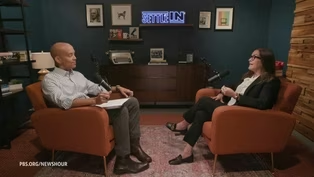
GEOFF BENNETT: What would happen if the next major national security threat wasn't a missile or a bomb, but a deliberately engineered pathogen?
That's the premise of the new book by Pulitzer Prize-winning investigative journalist Annie Jacobsen.
The book is called "Biological War: A Scenario."
I spoke with her for the PBS News podcast "Settle In," and we discussed America's preparedness for biological threats, what recent disease outbreaks reveal about vulnerabilities in our public health system, and why she believes that knowledge, not panic, is one of our best defenses.
Here's part of that conversation.
Well, let's start with the germ at the center of this book.
It's a form of plague, and it's engineered by Soviet scientists during the Cold War.
And the design is such that if you take the antibiotic that should save your life, that is what actually kills you.
Explain how that -- how that works.
ANNIE JACOBSEN, Author, "Biological War: A Scenario": Well, thank you for pointing out that it's tied to the Soviet bioweapons engineers of the Cold War, because my book is sold in the nonfiction department.
I write about science fact, even though it reads like science fiction.
And so I want readers to always feel like they are embedded in truth.
And there it was this horrific bioweapon created by the Soviets during the Cold War.
And this is 40 years ago, before genetic engineering, that -- what they called a super plague weapon.
And, of course, many people know about plague bubonic plague.
This is a form that goes in the lungs called pneumonic plague.
And as you mentioned, it is what is called a chimera pathogen, chimera, that Greek mythological idea of a beast of multiple parts, the head of a lion, the body of a serpent, two organisms at once.
The chimera is a genetically modified pathogen, so that it has a booby trap effect.
So what you think is going to cure you will kill you in an even more horrific way.
GEOFF BENNETT: Fast-forward to the current moment.
There is this question, if our government can't track a parasite in the lettuce supply with a two-month head start, what happens when the pathogen is engineered and someone is deliberately hiding the source of it?
ANNIE JACOBSEN: I mean, that is a rhetorically good question.
And I think that when I see the kind of lettuce outbreak or even the hantavirus outbreak in May overseas, when you look at Ebola in West Africa right now, I think that the information, good information coming out of those outbreaks and or epidemics, you can start to realize something must be done, the system isn't working the way it should, and people can really kind of demand change, because there is so much money involved.
You know, the U.S.
Department of Health and Human Services, HHS, is in charge of a biological incident or outbreak.
CDC is below HHS.
Most of your viewers, most of the people in the world don't know what HHS is, and yet it has a budget twice that of the Defense Department, twice.
So that's a lot of money.
Yes, it involves Medicare and Medicaid.
But there's still a problem with that we don't know -- we, the royal we, don't know the source of the lettuce outbreak.
GEOFF BENNETT: You have spent years interviewing former defense secretaries, senior administration officials, experts.
When you were -- as you said, when you were writing the book about the nuclear threat, they would describe the biological threat as shark in the water.
What were they most afraid of?
ANNIE JACOBSEN: Well, you certainly get that sense in the book, I think, because I give it to you in no uncertain detail.
But the big general idea is echoed in a Defense Department document I found.
It's called a threat spectrum.
And this is an unclassified document, but it looks at weapons of mass destruction on a scale.
And, of course, nuclear weapons are at the far end of the scale as the most destructive.
No one would argue with that.
But biological weapons are a very close second.
And even more disconcerting, they are -- quote - - "the greatest overall threat."
And that is because the barrier for entry is so incredibly low.
You need fissile material to make a nuclear weapon.
You need a delivery system like an ICBM.
We know now, particularly with A.I.-enabled bio, the barrier for entry is so low, high-ranking officials tell me a kid in a basement with very -- a bad actor with a nefarious mind in a basement with very little knowledge of biology can make a biological weapon.
GEOFF BENNETT: There is this idea too that, were this to happen, God forbid, no one's coming to save us.
So what can we do to be prepared, apart from stockpiling penicillin and rubbing alcohol and peroxide in our Cabinets?
Like, what can the average person do to prepare for something like this?
ANNIE JACOBSEN: You have hit upon like an interesting catch-22, where no one's coming from us, and what do we do and do we panic?
In all the Defense Department war gaming I came across, fear of infection, that actual quote, is repeated continually.
"Fear of infection will lead to."
And what it always leads to is anarchy and insurrection.
And all of the Pentagon war games know that or assume that.
And so that is where their plans in place we can talk -- if we have time to talk about that are shocking.
But on the fear of infection point, I would say, as far as the public is concerned -- and this is like me speaking not just as a journalist, but as a mom, that the way to prevent fear and panic is knowledge.
And so having a little bit of knowledge goes a very long way.
GEOFF BENNETT: You can watch that full episode of "Settle In" -- it's a good one -- and more on our YouTube page or wherever you get your podcasts.
AMNA NAWAZ: And that is the "News Hour" for tonight.
I'm Amna Nawaz.
GEOFF BENNETT: And I'm Geoff Bennett.
For all of us here at the "PBS News Hour," thanks for spending part of your evening with us.
Annie Jacobsen joins Geoff Bennett on 'Settle In'
Video has Closed Captions
Annie Jacobsen and Geoff Bennett discuss 'Biological War' on 'Settle In' (6m 27s)
How new satellites and AI are detecting wildfires early
Video has Closed Captions
How satellites and AI cameras are detecting wildfires before they get out of control (4m 32s)
Man charged with arson in Washington state wildfires
Video has Closed Captions
Man charged with arson as Washington wildfires devastate Spokane area (8m 8s)
News Wrap: Blanche nomination clears Judiciary Committee
Video has Closed Captions
News Wrap: Blanche nomination clears Senate Judiciary Committee (6m 42s)
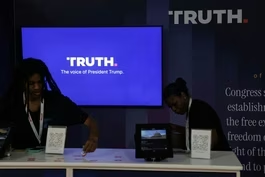
Paid early access to Trump's posts raises questions
Video has Closed Captions
Paid early access to Trump's posts raises insider trading questions (5m 37s)
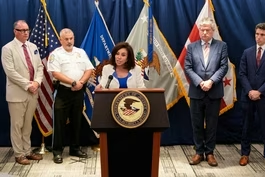
Pool case shows gap between Trump's claims, court record
Video has Closed Captions
Reflecting Pool case highlights disconnect between Trump's claims and court record (8m 4s)

The science behind prescribing arts to combat loneliness
Video has Closed Captions
The science behind using the arts to combat loneliness and social isolation (7m 46s)
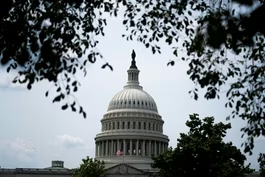
Senate faces long to-do list and little time before recess
Video has Closed Captions
Senate faces long to-do list and little time before recess (5m 10s)
Providing Support for PBS.org
Learn Moreabout PBS online sponsorship New Episode
- News and Public Affairs

Today's top journalists discuss Washington's current political events and public affairs.

- News and Public Affairs

FRONTLINE is investigative journalism that questions, explains and changes our world.


 New Episode
 New Episode
 New Episode
 New Episode
 New Episode
 New Episode

 New Episode
Support for PBS provided by:
Major corporate funding for the PBS News Hour is provided by BDO, BNSF, Consumer Cellular, American Cruise Lines, and Raymond James. Funding for the PBS NewsHour Weekend is provided by...