
How new satellites and AI are detecting wildfires early
Clip: 8/4/2026 | 4m 32sVideo has Closed Captions
How satellites and AI cameras are detecting wildfires before they get out of control
This year is becoming one of the worst for U.S. wildfires in at least a decade. There have been more fires and more acreage burned at this point in the year compared to any in the last ten. With fire seasons growing longer, early detection is critical. Special correspondent Ben Tracy of Climate Central reports on how AI is being used to spot fires faster. It's part of our series, Tipping Point.
Problems playing video? | Closed Captioning Feedback
Problems playing video? | Closed Captioning Feedback
Major corporate funding for the PBS News Hour is provided by BDO, BNSF, Consumer Cellular, American Cruise Lines, and Raymond James. Funding for the PBS NewsHour Weekend is provided by...
How new satellites and AI are detecting wildfires early
Clip: 8/4/2026 | 4m 32sVideo has Closed Captions
This year is becoming one of the worst for U.S. wildfires in at least a decade. There have been more fires and more acreage burned at this point in the year compared to any in the last ten. With fire seasons growing longer, early detection is critical. Special correspondent Ben Tracy of Climate Central reports on how AI is being used to spot fires faster. It's part of our series, Tipping Point.
Problems playing video? | Closed Captioning Feedback
Where to Watch PBS News Hour
PBS News Hour is available to stream on pbs.org and the PBS app.
Providing Support for PBS.org
Learn Moreabout PBS online sponsorshipAMNA NAWAZ: The catastrophic fires in Washington State underscore that 2026 is becoming one of the worst years for U.S.
wildfires in at least a decade.
There have now been more fires and more acreage burned at this point in the year compared to any year in the last 10.
And Europe is struggling with its worst wildfire season in recent history.
With fire seasons growing longer, early detection is critical to preventing small flames from turning into devastating infernos.
Special correspondent Ben Tracy of Climate Central shows us how artificial intelligence is now being used to spot fires faster, and sometimes before anyone even sees smoke.
It's part of our series Tipping Point.
MAN: Liftoff of Transporter 17.
BEN TRACY: When this rocket blasted off from the coast of California in July... MAN: Pitching downward.
BEN TRACY: ... it carried a new weapon against wildfires.
Minutes later, three new satellites began their mission.
MAN: FireSat 1 separation confirmed.
BEN TRACY: They're called FireSat, the first of a planned fleet of 50 satellites solely dedicated to detecting new wildfires anywhere on Earth within 20 minutes of ignition, even one as small as a beach bonfire.
MAN: Yes, just drop it a little bit so we can just check the gasket.
BEN TRACY: Down here on Earth, but still high in the mountains above Denver... MAN: Yes, moving out.
BEN TRACY: ... two technicians with no apparent fear of heights are checking a pair of eyes in the sky.
What are those things up there?
ARVIND SATYAM, Co-Founder, Pano AI: There are two Pano AI cameras.
They're sitting on top of that cell tower.
BEN TRACY: Arvind Satyam is co-founder of Pano AI, a San Francisco-based startup that's deployed more than 1,400 high-resolution cameras in 17 states across the country.
ARVIND SATYAM: So this is one of the cameras.
These are a six-megapixel.
They're on a swivel.
BEN TRACY: They're a powerful new tool for firefighters.
Using artificial intelligence to detect fire starts early so they can be contained.
What specifically is the A.I.
doing?
ARVIND SATYAM: The A.I.
algorithm is being run continuously on that imagery to say smoke, not smoke.
At nighttime, we're looking at heat signatures, so heat versus cold.
BEN TRACY: Once the system flags something, a human analyst reviews the image and alerts fire agencies in a matter of minutes.
Just outside Denver, West Metro Fire Assistant Chief Brendan Finnegan says these cameras give him a critical advantage, speed and a precise location.
BRENDAN FINNEGAN, West Metro, Colorado, Fire Rescue Assistant Chief: So having those eyes that can alert us well in advance of potentially a 911 call really make it a valuable tool for us.
BEN TRACY: Is this kind of a nice-to-have, or do you feel like this is a must-have, given the number of wildfires you're seeing?
BRENDAN FINNEGAN: I think it's a have-to-have in our toolbox now.
BEN TRACY: Climate change is fueling an increase in hotter, drier, windier days, creating a potent mix for wildfires.
According to Climate Central, some areas in the West now experience two additional months of fire weather each year compared to the 1970s.
PHILLIP SELEGUE, Cal Fire Chief: So this is all of our cameras.
BEN TRACY: Cal Fire Chief Phillip SeLegue oversees California's own system of more than 1,200 A.I.-enabled cameras called ALERTCalifornia.
PHILLIP SELEGUE: This is where the A.I.
had detected something.
BEN TRACY: He says, 50 percent of the time, these cameras have detected fires before anyone calls 911.
WOMAN: Engine 3168, outside fire, bravo, response.
BEN TRACY: One of them spotted this fire near Fresno 20 minutes before the first emergency call came in.
So you got a huge head start.
PHILLIP SELEGUE: Correct.
BEN TRACY: That fire was quickly contained.
PHILLIP SELEGUE: At Cal Fire, one of our missions is to suppress 95 percent of our fires at 10 acres or less.
This system helps us in accomplishing that goal.
BEN TRACY: How much do you trust this system and what it's telling you?
PHILLIP SELEGUE: We trust it enough that, when we receive that detection, we're already starting the process of sending resources to it.
The fires that the system has helped us dispatch resources to are the fires that you don't read about in the papers, the ones that you don't see.
BEN TRACY: Because the A.I.
eyes in the sky saw it first.
MAN: Yes, it looks like both the cameras are working good.
BEN TRACY: For the "PBS News Hour," I'm Ben Tracy with Climate Central.
Annie Jacobsen joins Geoff Bennett on 'Settle In'
Video has Closed Captions
Annie Jacobsen and Geoff Bennett discuss 'Biological War' on 'Settle In' (6m 27s)
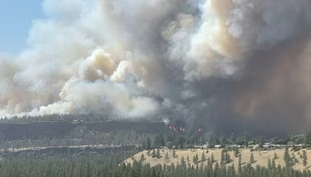
Man charged with arson in Washington state wildfires
Video has Closed Captions
Man charged with arson as Washington wildfires devastate Spokane area (8m 8s)
News Wrap: Blanche nomination clears Judiciary Committee
Video has Closed Captions
News Wrap: Blanche nomination clears Senate Judiciary Committee (6m 42s)

Paid early access to Trump's posts raises questions
Video has Closed Captions
Paid early access to Trump's posts raises insider trading questions (5m 37s)
Pool case shows gap between Trump's claims, court record
Video has Closed Captions
Reflecting Pool case highlights disconnect between Trump's claims and court record (8m 4s)
The science behind prescribing arts to combat loneliness
Video has Closed Captions
The science behind using the arts to combat loneliness and social isolation (7m 46s)
Senate faces long to-do list and little time before recess
Video has Closed Captions
Senate faces long to-do list and little time before recess (5m 10s)
Providing Support for PBS.org
Learn Moreabout PBS online sponsorship New Episode
- News and Public Affairs

Today's top journalists discuss Washington's current political events and public affairs.

- News and Public Affairs

FRONTLINE is investigative journalism that questions, explains and changes our world.


 New Episode
 New Episode
 New Episode
 New Episode
 New Episode
 New Episode

 New Episode
Support for PBS provided by:
Major corporate funding for the PBS News Hour is provided by BDO, BNSF, Consumer Cellular, American Cruise Lines, and Raymond James. Funding for the PBS NewsHour Weekend is provided by...