
April 15, 2026 - PBS News Hour full episode
4/15/2026 | 57m 46sVideo has Closed Captions
April 15, 2026 - PBS News Hour full episode
April 15, 2026 - PBS News Hour full episode
Problems playing video? | Closed Captioning Feedback
Problems playing video? | Closed Captioning Feedback
Major corporate funding for the PBS News Hour is provided by BDO, BNSF, Consumer Cellular, American Cruise Lines, and Raymond James. Funding for the PBS NewsHour Weekend is provided by...
April 15, 2026 - PBS News Hour full episode
4/15/2026 | 57m 46sVideo has Closed Captions
April 15, 2026 - PBS News Hour full episode
Problems playing video? | Closed Captioning Feedback
How to Watch PBS News Hour
PBS News Hour is available to stream on pbs.org and the free PBS App, available on iPhone, Apple TV, Android TV, Android smartphones, Amazon Fire TV, Amazon Fire Tablet, Roku, Samsung Smart TV, LG TV, and Vizio.
Providing Support for PBS.org
Learn Moreabout PBS online sponsorshipAMNA NAWAZ: Good evening.
I'm Amna Nawaz.
GEOFF BENNETT: And I'm Geoff Bennett.
On the "News Hour" tonight: Diplomats# lay the .. talks between the U.S.
and Iran, as Americans'# appetite for a prolonged conflict grows thin.
AMNA NAWAZ: A jury finds Ticketmaster## and Live Nation monopolized the# market and gouged ticket prices.
GEOFF BENNETT: And Judy Woodruff# looks into how and why the long## tradition of volunteering took root in the U.S.
ZAY HARTIGAN, Chief, Patagonia Volunteer Fire# and Rescue: A lot of volunteers, just they look## and they say, someone ought to do that.
And then# they say, well, I'm someone.
I'm going to do it.
(BREAK) GEOFF BENNETT: Welcome to the "News Hour."
International mediators tonight are pushing# for new peace talks between the U.S... and they're seeking to extend the# cease-fire that's set to expire next week.
AMNA NAWAZ: But nothing is set in stone,# and the sides remain far apart on issues## like the fate of Iran's nuclear# program and the Strait of Hormuz.
White House correspondent Liz Landers has# been tracking it all and starts our coverage.
LIZ LANDERS: The waters remain quiet through the# Strait of Hormuz.
The U.S.
military says its naval## blockade of Iran's ports is -- quote -- "fully# implemented" as it approaches its third full day.
But with the cease-fire between the U.S.# and Iran expiring in less than a week,## beneath the surface and behind the# scenes, there's been a flurry of## diplomatic conversations.
Regional leaders# like Turkey's President Recep Tayyip Erdogan## said efforts were under way to restart talks# between the U.S.
and Iran and to buy more time.
RECEP TAYYIP ERDOGAN, Turkish President# (through translator): We are making## the necessary suggestions and# attempts to .. extend the cease-fire and# continue the negotiations.
LIZ LANDERS: More regional officials say they're## making progress on both fronts# after last weekend's failed talks,## including that the U.S.
and Iran have agreed# in principle on extending the cease-fire.
Publicly, however, U.S.
and Iranian# officials say they have not formally## agreed to anything and that engagement continues.
White House Press Secretary# Karoline Leavitt today: KAROLINE LEAVITT, White House Press Secretary:# That these conversations are productive and## ongoing, and that's where we are right now.# I have also seen some reporting about the## potentiality for in-person discussions# again.
Those discussions are being had,## but nothing is official until you hear# it from us here at the White House.
LIZ LANDERS: In Iran today, Pakistani military# leaders arrived as mediators to discuss plans for## a new round of talks.
And Pakistani Prime Minister# Shehbaz Sharif, who hosted the last round of talks## and is considered a top intermediary, visits# Saudi Arabia, Qatar and Turkey through Saturday.
President Trump has suggested that talks# could be imminent, and in an interview this## morning on FOX Business, he said once again# that so could be the end of the war itself.
MARIA BARTIROMO, FOX News Anchor: Well,# you keep saying was.
Is this war over?
DONALD TRUMP, President of the United# States: I think it's close to over,## yes.
I mean, I view it as very close to over.
LIZ LANDERS: But on the biggest# sticking point in the talks,## any nuclear threat coming from Iran, the president## implied a more open-ended mission and again# threatened Iran's civilian infrastructure.
DONALD TRUMP: If they're going to have a# new nuclear weapon, we will be living with## them for a little while, but I don't know how# much longer they can survive.
As an example,## we could take out every one of their bridges# in one hour.
We could take out every one of## their power plants, electric power plants,# in one hour.
We don't want to do that.
LIZ LANDERS: But many experts say Iran# was nowhere near a nuclear weapon.
While visiting Asia today, Rafael Grossi, the# head of the United Nations nuclear watchdog,## said Iran's nuclear activities are# a reality that must be monitored.
RAFAEL GROSSI, Director General, International# Atomic Energy Agency: Iran has a very ambitious,## wide nuclear program.
So all of that will# require the presence of IAEA inspectors.## Otherwise, you will not have an agreement.# You will have an illusion of an agreement.
LIZ LANDERS: At an event with# young conservatives last night,## Vice President J.D.
Vance said that the U.S.# wouldn't settle for a small deal with Iran.
J.D.
VANCE, Vice President of the United# States: Right now, the cease-fire is## holding.
And what you're seeing is# what the president wants to ma.. he doesn't want to make like a small# deal.
He wants to make the grand bargain.
LIZ LANDERS: But Vance was also# heckled in the same event by## members of the audience who clearly# oppose the wars in the Middle East.
J.D.
VANCE: I certainly think the# answer is yes.
And I agree.
Jesus## Christ does not -- I agree.
Jesus Christ# certainly does not support genocide,## whoever yelled that out from# the dark.
He certainly does not.
LIZ LANDERS: Vance would# acknowledge their concerns.
J.D.
VANCE: I recognize that# a lot of young voters don't## love the policy that we have in the# Middle East, OK?
I understand that.
LIZ LANDERS: Today, in a test of Congress'# appetite for prolonging the Iran conflict: MAN: The motion is not agreed to.
LIZ LANDERS: Senate Republicans stood# behind President Trump and struck down## another Democratic-driven war powers effort to# block his ability to launch further strikes.
The treasury secretary today suggested## the U.S.
could strike Iran in a# different way, economically.
The SCOTT BESSENT, U.S.
Treasury Secretary:# Iranians should know that this is going to## be the financial equivalent of what# we saw in the kinetic activities.
LIZ LANDERS: Regardless of political leanings,# almost all Americans are feeling the pain at## the gas pump as the result of the# war.
Average prices remain above## $4 a gallon.
The treasury secretary# telling Americans this Tax Day: SCOTT BESSENT: The message is the# short-term volatility for long-term gain.
LIZ LANDERS: That optimism will be roundly# challenged in the waters of the Gulf,## as the White House navigates# a tense and narrow strait.
For the "PBS News Hour," I'm Liz Landers.
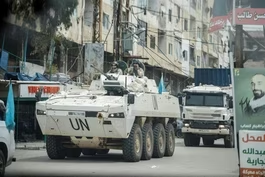
AMNA NAWAZ: Now to Lebanon, where# the toll of the wider war has## been severe.
More than one million# Lebanese are displaced.
Israel has## invaded the country's south again and# is demanding people vacate more land.
The United Nations' top refugee official# is there on a mission to survey the crisis,## and he sat down earlier today with# special correspondent Simona Foltyn.
SIMONA FOLTYN: Dr.
Barham Salih, thank you# very much for speaking to the "News Hour."
BARHAM SALIH, United Nations High# Commissioner for Refugees: Thank you.
SIMONA FOLTYN: Isr.. That's around a fifth of the population.# What has been the humanitarian impact?
BARHAM SALIH: It's undoubtedly very profound.
This# is truly a rapidly deepening humanitarian crisis.
Imagine the impact that this is# causing to the entire society,## to the entire country.
I have visited a# number of places, including shelters.
And## these are heart-wrenching scenes,# the stories that you're told,## people leaving everything behind, literally# in a matter of minutes walking miles on foot## to get to safety areas and so on.
This is truly# a humanitarian catastrophe by all standards.
And, remember, Lebanon has been a host of# refugees for so long.
Hundreds of thousands## of Syrian refugees have taken residence in this# country for more than a decade.
Not to mention## refugees from other places in the Middle# East.
For Lebanon to be impacted this way,## time and again, to be fair, is# really very sad, very painful.
SIMONA FOLTYN: Doing our reporting, we have seen# people sleep in their cars, sleep under tents.
SIMONA FOLTYN: The schools that have# been turned into displacement shelters## are at capacity.
What are some of the bottlenecks## that the Lebanese government and the# international community are facing?
BARHAM SALIH: To be fair, the government# is doing a lot.
The government is extremely## challenging.
It is operating in a very difficult# political, as well as economic condition.
But, to be fair, this government is trying# hard.
I think it's incumbent upon us in the## international community to help the government# of Lebanon, to help the state of Lebanon.
But## no amount of humanitarian assistance can really# deal with the scale, the scope of this crisis.
Look, nothing can replace losing your home.
And# many of these people have already seen their homes## destroyed.
And even the prospects of the returns# to their communities are somewhat in doubt.
SIMONA FOLTYN: The Lebanese government has# just issued fresh statistics saying that## more than 37,000 housing units have been# destroyed, many of them in Lebanon itself.
This means that, even when the fighting stops,# many families won't have a place to return to.
BARHAM SALIH: This is a very serious problem.
Many# of these homes have been destroyed in the south,## so these displaced people, at the end of the day,## they need to go back to their homes.# And the homes are already destroyed.
This is going to cause Lebanon, cause# the people of Lebanon not to mention## the victims themselves, a huge, huge problem.
SIMONA FOLTYN: More than 2,000 people have# now been killed by Israeli bombardment,## more than 300 on April 8 alone in what# is now known as Black Wednesday.
Roughly## a third of that were women, children, and the# elderly.
Israel says it's targeting Hezbollah.
You have visited some of these strike# locations.
Was there anything to suggest## that these buildings that were# being hit were military objects?
BARHAM SALIH: No doubt many of the casualties# are civilians, undeniably, so that the evidence## speaks for itself in the sense of the# word, whether Hezbollah is there or not.
At the end of the day, attacking civilians,## whether in Lebanon in the way that we have# seen, in Northern Israel that we have seen,## these are all acts that are unacceptable and# should not be happening.
Targeting civilians## and targeting civilian infrastructure is# something that is totally unacceptable.
This violence, this conflict, this war# really needs to be brought to an end,## and there is no military solution to# this.
There has to be a political,## diplomatic settlement based on security, based on## respect for sovereignty and respect for the# rights of the people in this part of the world.
SIMONA FOLTYN: Israel has maintained that it wants## to keep a depopulated buffer zone in# Lebanon's south.
Does that co.. BARHAM SALIH: Of course it concerns# me, unless these diplomatic## initiatives and efforts are going# to lead to a lasting security and## peaceful settlement that will end# these type of arrangements, because,## at the end of the day, any of these areas are# homes to people who have lived there forever.
And for them to leave their homes is not# something that anyone can condone or accept.
SIMONA FOLTYN: Do you see that there is sufficient# appetite on the part of international donors to## support the Lebanese government?
And# what is the funding gap at the moment?
BARHAM SALIH: I think, to be fair, the United# Nations has already published an appeal,## a flash appeal, calling for $308 million for# various U.N.
agencies.
UNHCR has called for## about $61 million specifically targeted at# Lebanon to deal with the displacement crisis.
We have been receiving some contributions.# We're grateful for those, but they are## nowhere near enough to deal with the scope# and the scale of the problem that we have.## We need more.
We need more engagement.
And# remember also, so we're not only dealing## with the displacement that is happening# as a result of the last few weeks of war.
We are also dealing with large, large# numbers of Syrian refugees who remain here,## who have already been -- because of these events,# have been displaced a year again.
And so you can## imagine the kind of humanitarian consequences# that this is bringing to bear.
And our teams## are working hard at this to try to deliver the# assistance needed for the people who need it.
SIMONA FOLTYN: Dr.
Barham Salih, thank# you for speaking to the "News Hour."
BARHAM SALIH: Thank you.
AMNA NAWAZ: And late this evening in Israel,# Prime Minister.. had ordered an expansion of the Israeli# invasion of Southern Lebanon to occupy## more territory and to march eastward to expand# what they call a security zone along Israel's## northern border.
GEOFF BENNETT:## In the day's other headlines: Time is running# out for Americans to file their taxes.
And new## data shows refunds are larger this year, though,# not nearly as big as the Trump administration had## projected.
The IRS says the average refund# so far this tax season is just under $3,500.
That's up around $350 from last# year, but it's far short of the## thousands of dollars or more that the# White House projected back in January.
REP.
MIKE JOHNSON (R-LA): We# don't believe you should send## it all here to Uncle Sam.
We want you to keep it.
GEOFF BENNETT: On Capitol Hill today,# House Republicans touted new tax breaks,## which include no taxes on tips and overtime, as# well as deductions for some seniors.
Democrats,## meantime, countered that any gains# are being wiped out by higher prices.
REP.
PETE AGUILAR (D-CA): The American# people are seeing their costs increase.## Even if they get a tiny bit of relief filing# their taxes, every month, they're paying more.
GEOFF BENNETT: Also on Capitol Hill today, the# head of the IRS told a Senate committee that his## agency is working to address the tax gap.
That's# taxes owed, but not paid.
That's even as the IRS## has seen its work force shrink around 27 percent# since President Trump returned to the White House.
Officials on a group of U.S.
islands in# the Pacific Ocean are assessing damage## from Tropical Storm Sinlaku, which battered# the region with fierce winds and rains.## Eyewitness footage shows the aftermath of what# was the year's most powerful tropical typhoon,## which flipped cars and left many without power.
Meantime, in other parts of the country,# powerful storms ripped through parts of## Michigan, toppling trees and damaging# buildings.
Some areas also saw flooding,## while, in Iowa, storm chasers filmed this# tornado, which touched down yesterday.
It's## part of a severe weather pattern that's# been hammering the Plains and Midwest.
And it comes as a heat wave sweeps across the East# Coast today, with record temperatures expected in## cities like New York and Philadelphia.
Forecasters# expect the heat to last well into the weekend.
In Turkey, officials there say a student opened# fire on two classrooms in a middle school today,## killing at least nine people.
It's the country's# second school shooting in as many days.
Chaos## unfolded outside that school as parents and# emergency personnel rushed to the scene.
Turkey's interior minister says the suspected# gunman is a 14-year-old student who was killed,## though he did not specify how.# The motive remains unclear.
MUSTAFA CIFTCI, Turkish Interior Minister# (through translator): This incident was an## individual act committed by only one# of our s.. terrorism.
I want to express once# again how deeply saddened we are.
GEOFF BENNETT: Officials in Turkey have# imposed a nationwide ban on publishing## images from the shooting that are considered# traumatic.
School shootings are rare in Turkey,## making this week's attacks all the more striking.
Sudan entered its fourth year of war# today, with millions facing the threat## of ongoing violence and famine.
In Eastern# Sudan, health workers are reporting a spike## in malnourished children since the fighting# started.
A U.N.-backed group has warned that## some 800,000 people will suffer from severe# acute malnutrition across Sudan this year.
Meantime, at an aid conference in# Berlin, European countries pledged## more than $1.5 billion in humanitarian# aid.
A U.S.
official at the meeting says## the Trump administration -- quote -- "remains# steadfast in its commitment to ending this war."
MASSAD BOULOS, U.S.
Senior Adviser for# Arab and African Affairs: We are working## closely with partners in.. from battlefield to the negotiating# table, from violence to dialogue,## and for ending this world's# biggest humanitarian crisis.
GEOFF BENNETT: The war between Sudan's military# and the Rapid Support Forces paramilitary group,## or RSF, erupted in April of 2023.# Since then, officials say around## 59,000 people have been killed and at# least 13 million have been displaced.
On Wall Street today, stocks ended mixed as hopes# rise for a possible end to the war with Iran.
The## Dow Jones industrial average slipped about 70# points on the day.
The Nasdaq jumped nearly 400## points to a new all-time high, and the S&P# 500 continued its rally from recent lows.
And Major League Baseball is celebrating# Jackie Robinson Day.
The annual event marks## the day back in 1947 when Robinson# broke the sports color barrier.
MAN: Every child who dares# to dream and every voice## that lives and inspires others, Jackie lives on.
GEOFF BENNETT: This year, the MLB rolled out## a splashy campaign in his honor.
And# across the league, players, coaches,## and umpires are wearing his iconic number# 42 on their jerseys during today's games.
Still to come on the "News Hour": the# Department of Justice moves to negate## more convictions for Capitol insurrectionists;# Donald Trump and J.D.
Vance continue their## attacks on the pope over the war against# Iran; and author Susan Page discusses her## book on the late Queen Elizabeth's# relationships with U.S.
presidents.
AMNA NAWAZ: A federal jury has found Live# Nation and its subsidiary Ticketmaster## have been operating as a monopoly in# violation of federal and state laws.## It's the long-awaited conclusion to a# blockbuster antitrust trial that could## have big implications for both the company# and the entertainment industry at large.
Dozens of states were party to the# suit, which argued that Live Nation## used its combined control of ticketing# platforms and a nationwide network of## concert venues to force artists into bad# deals and drive up prices for consumers.
For more on this, we're joined by Jem# Aswad.
He's music editor at "Variety."
Jem, thanks so much for being with us.
Before we get into details, just for context here,## how big a moment is this for Live# Nation, Ticketmaster, and the industry?
JEM ASWAD, Executive Music Editor, "Variety": It# is a big moment, but nobody knows yet what exactly## it is going to mean.
It is very much a rebuke to# the Department of Justice's decision early last## month to settle with Live Nation and have them# modify some of their policies and pay a few fines.
I think it was $260 million, which# Live Nation earns in a couple of days.
AMNA NAWAZ: We should point out that suit# was first filed by the Biden administration.## That's when the DOJ was involved.
When# the Trump administration came into office,## the DOJ a few days in walked away.
The# state decided to continue with that lawsuit,## which is how we ended up where we are today.
But, in retrospect, that settlement that# they reached, how does that look right now?
JEM ASWAD: Well, it was never approved by# the judge.
This is all being decided by one## judge.
Arun Subramanian I think# is how you say his name.
And he## was furious over the settlement because it# was basically done in a smoke-filled room.
There was a deal between DOJ officials and## Live Nation CEO Michael Rapino and presumably# some other people.
And the judge didn't even## know.
So he was furious over that.
And the# states decided to continue pushing ahead.
Now, does this mean that Live Nation and# Ticketmaster are going to be broken up and## tickets are going to get a# lot cheaper?
Absolutely not.
AMNA NAWAZ: We will get into more on that and# what we could expect ahead in just a moment.
But I want to remind folks about what the argument# was here behind the monopoly prosecution.
So,## DOJ was basically arguing that# they were stifling innovation,## they were causing higher prices for# consumers.
Remind people how they were## doing that.
What were the actual practices# they were alleged to have engaged in?
JEM ASWAD: I mean, there are so# many, it's a little hard to begin.
The practices that they were really being# criticized for really only trickled down to## consumers, quite honestly.
But it was things# like -- I don't -- I got to be careful with## the verbs here.
Like, persuading venues to# use Ticketmaster, their ticketing service.
And Rapino is heard in a recorded phone call# kind of threatening a venue by saying, well,## if you don't go with Ticketmaster and you# go with our competitor, boy, I don't know,## we're going to have a hard time routing some# of our big artists to your venue.
And that## venue is Barclays Center in Brooklyn, one# of the biggest arenas in the tristate area.
AMNA NAWAZ: Rapino, we should note, is the head## of Live Nation.
And those stories I# know were reported on fo.. As you mentioned, though, we do not yet know# what the remedies could be.
We should point out## in the verdict that the jury found Ticketmaster# overcharged consumers by about $1.72 a ticket.## Is there a chance here that concertgoers# could see some of their money coming back?
JEM ASWAD: It is really hard to say.
It's# very early in this process, quite honestly.
And we need to be fair to Live Nation here.
They# did not create this system.
The problem stems from## when ticketing went online, because, before, when# it was just hard tickets, you couldn't have a bot## buying up thousands of tickets and flipping them# for exponentially more than their face value.
And Live Nation has tried to fight that syndrome.# Sometimes, they're successful.
Sometimes,## they're not.
They're up against the most# sophisticated bots in the world.
So,## in sympathy to them, they are trying# to keep things in the stakeholders,## the people who actually put money and have# skin in the game with putting on shows,## venues, artists, managers, promoters, people# like that, instead of bots and scalpers.
But they do play rough.
And, I mean,# this is a capitalist society.
We're## allowed to push the limits to a# degree.
But the question here is## whether they pushed them too far.
And# the jury today found that they did.
AMNA NAWAZ: Live Nation has inarguably# been an absolute force in this industry,## right?
According to some of the trial testimony,## they sold about 10 times the number of# tickets as the next closest competitor.
What else have we heard from# them over the course of this## trial?
What's been their response to# the accusations about their practices?
JEM ASWAD: Oh, throughout, they have been saying,## we're not a monopoly.
We play rough.# They don't say, we pla.. we're competitive and we're aggressive, all of# which is certainly true and somewhat defensible.
But when you start getting into some of the# details, like with them trying to explain away## those famous Slack messages# where people are saying, oh,## my gosh, can you believe these# suckers, meaning concertgoers## paying for tickets.
It wasn't that exactly words# -- exactly those words, but it was the sentiment.
The particulars, they were less strong# on.
But, generally, they're just saying,## we are not a monopoly.
They# dispute a lot of the numbers,## the percentages of how much of the# ticketing market they have.
The## prosecution said it was about 86 percent.
They# said, oh, no, no, no, it's more like 44 percent.
And with anything like that, it's how# you slice and dice the numbers.
But## they have basically been saying,# we are playing by the rules.
And## it is up to the jury to decide# whether or not they believe that.
AMNA NAWAZ: We will see what happens next.
That is Jem Aswad, music editor for "Variety."
Jem, thank you so much.
JEM ASWAD: Thank you.
GEOFF BENNETT:## The Justice Department is at the center# of multiple major developments this week,## from a new report alleging political# weaponization under former President Biden,## to fresh efforts to reverse January# 6 convictions, to an unusual visit## connected to an inquiry involving the# Federal Reserve chair, Jerome Powell.
Our justice correspondent, Ali# Rogin, joins us now with the latest.
So, Ali, let's start with this legal# effort to drop the convictions connected## to the most serious crimes related# to January 6.
What more do you know?
ALI ROGIN: Yes, so to understand this latest news,## it's helpful to go back to the beginning of# President Trump's term, right after inauguration.. when he issued a blanket pardon for most of# the January 6 rioters, more than 1,000 people.
Trump did not pardon everyone, though.# There were 14 members of the extremist## groups the Proud Boys and the Oath Keepers whose# sentences he commuted, meaning he reduced them,## but he didn't outright pardon them.
Those people# included Oath Keepers head Stewart Rhodes,## who was facing 18 years in prison and was among# -- had the most serious convictions against him.
So, those 14, once those commutations came# in, they were released from their sentences,## but their cases were still making their# way through the appeals process.
Now what## has happened is, the Department of# Justice is asking the D.C.
Appeals## Court to completely dismiss# these cases with prejudice.
That means that the cases# will permanently be closed,## and the DOJ said in a short filing that this# is in the interests of justice.
This is,## however, a major blow to those attorneys who# previously were at the DOJ and prosecuted these## January 6 cases, many of which# had already been wiped away.
But some of them today said that this was# a reminder that the administration does## not care about constitutional due process, Geoff.
GEOFF BENNETT: And, separately, the Justice# Department released a report alleging that## the Biden Justice Department weaponized# the agency against its perceived enemies,## which is the very thing the Trump Justice# Department is accused of.
How did this come to be?
ALI ROGIN: Yes, this is the first product of# the so-called Weaponization Working Group,## which is something that former# Attorney General Pam Bondi stood up.
The stated goal was to uncover instances# of the Biden administration using the## levers of government power to achieve# political ends.
This report is about## the Biden DOJ's application of a# law that criminalizes interfering## with someone who is seeking to access# reproductive care, including abortion.
It's known as the FACE Act.
And the report alleges# that the Biden administration selectively enforced## the act by protecting abortion clinics, but not# other pregnancy centers that oppose abortion## rights, that they coordinated with pro-abortion# rights advocacy groups, exercised prosecutorial## misconduct, including screening jurors based on# religion, and that they sought longer sentences## for defendants who oppose abortion rights# than for those who support those rights.
Meanwhile, a former leader of the Biden era's DOJ## Civil Rights Division says that that# team enforced the law evenhandedly.
GEOFF BENNETT: And what more have you# learned about the way the Trump Justice## Department purged the people, the# prosecutors who worked on past cases?
ALI ROGIN: That's right.
I heard today from a d.. the department has fired personnel# who worked on those Biden era FACE## Act cases who had previously remained# employed at the Department of Justice.
Geoff, of course, all of this is happening as# President Trump has repeatedly and directly## called for the Department of Justice to prosecute# his political adversaries.
And Acting Attorney## General Todd Blanche, in an interview with# NBC last night, defended that contact.
TODD BLANCHE, Acting U.S.
Attorney General: That# type of communication from President Trump should## make every American happy, because it means# that there's an executive, a chief executive,## that is making sure every one of his Cabinet# members are working as hard as they should.
So, the president is a driver of# results, and so I don't have any## issues with that.
And as a matter of# fact, I think it's why he was elected.
GEOFF BENNETT: So add to all of that the# DOJ continues to investigate the Fed chair,## Jerome Powell.
And this includes a# visit to the construction site where## the Fed headquarters is undergoing# a renovation.
What more do you know?
ALI ROGIN: This was an attempt to# progress in that investigation,## which has seen multiple roadblocks, yesterday.
These employees from the D.C.
U.S.
attorney's# office made an unannounced visit to the site## of the Fed renovation.
They were trying to# check on progress at the site, this after,## last month, a federal judge threw out subpoenas# the Department of Justice issued to the Fed,## saying that there was abundant evidence that# the main purpose of these subpoenas and this## investigation was to harass and pressure# Fed Chair Jerome Powell to either resign or## yield to President Trump's policy demands.
Upon hearing of this unannounced visit# yesterday, outside counsel for the Fed## e-mailed the employees who tried to seek# access and told them that the federal judge## had concluded that their interest in this site# was -- quote -- "pretextual" and asked that## they commit not to seek to communicate with the# Fed outside of the presence of counsel, Geoff.
GEOFF BENNETT: All right, lots to track.
Ali Rogin, our thanks to you, as always.
ALI ROGIN: You bet.
AMNA NAWAZ:## The battle between the president and# the pope continues to play out on the## world stage.
And some allies of President# Trump are piling on to defend the war in## Iran.
The pope has not backed down from# his criticisms of the conflict either,## but he's taking a different# approach during his visit to Africa.
POPE LEO XIV, Leader of Catholic# Church: Good morning everyone.
AMNA NAWAZ: On his flight from# Algeria to Cameroon today,## Pope Leo avoided President Trump's war of words# and told journalists that the world needs peace.
POPE LEO XIV: Although we have different# beliefs, we have different ways of worshiping,## we have different ways of living,# we can live together in peace.
AMNA NAWAZ: His message came after a new social# media post from the president this morning sharing## an image of himself being cradled by Jesus.# President Trump deleted a controversial post from## earlier in the week of himself depicted as Jesus# that prompted criticism from many Christians.
But Christian and even Catholic members of# the Trump administration are standing behind## the president.
At a Turning Point USA event# in Georgia last night, Catholic convert and## Vice President J.D.
Vance disagreed with Leo's# theology and suggested the pope should be careful.
J.D.
VANCE, Vice President of the# United States: When the pope says## that God is never on the side of# those who wield the sword, there## is 1,000-year -- more-than-1,000-year tradition# of just war theory, OK?
Now, we can, of course,## have disagreements about whether this or that# conflict is just, but I think that it's important.
In the same way that it's important for# the vice president of the United States## to be careful when I talk about matters# of public policy.
I think it's very,## very important for the pope to be careful# when he talks about matters of theology.
AMNA NAWAZ: Many Republicans have stayed# quiet or urged the president to leave## the church alone.
But, today, House Speaker# Mike Johnson backed Vance and the president.
REP.
MIKE JOHNSON (R-LA): Obviously,# if you wade into political waters,## I think you should expect some political response,# and I think the pope's received some of that.
AMNA NAWAZ: The battle between the Vatican# and the White House began last weekend,## when Pope Leo spoke out in his strongest# terms yet against the war in Iran.## Leo denounced the -- quote --# "delusion of omnipotence" that## he argued was fueling the war in# Iran and other global conflicts.
Trump unloaded with a TRUTH Social post,## calling Pope Leo -- quote -- "weak on crime# and terrible for foreign policy" and said,## if it wasn't for his reelection, "Leo# wouldn't be the first American pope."
On Monday, he doubled down.
DONALD TRUMP, President of the United States: We# believe strongly in law and order.
And h.. to have a problem with that.
So there's# nothing to apologize for.
He's wrong.
AMNA NAWAZ: And that same# day, Pope Leo was defiant.
POPE LEO XIV: I do not look at my role# as being political, a politician.
I don't## want to get into a debate with him.
I don't# think that the message of the Gospel is meant## to be abused in the way that some people are# doing.
And I will continue to speak about this.
AMNA NAWAZ: We're joined now# by Reverend James Martin.
He's## a Jesuit priest and editor at# large of "America" magazine.
Father Martin, welcome back to the# "News Hour."
Thanks for being with us.
REV.
JAMES MARTIN, Editor at# Large, "America": My pleasure.
AMNA NAWAZ: So let me ju.. warn Pope Leo to be careful on matters# of theology.
What was your reaction?
REV.
JAMES MARTIN: That you have the vice# president warning the vicar of Christ,## who is an Augustinian, who is at that time# visiting the birthplace of St.
Augustine,## and who knows more about St.
Augustine than most# people have forgotten, that he doesn't understand## just war and that he doesn't understand theology,# I just found that really hard to swallow.
AMNA NAWAZ: Father Martin, this idea of just# war, what should we understand about that?
REV.
JAMES MARTIN: Well, it's an ancient# concept in the Catholic Church and in the## Christian church more broadly that talks about# the types of requirements that are needed for## war to be considered just.
And people can# go online and find them all.
For example,## there has to be a proportionate# response that's usually in defense.
And pretty much every theologian,# including Cardinal Robert McElroy,## who's a doctorate in theology and political# science, Archbishop Timothy Broglio,## former head of the USCCB, have concluded this# is not a just war in Iran.
So it's a certain## number of qualifications that they# needed to consider a war to be just.
AMNA NAWAZ: You posted a# very lengthy response online,## called out what you saw as the ironies of# Vice President Vance's criticism of the pope.
You also noted his conversion, and then you wrote:# "We rejoice over everyone entering the church.## What most of us do not rejoice over, however, is# a deadly combination of inaccuracy and hubris."
What did you mean by that?
REV.
JAMES MARTIN: Well, the inaccuracy# is that he doesn't seem to understand## the tenets of just war, which you can look up# all the Catholic leaders and cardinals and the## U.S.
Conference of Catholic Bishops that have# talked about that in the past couple of days.
And the hubris is telling the pope, of all# people, who has a doctorate in canon law## from a pontifical university and who has been# an Augustinian for many years, that he doesn't## understand theology.
It's really pretty hard to# imagine calling it anything other than hubris.
AMNA NAWAZ: And, as we just reported,# Father Martin, I have to ask you about## these pictures.
The president posted that# A.I.
image of himself being cradled by## Jesus.
That followed an A.I.
image of himself# as Jesus that he later deleted.
That followed,## we should remind people, an# A.I.
image of himself as pope.
Do these images go too far, in your view?
REV.
JAMES MARTIN: Yes, I mean, particularly the# one where he is picturing himself as Jesus.
Some## people have used the term blasphemy.
I think# it's more appropriate to call it idolatrous.
The First Commandment is, you shall have# no other Gods before me.
And so to picture## yourself as Jesus is really trespassing into# that territory.
And it's not just Catholics## who are upset.
I think any Christian who saw that# would have to scratch their heads or be offended.
AMNA NAWAZ: You know, we have saw there Pope# Leo say that he does not fear the president,## right, indicating he will continue to speak out# if he disagrees with something that he sees.
Is it fair to say that this is a pope who# is more willing to publicly disagree with## or to take on the president of# the United States than before?
REV.
JAMES MARTIN: I think that's not a# particularly good way of looking at it,## because it sets it up as a battle.
He's basically preaching the Gospel.# And, look, in the Gospels, Jesus says.. blessed are the peacemakers, not blessed are# the warmongers.
And after the resurrection,## he appears to the frightened disciples and# says, peace be with you, not vengeance is mine.
So the pope is proclaiming the Gospel and# these Christian messages of peace.
And if## it has a political implication, I think he# feels, so be it.
But he's not looking to## fight with President Trump or# any other political leader.
AMNA NAWAZ: Do you worry at# all that this pulls him into## what are seen as partisan or political battles?
REV.
JAMES MARTIN: No, I'm not worried at# all, because he's sticking to the Gospels.
I think what worries me the most is that,# when President Trump attacks the pope,## attacks the Holy Father, he gives rein to -- or# free rein to a lot of anti-Catholicism and also## just sort of denigrates the office and# denigrates a really important moral voice,## which I think people should listen to.
AMNA NAWAZ: What are you hearing from members of# the Catholic community at this time about all of## these headlines, about the pope's leadership# and these public feuds that we're seeing?
REV.
JAMES MARTIN: Well, I would say# Catholics from traditional Catholics to## progressive Catholics were really pretty appalled.
And people have been saying it's ironic# because this is the one thing that has## sort of pulled the Catholic community together# in the United States.
But there's a great deal## of love and affection for Pope Leo.
I think he# has something like an 84 percent approval rating.
But people like the guy.
And so# to see someone disparage the pope,## which is really disparaging the# representative of the Catholic Church,## and therefore disparaging the Catholic# Church, is very hard for people to take.
So,## all -- pretty much all the Catholics# I have talked to have been appalled.
AMNA NAWAZ: Do you think there's anything to this# being the first American pope that makes him more## of a focus of the American president's# ire when he feels he disagrees with him?
REV.
JAMES MARTIN: I think that's accurate,# because I think you can no longer use the excuse,## as some people did under Pope Francis# and even Pope Benedict and Pope John## Paul, that the pope doesn't# understand the United States.
So I think that gives his critiques or what# are perceived as critiques a lot more weight.
AMNA NAWAZ: That is the Reverend James Martin,## editor at large of "America"# magazine, joining us tonight.
Father Martin, thank you.
It's# always good to speak with you.
REV.
JAMES MARTIN: My pleasure.
GEOFF BENNETT:## Before the United States was founded, the# spirit of volunteering was already taking## hold in the colonies.
Today, Americans give more# of their time than citizens of any other country.
During this National Volunteer Month, our# Judy Woodruff set out to explore how this## tradition started and why it remains# such a defining part of the nation's## identity.
It's part of her# series America at a Crossroads.
JUDY WOODRUFF: The Patagonia all-volunteer# fire department has been a fixture of this## small Arizona border town for 102 years.
Its# firefighters cover 333 miles of surrounding land,## fighting every fire that comes their way,# while also providing vital emergency medical## services to the largely rural# mining and ranching community.
ZAY HARTIGAN, Chief, Patagonia Volunteer Fire# and Rescue: I think you find a lot of volunteers,## just they look and they say, someone# ought to do that.
And then they say,## well, I'm someone.
I'm going to do it.
JUDY WOODRUFF: Zay Hartigan# is the fire chief here... ZAY HARTIGAN: Just the jacket# here is a pretty heavy item.
JUDY WOODRUFF: ... overseeing 35 other volunteers## who are following what it turns# out is a long American tradition.
In 1736, founding father Benjamin Franklin# established the first formally organized## volunteer fire brigade in the colonies.# The Union Fire Company in Philadelphia## had 26 members and would become a model for how# fires in the new nation would be fought.
Today,## at least 65 percent of firefighters in# the United States are still volunteers.
ELISABETH CLEMENS, University of# Chicago: Rates of volunteering are... JUDY WOODRUFF: Elisabeth Clemens of the# University of Chicago studies the roots## of volunteerism and the way volunteer# groups organize.
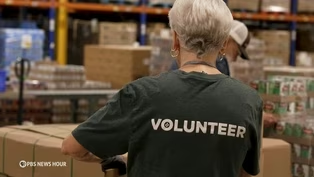
We spoke at another## hub for volunteers in the warehouse# of the Community Food Bank in Tucson.
ELISABETH CLEMENS: When we think about# volunteerism, we think about well-meaning## individuals who give freely of their time# and money.
And that's absolutely important.## But what it misses is the extent# to which the sort of governance of## American society was done by these groups.# These groups become powerful and critical.
JUDY WOODRUFF: What was it about the founding of# the country that left it important for American## citizens to come up with some of these structures# that would get the country up and running?
ELISABETH CLEMENS: Well, there wasn't much there,# right?
There wasn't much government.
And to have## a revolution to establish a government is# done by committees, some of which look very## voluntary.
So this idea that you can do public# action, whether it's responding to a natural## disaster or supporting an ally in war, that# you don't have to wait for government to do it.
NATALIE JAYROE, CEO, Community Food Bank: We# could not do what we do without our volunteers.
JUDY WOODRUFF: Natalie Jayroe is the# CEO of the Tucson community food bank,## which, on the day we visited, served 1,# 621 people with emergency food boxes.
WOMAN: Thank you.
JUDY WOODRUFF: What would it mean if these## individuals weren't giving# their tonnage to this place?
NATALIE JAYROE: A lot more people would be# hungry; 80 percent of everything that comes into## a food bank comes from private sources, and that's# private donations, that's food from manufacturers,## retailers, but that's also all the labor that# our volunteers give us on an everyday basis.
JUDY WOODRUFF: It's an idea# that Clemens says differs from## the European countries our founders left behind.
ELISABETH CLEMENS: In American political# development, there is a suspicion, I think,## of government doing too much, and so we have been# more reliant on ways of providing public goods## that don't look like government, even if there's# a fair amount of government hidden in them.
PEDRO TADEO, Volunteer, Community# Food Bank: I just like helping people.
MADDOX THOMPSON, Volunteer, Community Food# Bank: Everyone's not always goin.. fortunate as others, so being able to come# out here for a few hours.. of just help other people out just brings# me a little glow in life, a little light.
LINDA PETERSEN-VARGAS, Volunteer, Community# Food Bank: We're all part of a community.## We should be helping each other out and# doing what we can to help our neighbors.
TOM HUGHES, Volunteer, Community# Food Bank: think it's just a## national trait that we do# this.
Yes, it's unself.. JUDY WOODRUFF: All told, last year, volunteers# here donated more than 100,000 hours of their## time.
That's equal to the work of# nearly 50 full-time paid employees.
TIMOTHY SHRIVER, Chairman of the Board,# Special Olympics: What great volunteer## organizations do is remind you that you can make# .. JUDY WOODRUFF: Brothers Tim and Mark Shriver# have both harnessed the power of volunteers in## their work at international organizations like# the Special Olympics and Save the Children.
MARK SHRIVER, Board of Directors, Special# Olympics: People want to get involved.
I mean,## human beings are social animals,# right?
We want to be together.
We## want to do something that's good for the# community, good for your neighborhood.
JUDY WOODRUFF: They say they learned about the# value and power of service from their parents,## Sargent and Eunice Kennedy Shriver.# Sargent Shriver founded the Peace Corps## and then pivoted to fight President# Lyndon Johnson's war on poverty,## creating programs like Head Start and VISTA... NARRATOR: America needs VISTA volunteers.
JUDY WOODRUFF: ... or Volunteers# in Service to America.
He wrote about it all in a new posthumously# published memoir, "We Called It a War."
TIMOTHY SHRIVER: Daddy was a trained lawyer,## and he was a political realist and he was# very tough-minded.
But he also paid a.. of attention to our mom.
And she believed# as much in the goodness of volunteers.
She -- while he was building Head Start,# she was building the Special Olympics## movement.
So our mom was always telling# him, those scholars you like, Sarge,## from Harvard and Yale, don't forget# the teenagers.
Don't forget the moms.
JUDY WOODRUFF: Did you hear these conversations?
TIMOTHY SHRIVER: I heard that conversation.# He.. He wanted an American commitment to# ending poverty.
He knocked on as many## doors of Republican members of Congress# and the Senate as he did of Democrats.
JUDY WOODRUFF: Back in Patagonia, as in many# other small and mid-sized communities across## the country, volunteer fire crews save# the local government money.
Nationwide,## the time donated by volunteer firefighters# adds up to almost $50 billion a year.
This is a big responsibility# you're taking on.
It's dangerous,## and yet people still want to# do it and not be paid for it.
ZAY HARTIGAN: I think there's a# certain pride in just stepping up## and filling a need and not putting# a price on it.
It's priceless.
JUDY WOODRUFF: Volunteers in this department# come to the job from all different backgrounds.
But for Dan Goff and Annette Walker, their# reasons for volunteering are the same.
ANNETTE WALKER, EMT, Patagonia# Volunteer Fire and Rescue: This town## has been very gracio.. JUDY WOODRUFF: How has this town been good to you?
ANNETTE WALKER: My kids, my husband# -- I said it -- a couple years ago,## totally lost everything.
And then this department# gave them something to do, and then I joined in## right after.
It was my way to give back to# our town, who stood by us the entire time.
DAN GOFF, EMT, Patagonia Volunteer Fire# and Rescue: I will be up front with you.## And I know there's a stigma to this.
I'm# actu.. and being of service is sort# of part of that recovery.
So## it helps me with my -- tackling my# addictions and helping the community.
JUDY WOODRUFF: Wow.
That's# really powerful to hear.
DAN GOFF: I got Narcan, an apartment,## and was able to help people who were# in a situation like I .. JUDY WOODRUFF: So you're able to pay back.
DAN GOFF: Absolutely, and it feels great.
JUDY WOODRUFF: And from one of Patagonia's# longest-serving firefighters, Richard Connolly: RICHARD CONNOLLY, Volunteer, Patagonia# Volunteer Fire and Rescue: I think that's## part of the United States is#.. And to keep that tradition going and make it# even stronger, the more we can do, the better.
JUDY WOODRUFF: For the "PBS News Hour,"# I'm Judy Woodruff in Patagonia, Arizona.
GEOFF BENNETT: Like countless# powerful women throughout history,## Queen Elizabeth II was routinely underestimated.# But during her record-breaking 70-year reign,## she deftly managed the important strategic# relationship between the U.K.
and the U.S.,## meeting with 13 sitting presidents, more# than any other American or foreign leader.
USA Today's Susan Page traces# this and more in her new book,## "The Queen and Her Presidents: The# Hidden Hand That Shaped History."
I spoke with her earlier today.
Susan Page, welcome back to the "News Hour."
SUSAN PAGE, Author: It's#so great to be here.
GEOFF BENNETT: In this book, you make# the point th.. formal power over policy.
But you argue that she## was genuinely consequential.
What did# her influence look like in practice?
SUSAN PAGE: Well, you think about, say, her# first trip to the United States as queen.## It was in the aftermath of the Suez crisis.# Relations between the United States and the## United Kingdom were as bad as they had been# since the start of the special relationship.
And, somehow, through her# charm and her personality,## her connection with President Eisenhower,# she healed that wound.
And in the aftermath,## suddenly, relations kind of resumed# again.
It's not that she negotiated## with the president.
It's that she laid# the groundwork for the kind of special## relationship that was so important to# Great Britain and so important to her.
GEOFF BENNETT: You mentioned President# Eisenhower.
You describe her bond with## him as something special.
She knew him# when he was the wartime general before## he was president.
How did that# early relationship differ from## the ones she had with presidents she# met only in their official capacities?
SUSAN PAGE: So, she revered Eisenhower.
And he## was like an uncle.
She was a friend of her# father's.
They had had a real partnership.
But by the time you get to, say, President# Reagan, she is a peer.
And she and President## Reagan became, I think, as close as she# was to any of the 13 American presidents## she met while they were in office.# They were -- they bonded over horses,## as you might expect, and over Hollywood,# because she was an enormous fan of the## movies and had seen Reagan acting in# movies before he went into politics.
GEOFF BENNETT: That special relationship,# she saw maintaining that, you write,## as really central to her role.
How# conscious and strategic was she about that.
SUSAN PAGE: So she was, as it turned out, a deft# diplomat.
She was a smart politician.
She was a## shrewd judge of character.
And I think these are# things people didn't recognize in her in her,## because it was so behind the scenes.
She didn't# write a memoir.
She didn't give interviews.
But she did deal with presidents in a way## that protected the interest of# her country over seven decades.
GEOFF BENNETT: I didn't know# this until reading your book,## but she had access to extraordinary# intelligence briefings.
How did .. SUSAN PAGE: So, almost every day, she# would get briefing papers.
Every week,## she would get top secret intelligence documents.
And so, over the period of decades, she# was as informed about intelligence issues## around the world as any other person# for over a longer period of time than## any leader and even over issues, say,# contingency plans for a nuclear war.
GEOFF BENNETT: Really?
SUSAN PAGE: She was th.. plans were over that whole narrative -- over that# whole time when nuclear war was such a threat.
GEOFF BENNETT: You write that there# were presidents who were smitten by her,## to include Truman, Reagan, George W. Bush.
But# soft power can only go so far in many respects.
So give us an example where she tried to use# her influence, but it simply didn't work.
SUSAN PAGE: Well, no one was more smitten# with her than President Trump.
He told me## when I interviewed him for the book that his# -- one of his earliest childhood memories was## being 6 years old sitting next to his mother# watching Elizabeth being crowned on television.
And when Queen Elizabeth met# with him during his first term,## there were high hopes that this would lead# to a trade deal that would be beneficial to## Great Britain.
That didn't happen.
There# were other factors, of course, in that.
There was finally a trade deal.
It# was after her -- after her death.
So## it didn't it didn't mean that she always# delivered.
But she was very disciplined## and she was always out there trying to# deliver.
Winston Churchill told her,## "Stay close to the Americans.
"# And that is what she tried to do.
GEOFF BENNETT: That Trump meeting, you report# that a senior British official described the queen## wearing the Obama brooch on the day of President# Trump's arrival as a silent act of resistance.
That is a striking claim for a monarch# who was really studied in neutrality.
SUSAN PAGE: A rare example of that.
But this was a brooch that Michelle Obama# had given her.
She had worn it only once,## and that was for the reciprocal dinner with# the Obamas.
For seven years, she had -- it## had not been seen in public.
Then, on the# day that President Trump arrives in England,## she is in a formal meeting with some# religious leaders and she's wearing it.
And I think those close to her told me# there was no other way to interpret that## but to interpret it as a statement of# resistance to Trump and a statement of## support for President Obama, with# whom she was actually quite close.
GEOFF BENNETT: The queen, as you# mentioned, gave no interviews,## never wrote a memoir.
She kept a diary.
How# did you go about reconstructing her inner life?
SUSAN PAGE: So, watch what she did, not what# she said, because what she said was, let's## toast our special relationship.
She was never# critical in public of any American president.
But there were presidents she clearly liked# and wanted to spend time with, and there were## presidents she did not.
She spent a lot of time# with Reagan and a fair amount of time with George## W. Bush.
She spent very little time with Jimmy# Carter.
And I think there was a message there.
GEOFF BENNETT: You have covered Washington# for decades.
What did you learn about the## presidency itself, not just the queen, by# looking at 13 presidents through her eyes?
SUSAN PAGE: We think about the# force of history of historic events,## and maybe it's easy to forget the# power of personality and the way## in which these relationships can# really matter, can have an effect.
Thinking about the Falklands War, there were# some in President Reagan's administration## who didn't want to come down on the side of# Great Britain.
And the relationship between## the queen and President Reagan and his very# strong interest in that horseback ride in## Windsor Park contributed to the decision# to come down hard on Great Britain's side.
GEOFF BENNETT: Susan Page.
The terrific# new book is "The Queen and Her Presidents:## The Hidden Hand That Shaped History."
Always great to speak with you.
SUSAN PAGE: Oh, it's so nice to see yo.. As always, there's a lot more online,# including a look at the hidden reasons## airlines are raising bag fees for some# passengers.
That's at PBS.org/NewsHour.
AMNA NAWAZ: And that is the "News# Hour" for tonight.
I'm Amna Nawaz.
GEOFF BENNETT: And I'm Geoff Bennett.
For all of us here at the "News.. thanks#for spending part of your evening with us.
American pope's critiques of Trump hold weight, priest says
Video has Closed Captions
Pope Leo's critiques of Trump policies hold more weight as a fellow American, priest says (8m 36s)
Book explores Queen Elizabeth's hidden hand in history
Video has Closed Captions
New book explores Queen Elizabeth's relationships with 13 U.S. presidents (6m 46s)
Diplomats lay groundwork for new talks between U.S. and Iran
Video has Closed Captions
With U.S.-Iran ceasefire expiring in a week, diplomats lay groundwork for new talks (5m 1s)

Live Nation abused power and gouged consumers, jury finds
Video has Closed Captions
Live Nation and Ticketmaster abused monopoly power and gouged consumers, jury finds (6m 23s)

News Wrap: IRS says average tax refund just under $3,500
Video has Closed Captions
News Wrap: IRS says average tax refund just under $3,500 this year (5m 25s)
Trump’s DOJ moves to reverse Jan. 6 convictions
Video has Closed Captions
Trump's DOJ targets Jan. 6 convictions, broadens Fed construction site probe (5m 31s)
UN refugee chief warns war in Lebanon a 'catastrophe'
Video has Closed Captions
Israel’s campaign in Lebanon a 'humanitarian catastrophe,' UN refugee chief warns (6m 5s)
Why volunteering is a defining part of America's identity
Video has Closed Captions
Why the spirit of volunteering is a defining part of America's identity (8m 36s)
Providing Support for PBS.org
Learn Moreabout PBS online sponsorship
- News and Public Affairs

Today's top journalists discuss Washington's current political events and public affairs.

- News and Public Affairs

FRONTLINE is investigative journalism that questions, explains and changes our world.
Urban Consulate Presents










Support for PBS provided by:
Major corporate funding for the PBS News Hour is provided by BDO, BNSF, Consumer Cellular, American Cruise Lines, and Raymond James. Funding for the PBS NewsHour Weekend is provided by...