
Book explores Queen Elizabeth's hidden hand in history
Clip: 4/15/2026 | 6m 46sVideo has Closed Captions
New book explores Queen Elizabeth's relationships with 13 U.S. presidents
Like countless powerful women throughout history, Queen Elizabeth II was routinely dismissed and underestimated. But during her 70-year reign, she managed the strategic relationship between the UK and the U.S., meeting with thirteen sitting presidents. Geoff Bennett spoke with Susan Page, who traces this and more in her new book, “The Queen and Her Presidents: The Hidden Hand That Shaped History."
Problems playing video? | Closed Captioning Feedback
Problems playing video? | Closed Captioning Feedback
Major corporate funding for the PBS News Hour is provided by BDO, BNSF, Consumer Cellular, American Cruise Lines, and Raymond James. Funding for the PBS NewsHour Weekend is provided by...
Book explores Queen Elizabeth's hidden hand in history
Clip: 4/15/2026 | 6m 46sVideo has Closed Captions
Like countless powerful women throughout history, Queen Elizabeth II was routinely dismissed and underestimated. But during her 70-year reign, she managed the strategic relationship between the UK and the U.S., meeting with thirteen sitting presidents. Geoff Bennett spoke with Susan Page, who traces this and more in her new book, “The Queen and Her Presidents: The Hidden Hand That Shaped History."
Problems playing video? | Closed Captioning Feedback
How to Watch PBS News Hour
PBS News Hour is available to stream on pbs.org and the free PBS App, available on iPhone, Apple TV, Android TV, Android smartphones, Amazon Fire TV, Amazon Fire Tablet, Roku, Samsung Smart TV, LG TV, and Vizio.
Providing Support for PBS.org
Learn Moreabout PBS online sponsorshipGEOFF BENNETT: Like countless powerful women throughout history, Queen Elizabeth II was routinely underestimated.
But during her record-breaking 70-year reign, she deftly managed the important strategic relationship between the U.K.
and the U.S., meeting with 13 sitting presidents, more than any other American or foreign leader.
USA Today's Susan Page traces this and more in her new book, "The Queen and Her Presidents: The Hidden Hand That Shaped History."
I spoke with her earlier today.
Susan Page, welcome back to the "News Hour."
SUSAN PAGE, Author: It's }so great to be here.
GEOFF BENNETT: In this book, you make the point that Queen Elizabeth had no formal power over policy.
But you argue that she was genuinely consequential.
What did her influence look like in practice?
SUSAN PAGE: Well, you think about, say, her first trip to the United States as queen.
It was in the aftermath of the Suez crisis.
Relations between the United States and the United Kingdom were as bad as they had been since the start of the special relationship.
And, somehow, through her charm and her personality, her connection with President Eisenhower, she healed that wound.
And in the aftermath, suddenly, relations kind of resumed again.
It's not that she negotiated with the president.
It's that she laid the groundwork for the kind of special relationship that was so important to Great Britain and so important to her.
GEOFF BENNETT: You mentioned President Eisenhower.
You describe her bond with him as something special.
She knew him when he was the wartime general before he was president.
How did that early relationship differ from the ones she had with presidents she met only in their official capacities?
SUSAN PAGE: So, she revered Eisenhower.
And he was like an uncle.
She was a friend of her father's.
They had had a real partnership.
But by the time you get to, say, President Reagan, she is a peer.
And she and President Reagan became, I think, as close as she was to any of the 13 American presidents she met while they were in office.
They were -- they bonded over horses, as you might expect, and over Hollywood, because she was an enormous fan of the movies and had seen Reagan acting in movies before he went into politics.
GEOFF BENNETT: That special relationship, she saw maintaining that, you write, as really central to her role.
How conscious and strategic was she about that.
SUSAN PAGE: So she was, as it turned out, a deft diplomat.
She was a smart politician.
She was a shrewd judge of character.
And I think these are things people didn't recognize in her in her, because it was so behind the scenes.
She didn't write a memoir.
She didn't give interviews.
But she did deal with presidents in a way that protected the interest of her country over seven decades.
GEOFF BENNETT: I didn't know this until reading your book, but she had access to extraordinary intelligence briefings.
How did that work?
SUSAN PAGE: So, almost every day, she would get briefing papers.
Every week, she would get top secret intelligence documents.
And so, over the period of decades, she was as informed about intelligence issues around the world as any other person for over a longer period of time than any leader and even over issues, say, contingency plans for a nuclear war.
GEOFF BENNETT: Really?
SUSAN PAGE: She was the one person, I think, who was involved in, aware of what the contingency plans were over that whole narrative -- over that whole time when nuclear war was such a threat.
GEOFF BENNETT: You write that there were presidents who were smitten by her, to include Truman, Reagan, George W. Bush.
But soft power can only go so far in many respects.
So give us an example where she tried to use her influence, but it simply didn't work.
SUSAN PAGE: Well, no one was more smitten with her than President Trump.
He told me when I interviewed him for the book that his - - one of his earliest childhood memories was being 6 years old sitting next to his mother watching Elizabeth being crowned on television.
And when Queen Elizabeth met with him during his first term, there were high hopes that this would lead to a trade deal that would be beneficial to Great Britain.
That didn't happen.
There were other factors, of course, in that.
There was finally a trade deal.
It was after her -- after her death.
So it didn't it didn't mean that she always delivered.
But she was very disciplined and she was always out there trying to deliver.
Winston Churchill told her, "Stay close to the Americans."
And that is what she tried to do.
GEOFF BENNETT: That Trump meeting, you report that a senior British official described the queen wearing the Obama brooch on the day of President Trump's arrival as a silent act of resistance.
That is a striking claim for a monarch who was really studied in neutrality.
SUSAN PAGE: A rare example of that.
But this was a brooch that Michelle Obama had given her.
She had worn it only once, and that was for the reciprocal dinner with the Obamas.
For seven years, she had -- it had not been seen in public.
Then, on the day that President Trump arrives in England, she is in a formal meeting with some religious leaders and she's wearing it.
And I think those close to her told me there was no other way to interpret that but to interpret it as a statement of resistance to Trump and a statement of support for President Obama, with whom she was actually quite close.
GEOFF BENNETT: The queen, as you mentioned, gave no interviews, never wrote a memoir.
She kept a diary.
How did you go about reconstructing her inner life?
SUSAN PAGE: So, watch what she did, not what she said, because what she said was, let's toast our special relationship.
She was never critical in public of any American president.
But there were presidents she clearly liked and wanted to spend time with, and there were presidents she did not.
She spent a lot of time with Reagan and a fair amount of time with George W. Bush.
She spent very little time with Jimmy Carter.
And I think there was a message there.
GEOFF BENNETT: You have covered Washington for decades.
What did you learn about the presidency itself, not just the queen, by looking at 13 presidents through her eyes?
SUSAN PAGE: We think about the force of history of historic events, and maybe it's easy to forget the power of personality and the way in which these relationships can really matter, can have an effect.
Thinking about the Falklands War, there were some in President Reagan's administration who didn't want to come down on the side of Great Britain.
And the relationship between the queen and President Reagan and his very strong interest in that horseback ride in Windsor Park contributed to the decision to come down hard on Great Britain's side.
GEOFF BENNETT: Susan Page.
The terrific new book is "The Queen and Her Presidents: The Hidden Hand That Shaped History."
Always great to speak with you.
SUSAN PAGE: Oh, it's so nice to see you.
Thanks.
American pope's critiques of Trump hold weight, priest says
Video has Closed Captions
Pope Leo's critiques of Trump policies hold more weight as a fellow American, priest says (8m 36s)
Diplomats lay groundwork for new talks between U.S. and Iran
Video has Closed Captions
With U.S.-Iran ceasefire expiring in a week, diplomats lay groundwork for new talks (5m 1s)

Live Nation abused power and gouged consumers, jury finds
Video has Closed Captions
Live Nation and Ticketmaster abused monopoly power and gouged consumers, jury finds (6m 23s)
News Wrap: IRS says average tax refund just under $3,500
Video has Closed Captions
News Wrap: IRS says average tax refund just under $3,500 this year (5m 25s)
Trump’s DOJ moves to reverse Jan. 6 convictions
Video has Closed Captions
Trump's DOJ targets Jan. 6 convictions, broadens Fed construction site probe (5m 31s)

UN refugee chief warns war in Lebanon a 'catastrophe'
Video has Closed Captions
Israel’s campaign in Lebanon a 'humanitarian catastrophe,' UN refugee chief warns (6m 5s)
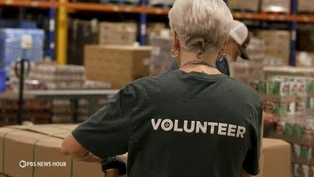
Why volunteering is a defining part of America's identity
Video has Closed Captions
Why the spirit of volunteering is a defining part of America's identity (8m 36s)
Providing Support for PBS.org
Learn Moreabout PBS online sponsorship
- News and Public Affairs

Today's top journalists discuss Washington's current political events and public affairs.

- News and Public Affairs

FRONTLINE is investigative journalism that questions, explains and changes our world.
Urban Consulate Presents










Support for PBS provided by:
Major corporate funding for the PBS News Hour is provided by BDO, BNSF, Consumer Cellular, American Cruise Lines, and Raymond James. Funding for the PBS NewsHour Weekend is provided by...