
Red Butte Garden & Arboretum, Hour 1
Season 30 Episode 1 | 52m 24sVideo has Closed Captions
ROADSHOW celebrates an all-new Season 30, kicking off with a stop in Salt Lake City, UT!
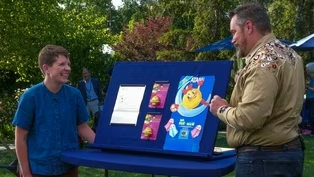
ROADSHOW celebrates an all-new Season 30, starting with a stop in Salt Lake City! Discoveries include German candy containers, ca. 1910, a Donegal Arts & Crafts carpet and a 1937 “The Hobbit” first UK edition. Which find is valued at $100K?
Problems playing video? | Closed Captioning Feedback
Problems playing video? | Closed Captioning Feedback
Funding for ANTIQUES ROADSHOW is provided by Ancestry and American Cruise Lines. Additional funding is provided by public television viewers.
Support provided by:


Red Butte Garden & Arboretum, Hour 1
Season 30 Episode 1 | 52m 24sVideo has Closed Captions
ROADSHOW celebrates an all-new Season 30, starting with a stop in Salt Lake City! Discoveries include German candy containers, ca. 1910, a Donegal Arts & Crafts carpet and a 1937 “The Hobbit” first UK edition. Which find is valued at $100K?
Problems playing video? | Closed Captioning Feedback
How to Watch Antiques Roadshow
Antiques Roadshow is available to stream on pbs.org and the free PBS App, available on iPhone, Apple TV, Android TV, Android smartphones, Amazon Fire TV, Amazon Fire Tablet, Roku, Samsung Smart TV, and Vizio.
Buy Now

ANTIQUES ROADSHOW's 2026 Production Tour
Enter now for a chance to win a pair of free tickets to one of the three stops on ANTIQUES ROADSHOW's 2026 Tour. Sweepstakes entry deadline is April 6.Providing Support for PBS.org
Learn Moreabout PBS online sponsorship♪ ♪ CORAL PEÑA: "Antiques Roadshow" is finding flowers and vintage finds in full bloom at Red Butte Garden in Salt Lake City.
I think my dad hosed it off in the sink to get some of the dust off once, so I'll tell him not to do that again.
(laughs) ♪ ♪ PEÑA: "Roadshow" has landed at Red Butte Garden and Arboretum, where the diversity of plant life is astounding.
Part of the University of Utah, the garden has been open to the public and growing in every way since 1985.
This interface of urban and wild land includes 21 acres of managed landscape with about 75 acres of natural area.
"Roadshow" cameras are ready to record as the lines of eager treasure seekers weave around the flower beds and our experts inspect every object brought to this gorgeous garden.
Which ones were picked for you to see?
Take a look.
♪ ♪ What do you think this was used for?
♪ ♪ I brought in an Egyptian Revival coffee pot.
We're not really quite sure where it's from or when it's from, so we're excited to get it appraised.
I brought a platter of some kind.
Um, it was in my grandpa's house for as long as I can remember, and we don't know really that much about it.
When I first saw this, you, you brought it to the table and you, you peeled back the, the packaging, and my heart kind of skipped a beat just a little bit.
(chuckles) Because I knew instantly what it was and where it was from.
Great.
And it's just such a beautiful example.
This is a Viennese silver, enamel, and rock-crystal presentational centerpiece, or charger, dating from around about 1880, and we attribute it to the very, very successful maker called Hermann Böhm.
Okay.
And he was most well-known for this Renaissance revival.
Mm-hmm.
Which is what we're looking at here.
When my colleagues and I looked at it, the first thing that we were really taken by is that at first glance, the panels appear to be glass.
Mm-hmm.
But in fact, they're not.
Oh.
They're made of rock crystal.
Oh, wow.
Okay.
In fact, it's a variation of quartz.
Mm-hmm.
And in one of these panels, you can just see one of the internal fractures... Mm-hmm.
...that helps us identify that it is rock crystal.
Wow.
It's meticulously carved.
Mm-hmm.
It's got this beautiful silver and enamel decoration throughout, uh, with, with putti, cherubs, winged figures, uh, satyr masks-- you name it, it's, it's all there.
And then centered by these beautiful, uh, maidens within cornucopias.
Mm-hmm.
It's just really fabulous.
One of my favorite things about this is the way it's made.
Each individual bolt here represents one of the pieces that's been applied to the front.
Okay.
That's a real reflection of the craftsmanship.
Mm-hmm.
Surrounding each panel of rock crystal, you have this little decorative framework, as well.
And perhaps one of my favorites and the most unseen are the feet.
Mm-hmm.
These beautiful, uh, hairy paw or lion paw feet with enamel decoration.
It's also incredibly big.
Yes.
It's a really large example.
This is nearly 22 inches in diameter.
Um, have you ever had it appraised?
No-- nope.
It's just been sitting, gathering dust.
(chuckles) So, I'm glad you said, "Gathering dust."
It's dusty.
(chuckles): Uh, yes.
It could do with just a little bit of love, uh, like... I, I think my dad hosed it off in the sink to get some of the dust off once, so I'll tell him not to do that again.
(laughs) With a little bit of love and a little bit of cleaning, I think, if I were to see this come up at auction, I would feel very comfortable with an auction estimate of $30,000 to $50,000.
(chuckles): Oh, wow-- oh, my gosh.
Wow.
Um, uh, we had no idea.
That's incredible-- we've always loved it.
I always loved the little jewels as a, as a kid.
I always thought it was beautiful, but... Uh, wow.
That's amazing.
(laughing) Wow.
(sniffles) (chuckles softly) I'd recommend an insurance value of $60,000.
(inhales) Wow.
Okay, so... No more hosing it off.
(laughs) My husband has lugged it around all day today, so I'm glad it was worth, worth the effort.
(laughs) We got it at an estate sale around here.
Yeah.
And we just loved it, and we always need it somewhere where we can see it, because we actually just love it.
You can't really tell what the signature says, but the frame is worth about the same price as the painting, so... (laughs) Yeah.
It's good.
I actually don't know a ton about it.
That's actually why I wanted to bring it.
Um, my grandmother was an avid antique collector, and she was from England, so she actually bought this in England.
And then when she moved to America, she brought it over with her.
It's always been referred to in my family as "the monk's bench."
I brought you Pennsylvania German birth certificates.
They've been in our family forever.
This one is my great-great-grandfather.
The one on, uh, the other side is my great-great-grandmother.
And then this is my great-great-great-grandmother.
This is her son.
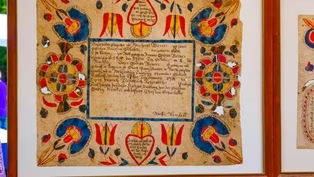
Well, you have brought three wonderful examples of Pennsylvania frakturs.
There was a huge immigration into Pennsylvania in the 18th and the 19th centuries, and one of the wonderful traditions that was brought to America was the tradition of making frakturs.
And the two large ones are by a very well-known artist whose name is down here at the bottom, Martin Brechall.
And he worked throughout Pennsylvania, in Lehigh County, Berks County, making these birth and baptismal records.
The one that's next to you, we have the birth certificate of Gideon Barner, who was born 1810, baptized 1811.
This would have been probably created in 1811.
This fraktur commemorates the birth of Hannah Bear.
She was born in 1813, baptized in 1814.
So, we know that because it also says "Lehigh County," Lehigh County wasn't incorporated until 1812.
Oh.
So we know that it was actually produced 1812 or later.
Mm-hmm, mm-hmm.
Martin Brechall was a very prolific artist.
We see a lot of wonderful frakturs by him.
Mm-hmm.
And this is classic Brechall.
They're very, almost, really primitive, very naïve-looking, and that's what makes them great folk art.
Now, the one up at the top... Mm-hmm.
...that is by a, a, a quite well-known artist... Oh.
...that, at the moment, does not have a real name.
Hm.
Some people think it might be Henry Wetzel, but they call him the "Dotted One Artist," and that's because of the exclamation mark... Oh.
...after the title.
And it's classic, with this asymmetrical flower... Mm-hmm.
...and this ground patch... Mm-hmm.
...and then these abstract shapes along the border.
This fraktur is for Elizabeth Old, born in 1774.
She was baptized in 1774.
But because we have Lehigh County mentioned there-- that's Lehigh County spelled the German way-- we know that this couldn't have been done before 1812.
So, decades after she was born, they produced this fraktur, which was quite common in Pennsylvania.
Mm-hmm, mm-hmm.
And even though that's smaller... Mm-hmm.
...that's really a more rare fraktur.
Oh, okay.
So, these are all hand-painted, they're not printed.
Mm-hmm.
And they're made of ink and watercolor.
It, it wasn't until the 1820s and 1830s that they started making them... Okay.
...using a printing press to make part of them.
Mm-hmm.
They've suffered a bit condition-wise.
Mm-hmm.
So, that does affect value.
Mm-hmm.
They are bright, the colors are bright.
That's a wonderful thing.
But they, the condition does... Mm-hmm.
...affect their value.
I know that you're probably never going to sell, though, right?
No-- I have two children.
Oh.
I'm going to hand them down.
I'd put an insurance value on each of these two, the, the Brechalls, of $3,000.
Okay.
So, $3,000 each.
Mm-hmm.
And on the Dotted One, I'd put an insurance value of $4,000.
Okay, thank you.
This water conservation garden, where I'm standing right now, I would consider this our flagship garden.
It's a place where people can come and learn about responsible gardening practices in an arid, high-mountain desert.
An arid garden can be lush and colorful.
And it is.
And so we want to show people you don't just have to have rocks and cactus.
The other thing is, this is essentially a three-acre stormwater management system.
So, we try to collect and capture any rain we can get, 'cause we don't get much, and we want to make sure it absorbs into the ground.
So, every one of these gardens is built into a basin, and as one fills, it goes into the next one, into the next one, into the next one, and ultimately feeds our oak groves down at the bottom of the hill as it transitions its way down.
It's a combination of both native plants and plants that are really well-adapted to the region.
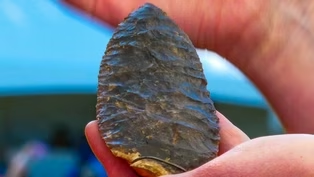
I brought a spearhead.
I found it on my folks's property out of Mandan, North Dakota, in about 1947.
How old were you when you found it?
Oh, you'd ask that.
(laughing) (chuckles) Oh, I must have been about... Good God.
(chuckles) (laughs) Uh, I think I was seven or eight.
Do you have any idea who made it, time period?
No-- no.
No.
No guesses?
No gue... (chuckles) Well, I know it's flint.
Mm-hmm.
Or I think it's flint.
Okay.
And I don't know which tribe it was made it.
So, this predates tribal affiliations of any kind.
So, we're going to go pre-contact period here.
Oh, okay.
So, we're going to go to about 8000 BC.
What?
(laughs) So, we're going to date this to the Archaic to Woodland period.
8000 BC at the earliest to about 1200 A.D.
At this point in the pre-contact time, archaeologists are grouping Indigenous people by technology.
So, the Archaic period, we're just coming out of the Ice Age.
The continent's warming.
The game that they're hunting is smaller, so they're readjusting to that kind of life.
And then, when you get into the Woodland period, you get the introduction of pottery and the introduction of agriculture.
Mm-hmm.
So when we're dating points of any kind, we're looking at the form, we're looking at how this is made, the shape, the shape of the base.
But because this doesn't fall into a specific type, we're giving it a broader range.
So, the other really fun thing about this is, it's a very specific flint to North Dakota.
It's called Knife River flint.
It's only found in a small area along the Knife River in Western North Dakota.
I didn't know there was a Knife River.
(laughs) And the really cool thing about this... ...if you haven't done this, shown it to the light, it's translucent.
Really?
Mm-hmm.
So, Knife River flint is very highly collectible because of the translucency, and it was highly prized by Indigenous cultures.
Do you have any idea on the value?
(laughing): No, I haven't even come close.
If I can't come close on... (laughs) ...time-wise... I have no idea.
So, conservatively, if this were to come up to auction, I would expect it to bring in the $2,000 to $4,000 range.
Hm.
Hm, that's pretty good.
That's pretty good-- thank you.
I brought in some, uh, skis that belonged to my grandfather.
We don't really know much else about 'em.
Just that they're from probably around the '30s, maybe?
GUEST: This is a 1968 Fender Telecaster Bass.
The original owner had passed away.
His wife was selling off his gear.
So I picked it up from her, met her in a music store.
I paid about $2,200.
I'm very lucky and fortunate to have it.
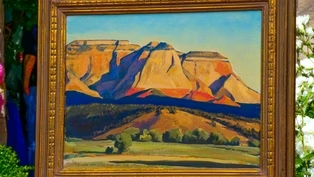
(laughs) GUEST: This painting was a painting that my grandfather was given.
It was given by Maynard Dixon himself.
Maynard Dixon had a studio and lived in Mount Carmel, Utah, part of the year and then, I understand, in, uh, Tucson, I believe.
Mount Carmel, Utah, would be right here on the, up the road from this scene.
So, this is looking east from Mount Carmel, where his studio would, would've been.
Probably three hours, three-and-a-half hours south of here.
It's on the east side of Zion National Park.
He had gotten himself caught and stuck in a bog of some kind, a muddy, muddy spot in a country road.
And my grandfather just happened to be out there.
He had a small farm there, and, uh, was able to pull Maynard Dixon and all of his stuff out of this muddy bog.
And a few days later, Maynard showed up on his doorstep and gave them this painting.
Wow.
So, were they friends?
Did they know each other before this, this encounter?
W, what I understand from what my father said is, everybody knew who Maynard Dixon was.
He was the odd man that everybody knew was kind of famous, but they didn't know exactly why he lived down there.
My father passed away in 1991, and so I've had it since then.
It's a wonderful painting, and it's a better story.
Maynard Dixon was born in California in 1875.
Had kind of a journeyman life.
Mm-hmm.
Lived in San Francisco, left San Francisco after the 1906 earthquake... Oh.
...destroyed a lot of his earlier work.
He was, um, he started off as an illustrator, as a lot of these artists did.
Right.
He was pretty much self-taught.
He did go to art school in San Francisco, but he only was there for about three months, and then stopped.
He traveled around, painting in different parts of California.
He eventually discovered Arizona and the West, and fell in love with the Southwest, with Native American culture.
He did paintings of Native Americans.
In 1939, he moved to this area... Okay.
...of Utah with his wife.
And they also had a place in Tucson, which you mentioned.
The climate was drier there, and he had some health issues.
This is an oil on board.
Okay.
It's, uh, 12 by 16 inches, which is kind of a standard size.
Artists would buy these artist boards that they could carry with them.
It's a wonderful example of his later style.
He died in 1946.
He inscribed it on the back, as well.
Well, it has his name and address.
I believe this is the original frame.
About 25 years ago, or 30, I, I did take it in to the curator of, of the B.Y.U., uh, art museum, and they took a photo of it.
They wanted to catalogue it.
They told me at the time it w, that it should be worth from $10,000 to $15,000.
The insurance value for this painting would be $50,000.
Oh, my gosh.
(laughs) Well, I hope we never have to collect... (laughing): ...on that insurance policy, but... I, uh, yeah.
I just, I like it because of the history.
My father was really attached to this painting, and, uh... (chuckles): I'm blown away.
Dixon's auction record is, uh, over $2 million.
Wow-- oh, my.
GUEST: I got this carpet from my mother.
APPRAISER: Okay.
And it was part of her grandmother's dowry.
Okay.
She had it for about 40 years.
Well, I'll fill in some of the blanks for you.
Okay.
Um, the rug is in the Ushak style that... Okay.
Ushak rugs were decorative carpets woven in Turkey.
Okay.
Going back to the 15th century.
They were very popular throughout Europe in the late 19th and early 20th century.
Alexander Morton and Company was a Scottish firm that made textiles.
So, they were approached... Okay.
...by the Congested Districts Board of Ireland.
Their purpose was to promote industry in some heavily populated areas.
Okay.
The board went to Alexander Morton and Company and proposed that they would set up looms in the town of Killybegs, in County Donegal in Northwest Ireland.
And they were promising affordable labor, subsidize the construction of multiple factories, and provide a deep sea port for shipping their carpets all over the world.
So it was a great offer, and Morton and Company jumped at it.
So, starting around 1900, they were, started weaving pile carpets like this, in the Ushak style, with an Arts and Crafts influence, in Killybegs, Ireland.
Okay.
Okay?
Now, Morton and Company had their own designers, and the design of this carpet was done by Gavin Morton and G.K.
Robertson.
Wow.
And in their designs, really, what they wanted to do was show the contrast between the intricate floral elements and plain areas of color, a more dramatic effect to the eye.
So, do you have any idea how much this carpet is worth?
Well, I know it's a special rug.
I, as far as how much it's worth, I was told by a rug guy that I took it to in Eureka that it was worth about $3,000.
Okay.
My boyfriend thinks it's worth $2.2 million.
$2.2 million.
(laughs) This is a pretty big range, between $3,000 and $2.2 million.
Yeah.
This Donegal carpet, in auction, would sell for between $20,000 and $30,000 today.
Wow.
Yeah.
Wow.
So, thank you so much for bringing it in.
Wow, that's great.
Thank you so much.
Thank you.
This was my great-grandfather's pocket watch that he got when he retired.
Uh, he was a steel man.
(chuckles) Um, I don't know much about it, other than, I looked up the serial number, and apparently, it was made in 1905.
I saw it in a vintage store window as I was driving down the street.
I stopped, I parked, I went in, I bought it.
PRODUCER: How much did you have to pay for it?
$90.
I'm hoping that somebody's horse, favorite horse died, and... (laughing): And then they did this.
But who knows?
That's really all I know about it, um, 'cause I haven't had it that long.
It's not a family heirloom or anything, but maybe for my grandkids.
(laughing) This is a painting by Jane Stuart, who was the daughter of Gilbert Stuart, who did all the famous George Washington paintings in, during the colonial period.
And on the back, it says "Miss Sarah Hart."
I don't know who Sarah Hart was.
And so that's what this is.
I keep them up year-round, but I have a special place in the entryway for holiday items.
So, I love the holidays.
These are decorative candy containers.
They're holiday, uh, decorations or ornaments.
Mm-hmm.
But they served a purpose that you could actually store a small biscuit, cookie, a candy inside.
Mm-hmm.
So you can give the item to the child, they'd have a sweet and a snack, and then it became a decoration thereafter.
I'll actually show you on this one here, so... She detaches in half.
And this would be the storage container.
This one is a quite large example.
Yes.
And you can see, the size of his candy head... Yeah.
...is much larger.
A lot of room for candy in there.
A lot of room for a lot of candy.
(laughs): Lots of cookies, yeah.
He is much larger than we commonly see for a seated bunny candy container.
Are they glass eyes?
They, they are glass eyes.
Each of these is more or less handmade.
There are molds.
Mm-hmm.
But they're all handmade, hand-painted, and hand-dressed.
Wow.
So there'll be slight variation to each one.
And they're primarily made of either a pressed cardboard, sort of a composition or papier-mâché material... Mm-hmm.
...and then a lot of the cloth material, fabric, is a, a felt-like material.
And each of these, I believe, was made in Germany.
Mm-hmm.
They were most likely made for a number of years, several decades, even.
Mm-hmm.
So, a comfortable circa is some time between 1900 and 1920.
Highly collectible.
Many of these were made in numerous different sizes.
So this is a fairly large bunny.
Mm-hmm.
About a medium-sized witch, and that's a small Santa.
The value ranges, and condition is very important.
However, they display lovely.
Collectively, you have an auction estimate value here of $8,000 to $12,000.
Oh, wow!
Wow, that's great!
That's great news!
Which one would you say would be the most valuable?
Uh, at this present time, Halloween is a very hot field.
Oh, really?
It is.
Okay.
Christmas has always been the king, but right now, Halloween is... Halloween's hot.
...taking a position.
Okay.
So, this witch at auction could easily fetch $3,000 to $5,000.
Oh, wow!
I'll have to look for more witches.
(chuckles) Yes, but I, I think I'll have to keep her, though.
I got it at a thrift store.
I was looking for frames, actually, 'cause I'm an amateur artist, and I saw this old frame, and it had been painted black.
Had overpainted the painting, as well.
But I bought the frame.
I paid, uh, three dollars for it.
And that was about ten years ago.
I took it home and deframed it, and, uh, I could see the color on the edge of the, uh... Where it was overlapped, it was still bright.
So I got some acetone and cleaned it up.
And I got down to the signature, and didn't know who that was.
Looked it up on the internet, and I said, "Oh, he's a known artist."
(laughs) Right.
Good for you.
So that was fun, yep.
Yeah, well, you found something nice.
This is a painting by Edgar Payne, and it depicts the Canyon de Chelly in Northern Arizona.
It's an oil on canvas board, and probably executed in the 1930s to early 1940s.
Edgar Payne was born in 1883 and he died in 1947.
He only studied art briefly at the Art Institute... Mm-hmm.
...of Chicago.
He was mainly self-taught, and earned a living painting murals and signs and houses.
And then, eventually, in 1917, he got a big commission through the Santa Fe Railroad to go to tour the Southwest and paint, as a form of advertising.
Mm-hmm.
And that's the first time that he visited the Canyon de Chelly.
And he loved it so much that he revisited over and over again, until the early 1940s.
Mm.
One thing that is notable about these paintings is the majestic mountains and the colors that he used.
He was known as a plein air painter, and he would go outdoors and paint at all different times of the day.
Mm-hmm.
And another thing that he's known for is the scale and the discrepancy in the scale of the mountains and the figures.
Oh, really?
(chuckling) Do you have any idea, um, what the value is on something like this?
Uh, no.
Have you researched it, it at all?
Well, a local art dealer in our town, he offered me, like, 14K for it after I found out who the painter was.
Yeah.
But I wasn't interested in selling it, so... Well, uh, at auction, it would easily sell within the range of $15,000 to $25,000.
Okay.
Many of these paintings ha, that have come up for auction have gone for much more, in the 30s and even low 40s.
That was a good three-dollar investment, anyway.
(laughing) Right.
PEÑA: With Salt Lake City's hot summer days and cold winter nights, some plants here get to live their best lives indoors year-round.
KARA HASTINGS: We are in Red Butte's original greenhouse.
It was built in 1992.
This greenhouse specifically is our cacti greenhouse.
Um, we let the temperatures fluctuate a lot more than our traditional greenhouses.
We have lots of agave.
Um, we have opuntia, which is prickly pear, which is very common in the region.
We have a, an assortment of native and non-native cacti.
PEÑA: There are over 150 prickly pear species worldwide.
My grandfather was born in 1922 in Schwarza, Germany.
He's Jewish, and the 1930s weren't a good, good time to be Jewish in Germany.
When he was 16 years old, he was able to take a train, the Kindertransport, to England, which really saved his life.
He was one of, I think, several hundred people who were able to do so.
And then, within a few years, he joined the Pioneer Corps.
He was eventually able to join a combat unit after Winston Churchill realized that there were a number of German-born Jewish individuals who were considered enemy aliens in England.
But they spoke fluent German, and they could actually be assets in war.
Many of his comrades were, um, their parents and siblings and aunts and uncles died in the concentration camps.
So these individuals wanted nothing more than to fight the Nazis.
When the opportunity presented itself to actually join a combat troop, he had, I think, minutes to decide whether or not he wanted to join.
And then, upon joining, had to change his name, uh, change his origin story.
So overnight, being a German, he became English.
He joined the Church of England.
And, um, he could never tell a soul his true identity.
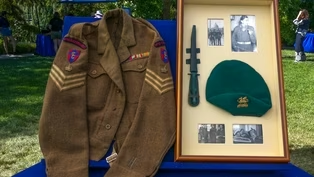
So what you brought is a World War II No.
10 Commando archive.
When you think about it, we, we don't have reconnaissance satellites at that point in history.
There's limited aerial reconnaissance available.
A lot of what was going to happen needed to be planned based on human intel, hands-on.
And who better to do that than commandos?
These folks needed to be problem-solvers.
They needed to be able to think on their feet and think creatively, because if you go across the channel, courtesy of the Royal Navy, who would insert them, and you get caught in bad, it's up to you.
Nobody's coming to save you.
You have to figure it out.
They needed a very special group of young men to do this.
He did leave you a legacy-- he left us some artifacts.
For instance, the uniform.
It's a British battle dress jacket with these No.
10 Commando titles.
Now, do you know which troop he was in within No.
10?
I believe he was in Troop 3.
Troop 3 was the troop that was primarily made up of Germans who were Jewish.
Mm-hmm.
Casualty rate among No.
10 Commando and No.
3 Troop, I believe I've seen references to 50%.
Wow.
So there just really isn't that much of this material out in the world.
He's a staff sergeant, and you have the '39-'45 ribbon bar, you have the Italy bar, and then his, uh, Defence bar.
So apparently, he made some raids in Italy, as well.
Wow, I didn't know that.
You've got photographs of him while he's serving.
Here he is wearing the beret.
Got his, uh, Fairbairn-Sykes commando knife.
There's a lot to this that gives us at least hints of where he was and what he was doing.
These were some of the few people who had an opportunity to train and go do something about it.
And it just gives you goosebumps.
It does.
Being in the presence of that material.
That cultural and historical value translates through to monetary value, as well.
If we were to put an insurance value on this set, this would fall very easily into the $20,000 to $25,000 range.
Wow.
Never really thought about how much it would be worth monetarily, uh, because it is so sentimental.
That's amazing.
This is the kind of stuff that movies are made of, the things that these guys did.
Yeah.
I got it as a gift from a friend.
They, uh, got it from an old, uh, video rental place in a grocery store.
And when, uh, they were shutting it down, he got to keep all the movie signs, and gave me this one, 'cause I'm a big Trekkie.
(chuckles) It's from, uh, the movie "Star Trek: Generations," where Kirk and Picard teamed up.
And, uh, yeah, we just, uh, put a light behind it and have it in our basement right now.
This is a sewing machine that belonged to my great-grandmother, um, passed down to her daughter, and her daughter, and now me, so... It's just been sitting on a shelf.
(laughs) I think my mom was the first one that put it on a shelf.
And now it's my turn.
(laughs): It's a solid chunk, just metal here.
My parents were big collectors, and they loved Japan.
They made numerous trips there.
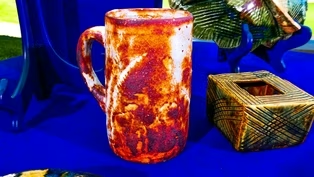
They had a large collection of what I believe is Rosanjin pottery.
They sold most of it in the early '70s, and it was this glaze here.
So this is the remainder of the collection that they had.
Ah!
Oh, really?
And what do you know about Kitaoji Rosanjin?
Well, I know he was a poet, a chef.
These have been family friends since I've been a child.
And this vessel was always outside with the lemonade and a bamboo dipper.
And I can't tell you how many floral arrangements my mother and I did in this vessel.
Um... So it's, it's very special to me.
Where did they buy these pieces?
I believe they bought them directly from the artist.
Kitaoji Rosanjin was born in 1883.
Mm.
And he died in 1959.
Kitaoji Rosanjin was a, an extremely important, seminal artist in the whole sort of history of modern, contemporary Japanese ceramics.
He, uh, was also a calligrapher, he was a painter, he was a poet, and he collected classical Japanese ceramics.
Hm.
And his collection was destroyed in the Tokyo earthquake in 1923.
And so after that, he decided to make his own, his own ceramics.
He received various honors, the last in 1959, when he was named a national treasure... Mm.
...which he refused.
I heard that.
All of these Japanese, uh, forms-- Bizen ware, Oribe ware-- all of these are reflected in the five pieces that you have here, the, the most outstanding of which is your well.
Okay?
Actually, when you look back in Chinese history, this is modeled after a Han Dynasty second-century BC to A.D.
prototype.
I understand that you drink out of this, you said?
I do, weekly.
(laughs) It goes through the dishwasher.
And what about this piece?
I think it's an ashtray, but I'm not sure.
It's actually an incense burner.
Oh, it is?
Yes, and it probably originally had a silver cover.
Oh.
You have various dishes that were part of his whole display for his kitchen.
Mm.
And he used them in his restaurant.
Mm-hmm.
This is, it... Regardless of the damage, and there is a restoration here, and I think one in one of the handles here... Mm-hmm, here.
...this is probably the most unusual piece of the collection-- all of them are signed with his characteristic signature, which is a ro, it's like a square.
Mm-hmm.
I think all of these pieces were made in the 1950s.
I understand you don't have the boxes, right?
No.
At auction, this piece alone is worth between $6,000 and $8,000.
(chuckles) Wow-- even with the damage?
Yes.
Altogether, I would say your five pieces would constitute about $10,000 to $15,000 at auction, regardless of whether you have the signed boxes.
Wow.
Ah, soo.
(both laughing) Domo arigato!
Yeah, do itashimashite.
(both laughing) These pieces are quite rare.
You don't see them come up at auction very often.
Hm.
GUEST: My wife and I went to a little consignment shop and I saw this, and I went, "Whoa, this thing, that can't be real," I didn't think, 'cause the colors were so beautiful.
So I asked the lady, I said, uh, "How much is it?"
And she says, "Well, that depends.
"'Cause the old gentleman that's consigning it "wants somebody to love and treasure it, 'cause it's got a lot of sentimental value to it."
He was a gentleman in late 80s or early 90s.
He was pretty old-- he was born in that town.
When he was in his teens, he had an uncle that owned an antique shop down in Los Angeles.
And he said he'd come across a print, and, uh, he said he didn't like the frame on it.
So he asked if he could send the frame up, and could the kid build him a new frame for it?
And then within a week or two after he got it, his uncle passed away unexpectedly, at a young age.
So he kind of just put it, this print, into the garage.
And for the next 70-some-odd years, through multiple marriages and divorces, he always carried this with him, because it reminded him of his uncle.
And he decided to disassemble it.
When he did, this was the backing.
I would have loved to be there for, for his reaction.
(chuckles) When you're peeling back the print that's been there that you think nothing of.
Right.
And you go to get something out of a frame, and lo and behold, this is hiding behind it.
Yeah.
What did you have to pay, if you don't mind me asking, for this one?
$450 for it.
So this is a late-19th-century cigar advertising sign depicting Henry George, uh, made for the Hirschhorn, Mack, and Company, uh, makers based out of New York.
Now, Henry George was an economist, he was a social activist, he was a journalist.
He was regarded at one point as one of the most popular individuals in the United States.
Wow.
Um, known for a book entitled "Progress and Poverty."
He spoke to your common man, he spoke to your laborer, he spoke to your working Joe that was going through the Industrial Revolution.
Right-- okay.
And we can date it pretty concretely to about 1895 to 1900.
And if you look down here at the very, very bottom, the Tuscarora Advertising Company.
They were established in mid-1880s, and they originally started off by selling burlap bags with logos... Okay.
...on them.
Sure.
And they quickly progressed, as technology advanced, to doing signs, to doing anything and everything in advertising.
These were the people that were doing Coca-Cola signs, that were taking orders from all around the country... Okay.
...for advertising signs.
So this sign is a single-sided tin sign with embossing that has lithography on it.
Okay.
Now, they took it a step further, um, and really pioneered offset lithography.
Now, that added an additional step where, once that original plate was made, they would transfer the image to a sheet of rubber, and then roll the rubber containing the image through a press that would then press it onto metal without destroying the original plate.
Right.
So they could do a lot more volume, um, they could be a lot more detailed, and the rubber was more forgiving.
As you're rolling over a hard metal surface, imagine if you're trying to press that into a stone.
Right.
It's not gonna go so great.
So you've got great subject matter with an important American figure.
Right.
You've got cigars, which appeals to tobacciana collectors... (laughs) ...and, quite frankly, most people with a man cave, right?
Right, there you go.
It's an attractive subject with a prominent American individual.
If this sign came up to auction today, I would put a conservative auction estimate on it of $4,000 to $6,000.
Wow-- wow.
Okay, that's, uh, pretty cool.
I went to a yard sale, and I wasn't even looking for this.
I was looking for some yard art.
And after I bought a big chicken for my yard, the lady said, "I have some other stuff in the back, if you want to look at it."
And I said, "Sure," and this was sitting there.
I picked it up, yeah.
$100-- I think I got a pretty good deal.
Um, I found it at an estate sale a number of years ago.
It's a, to the best of my knowledge, a Seth Thomas clock from, uh, about 1913, 1915.
Uh, not sure if that's accurate or not.
Not sure if it's authentic or not.
Been wanting to have it looked at to see if it's worth getting fixed up and getting running again.
And it's actually the same era as my house.
So, matches the decor.
PRODUCER: And how much did you have to pay for it?
Uh, like, ten dollars?
GUEST: We were at a video game convention in 2012, and we were listening to a panel conversation, and one of the people there was Steve Golson, who was one of the developers of the game that would become Ms.
Pac-Man.
He seemed like an affable guy, and we thought, "Let's go see if we can talk to him."
And we had had a Pac-Man wedding cake at our wedding, and we went up to him... (chuckles) ...and said, "Hey, we love this game.
Can we show you a picture of our wedding cake?"
(laughs) And he said, "Yes," and he loved the picture so much, he asked me to email it to him so he could show the other people who worked on the game with him.
After that email, he reached back out and said, "Hey, can I have your address?"
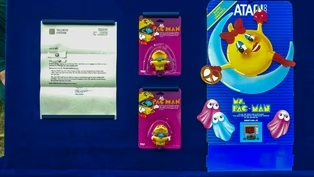
And then, a couple weeks later, these items showed up in the mail.
What's the content of the letter?
It's kind of describing when we met him... Mm-hmm.
...and that he enjoyed seeing the photo of our wedding cake, and then, talks about these items that he's included.
They're little windup Pac-Man toys.
In the letter, he describes that he bought them and then gave them to other people who worked on the game.
Mm-hmm.
And then he also mentions that the display came from his personal collection, which I thought was a really lovely detail for him to include.
And then he signed it for us.
Did you play Pac-Man growing up?
Oh, definitely.
Yeah.
I had parents who definitely taught me all the tricks of... Mm-hmm.
...of Ms.
Pac-Man, in particular.
Mm-hmm.
Many a quarter... Mm-hmm.
...spent at the arcade.
The original Pac-Man was released in Japan in May of 1980 and came to the United States in October of 1980.
And it was the biggest phenomenon in the United States for arcade machines.
But in 1980, '81, it started to get a little tired, and they were looking for new ways to refresh the cabinets.
And there were a bunch of companies making conversion kits, where you could go to your arcade cabinet and replace the glass, replace the stickers, replace the, the memory board, and have a whole new game.
And Ms.
Pac-Man was released in 1982, and it reinvigorated the whole Pac-Man craze all over again.
But it wasn't originally Ms.
Pac-Man.
Do you know what it was called?
It was called Crazy Otto.
Mm-hmm.
And that was the conversion kit that Steve Golson at General Computer helped come up with.
It wasn't released on just the arcade cabinets and cocktail cabinets.
It was also released on home computers, um, like the Commodore 64, and the home video game systems, like the Atari 2600.
And what you have here is a couple of little windup Ms.
Pac-Man.
But then you have this advertising display.
This standup is originally for the Atari 2600 VCS, video computer system, and it's from about 1982.
You'd punch it out, you'd set it up on the top of a shelf, and it had a little clockwork mechanism in the back powered by a battery.
And Ms.
Pac-Man would just swing a little bit.
Oh!
This thing is untouched.
Little bit of damage, but it's never been punched out.
It's never been set up.
And in the advertising world, an untouched, unused sign is, like, the pinnacle.
Oh, wow.
This is probably one of the best examples I've seen.
Oh, my gosh.
(laughs) A great letter.
It doesn't have a lot of value on its own, but it really ties all the pieces together.
We estimate at auction, for all these pieces, we'd say around $800 to $1,200.
Wonderful!
Mm-hmm.
That's so great to know.
Uh-huh.
Thank you.
Most of the value's in this.
Yeah.
It's these little guys that are 40 to 50 bucks each.
Right, totally.
It's a heck of a wedding gift.
Yep, not bad.
(laughs) Even if it was a few years late, I'll take it.
Mm.
(both chuckle) PEÑA: Red Butte Garden's vast collection of plants includes around 200 varieties of roses.
CRYSTAL KIM: This rose garden is special because we have designed it with roses that are well-adapted to our region and are disease-resistant, as well as absolutely beautiful.
One of the rare varieties of roses that we have here in the rose garden is La France, which is considered by many to be the first hybrid tea that was developed, which means it was the first of the modern roses.
La France has a beautiful pink rose and it has just an amazing fragrance.
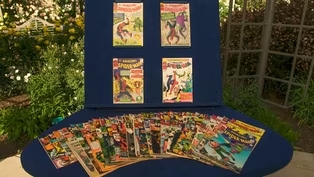
GUEST: I brought a bunch of comic books that my husband bought when they were brand-new, and they'd been in my mother-in-law's basement for about 50 years.
When she was getting ready to go out of her house about ten years ago, I went back there and helped move things, and I found this box.
I'm so jealous of your husband's experience.
(chuckles) The fact that he was able to buy these directly off the newsstand when they were brand-new.
He was between 11 and 13, I believe, and he would bike down to the neighborhood drugstore to buy them.
So we know exactly what he paid for 'em.
He was paying 12 cents apiece.
(laughing): 12 cents.
That's amazing.
It is.
I'm, all the comics you have here today range from what we call the Silver Age of Comics, 1956 to 1970.
You have a mix of both DC and Marvel comics, but our hero of the day is Spider-Man.
Amazing Spider-Man, that is.
Mm-hmm.
I mean, he is, by far, in my opinion, the most recognizable, fan-favorite child hero of superheroes today.
For the books you have here, your earliest "Amazing Spider-Man" being issue five, which is from 1963.
The reason this book in particular is a fan favorite is because it has the one and only Dr.
Doom.
(laughs) Evil bad guy.
Right.
The bad.
Victor von Doom first appeared in "Fantastic Four" issue five.
This is his first crossover into "Amazing Spider-Man."
We have, uh, "Amazing Spider-Man" six, first appearance of the Lizard, Dr.
Curt Connors, staple in the "Amazing Spider-Man" world.
Here, "Spider-Man" 15.
This is the first appearance of Kraven the Hunter, pseudo, like, hero, anti-hero, villain.
(chuckles) And then my favorite book here on the table, "Amazing Spider-Man" annual one, this book featuring the first appearance of the Sinister Six.
It's all the greatest Spider-Man villains in the second year of the stand-alone title.
When it comes to value of comics, it's all condition-based.
We would say these books range anywhere from 2.0 to maybe a 4.0, 4.5, that meaning your husband absolutely loved these books.
He read them multiple times.
(chuckles) Yes.
The Kraven the Hunter book is a little bit rougher on the end of the spectrum value-wise.
We would place this book at $700 to $1,000 today.
Wow.
"The Amazing Spider-Man" annual one, similar to the two above it, this book falls in the, uh, $800 to $1,200 range.
But... (chuckles) ...these are just four books on the table.
Everything that you have here fanned out is beautiful.
There are so many iconic, key books in here mixed in.
Conservatively, at auction, for the collection, this would easily be a $10,000 to $15,000 group of comics.
(laughing): Not what I expected to hear at all, that's amazing.
That's fantastic!
Mike would have been pleased.
He loved these books, he loved sci-fi.
He'd have been so excited-- that's great.
So I got this-- this was gifted to me after graduating medical school.
It's from my great-grandpa.
It's "The Practice of Medicine" by William Osler.
And I think it's a first edition of the book.
PRODUCER: Now, to graduate, did you have to read that thing?
No, not this exactly.
(both laughing) Bloodletting's still in here.
(laughing) GUEST 2: Well, yeah, he was, he was actually a proponent of the bloodletting, so... That's still here.
Well, it's a Japanese copy of the Gibson.
It's a 1970-71 Ibanez.
Hollow body.
A Gibson look-alike.
Father-in-law was, had it down in his basement, and he wanted $35 for it.
So I gave him 35 bucks.
Well, I play it every day, every morning, just play it.
Yeah, it's fun.
GUEST: My grandma purchased it when she was in the U.K.
during World War II.
She served in the Royal Navy.
Mm-hmm, mm-hmm.
So she brought it back after that, um, when she moved back to the United States.
My grandma passed away, I believe, 2014.
My dad and I were helping clean out her house, and my dad gave it to me from her book collection.
Okay, okay.
He, he knew that I liked Tolkien.
Mm-hmm, mm-hmm.
I, I've been a big fan for most of my life, and it's actually kind of how my wife and I met.
We were at a Halloween party.
Someone was talking about Tolkien.
I mentioned that I'm fairly knowledgeable about it.
So we started talking, and then, um, I asked her on a date, and I brought it to our first date.
It's in no small part how we met, so... Uh, that, that's, that's delightful.
Yeah.
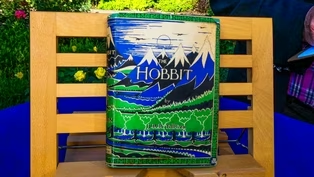
This was Tolkien's very first published book, "The Hobbit."
It began as a series of bedtime stories for his children, and he later codified it and published it in England.
And then he spent most of the rest of his life creating this world of Middle-earth.
And by 1954 and '55, the three volumes comprising "The Lord of the Rings"-- "The Fellowship of the Ring," "The Two Towers," and "The Return of the King"-- were first published.
And that just made his career.
Yeah.
Back when your grandmother purchased this book, a new copy of "The Hobbit" would have cost perhaps a dollar or less.
On the rear flap of the dust jacket, on, only on the 1,500 copies of the first printing... Oh, okay.
...of the first edition... Okay.
...there's a typographical error.
They compare, uh, rightly so, "The Hobbit" and Tolkien to his mentor Lewis Carroll, or C.L.
Dodgson.
Mm-hmm.
Where they spell Dodgson's name, they put an E in it.
Okay.
And that's a hand-corrected typographical error.
And that's how you can tell the true first printing of the first edition from all later printings.
Here we can see the publisher, "The Hobbit, or There and Back Again," by John Ronald Reuel Tolkien, uh, published in London in 1937.
All of the illustrations in the book and the dust jacket itself are drawn by J.R.R.
Tolkien.
Most 20th-century novels, in particular... Mm-hmm.
...have dust jackets or dust wrappers.
Mm-hmm.
And this one has its dust wrapper.
Likely, fewer than 20, 25% of those 1,500 copies... Oh, wow.
...these dust jackets remain.
Yeah.
They're, and this one, it shows wear, the book itself, the boards show wear, the dust jacket shows wear.
There's a small piece missing from this front corner.
Mm-hmm.
And the back corner, as well.
But it's remarkably intact, which makes it even scarcer.
Condition and the presence of dust jackets are everything on modern first editions.
Okay.
So this is maybe a good-plus to very good copy?
Okay.
But the jacket is remarkably difficult to find in any condition.
Mm-hmm.
I would estimate this copy at retail would bring $100,000.
Oh, my God.
That is significantly more than what I thought.
(laughing): Oh, my God.
That's... That is a non-insignificant amount of money that I've been carrying around.
(both chuckling) Slightly too casually.
(laughs) My precious, right?
I should stop telling people I have this.
(both laugh) It's too late now.
It's too late now, yeah.
(both laughing) That's wild.
A fine copy and a fine jacket at retail would bring a quarter of a million dollars.
Oh, my gosh.
PEÑA: And now it's time for the "Roadshow" Feedback Booth.
And I brought my grandmother's, uh, mustache cup.
This was one of her prized possessions.
I found out it's, it's pretty rare for a mustache cup to be, uh, from France, but, uh, also worth not that much money, so... But we're so glad we came here.
And we had a great time today.
We went to the Asian booth to have my wedding kimono that was actually my mother's, um, appraised.
They said it was worth $500 to $800.
They said it's not much of a market anymore for wedding kimonos.
But I think it's beautiful and it hangs on our wall.
And I brought this pocket watch that belongs to my father-in-law, and I found out the fob's worth more than everything else we brought together.
I brought with me this seal from Phoenix this morning.
Got stopped by TSA.
Really only came to show my love for PBS.
Long live PBS.
Love you.
Well, this one is a Danish piece, and this one I think is Australian piece, and they're glass pieces, and together they're worth about $800.
And I bur, purchased them at a online auction, estate auction.
And, um, I'm glad to be here, and I'm exhausted.
(laughs) All I could say about my day is, antique watch on my wrist, antique buttons on my vest, getting to see the "Antiques Roadshow" appraisal all-stars, man, this is the best.
(laughs) PEÑA: Thanks for watching.
See you next time on "Antiques Roadshow."
Appraisal: 1937 The Hobbit First Edition
Video has Closed Captions
Clip: S30 Ep1 | 3m 58s | Appraisal: 1937 The Hobbit First Edition (3m 58s)
Appraisal: 1941 Maynard Dixon Oil on Board
Video has Closed Captions
Clip: S30 Ep1 | 3m 27s | Appraisal: 1941 Maynard Dixon Oil on Board (3m 27s)
Appraisal: 1982 Ms. Pac-Man Collection
Video has Closed Captions
Clip: S30 Ep1 | 3m 26s | Appraisal: 1982 Ms. Pac-Man Collection (3m 26s)
Appraisal: 1989 Ronald Reagan "Shoes" Note
Video has Closed Captions
Clip: S30 Ep1 | 1m 4s | Snapshot: 1989 Ronald Reagan "Shoes" Note (1m 4s)
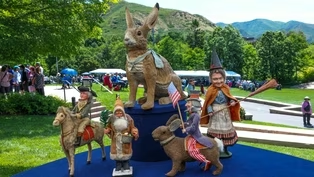
Appraisal: Candy Containers, ca. 1910
Video has Closed Captions
Clip: S30 Ep1 | 2m 9s | Appraisal: Candy Containers, ca. 1910 (2m 9s)
Appraisal: DC & Marvel Comic Books
Video has Closed Captions
Clip: S30 Ep1 | 2m 57s | Appraisal: DC & Marvel Comic Books (2m 57s)

Appraisal: Donegal Arts and Crafts Carpet
Video has Closed Captions
Clip: S30 Ep1 | 2m 32s | Appraisal: Donegal Arts and Crafts Carpet (2m 32s)
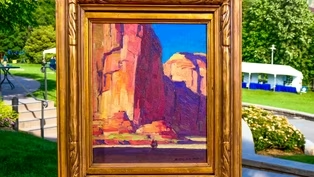
Appraisal: Edgar Payne Oil on Board, ca. 1940
Video has Closed Captions
Clip: S30 Ep1 | 2m 57s | Appraisal: Edgar Payne Oil on Board, ca. 1940 (2m 57s)
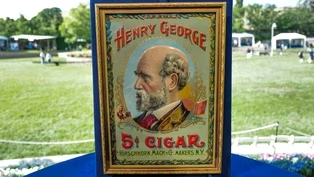
Appraisal: Henry George Embossed Tin Cigar Sign, ca. 1895
Video has Closed Captions
Clip: S30 Ep1 | 3m 39s | Appraisal: Henry George Embossed Tin Cigar Sign, ca. 1895 (3m 39s)
Appraisal: Kitaōji Rosanjin Studio Ceramics, ca. 1955
Video has Closed Captions
Clip: S30 Ep1 | 3m 36s | Appraisal: Kitaōji Rosanjin Studio Ceramics, ca. 1955 (3m 36s)
Appraisal: Pennsylvania German Frakturs, ca. 1815
Video has Closed Captions
Clip: S30 Ep1 | 3m 37s | Appraisal: Pennsylvania German Frakturs, ca. 1815 (3m 37s)
Appraisal: Pre-contact Knife River Flint Spear Point
Video has Closed Captions
Clip: S30 Ep1 | 2m 43s | Appraisal: Pre-contact Knife River Flint Spear Point (2m 43s)

Appraisal: Viennese Platter Attributed to Herman Böhm, ca. 1880
Video has Closed Captions
Clip: S30 Ep1 | 3m 37s | Appraisal: Silver Platter Attributed to Herman Böhm, ca. 1880 (3m 37s)
Appraisal: WWII British No. 10 Commando Soldier's Archive
Video has Closed Captions
Clip: S30 Ep1 | 4m 12s | Appraisal: WWII British No. 10 Commando Soldier's Archive (4m 12s)
Preview: Red Butte Garden & Arboretum, Hour 1
Video has Closed Captions
Preview: S30 Ep1 | 30s | Preview: Red Butte Garden & Arboretum, Hour 1 (30s)
Providing Support for PBS.org
Learn Moreabout PBS online sponsorship
- Home and How To

Hit the road in a classic car for a tour through Great Britain with two antiques experts.

Parent Hacks












Support for PBS provided by:
Funding for ANTIQUES ROADSHOW is provided by Ancestry and American Cruise Lines. Additional funding is provided by public television viewers.