
Tamara Keith and Amy Walter on Washington's response to AI
Clip: 9/14/2026 | 8m 7sVideo has Closed Captions
Tamara Keith and Amy Walter on Washington's response to AI and data center concerns
NPR’s Tamara Keith and Amy Walter of the Cook Political Report with Amy Walter join Amna Nawaz to discuss the latest political news, including how Washington is responding to AI and data center concerns, Mitch McConnell returning to the Senate and how midterm voters feel about affordability and political corruption.
Problems playing video? | Closed Captioning Feedback
Problems playing video? | Closed Captioning Feedback
Major corporate funding for the PBS News Hour is provided by BDO, BNSF, Consumer Cellular, American Cruise Lines, and Raymond James. Funding for the PBS NewsHour Weekend is provided by...
Tamara Keith and Amy Walter on Washington's response to AI
Clip: 9/14/2026 | 8m 7sVideo has Closed Captions
NPR’s Tamara Keith and Amy Walter of the Cook Political Report with Amy Walter join Amna Nawaz to discuss the latest political news, including how Washington is responding to AI and data center concerns, Mitch McConnell returning to the Senate and how midterm voters feel about affordability and political corruption.
Problems playing video? | Closed Captioning Feedback
Where to Watch PBS News Hour
PBS News Hour is available to stream on pbs.org and the PBS app.
Providing Support for PBS.org
Learn Moreabout PBS online sponsorshipAMNA NAWAZ: For more on how Washington is responding to A.I.
and other issues shaping midterms races, we turn now to our Politics Monday duo.
That is Amy Walter of The Cook Political Report With Amy Walter and Tamara Keith of NPR.
It's great to see you both.
AMY WALTER: Hello.
TAMARA KEITH: Good to be here.
AMNA NAWAZ: Let's start with these growing concerns over A.I., what might actually be done to address them.
We reported earlier President Trump says he does not want to see more regulation.
House Speaker Mike Johnson has said tech companies should take the lead.
As you have seen, this issue is making for some strange alliances, Steve Bannon, Bernie Sanders now finding themselves on the same side of this issue.
Congress is back in session, Tam, as you know, but we have also -- we want to note Senator Mitch McConnell is back on the Hill tonight for the first time after a three-month absence due to health issues.
That's him there in the wheelchair at the bottom of your screen.
But, Tam, this is lawmakers' final week before the midterms.
Are they going to do anything when it comes to A.I.?
TAMARA KEITH: Probably not in any serious way that will become law, because I will just point out that Facebook has been around, social media has been around since the mid-2000s, and many of those companies in a previous life were begging Congress to regulate them, to create guardrails, to create rules of the road.
And you know what happened?
Nothing.
Right now, there is some bipartisan agreement when it comes to social media to protecting children.
And yet they have not been able to get any legislation over the finish line.
And now we're talking about a new technology that -- where the U.S.
would like to have a competitive advantage, where there's a real collective action problem, a lot of money at stake.
And then you see this division between -- there are actually a lot of rank-and-file Republicans who are hearing from their constituents like, hey, we're worried about A.I.
data centers, we're worried about A.I.
taking our jobs, we're concerned about these things, and then the president of the United States, who is essentially saying you're going to be a backwards loser if you are concerned about A.I.
or don't want a data center in your backyard.
AMNA NAWAZ: Amy, these fears, though, that we're hearing from tech leaders, they are new, they are different.
Is this the kind of thing voters are paying attention to?
AMY WALTER: This still is an affordability election.
That's what voters say over and over again their top concerns are.
And in that way, it's -- the data centers are part of the affordability conversation.
What we're seeing in campaign ads, what we're hearing on the campaign trail are candidates saying, either look at me, I'm here to help regulate the data centers to ensure that your electricity bills do not go up or to bring the cost of your electric bills down, or, better yet, to blame your opponent for the high cost of electricity because they OKed data centers and gave them tax breaks.
But the degree to which the actual topic of A.I.
and its influence, these concerns about it breaking out of its sandbox and its impact is not yet something that we're hearing candidates talk about.
And, quite frankly, the midterm elections probably aren't the place for it to happen.
Where it will, I think, become a very big topic, and topic number one will be once we get into the presidential race.
AMNA NAWAZ: How about how closely voters are paying attention to some of the other stories we're covering right now, the one Liz was reporting on earlier, the revelations from the ProPublica investigation that showed Don Trump Jr.
's wedding celebration was substantially bankrolled by a Russian oligarch with close ties to Putin?
And Trump Jr.
and his wife confirmed the funds.
They called it a wedding gift.
Do Americans see that, these conflicts as problematic, or have they just become normalized?
AMY WALTER: Well, I think that what Americans believe is politics is corrupt and they have very little faith in actually most institutions.
But, in politics, it's being able to make the link between corruption and the cost to you.
What does it mean for a political system or person to be corrupt?
It means that you're paying more or getting less.
That is the connection.
We're seeing that conversation happening in campaigns.
So it's not that corruption doesn't matter, but, for voters, they do have to see how this is impacting them.
AMNA NAWAZ: And the appearance of the impropriety used to be enough to prevent the behavior.
Are the guardrails just totally gone?
TAMARA KEITH: There are not a ton of guardrails, though I think voters can be the ultimate guardrail.
We saw in the 2006 blue wave that there were a lot of concerns from voters about scandal among Republicans.
Well, so, this election, we are seeing that corruption is a big concern.
It's actually a bipartisan concern.
And the general feeling among -- voters are very cynical.
And the general feeling is that the political class is getting ahead, while regular people are struggling to get by, their gas costs more, their groceries cost more, and they're just struggling to make it.
And then these guys can just get rich, which is why you see some candidates talking about the ban on stock trading for members of Congress.
You actually see candidates from both sides of the aisle doing this.
You do see a lot of discussion of corruption.
But, obviously, it varies by party how they're directing it.
And there just isn't that much focus on Trump and his family in sort of paid advertising.
AMNA NAWAZ: I do want to turn now to where we're going to find the president and the vice president both today and the rest of the week.
Vice President Vance, we should point out, is in Kansas tonight.
He's stumping for Senator Roger Marshall, who's seeking a second term there against the Democrat Adam Hamilton.
President Trump himself will be in North Carolina later this week.
He's hoping to boost Michael Whatley's Senate campaign there against the former Democratic Governor Roy Cooper.
Tam, what does it say to you about those races, the fact that the vice president and president are on the ground for these candidates?
TAMARA KEITH: Yes, so the vice president is there in Kansas.
I will say that it's much cheaper to send the vice president to Kansas, especially when there's like an official visit attached to it, than it is to drop a few million on TV ads.
At this point, we are not seeing MAGA Inc.
or any of the other big groups dropping money in Kansas, but this is a signal that they have their eyes on it and they want to help, at least a little bit.
North Carolina is a race.
I mean, actually, it's not really a race at this point.
Roy Cooper is polling much -- in a much better place than Michael Whatley.
Michael Whatley is someone who Trump feels something of a debt to because he was the chair of the Republican National Committee.
He's also the person that President Trump wanted running in that Senate seat, and Whatley has had something of a lackluster campaign.
AMNA NAWAZ: Amy, how are you looking at this?
AMY WALTER: I mean, the fact that these are two very different states and yet they're both on the board tells you a lot about this election season.
And they're on the board for different reasons, but also one thing that they both have in common is a lack of enthusiasm from the Republican base.
Obviously, the president spent a good deal of time last week -- Tam was there in Dallas -- telling his base, come and vote, pretend I'm on the ballot.
AMNA NAWAZ: That was at the midterm convention in Dallas, yes.
AMY WALTER: That was at the midterm convention.
But the challenge the president has with his base is that the ones who are saying they are the least enthusiastic about showing up also happen to be the ones who are most stressed about the economy, who believe that the president isn't doing a particularly good job on handling the economy.
And so when you bring out the president to a place like North Carolina, the vice president to Kansas, they are speaking to the base.
They are not really trying to speak to the swing voters who, quite frankly, are in North Carolina more so than they're in Kansas.
AMNA NAWAZ: Fifty days to go until those midterms.
AMY WALTER: Yes.
AMNA NAWAZ: Amy Walter, Tamara Keith, great to see you both.
Thank you.
AMY WALTER: You're welcome.
TAMARA KEITH: You're welcome.
AI leaders fuel calls to rein in rapidly advancing tech
Video has Closed Captions
Trump pushes back as AI leaders fuel calls to rein in rapidly advancing technology (8m 34s)
EPA repeals regulations limiting power plant emissions
Video has Closed Captions
EPA repeals limits on greenhouse gas emissions from power plants (7m 17s)
Houthi gains, Saudi pipeline attack pressure oil markets
Video has Closed Captions
Houthi gains in Yemen, attack on Saudi pipeline compound pressure on oil markets (9m 36s)

Jenny Yang takes act to stages in immigrant grocery stores
Video has Closed Captions
Comedian Jenny Yang takes act to stages inside immigrant grocery stores (6m 15s)
News Wrap: Kennedy Center warns of 'fiscal collapse'
Video has Closed Captions
News Wrap: Kennedy Center warns of 'fiscal collapse' without Trump's name on building (5m 59s)
Russian oligarch paid for Trump Jr.'s wedding celebrations
Video has Closed Captions
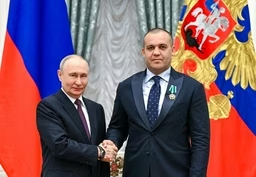
Putin-tied Russian oligarch paid for Trump Jr.'s wedding celebrations (6m 25s)
Providing Support for PBS.org
Learn Moreabout PBS online sponsorship New Episode
- News and Public Affairs

FRONTLINE is investigative journalism that questions, explains and changes our world.
 New Episode
- News and Public Affairs

Today's top journalists discuss Washington's current political events and public affairs.
 New Episode
 New Episode
 New Episode
 New Episode
 New Episode


 New Episode
 New Episode
 New Episode
Support for PBS provided by:
Major corporate funding for the PBS News Hour is provided by BDO, BNSF, Consumer Cellular, American Cruise Lines, and Raymond James. Funding for the PBS NewsHour Weekend is provided by...