
May 13, 2026 - Full Show
5/13/2026 | 26m 49sVideo has Closed Captions
Watch the May 13, 2026, full episode of "Chicago Tonight."
A push to decrease the number of Americans using antidepressants. And how local grocers are adjusting to changes in SNAP benefits.
Problems playing video? | Closed Captioning Feedback
Problems playing video? | Closed Captioning Feedback
Chicago Tonight is a local public television program presented by WTTW
WTTW video streaming support provided by members and sponsors.
May 13, 2026 - Full Show
5/13/2026 | 26m 49sVideo has Closed Captions
A push to decrease the number of Americans using antidepressants. And how local grocers are adjusting to changes in SNAP benefits.
Problems playing video? | Closed Captioning Feedback
How to Watch Chicago Tonight
Chicago Tonight is available to stream on pbs.org and the free PBS App, available on iPhone, Apple TV, Android TV, Android smartphones, Amazon Fire TV, Amazon Fire Tablet, Roku, Samsung Smart TV, LG TV, and Vizio.

WTTW News Explains
In this Emmy Award-winning series, WTTW News tackles your questions — big and small — about life in the Chicago area. Our video animations guide you through local government, city history, public utilities and everything in between.Providing Support for PBS.org
Learn Moreabout PBS online sponsorship>> Hello and thanks for joining us on Chicago tonight.
I'm Brandis Friedman.
Here's what we're looking at.
Prozac, Lexapro, Zoloft.
Just some of the antidepressants, federal health officials.
We're working to wean Americans off of.
And hundreds of thousands of Illinoisans and the stores that feed them are bearing the brunt of SNAP cuts.
>> First off tonight, Chicago Public Schools board members are calling on state lawmakers to help fill the district's 730 million dollar budget gap.
>> We saw the difference between having that additional COVID funding.
And and our students really flourished.
The numbers went up the scores when turns out CPS has been underfunded for decades.
And we need more money.
>> Just yesterday, CPS officials announced plans to cut staff at schools across the city this summer in efforts to close that budget gap.
They say the deficit is driven by a lack of state and federal funding as well as when doing enrollment board members both elected and appointed by the mayor say the state has failed to adequately funds the district, according to the evidence based funding formula.
They specifically cited proposed bill that would overhaul the state's property tax laws in favor of mega developments such as a new potential Bears stadium in Arlington Heights.
A pilot program to respond to people in mental health distress is going citywide.
The crisis assistance response and engagement or care program.
He's already been operating in 6 police districts but is now expanding.
>> And so how does not happen in a vacuum right?
>> Mental health is public health, of course, with mental health is also public safety, right?
also relates to youth development.
Mental health relates resource allocation or a lack of resource allocation.
Right.
And I think the thing about this program that is so beautiful is that with us being integrated into the city system, we can better serve our clients.
>> City officials say the program deploys trains, behavioral health professionals and EMT's to help people in mental health crises or socio emotional distress.
Additionally care teams can now serve a broader range of residents, including youth as young as 6 years old and adults over the age of 65.
The team's only respond to nonviolent non-medical situations where there is no active safety threat.
Residents can still dial 9-1-1, to request a care team.
There's a new addition in King County is bison herd and it came as a bit of a surprise.
6 bison were released onto Burlington Prairie back in December.
And one of the newcomers was hiding a secret.
Well, it's out now on May 9th, one of the herds females gave birth to a calf officials estimate.
It's the first baby bison born on tall grass prairie in the county in 200 years.
In a unique arrangement.
The bison roam on land owned by Kane County Forest Preserves.
But the Chicago based American Indian Center owns the Bison Vo.
They prefer the word steward, the center plans to offer bison related programming later in the summer.
Burlington Prairie in Sycamore is open to visitors daily from sunrise to sunset.
The movement targets SS our eyes right after this.
>> Chicago tonight is made possible in part why the Alexandra and John Nichols family.
The Pope Brothers Foundation.
And the support of these donors.
>> Health and Human Services Secretary Robert F Kennedy Junior is creating plan to reduce the number of Americans on antidepressants.
He along with others in the Make America Healthy again an initiative claim the country has a problem with overprescribing psychiatric medications as the first line of defense against mental health conditions.
Instead, they want to emphasize holistic remedies like talk therapy, exercise and healthy eating.
Joining us now is Jim Pool, senior director of policy at the National Alliance on Mental Illness in Chicago.
Jim, thanks for joining RK Junior.
He's been openly critical of a selective serotonin re uptake inhibitors.
Ssri is not for a while.
Stating with the drugs are harder to wean off of than heroin and >> partially to blame for mass shootings.
not sure that there's a lot of research tobacco's out there, but are these something that we should be looking at more critically?
So I think it's important, though, that the research is not show those things that the speech had better be the secretary right?
>> These are very common medications that been around the 1950's.
They're pretty low.
So, you know, for decades, there are certainly side effects of medication, but we should be paying with a broad brush.
And I think our concern in on Chicago is that this reinforces sort of a medication stigma that people might feel.
There's something shameful about using a mental health medication.
And we know from our conversations every day, that's a really important tool for lots of folks in their recovery.
And it's life changing life saving for many of our To that point, do you think are Americans overprescribed ssrs?
>> I think that's dead.
no, I don't think that I think that the last to 6 I saw from 2024 where that about half of those diagnosed the mental health condition and United States did not receive treatment the previous year.
>> So I think we have a tremendous gap in our care system in this country.
There are many communities that don't have access.
No health care either cannot.
It has an affordable you can transfer yourself to it right?
There's that going on.
So I think overprescribing there's maybe something to talk about some niche of our system, but I'm not sure there's any argument to be made that what's happening in America's too much health care march.
So at my has mental health and over medical is Asian summit.
Last week RFK Junior talked about the country's mental health crisis.
>> United States that's not just face of mental health crisis.
We face a dependency crisis.
Craven by over medical is Asian.
This is a system level pattern.
Too many patients begin treatment without a clear understanding of the risks.
And how long they will stay on these drugs or had to come off of them.
And that's not informed consent.
We are going to fix it.
>> What's your reaction to the secretary's comments?
So I think everyone should have informed consent right before they begin medical to his point that everyone should be informed about possible side effects are contraindications of medication.
We are 100% in alignment with Secretary Kennedy on that.
However, that's the case for any medication and sort of painting with a broad brush over Sri not responsible.
And I really found medication.
I a literature.
I think he's also talking about dependency.
They're using that word.
And I think there is something about community that's very important to recovery and all of us as people, I think part of the reason we're having a mental health crisis is that we're seeing more loneliness, more social separation, less connecting this as a community.
People struggling more with having more stress.
And so I think that's also very that's a huge driver of this.
So I would just put on a individual medication that's sort of irresponsible >> what authority does at the same time?
This is the federal government to what authority does the federal government have prescription drugs to?
The FDA?
Is the regulator prescription drugs in the United States.
so they based on evidence, right?
So the FDA works.
secretary called Gold standard evidence, research to figure out what what is the best way to advise the public on medications?
And so the FDA certainly has a role here.
They should be grounded in science.
We don't want that to be going in rhetoric in opinion and will be think we might have make sure having science and research based clinical decision making on all of The department has said that it plans to develop guidelines for doctors to help with weaning and changes to insurance billing, which that's going to raise some eyebrows.
Do you have any concerns with that?
The potential changes that could be coming on board?
I I'm very concerned about people losing access, their medication arbitrarily, right.
And so I think any kind of blanket ban is certainly of great concern to us.
There are good reasons to pursue sort better better clarity on best practices for weaning people off medications and avoiding discontinuation symptoms do occur.
People to come on and off of these medications.
And so there is good reason make everything else that use make a point that he's there, which is there is grounds for research here and we do have to continue to develop and continues do science to improve mental health care and the medications are provided, as you mentioned.
And as the Centers for Disease Control and have also said we are in the midst of a mental health crisis in the United States.
Nearly 17% of American adults currently take SS arise or other antidepressants.
Prescription rates generally increase with age with just over 19% of adults over 60 using these medications.
>> And in 2023, 40% of U.S.
high school students reported persistent feelings of sadness or hopelessness.
What are the factors, Jim, that are contributing to these rates of depression and anxiety?
I wish I had a clear answer for your brand But the the it's many things altogether, right?
So there's been lots of hypotheses.
>> One is I think that we social media technology changes that have kind of brought more content into the eyes of young people perhaps create more stress morning puts that are that negative.
I think there's also I think we're also just better at talking about mental health in some or knowledge more certainly than I-20 years ago when I was I was turned 23 years going.
I was young.
I think some of that is right.
Dana, find more people, especially young people are speaking out more about and that part is good.
But I do think we are seeing like a higher prevalence of these things.
Also because of economic stress, there'd the patient, economy us is hitting lots of folks.
The more stress people have, the more that accelerates any kind of mental health challenges they're having.
As movement prioritizes natural or holistic remedies to treating meant treating mental illness like nutrition, physical activity, social connection.
>> Lifestyle changes think those be substituted for for medicine, for chemical changes.
Certainly not.
They're not a substitute in any way they can be enhancing to mental health care and the many people find them to be helpful.
>> I think that there's a lot literature around movement and mindfulness and things that can be really healing and restoring for people.
But they're not a replacement for medication when that's needed.
I don't think we should be shaming folks for using a medication pursuing medication exploring It's a very useful tool in for lots of folks that I've talked to.
It's life changing life saving for them and they would not know what they're honestly quite nervous.
And it's gonna be taken away from them >> What do you say to people who use these medicines?
What should they know to either ask their doctors as the federal government starts to move a move forward with this and what they know for themselves?
>> I mean, you know, that it's it's a process for this to happen.
They can't just summarily banned medications and so try to throttle some of that concern.
But I would talk your doctor about about your concerns you have and think about how you can stay on.
I don't think it's any near-term concern.
So nothing really the next year, probably.
But hopefully those of us and advocacy work hard and we can all speak out and defend from some kind of attempt to ban these medicines.
Ok, Jim Paul, thank you so much for joining us.
We appreciate it.
Spread.
>> Up next, the ripple effects from cuts to SNAP benefits.
Major changes to the Federal Supplemental Nutrition Assistance Program or SNAP mean an estimated 120,000 Illinoisans or more are at risk of losing those benefits, formerly known as food stamps.
But the changes aren't just hurting people who use snap to feed themselves and their families.
Some say they're also heard in grocery stores and beyond.
Joining us now are I tell ya, McCarthy?
General manager of the Dill Pickle co-op in Logan Square.
Elizabeth Bruno owner and operator 40 Acres, Fresh Market and Nolen Downey senior director of policy at the Greater Chicago Food Depository.
Thanks to all of you for joining us.
Appreciate it.
you know what I want to I want to come to you first.
How do we SNAP cuts are impacting grocery stores?
Bottom line?
>> Well, so these are the first real we're starting to see as a result of the so-called one big beautiful bill that was passed last summer.
That bill contained 200 billion in cuts to snap another trillion in cuts to health care programs like Medicaid.
And we're now starting to see not only the primary impacts, as you 120,000 people losing benefits just this month, but we're now starting to see some of the secondary consequences not only to businesses but the whole communities and indeed the entire state economy.
Snap brings 4 billion dollars into the state that 4 billion generates another 6.6 billion in economic activity.
This program is a load bearing pillar of society.
And if that weekend we are all feeling.
>> Tell me a little bit about that sort of backed the ripple effect.
We've heard reports that of vendors that that work with grocery stores, for example, that served SNAP beneficiaries.
They're also experiencing the pain.
>> There's no question.
I mean, this program is big enough that it not only provides critical assistance to recipients to supplement their grocery budgets, but it provides critical revenue to grocery stores, which is not exactly a huge margin business.
It also support jobs.
Talk about thousands of jobs across the state and across the country.
So again, this is really something or even if somebody is not on snap the program being weakened to this degree at the federal level is something that we're going to feel both in the grocery sector, the retail sector, but also across the entire state economy.
And tell you what's been your experience.
>> Our experiences we have about 20% of our sales come from SNAP beneficiaries in our grocery store including a lot of our staff are participating in the SNAP program as well.
And we've definitely seen a decline, but result we've also uplifting.
From the community for making sure that where supplementing some of these we're doing a lot mutual aid programs and our store.
We have a grab bag donation where you can buy $10 worth of groceries that go to a food pantry that we also have a lot of our snap beneficiaries educated about where those are at in case they supplemental food.
But like those the types of things that we're seeing in our grocery store.
Get something a little bit more about about some of those and how you're able to sort of implement those programs, you know, and then still allowing folks you know, maintain the dignity.
But also sort of providing and supporting the community.
Yeah.
So we have are Needs-based owner program where anyone who has snapper has some type of hardship in their life.
They can apply and be coming on or you get 10% off all of your groceries when and also we have weak match program.
That provided by the state where you can get up to $10 worth of link backs dollars when you use their snap card at the store to purchase fresh produce.
And that's all free.
A grant money that we received, they can participate as well.
And you have those things have been working really well.
We've seen an uptick people signing up for that program and that that's been helping a lot, I think in our community.
Liz, tell me a little bit about 40 acres.
You all haven't quite started to see the impact just yet.
>> I think that when you're in your first year of operation, you're just trying to figure out what your trends are and what your patterns are.
One month snap could make up 10% of our revenue the next month that could make up 15.
And so what you're looking for is a 12 month average and we've only been open for 8 months.
So it's really hard to get your bearings when the ground beneath you keeps shifting every 2 to 6 months.
>> Okay.
And also bringing got a new player joining the band were also now joined by militant Winston senior director of Living Fresh Market in Forest Park.
Melody, tell us about how SNAP cuts, how they're impacting the bottom line.
There.
>> Well, there impacting us in a few different ways.
Not just the 15% of the sales that we see daily.
>> From most snap recipients.
But also our vendors who are first time on the shelf in a grocery store and they're saying maybe less purchases made for them.
So that's less money that they could to take home to their families.
So it's a ripple effect that call it.
>> What are some of the different steps that you taken to sort of sustained local, independent grocers or how what is in the different steps you've taken?
Well, know, we have to get lean sometimes.
And that's just a part of business everywhere.
man, a few girl, sir, you know, years selling shoes or whatever the case may be.
But you lean in a few different ways and one might be the hours that your employees work a day anyone across chainmail and you know that the cashier might start going and helping in floral learn.
You know, it's because some shifts that you have to make a I call it a pivot because it doesn't have to be necessarily a negative thing, but it can positively impact the business so that you continues to thrive through these times.
Right?
And of course, you I tell you, we just heard from you about some of the ways the different ways that the co-op is able to support people and help them still get access to food.
But Nolan, give us a sense of, you know what it takes to sort of make up the difference.
And if it can be made up, I mean, I I first and foremost, just want to applaud all the efforts of everybody because I think it's incredibly heartening in this moment to see retailers stepping up land to be stepping up.
>> What we've got to be clear, this is not going to be enough in this moment.
part of the reason why we're really asking for the partnership of State government if the federal government is going to be abdicating its responsibility to provide for people's basic needs, what can we do at the state level?
It's part of why food depository we're convening the Save.
Our Snap Coalition a coalition of as of today over 100 organizations that our statewide working too at advocate for policies at the state level that can make a real impact for people.
Now, couple of those being emergency assistance for people that have lost now another being expanding existing state programs to bring in some of the populations that have lost access to these critical benefits.
These are steps that we can take now that they can afford.
And we must take 100 go and check in all of the estimated at 120,000 people could stand to lose their snap benefits, including 16,000 immigrants and refugees who have legal protected status.
>> If that is the case, if these folks, you know, start sort of, you know, falling off the rolls or the in eligible to reapply for benefits.
What what options do they have?
So those 16,000 humanitarian immigrants, they are going to be ineligible in a way that is ongoing part of the reason why some of that expansion of programs to bring some of those folks in at the state level is critical not to population that's very vulnerable and really needs that assistance.
Now, as for those 120,000 people that lost because of expanded work requirements, there can be a path back to the program.
And so what we really encourage people to deal first and foremost, find out if you're exempt.
Many, many people should be exempt from the work requirements.
There's a screening tool in the state's website that people can go and access to see if they need exemption.
If they do get that information to the Department of Human Services right now.
But I think we have to recognize not everybody's going to exemption.
20,000 people.
Surely some of them have lost access to benefits in a way ongoing.
So what can we do for those people who now are in crisis?
details about some of the programs and events that your store has has created laid out to help people still gain access to food while maintaining their dignity.
Absolutely.
Absolutely.
We've started the 62nd shopping spree.
>> And it turned out to be a bit of an amazing event that we have that where community can sponsor and donate for these.
>> Shopping sprees and we can have people who come in want some up on the last Saturday of every month and they come and shop.
They get a raffle ticket.
They sign a far fresher was program and then they're off to the races.
So it's really a great time to see how people can get food on their tables and then they up sharing with their family and other household.
So it being a good thing on all sides.
It's a win-win, but also this weekend, we have the good neighbor Day at living fresh markets for his part, we asked people to come out and do something good for neighbors.
So we'll be giving away 500 bags of groceries to people who comment and feeding and clothes those sorts of things.
I tell you, why is it, you know, important for people to be able to receive food assistance without shame.
>> It's really it's extremely important because food should be accessible to I mean, that's our motto at the co-op for sure.
And I I think it's important as all of us humans to to be humanitarian.
That's another.
You know, that's what makes us a great community.
And I think Chicago has really stood up, you know, as far as what's been going on in the world right now.
I think.
doing really good job at And it's really fun to see all the things that always what you're doing at the food depository.
What you guys are doing, your markets really important stuff.
We're doing.
some of the other challenges that you experience with running a grocery she last got So I think that has a brand new grocery store.
One of the things that you're always competing against is and that's >> people.
It's easier for people always do what they've always done to store.
They always go to so bringing that awareness and attention that you are there drawing people in learning how to operate a store when you've never done it before.
But the pressures of grocery are labor is it's an expense Lot of things you have to pay cash on delivery.
So just keeping your stuff your shelves stocked.
Spoilage, you're constantly chasing dates calling and making sure that your Your shelves are fresh.
So it's it's a constant business.
I don't sleep.
I don't know when the last time I had a good night's sleep just yeah, it's it's hard.
And you don't know when it's going to turn around try things and sometimes like you have to wait and wait and wait to see those results but you just try to get better every single day.
Certainly not for the faint of heart.
There is a new bill being introduced in the state called the Fresh Act stands for Families Receiving emergency support for hunger.
>> That if passed, it would provide one-time $600 payments to those who lose eligibility for snap.
No, we've got about 30 seconds left left.
Is this, you know, just the first step?
What else would ease the burden?
This is the first step.
But this is one of these interventions that we can afford that would make a real difference for people.
Now, again, the federal government has created this situation.
But at the state level, we have a responsibility to do what we can first test to step up for people.
>> And I think this moment just listening to folks are on the table.
All the hardship is created by this.
This can be a very dark time for communities or this could be our finest hours.
The state we need to step up and we need to do it Do you know the bill status likelihood passage?
Well, listen, I mean, anything that costs money in the state is an uphill climb.
But I'll tell you the state's going to spend money on something this year.
I find it hard to find a priority that's more important than feeding people were just locks access to critical systems.
right.
We'll have to leave it there.
Thanks to all of you for the work that you do.
And for joining us.
little ones to Natalia McCarthy, Nolan Downey and Liz who know things everyone.
>> And that is our show for this Wednesday night.
Check out our website from our Chicago SUP for our Chicago Summer Festival guide from Street Fests and art shows to outdoor concerts and cultural celebrations.
We have got you covered.
It is all at W T Tw dot com slash festivals.
>> And join us tomorrow night at 5, 30 10.
It is at the center of a deadly cruise ship outbreak.
But what is the hantavirus and how is it transmitted?
Now for all of us here at Chicago tonight, I'm Brandis Friedman, thank you for watching.
Stay healthy and safe and have a good night.
>> Closed caption News may by Robert a cliff for Chicago personal injury and wrongful death that serves needs of
 New
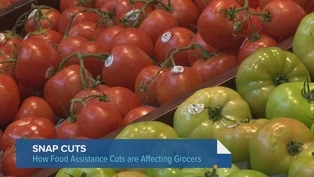
NewHow Illinois Grocers Are Being Impacted by Changes to SNAP Benefits
Video has Closed Captions
An estimated 120,000 Illinoisans are at risk of losing access to SNAP benefits. (12m 39s)
 New
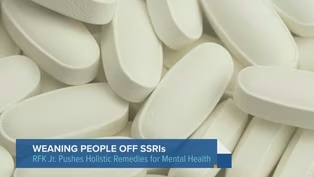
NewRFK Jr. Seeks to Reduce Number of Americans on Antidepressants
Video has Closed Captions
The Health and Human Services secretary claims the U.S. has a problem with overprescribing. (7m 10s)
Providing Support for PBS.org
Learn Moreabout PBS online sponsorship
- News and Public Affairs

Top journalists deliver compelling original analysis of the hour's headlines.

- News and Public Affairs

Today's top journalists discuss Washington's current political events and public affairs.
Urban Consulate Presents











Support for PBS provided by:
Chicago Tonight is a local public television program presented by WTTW
WTTW video streaming support provided by members and sponsors.