
March 9, 2026 - PBS News Hour full episode
3/9/2026 | 56m 46sVideo has Closed Captions
March 9, 2026 - PBS News Hour full episode
Monday on the News Hour, as Iran chooses a new supreme leader and the conflict deepens across the region, we speak with the Iranian foreign minister. Oil prices surge amid the turmoil, sending gas prices higher. Plus, Tamara Keith and Amy Walter discuss the political implications of the war.
Problems playing video? | Closed Captioning Feedback
Problems playing video? | Closed Captioning Feedback
Major corporate funding for the PBS News Hour is provided by BDO, BNSF, Consumer Cellular, American Cruise Lines, and Raymond James. Funding for the PBS NewsHour Weekend is provided by...
Support provided by:

March 9, 2026 - PBS News Hour full episode
3/9/2026 | 56m 46sVideo has Closed Captions
Monday on the News Hour, as Iran chooses a new supreme leader and the conflict deepens across the region, we speak with the Iranian foreign minister. Oil prices surge amid the turmoil, sending gas prices higher. Plus, Tamara Keith and Amy Walter discuss the political implications of the war.
Problems playing video? | Closed Captioning Feedback
How to Watch PBS News Hour
PBS News Hour is available to stream on pbs.org and the free PBS App, available on iPhone, Apple TV, Android TV, Android smartphones, Amazon Fire TV, Amazon Fire Tablet, Roku, Samsung Smart TV, and Vizio.
Providing Support for PBS.org
Learn Moreabout PBS online sponsorshipGEOFF BENNETT: Good evening.
I'm Geoff Bennett.
AMNA NAWAZ: And I'm Amna Nawaz.
On the "News Hour" tonight: War rages on.
As Iran chooses a new supreme leader and the conflict deepens across the region, we speak with the Iranian foreign minister.
ABBAS ARAGHCHI, Iranian Foreign Minister: This is a war imposed on us.
And what we are doing is only defending ourselves.
GEOFF BENNETT: Oil prices surge amid the turmoil, sending gas prices higher too.
AMNA NAWAZ: And Tamara Keith and Amy Walter discuss the political implications of the war.
(BREAK) AMNA NAWAZ: Welcome to the "News Hour."
The U.S.
and Israel's war with Iran is now in its 10th day.
And the global economy is preparing for major blowback, as weekend attacks on oil infrastructure spiked prices globally.
GEOFF BENNETT: But President Donald Trump today insisted the war is -- quote -- "very complete," adding the U.S.
is ahead of his four-to-five-week estimated time frame for the conflict.
Our special correspondent Leila Molana-Allen is in the Gulf and starts our coverage.
LEILA MOLANA-ALLEN: In Tehran, thick toxic plumes of smoke coat the embattled nation's capital days after an Israeli airstrike targeted a crucial oil depot in the north of the city, igniting a fire so massive, its flames glowed in the evening skyline miles away.
The Israeli air force also struck two other oil depots over the weekend, sending burning oil running into residential neighborhoods across the city, as homes burst into flames and killing at least four tanker drivers, according to Iranian state media.
Today, Iran's military spokesperson warned of the market repercussions.
LT.
COL.
EBRAHIM ZOLFAGHARI, Iranian Military Spokesperson (through translator): Otherwise, similar actions will take place in the region.
And if you can handle a barrel of oil over $200, keep playing this game.
LEILA MOLANA-ALLEN: Since the war began over a week ago, the price of oil has continued to spike, briefly at almost $120 per barrel today.
Last night, President Donald Trump brushed off concerns, posting on TRUTH Social - - quote -- "Short-term oil prices, which will drop rapidly when the destruction of the Iran nuclear threat is over, is a very small price to pay for USA and world safety and peace.
Only fools would think differently."
But international concern remains rife.
TIM OECHSNER, German Capital Markets Expert (through translator): The longer the war continues, the greater the concerns about inflation and growth will naturally become, especially as long as oil prices remain high.
LEILA MOLANA-ALLEN: But the price of war is much greater.
An Iranian strike in Central Israel today killed at least one civilian and injured two.
And Iran today announced a new wave of its military operation, showcasing a missile launch.
Meanwhile, the United States and Israel struck three Iranian ships in the Persian Gulf, leaving this Iranian vessel in flames off the port of Bandar Abbas in the southeast.
As the conflict spreads across the Middle East, the U.S.
State Department urged Americans in Saudi Arabia to -- quote -- "strongly consider departing" and avoid the U.S.
Embassy and U.S.
Consulate.
This comes a week after an Iranian drone struck Riyadh's U.S.
Embassy compound and just a day after the U.S.
Central Command confirmed a seventh American service member was killed during an Iranian attack on a Saudi Arabia base last week, 26-year-old Army Sergeant Benjamin Pennington from Kentucky.
Meanwhile, in Tehran, grief and anger engulfs families gathering to bury their loved ones killed in airstrikes across the city.
ZAHRA MASROOFI, Bereaved Relative (through translator): What sin had my children committed?
My children still had dreams.
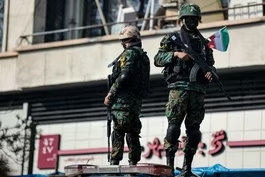
LEILA MOLANA-ALLEN: But the streets, in spite of the constant bombardment, also hosted a celebration, with a new supreme leader emerging.
MAN: Mojtaba Khamenei.
(CHEERING) LEILA MOLANA-ALLEN: Mojtaba Khamenei, named 10 days after the killing of Ayatollah Ali Khamenei, his father, the choice echoing the kind of hereditary rule the Islamic Republic purported to replace.
Pro-government supporters chanting "Death to Israel" say they stand behind the revolution.
ABBAS ALI SAEEDIPOOR, Tehran Resident (through translator): America and Israel, you have failed and you will drown in the swamp you are stuck in.
LEILA MOLANA-ALLEN: The 56-year-old expected to continue his father's hard-line approach.
President Donald Trump calling him an unacceptable choice, telling NBC today -- quote -- "I think they made a big mistake."
Just a year ago, Mojtaba Khamenei's appointment as his father's successor seemed deeply unlikely.
But the killing of his parents, wife and son in U.S.-Israeli strikes last week makes him a symbolic figurehead for pro-regime supporters and sends a firm message to Donald Trump, who declared he wanted a hand in choosing the next leader, about the inviolability of Iran's sovereignty.
In the vacuum left since his father's death, analysts say power has swung even further into the hands of the military establishment, so the new supreme leader's close ties to the all-powerful IRGC may also have spurred the choice.
For the "PBS News Hour," I'm Leila Molana-Allen in Doha, Qatar.
AMNA NAWAZ: Now to the view from the Iranian government.
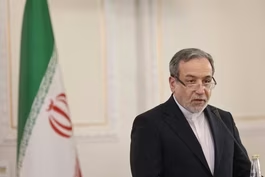
Earlier today, I spoke with Iran's Foreign Minister Abbas Araghchi, who joined us from Tehran.
Mr.
Minister, welcome to the "News Hour."
Thank you for joining us.
ABBAS ARAGHCHI, Iranian Foreign Minister: Thank you for having me, Amna.
Thank you indeed.
AMNA NAWAZ: So I'd like to ask you first about the news, the selection of Mojtaba Khamenei, the son of the late ayatollah, who's been named the new selected supreme leader of Iran.
Some say his selection is a message of continuity of his father's leadership, of continued defiance to the U.S.
and Israel.
Do you agree with that?
Is that the message Iran would like to send?
ABBAS ARAGHCHI: Well, I think that is the correct evaluation.
It shows that -- the continuity and some sort of stability at the same time.
AMNA NAWAZ: And since his selection, has he or anyone in your leadership had any contact with U.S.
officials?
Is that something that he is open to, to talk about negotiations or a cease-fire?
ABBAS ARAGHCHI: Well, first of all, it's too soon for him to make any comment.
We are all waiting for his speeches and comments, which will come later on.
But I don't think the question of talking with Americans or negotiation with Americans once again would be on the table, because we have a very bitter experience of talking with Americans.
We negotiated with them last year, in last June, and they attacked us in the middle of negotiations.
And again this year, they tried to convince us that this time is different.
They promised us that they don't have any intention to attack us, so -- and they wanted to resolve Iran's nuclear question peacefully and to find a negotiated solution.
And we finally accepted.
But, again, after three rounds of negotiation, and after the American team in the negotiation said itself that we made a big progress, still they decided to attack us.
So I don't think talking with Americans anymore would be on our agenda anymore.
AMNA NAWAZ: Mr.
Minister, this war has now entered its 10th day.
I know you have said that, unless there's a permanent end to the war, not a cease-fire, in other words, that Iran will continue to defend itself, continue to fight.
Can I ask you, what do you believe that the U.S.
and Israel are trying to achieve or trying to change with this war?
ABBAS ARAGHCHI: Well, actually, they tried to achieve some targets, some of their goals, but they failed.
They thought that, in a matter of two or three days, they can go for a regime change, they can go for a rapid, clean victory, but they failed.
So I believe that the option plan A was a failure, and now they are trying other plans, but all of them have failed as well.
And I don't think they have any realistic endgame in their mind, because we are seeing some sort of a chaos thing.
Their sayings and their actions, they have just started to attack us blindly.
They are attacking -- today, they attacked residential areas.
They attacked hospitals.
They attacked schools.
And they entered into attacking our infrastructure, which is a very dangerous move.
And, as a result, you can see that the -- the oil prices everywhere in the world.
So I don't see any reasonable goal that they are following.
They failed to achieve their goals at the beginning, and now, after 10 days, I think they are aimless.
AMNA NAWAZ: I do want to ask more about the oil prices.
As you mentioned, there have been widespread disruptions in the delivery of oil in the Persian Gulf.
We're seeing prices here in the U.S.
start to rise as well.
Do you believe that you can pressure the U.S.
and Israel to stop their attacks by slowing or stopping oil production as well?
ABBAS ARAGHCHI: Well, this is not our fault.
This is not our plan.
The oil production, the transportation of oil has been slowed down or stopped not because of us, because of the attacks and aggression made by Israelis and Americans against us.
So they have made the whole region insecure.
And this is why the tankers, the ships are scared to pass through the Strait of Hormuz.
We have not closed that strait.
We have not -- we are not preventing them to navigate in that strait.
But this is the result of the aggression by Israelis and Americans, which has made the whole region insecure, unstable.
And the consequences are huge for not only us, but for the whole region, and now for the international community.
AMNA NAWAZ: Iran has, though, hit multiple oil facilities in other nations and some of the region's top-producing nations, in fact, Saudi Arabia and Iraq and Kuwait.
And we heard from your top military spokesman today, who said: "If you can tolerate oil at more than $200 per barrel, continue this game."
So is limiting oil supply part of your strategy here?
ABBAS ARAGHCHI: Well, actually, this is a war imposed on us.
And what we are doing is only defending ourselves.
We are facing an act of aggression, which is absolutely illegal.
And what we are doing is the act of self-defense, which is legal and legitimate.
Well, we have already warned everybody in the region that, if the U.S.
attack us, since we cannot reach the American soil, we have to attack their bases in the region, their facilities, their installations, their assets.
And as a result, the war would be spread into the whole region.
So this is the consequences, the consequence of the U.S.
aggression against us.
We are not responsible for that.
AMNA NAWAZ: I do want to ask you about another recent strike that killed more than 170 people in Minab in Southern Iran.
It was at a girls school.
We have heard from President Trump, who said this weekend he denied any U.S.
involvement.
On Saturday, he actually said: "Based on what I have seen, that was done by Iran."
You have said that strike would not go unanswered.
What did you mean by that?
ABBAS ARAGHCHI: Well, this is ridiculous.
I think all U.S.
medias and different sources from American intelligence and American media, everybody have admitted that this is done by an American missile.
There are footages of that.
The footages are analyzed by neutral sources.
And it is now a consensus that the attack is made by the United States, and they are in charge of the killing of 168 schoolgirls who were absolutely innocent.
They had sat in their classrooms, and they -- all of a sudden they were killed by American military.
AMNA NAWAZ: And we've heard from the secretary of defense an investigation is ongoing.
But in saying that that strike will not go unanswered, I should note that Iranian strikes in other nations have already killed civilians.
Are you saying now that civilians are fair targets in other nations?
ABBAS ARAGHCHI: No, no, no, not at all.
Civilians are not target.
Maybe there has been some collateral damages, which is quite natural in any war, but we have not targeted -- contrary to Americans, who deliberately targeted our schools and hospitals and our infrastructure, even freshwater desalinations, we have never targeted any civilian location, any civilian purpose, any civilian place.
There might be some collateral damages, as I said, but we -- this is not our plan to do that.
AMNA NAWAZ: Your strikes in some of your neighboring nations, though, have hit a hotel.
They've hit oil facilities as well.
We've heard from Saudi Arabia's foreign minister, who is condemning those attacks and warning that it retains its full right to take all necessary measures to safeguard its security.
Are you worried about the regional impact of your strikes in the neighboring nations, that you will damage Iranian relations in the long run?
ABBAS ARAGHCHI: Well, if they have all rights to take all necessary measures to protect their facilities, I think we are even -- we have more rights to take all necessary measures to defend ourselves, to protect our people.
And this is exactly what we are doing.
No, we -- this is not our war.
This is not our choice.
This war is imposed on us.
We are under aggression.
And we are defending ourselves.
They cannot accuse us for things which happened on the other side.
They should accuse those who started this war.
And I think they should be held responsible for any damage inside Iran and in the region, because everything has -- started by the United States and Israel.
AMNA NAWAZ: U.S.
officials have noted that they're targeting your nuclear programs, your ballistic missile and drone programs, your naval assets.
There are some who've pointed out they're also targeting headquarters and facilities of your internal security forces, some of those forces who have been used to suppress public dissent in the past.
And some analysts say the U.S.
may be laying the groundwork for some kind of public uprising.
Do you believe that's the case?
And if protesters take to the streets, will they be allowed to protest?
ABBAS ARAGHCHI: Well, where are those protesters?
We have now millions of people in the streets right now in support of the Islamic Republic, in support of the new supreme leader, in support of the military armed forces.
Now, where are those protesters?
People are - - the big majority of people are now angry about this aggression.
They are supporting our armed forces.
They are in the streets with the Iranian flags everywhere.
So where are those accusations come from?
Yes, they have attacked many of our facilities.
They have attacked our nuclear facilities, but they couldn't destroy our nuclear program because it is technology advanced and developed by ourselves.
They have also attacked our missile facilities, but they have not been able to stop firing missiles against themselves.
So the firings continues.
And we are prepared.
We are well prepared to continue attacking them with our missiles as long as needed and as long as it takes.
AMNA NAWAZ: That is the foreign minister of Iran, Abbas Araghchi, joining us today.
Mr.
Foreign Minister, thank you for your time.
ABBAS ARAGHCHI: Thank you, indeed.
Thank you for having me.
AMNA NAWAZ: And a note.
We did invite White House officials for an interview on the "News Hour."
They declined.
Our invitation still stands.
GEOFF BENNETT: Well, it was a day of major volatility in global energy markets and a moment of real concern for consumers.
Oil prices briefly surged overnight, coming close to $120 a barrel, levels we haven't seen since 2022.
But, by the end of the day, prices had fallen sharply, finishing closer to $87 a barrel.
Even so, that's still much higher than before the war started, when oil was trading closer to $72 a barrel.
Drivers are already feeling it.
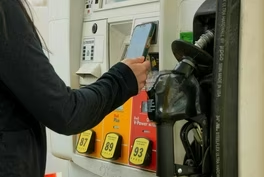
The national average price of gasoline per gallon has risen nearly 50 cents since the conflict started.
We're joined now by Daniel Yergin, vice chairman of S&P Global and a widely watched expert on energy, geopolitics and economics.
He's the author of several books, including "The Prize: The Epic Quest for Oil, Money & Power."
Thanks for joining us.
DANIEL YERGIN, Author, "The Prize: The Epic Quest for Oil, Money & Power": Thank you.
GEOFF BENNETT: We have seen extraordinary volatility in oil markets, prices briefly spiking overnight before falling later today.
What's driving these swings right now?
DANIEL YERGIN: What drove the prices up, of course, was the shutting of the Strait of Hormuz, through which pass 20 percent of world oil and 20 percent of LNG, liquefied natural gas, amplified by the fear of attacks on the very extensive infrastructure on the Arab side of the Gulf.
That was what drove prices to the level you're talking about.
Now they've come down because the president says that this war may soon be over.
And prices now -- you compared them to '72, but if we really go back to where the prices were before the military buildup began, which is around $60 or so, they're still a good deal higher, but nowhere near that $120 that you were talking about.
GEOFF BENNETT: You wrote recently in The Financial Times that the world could be facing a potential nightmare scenario.
I hear you say the markets are responding to the president's latest comments, but what's the level of concern that this conflict could last far longer than the president is projecting?
And if it does, how disruptive would that be for global energy supplies?
DANIEL YERGIN: Well, what would get one to the nightmare scenario would be an extended period of the closure of the Strait of Hormuz combined with extensive damage to the infrastructure.
And that would be the type of thing that would send prices up high, higher than what you were talking about, would hit financial markets, and could well as in -- we saw in the 1970s, it could push the world into recession.
That's the nightmare scenario.
But if as of the last couple of hours, there's been a receding from that specter.
GEOFF BENNETT: The energy secretary, Chris Wright, said yesterday he believes that oil tanker traffic through the Strait of Hormuz could resume normally soon.
Take a listen.
CHRIS WRIGHT, U.S.
Energy Secretary: A large tanker went through the Gulf about 24 hours ago, through the Straits of Hormuz.
So we're still focused right now on continuing to attrit their missile and drone capability to reduce their ability to disrupt traffic, to attack their 10 neighbors that they have been attacking.
And that work is going tremendously well.
GEOFF BENNETT: Do you share that optimism?
Just today, as we sit here and speak, President Trump is addressing reporters and he suggested that there might be naval protection for tankers.
Would that be appropriate or necessary?
DANIEL YERGIN: Well, that certainly would recall what has happened in decades past when there were convoys that escorted it.
And one big tanker did pass through the Strait of Hormuz yesterday.
It's about a day away from arriving in India.
But there's still -- I mean, for people shipping, most people are not shipping oil because they're still worried about attacks.
They're worried about drones.
They're worried about explosive speedboats.
And until their sense of security is there and insurance rates come down, we won't see that passage.
But that's the question of really how the overall war goes.
GEOFF BENNETT: If energy costs continue to climb, where might Americans feel it the most beyond the gas pump?
DANIEL YERGIN: I think it's really in -- the gas pump is where you'd feel it more.
But it shows up in a lot of other things.
People don't think about it, but energy is a big cost going into food, our agriculture.
About 70 percent of the cost of food, it's been estimated, comes from energy.
And that would show up in transportation and processing.
But, of course, the one that people see every day is that -- is those numbers on the signs outside the gasoline stations.
GEOFF BENNETT: The president made the case that there's still plenty of oil on reserve.
What should Americans understand about the difference between the physical supply and the fear that the markets reacted to overnight?
DANIEL YERGIN: Well, you're quite right that there is a difference at markets that the price that you see, that the price that gets posted is what people are bidding because they're worried.
And people start bidding for oil, bidding up the price of oil and natural gas.
But you mentioned storage, that we have a system of strategic reserves that was actually established after the oil crisis of the 1970s to deal exactly with this type of situation.
And of course, now there's discussion among the U.S.
and among other Western countries who belong to the International Energy Agency about actually releasing oil from those strategic stockpiles.
GEOFF BENNETT: What are you watching beyond the president's rhetoric to get a sense of where the market really is?
DANIEL YERGIN: Well, that's a very good question.
I mean, obviously, you look at price, and then also whether you start seeing where the shortfalls show up.
And actually you asked the impact for Americans.
The biggest impact has actually been in Asia so far, because 80 percent of the oil that comes out of the strait goes east to Asia, over 90 percent of the LNG.
And so we really get the rebound of the impact of shortages in Asia.
But you know who the biggest beneficiary of the very high prices is Vladimir Putin, who makes a lot more money, which he can then use to fund his war in Ukraine.
GEOFF BENNETT: Daniel Yergin of S&P Global, thank you for sharing your insights with us.
DANIEL YERGIN: Thank you.
AMNA NAWAZ: In the day's other headlines: Federal prosecutors charge two men today with attempting to support ISIS after they allegedly brought bombs to a New York City protest this weekend.
Ibrahim Kayumi and Emir Balat are being held without bail on charges including attempting to provide material support to a terrorist organization and using a weapon of mass destruction.
Police found the homemade devices, which did not explode, outside Mayor Zohran Mamdani's official residence on Saturday.
The scene unfolded during a counterprotest to an anti-Islamic demonstration organized by far-right activist Jake Lang.
Today, New York's police commissioner said the bombers intended to inflict maximum damage, citing statements from one of the suspects, Emir Balat in particular.
JESSICA TISCH, New York City Police Commissioner: He also told investigators that he had hoped to carry out an attack even bigger than the Boston Marathon bombing, which he noted resulted in only three deaths.
This was a planned attack motivated by extremist ideology and inspired by a violent, foreign terrorist organization.
AMNA NAWAZ: The police commissioner also said there are no indications that the attack was connected to the ongoing war with Iran.
The Justice Department says it's reached a tentative agreement in its antitrust lawsuit against Ticketmaster and its parent company, Live Nation.
Under the terms of the deal, Live Nation would pay up to $280 million in fines and divest ownership of 13 amphitheaters.
It would also allow venues to use other vendors to sell tickets and cap service fees, which could potentially lead to lower prices for consumers.
But it spares the business from being split apart, leaving some states worried that it remains a monopoly.
The deal still must be approved by a judge, and some states say they'll carry on with the ongoing trial in New York.
Security lines at airports across the country stretched for hours again today as more TSA agents are calling off work due to the partial government shutdown.
At Houston's Hobby Airport, passengers were advised to arrive four hours before their flights.
The delays are lingering after a travel nightmare this weekend.
MAN: We're going on two hours right now in just TSA's line.
Right now, I'm trying to keep high spirits right now to keep everybody else up, but I -- everyone's in a bad mood, hot and sweaty and everything.
MAN: Come on, two lines, two escalators.
Let's go.
AMNA NAWAZ: In New Orleans, lines snaked through the concourse and out to the parking garage as airport officials warned of a two-hour wait there.
The partial government shutdown of the Department of Homeland Security, which oversees the TSA, started nearly a month ago.
Around 50,000 airport screeners have been working without pay.
A.I.
company Anthropic is suing the Trump administration after officials labeled it a supply chain risk, rendering it ineligible for government contracts.
It came after the company said it did not want its technology to be used for mass surveillance of U.S.
citizens or for autonomous lethal weapons.
In a pair of lawsuits, Anthropic called the designation -- quote -- "unprecedented and unlawful," saying -- quote -- "The Constitution does not allow the government to wield its enormous power to punish a company for its protected speech."
Defense Secretary Pete Hegseth had insisted that Anthropic accept all lawful uses of its technology and threatened to punish the company if it failed to comply.
Australia has granted asylum to five members of the Iranian women's soccer team.
They were in the country for the women's Asian Cup last month before the war began.
Australia's home affairs minister said they had been moved to a -- quote - - "safe location" by federal police officers, and he added asylum was offered to other team members as well.
Iran was knocked out of the tournament over the weekend and was facing the prospect of returning to a home country under bombardment.
On Wall Street today, stocks erased earlier losses to end higher.
The Dow Jones industrial average added nearly 240 points on the day.
The Nasdaq rose more than 300 points.
The S&P 500 also managed a decent gain.
And we have two passings of note this evening, starting with former White House aide and Watergate figure Alexander Butterfield.
During Senate hearings in 1973, Butterfield revealed the existence of a secret recording system inside the Nixon White House.
MAN: Mr.
Butterfield, are you aware of the installation of any listening devices in the Oval Office of the president?
ALEXANDER BUTTERFIELD, Former Deputy Assistant to President Richard Nixon: I was aware of listening devices, yes, sir.
MAN: When were those devices placed in the Oval Office?
AMNA NAWAZ: His testimony shocked a nation and would help prove Richard Nixon's role in the Watergate cover-up.
He resigned the presidency the following year.
Butterfield also served as head of the FAA and as a business executive in California.
In later years, Butterfield said he didn't expect his testimony to lead to Nixon's downfall, but considered him a crook and cheered when he left office.
Alexander Butterfield was 99 years old.
And the musician known as Country Joe McDonald has died.
His performance at Woodstock in 1969 was a highlight of the event and a symbol of the times.
McDonald's anti-war song "I Feel Like I'm Fixing To Die Rag" and its sing-along chorus was an anthem for Vietnam War protesters.
He also led the crowd in a four-letter expletive chant that captured the anger of the era.
He and his band, Country Joe and the Fish, came out of the psychedelic rock scene of the Bay Area.
McDonald went on to release a number of solo albums over the decades that followed.
His wife says he died due to complications from Parkinson's.
Country Joe McDonald was 84 years old.
Still to come on the "News Hour": Tamara Keith and Amy Walter break down the latest political headlines; and a professor of online information joins our PBS News podcast to discuss how to spot manipulated images.
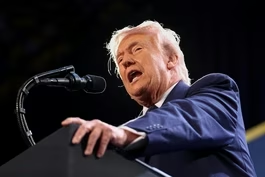
Returning now to the war with Iran, President Trump spoke to reporters late this afternoon at his golf resort outside Miami.
In his first formal news conference since the U.S.
and Israel began strikes on Iran over a week ago, the president made a new threat.
DONALD TRUMP, President of the United States: We're also hitting where they make missiles and where they deliver missiles.
We've struck over 5,000 targets to date, some of them very major targets.
And we've left some of the most important targets for later in case we need to do it.
If we hit them, it's going to take many years for them to be rebuilt.
AMNA NAWAZ: Joining us now with more on what the president had to say about the war in Iran is our foreign affairs and defense correspondent, Nick Schifrin.
So, Nick, when the president talks about new targets there, what does he mean?
NICK SCHIFRIN: Yes, this is new, Amna.
We have not heard this from him or any other U.S.
official specifically talking about the threat of hitting, in his words, electricity production.
That presumably means civilian targets, how the country keeps its lights on, keeps its heat going.
And U.S.
and Israeli officials have pointed out that ideally they would actually leave some of that intact because they want the future of Iran to be one that they deal with.
That depends on the leadership, of course.
But, again, a new threat from President Trump and really saying: "We're not looking to do that if we don't need to.
We are waiting to see what happens before we do," leaving an ellipsis at the end of that sentence.
AMNA NAWAZ: He also spoke about the timeline for the war.
What did he have to say about that?
NICK SCHIFRIN: So, this is really important, I think, because we've heard President Trump speak to reporters lately saying that, well, maybe the war is almost done.
He's cited all of the air defense in Iran is gone.
Missile -- the ability for Iran to launch missiles is down some 90 percent.
All of these U.S.
airstrikes that you're seeing, some video of hitting drones, etc.
But this is what he said tonight.
He said: "The war will end soon, very soon."
And when asked about how he could help protesters, right, the ones who he promised to help back in January, when tens of thousands of them were killed, he said that he would love to help the protesters, but that the Iranian system would have to be a system -- quote - - "that allows them to be helped."
And then this is the end of the quotation.
"And if we cannot have that, if we cannot have a new Iranian system, we might as well get over with it right now."
That is a very big suggestion that some of his advisers are doubting whether regime change can be achieved.
And, therefore, once the military objectives are achieved, perhaps the U.S.
cannot fulfill his promise to help all of those protesters back in January overthrow the regime, again, just a suggestion from the president.
We got other suggestions as well in this press conference, but a big hint there that he did not see a need to keep on going once these military objectives are achieved.
And he said they're almost all achieved already.
AMNA NAWAZ: Nick Schifrin with the very latest from President Trump.
Nick, thank you.
NICK SCHIFRIN: Thank you.
GEOFF BENNETT: For more on the political fallout of the military action in Iran, we're joined now by our Politics Monday duo.
That's Amy Walter of The Cook Political Report With Amy Walter and Tamara Keith of NPR.
It's great to see you both.
TAMARA KEITH, National Public Radio: Hello.
Good to be here.
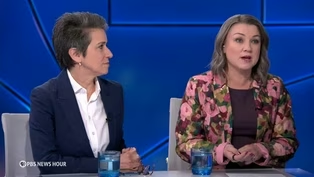
GEOFF BENNETT: So, Tam, as you well know, House Republicans are gathered today at President Trump's golf club just outside Miami as this midterm season starts to take shape.
And, of course, the backdrop to all of this is complicated.
The cost of living remains high.
You have the administration opening a military confrontation in the Middle East without a clearly articulated strategy to the public.
What went down in Doral today and what's the message from Republicans and how does that square with reality?
TAMARA KEITH: Well, President Trump pitched Republicans on passing what is called -- he's calling the SAVE America Act.
That was his big pitch.
He delivered a lot of remarks.
It was pretty wide-ranging.
But his argument was that Republicans, if they could just pass that, they could win the midterms.
Now, we should explain what that is.
That is a law or a bill that may never become a law because there are problems in the Senate getting it through.
But it is a piece of legislation that would require not just voter I.D., but proof of citizenship in order to vote.
He also wants the House to of sort of reopen it and tack on some items related to transgender people and sports and medical procedures.
So it is what the president sees as sort of the gold medal legislation that can be their entire message for the midterms.
And, as an added bonus, he's arguing Democrats won't be able to win if they can't cheat.
Now, that -- there's a lot underlying that.
But that is his pitch.
That is his pitch to Republicans.
And he has said, he said today, he has said on social media he is not going to sign other legislation until this is on his desk, which I don't know if he can hold to that.
AMY WALTER, The Cook Political Report: It is quite remarkable when you think about what he said today in Florida and what the White House aides have been saying to Republicans for the last few weeks, which is, don't worry, we're going to talk about affordability nonstop.
The president's going to go on tour.
He's going to talk up what you all did, Republicans in Congress to pass this tax cut.
He's going to echo that.
We're going to talk about affordability.
Maybe there's even an opportunity -- this isn't the White House saying this, but this has been bandied about -- of another piece of legislation, a reconciliation bill that would be Republican only that would also talk about affordability.
That is the number one issue for voters.
It is pretty clear.
We saw it at the State of the Union.
We're hearing it now.
That idea of a president running on an affordability agenda or promoting that is just not going to happen.
GEOFF BENNETT: Well, let me ask you this, because the president, in speaking to his Republican colleagues today, said -- quote -- "No other president could do some of the 'expletive' I'm doing."
There are certainly Republicans who wish that he was doing less.
I mean, what is the level of anxiety?
AMY WALTER: But he's not -- and he's not wrong.
GEOFF BENNETT: He's not wrong at all.
You're right.
But what's the level of anxiety among Republicans right now heading into the midterms?
AMY WALTER: Well, I think they're -- it feels as if for many there's a sense of resignation.
They have a very narrow majority on the House side.
They have a very narrow majority.
It is unlikely, it is very challenging for any party to do well in a midterm election, especially at a time when the president's approval rating is where it is.
So there seems to be some resignation that it's going to be really hard for us to keep the House.
What I think they're looking for is some sense that -- and they have to do two things.
They need to keep losses at least manageable, so that it's not a blowout.
And the Senate becomes the real question mark.
If you see higher level of concern among Republicans, it would be if they're worried that the Senate is now also on the line.
Right now, they don't believe that.
I think that's correct.
But they would like for the president to at least ensure that that doesn't happen.
GEOFF BENNETT: Tam, on Iran, there are reports that the White House was surprised by the scale of Iran's retaliation in the Gulf, the number of drones and missiles fired at the UAE and fired at civilian targets.
What does that say about how prepared the administration was for the series of consequences, intended and otherwise?
TAMARA KEITH: Yes, and I would like to jump to another consequence that I think is very clearly weighing on the president, whether he admits it or not, and that is oil and gas prices.
That is something that affects voters immediately the second they go to fill up their gas tanks.
And it undercuts the affordability agenda that the president has been talking about.
I mean, he's mostly been dismissing affordability and he has repeatedly, including in his State of the Union, touted these record low, not really record, very low gas prices and low gas prices were going to be the solution to all of the ailments, everything that ails everyone on affordability.
And he's saying that they knew that oil prices would rise as a result of this war.
But they are rising now, and he is suddenly talking about this as, oh, this is just an excursion, this is a very short-term excursion.
We are going to fix this because we need to fix the oil prices, we need to fix the gas prices.
GEOFF BENNETT: The president trying to speak it into existence.
AMY WALTER: Yes.
And, look, it is true if this does indeed become something that is very short-lived, the military presence, the U.S.
military presence in Iran, if we get gas prices, oil prices to go down, then, yes, this is not something that people will be talking about in November.
However, it is just one more reminder, I think, to a lot of voters of the chaos that they are feeling in their lives when it comes to the cost of stuff.
GEOFF BENNETT: Tam?
TAMARA KEITH: Yes, repeatedly, polls - - and this was before the Iran war, but polls have shown voters saying that they believe that the president isn't focused on the issues that matter most to them.
I have been talking to a lot of swing voters.
Whether they support him or not, literally every single one of them has said that the economy is their number one issue.
And this war is affecting, at least temporarily and maybe longer term, the economy in a way that is completely counter to what the president promised when he ran for office.
AMY WALTER: I talked to a Republican strategist the other day who -- I'm paraphrasing, but basically said what we would really like as Republicans to see the president declare war on the price of groceries, rather than making the focus on Iran.
GEOFF BENNETT: Amy Walter and Tamara Keith, thanks to you both.
AMY WALTER: You're welcome.
TAMARA KEITH: You're welcome.
AMNA NAWAZ: And we will be back shortly with an excerpt from our "Settle In" podcast that will help you identify fakes on the Internet.
GEOFF BENNETT: But, first, take a moment to hear from your local PBS station.
It's a chance to offer your support, which helps to keep programs like the "News Hour" on the air.
For those of you staying with us: More than a quarter of all parents of children with disabilities say they struggle to find appropriate childcare for their kids.
AMNA NAWAZ: Judy Woodruff has this encore report.
It's part of our series Disability Reframed.
JUDY WOODRUFF: In many ways, Caine Harris is a typical young boy.
He loves Curious George and watching videos on his mom's iPad.
So tell me about this young man that we're sitting here talking with.
He's 4 years old.
Is that right?
And... JASMINE WATKINS, Mother of Caine Harris: Yes, that's my 4-year-old son, Caine.
JUDY WOODRUFF: And he is a bundle of energy.
JASMINE WATKINS: Yes, he's very hyper.
(LAUGHTER) JUDY WOODRUFF: But Jasmine Watkins says, when her son was around 18 months old, he began falling behind some of his peers.
JASMINE WATKINS: I recently, within these last three weeks, have gotten him diagnosed with autism.
But that's, like, a very new diagnosis.
Prior to that, I would say he has a speech delay, a cognitive delay.
JUDY WOODRUFF: On top of that, Caine is not potty trained, common for children his age with autism.
All this has made it incredibly difficult for Watkins, a single working mom in Silver Spring, Maryland, to find childcare.
JASMINE WATKINS: They ask you about your child's personality.
They ask if there's any diagnosis.
And they will ask you that.
And if you're like, oh, my child, he doesn't talk or he's still in diapers, these are things that they're putting into perspective when they're trying to enroll you in a program.
JUDY WOODRUFF: She says, earlier this year, after looking at several childcare centers in the area that couldn't meet Caine's needs, a spot opened up at Easterseals, a national nonprofit that provides day care to all children, including those with special needs.
CHYRLETTE CRUMP, Easterseals: We get calls every day with families looking for space for their child with special needs.
And, sometimes, the families don't want to share that information over the phone because they're afraid that they're going to hear that answer no.
JUDY WOODRUFF: Chyrlette Crump is the director of the child development center at this Easterseals, which serves about 60 kids ages 5 or younger.
The organization relies on both public and private funding, including grants and donations, to offer these services.
Parents pay based upon their income.
Caine is one of about 12 children here with special needs.
CHYRLETTE CRUMP: I think what sets us apart is, we're not afraid to work with children with disabilities.
Sometimes, for educators or programs, it's fear of the unknown.
We're not afraid.
We need to meet children exactly where they are, so if there is ability or disability, we can help support them.
JUDY WOODRUFF: But finding that support isn't easy.
ELIZABETH CURDA, U.S.
Government Accountability Office: Our analysis showed there's over 2.2 million children in the United States with disabilities who are aged 5 or younger.
And their parents are having a very difficult time finding childcare for them.
JUDY WOODRUFF: Elizabeth Curda is a director at the U.S.
Government Accountability Office, which released a report last year.
It showed many childcare centers often put up barriers for children with special needs, including requirements for potty training by the age of 3.
Their parents can face yearslong wait-lists and sometimes even be forced to move to access childcare.
ELIZABETH CURDA: And what we heard from providers is, they need training, they need additional staff and funding for accommodations and for making the physical environment accessible.
NAKISHA URBINA, Teacher, Easterseals: They learn the routine.
They learn the consistency.
JUDY WOODRUFF: At Easterseals, teachers like Nakisha Urbina do receive extra training and instruction on how to interact with students like Caine Harris.
NAKISHA URBINA: Just having an open mind that not to take the behavior personal, because sometimes they're not going to be in compliance.
JUDY WOODRUFF: She says this training has been crucial and that she now enjoys having special needs children in her classroom.
NAKISHA URBINA: It helps me teach the other children that everyone is learning differently.
So, it helps me create the lesson plan that includes Caine and the other children.
So it's not challenging.
It just helps me become better at what I'm doing and how I'm teaching both children with special needs and children that do not have special needs.
JUDY WOODRUFF: Some staff here are also trained on even more medically complex needs, like how to properly feed 1-year-old Miracle Wynn.
ROBERT WYNN, Grandfather of Miracle Wynn: I have never seen a baby like this, so independent.
She's a fighter.
JUDY WOODRUFF: Grandfather Robert Wynn raises Miracle, who's relied on this tube attached to her stomach to be fed ever since surviving open-heart surgery at birth.
ROBERT WYNN: I could show you pictures where she had tubes all over.
I cried every day because I didn't know if she was going to make it, but God is good.
Right here.
Right here.
JUDY WOODRUFF: While some parents pay up to $2,500 a month for childcare at Easterseals, Wynn received a grant from Montgomery County in Maryland that allows him to send Miracle here for free.
What would it be for you, what would it mean for you if this place didn't exist?
ROBERT WYNN: I have no idea.
I would be lost.
I'm going to be honest with you.
I would be lost.
They allow me to go to work.
I hadn't worked in almost a year.
They allow me to go to work.
I mean, boy, they do my baby's hair.
I'm dad.
I mean, I have got five girls, but I have not learned how to do hair.
JUDY WOODRUFF: You're not good with hair.
ROBERT WYNN: Not at all.
And they do it for me.
JUDY WOODRUFF: That level of care is what Jasmine Watkins says has made Easterseals a good fit for her son, who now also gets picked up five days a week for additional speech training at a local school.
JASMINE WATKINS: I just want Caine to be happy.
I want him to be able to articulate himself.
I want him to be a kind, loving person that's thriving.
And to be able to do that, he needs extra help.
And that's OK.
JUDY WOODRUFF: Extra help that still remains out of reach for so many parents across the country.
For the "PBS News Hour," I'm Judy Woodruff in Silver Spring, Maryland.
AMNA NAWAZ: We turn now to our PBS video podcast "Settle In."
For our latest episode, I spoke to pioneering digital forensic expert Hany Farid.
We talked about why disinformation spreads online, how to find reliable sources of information, and why he's still hopeful about our digital future.
HANY FARID, University of California, Berkeley: The thing you have to understand about social media is, not only is it -- doesn't care about real, fake, true, lies.
In fact, it actually prefers algorithmically the spread of mis- and dis-information because that's what leads to user engagement.
So the algorithms have learned how to spread the most salacious, outrageous conspiratorial content because that's what the billions of people online click on.
And so in many ways -- we've known this for a long time -- is that the lies spread much, much faster than the truth, which of course adds a whole 'nother complexity to the speed with which we have to respond and also the consequences for getting it wrong.
AMNA NAWAZ: I mean, you just said something fascinating, though.
It's not just that people are spreading these things, because they do.
It's not a coincidence rage bait was the word of the year last year, right?
But it's that the algorithms actually prefer them over real information or real images.
Is that right?
HANY FARID: That's 100 percent right.
And the reason, of course, is because the business model of social media, think X, Facebook, Instagram, TikTok, et cetera, is user engagement.
The more you click, the more ads we deliver, the more money they make.
And so the algorithms, they didn't set out to burn the place to the ground.
They didn't set out to do that.
It was learned.
And you could blame the social media giants for this, and I think we should.
But, at the end of the day, we're the ones clicking on those posts.
We are the ones teaching the machines that this is what we will engage with.
And so, yes, it's learned that, well, when the user clicks on this, give them more of this.
And rage bait works.
Clickbait works.
We click on it.
And so we have to return to our trusted sources.
We have to understand that people like you are really -- work really hard to figure out what is going on in the world.
They talk to people like me to understand it and to bring that information to you.
And you don't have to figure out what's going on in the world in the first 10 seconds of an event.
There is a speed/accuracy trade-off.
The faster you get your information, the less accurate it is.
I would much, much rather wait until tomorrow morning and know what is going on than be lied to for the intervening 12 hours.
And we just have to change that culture, that people have to understand that social media is not designed as a reliable source of information.
It's not.
It never has, and it never will.
AMNA NAWAZ: The majority of Americans do get their news and information from social media.
That's where we are right now.
What you're calling for is an enormous cultural shift, the likes of which we are definitely not trending towards, right?
So, just culturally, short of even policy guidelines or companies and CEOs completely changing how they do their work, how does that kind of thing start?
HANY FARID: Yes.
So, first, I'm not naive about this is a massive cultural -- not just here in the United States, but globally.
But I'm also old enough to remember when something like one-third of Americans smoked cigarettes, and we thought, wow, that's just the way it is.
And we smoked in grocery stores.
We smoked in restaurants.
We smoked in airplanes, for God's sakes.
And it was the norm.
But we changed because we realized that this stuff is killing us.
And I would argue social media is not that different.
Now, I don't think that change will happen slowly.
I don't think it will come without pressure from Congress, from our regulators, with liability from the courts holding these companies responsible for the harms.
The parallels to tobacco are not far off.
Now, the good news is, I think there's some -- at least a glimmer of hope in the horizon.
So, if you look, for example, today, there are massive litigations happening around social media and addictive properties and the impact of children in a way that I think 10 years ago I didn't think we would see these cases.
And so there is movement.
Australia has banned social media for kids under the age of 16.
The E.U.
and the U.K.
and other parts of the world are considering similar legislation.
I think there is an awakening that, while there are positive aspects to these technologies, to social media, it is clear the harms are unambiguous.
It will take a lot of conversations.
It will take a lot of serious people thinking about this in a serious way.
And it will take fighting back against massive, massive global corporate interests.
But I don't know what the other option is.
AMNA NAWAZ: And you can watch that full conversation and all the episodes of "Settle In" on our YouTube channel or wherever you get your podcasts.
GEOFF BENNETT: And that's the "News Hour" for tonight.
I'm Geoff Bennett.
AMNA NAWAZ: And I'm Amna Nawaz.
On behalf of the entire "News Hour" team, thank you for joining us.
 New
NewAraghchi says Iran will fight 'as long as it takes'
Video has Closed Captions
Clip: 3/9/2026 | 12m 14s | Iran’s Araghchi calls U.S. strikes a ‘failure’ and vows to fight 'as long as it takes' (12m 14s)
 New
NewHany Farid joins Amna Nawaz on 'Settle In'
Video has Closed Captions
Clip: 3/9/2026 | 4m 29s | On 'Settle In,' Hany Farid and Amna Nawaz discuss spotting manipulated images (4m 29s)
 New
NewIran war will end 'soon' but targets remain, Trump says
Video has Closed Captions
Clip: 3/9/2026 | 3m 1s | Iran war will end 'soon' but 'important targets' remain if needed, Trump says (3m 1s)
 New
NewKhamenei’s son named supreme leader in Iran
Video has Closed Captions
Clip: 3/9/2026 | 4m 52s | As Iran war deepens, Khamenei’s son named new supreme leader (4m 52s)
 New
NewNews Wrap: 2 charged with bringing explosives to NYC protest
Video has Closed Captions
Clip: 3/9/2026 | 6m 25s | News Wrap: 2 charged with bringing explosives to New York protest (6m 25s)
 New
NewOil expert warns of 'nightmare scenario’ war could spark
Video has Closed Captions
Clip: 3/9/2026 | 6m 23s | Oil expert warns of ‘nightmare scenario’ Iran war could spark (6m 23s)
 New
NewTamara Keith and Amy Walter on Trump's midterm message
Video has Closed Captions
Clip: 3/9/2026 | 7m 5s | Tamara Keith and Amy Walter on Trump's midterm message (7m 5s)
Providing Support for PBS.org
Learn Moreabout PBS online sponsorship
- News and Public Affairs

FRONTLINE is investigative journalism that questions, explains and changes our world.

- News and Public Affairs

Amanpour and Company features conversations with leaders and decision makers.
Urban Consulate Presents











Support for PBS provided by:
Major corporate funding for the PBS News Hour is provided by BDO, BNSF, Consumer Cellular, American Cruise Lines, and Raymond James. Funding for the PBS NewsHour Weekend is provided by...