
March 6, 2026 - PBS News Hour full episode
3/6/2026 | 57m 46sVideo has Closed Captions
March 6, 2026 - PBS News Hour full episode
Friday on the News Hour, President Trump demands "unconditional surrender" from Iran while Israel ramps up its strikes against Hezbollah in Lebanon. The U.S. shows signs of a strained economy that's now facing even more uncertainty from the war with Iran. Plus, Americans who found themselves stranded abroad when the war started share their struggle trying to return to the U.S.
Problems playing video? | Closed Captioning Feedback
Problems playing video? | Closed Captioning Feedback
Major corporate funding for the PBS News Hour is provided by BDO, BNSF, Consumer Cellular, American Cruise Lines, and Raymond James. Funding for the PBS NewsHour Weekend is provided by...
Support provided by:

March 6, 2026 - PBS News Hour full episode
3/6/2026 | 57m 46sVideo has Closed Captions
Friday on the News Hour, President Trump demands "unconditional surrender" from Iran while Israel ramps up its strikes against Hezbollah in Lebanon. The U.S. shows signs of a strained economy that's now facing even more uncertainty from the war with Iran. Plus, Americans who found themselves stranded abroad when the war started share their struggle trying to return to the U.S.
Problems playing video? | Closed Captioning Feedback
How to Watch PBS News Hour
PBS News Hour is available to stream on pbs.org and the free PBS App, available on iPhone, Apple TV, Android TV, Android smartphones, Amazon Fire TV, Amazon Fire Tablet, Roku, Samsung Smart TV, and Vizio.
Providing Support for PBS.org
Learn Moreabout PBS online sponsorshipAMNA NAWAZ: Good evening.
I'm Amna Nawaz.
GEOFF BENNETT: And I'm Geoff Bennett.
On the "News Hour" tonight: President Trump# de.. while Israel ramps up its strikes# against Hezbollah in Lebanon.
AMNA NAWAZ: The U.S.
loses nearly# 100,000 jobs in February, showing## signs of a strained economy that's now facing# even more uncertainty from the war with Iran.
GEOFF BENNETT: And Americans who found# themselves stranded abroad when the war## started share their struggle# trying to return to the U.S.
JOHN ALMEIDA, American Citizen:# The American Embassy here has## been utterly useless.
We called# and called and e-mailed.
I mean,## you launch an attack and you don't man these# stations with support for your citizens?
(BREAK) GEOFF BENNETT: Welcome to the "News Hour."
Nearly a week into the U.S.-Israel war with# Iran, President .. Republic surrender and again said he wants# a hand in choosing the nation's next leader.
AMNA NAWAZ: The Iranian Red Crescent# says more than 1,300 people have now## been killed by the American and Israeli bombing.## Local officials in Tehran also said another# school was hit with an airstrike.
The bombing## of a girls school last Saturday killed# more than 150 people, mostly children.
Special correspondent Leila Molana-Allen is in the## Gulf and starts our coverage tonight of# the expanding war, beginning in Lebanon.
LEILA MOLANA-ALLEN: The strikes echo# like deep thunder.
Thick gray smoke## blankets the skyline of Lebanon's capital,# the view from the ground even more menacing,## buildings completely eviscerated.
Overnight# and into today, Israel pounded Beirut and its## southern suburbs with by far the most intense# airstrikes since last year's cease-fire.
Israeli officials say their# campaign against Hezbollah## will continue even after their war on Iran ends.
BRIG.
GEN.
EFFIE DEFRIN, Israeli Defense Forces# Spokesperson (through translator): Hezbollah## and the Iranian regime are.. must get rid of Hezbollah and soldiers# of the Revolutionary Guard who operate## on its territory.
If they won't,# we will chase and attack them.
LEILA MOLANA-ALLEN: Yesterday, the IDF ordered# the entirety of Southern Lebanon to evacuate,## some 400,000 people ordered to# head north of the Litani River,## and today told all residents of several villages# in the Beqaa Valley to leave too, having already## extended the unprecedented evacuation orders to# cover entire neighborhoods in Southern Beirut.
In this densely populated area, hundreds of# thousands of people forced to flee their homes,## terrified families with nothing# but the clothes on their backs.
JAMAL SEIFEDDIN, Displaced Lebanese# (through translator): We're sleeping here## in the streets.
Some are sleeping in .. LEILA MOLANA-ALLEN: Meanwhile, U.S.-Israeli# attacks intensified across Iran, pushing the## war into a new phase as it nears the one-week# mark.
A spokesperson for Iran's Foreign Ministry## released this video showing what appears to be a# school in Tehran smashed into ash by an airstrike.
The IDF launched what it called a broad-scale# wave of strikes on Tehran and the western city## of Kermanshah, home to multiple ballistic# missile bases.
And U.S.
Central Command## said it struck this Iranian drone carrier.
It all# came alongside yet another message from President## Donald Trump.
He ruled out anything other than# Iran's -- quote -- "unconditional surrender."
But Iranian President Masoud Pezeshkian today## tweeted that -- quote -- "Some countries# have begun mediation efforts, which should## address those who underestimated# Iran and ignited this conflict."
Trump also met behind closed doors with leaders# of American military contractors and said the## top defense manufacturing companies would, in his# words, quadruple production of certain munitions.
COL.
MARK CANCIAN (RET.
), Center for Strategic# and International Studies: Production for## these kinds of systems takes years.
LEILA MOLANA-ALLEN: Retired Colonel# Mark Cancian told us whatever they## do now won't have any impact on this war.
COL.
MARK CANCIAN (RET.
): He's likely exhorting# them to increase their production capabilities## so that, when the war is over, the United# States can replace these munitions more## quickly and provide them to allies and partners.# Patriots, for example, are used very widely.
LEILA MOLANA-ALLEN: Those systems hard# at work over Tel Aviv.
Israel shot## down Iranian missiles as they flew toward the# capital.
And, today, missiles reached Kuwait,## Saudi Arabia, Bahrain and Qatar, though# the number of attacks is declining.
It's sunset here in Qatar and time to break the# Ramadan fast.
Usually, these streets would be## packed, but with so many incoming attacks from# Iran, many residents are choosing to stay home.## We have just had another emergency alert go off# for incoming missiles while we were standing here.
Thus far, Gulf nations have managed# to intercept most of these attacks,## but now stocks for their missile# defense systems are running low.## And Gulf leaders are beginning# to consider a firmer response.
Under the constant threat of Iranian# missiles, the capital Doha's residents,## including its large population of foreign# workers, are trying to go on with life as normal.
ABDUL HARIS, Doha, Qatar, Resident: In Qatar,# always, they have very good alliance with many of## other countries, especially neighboring countries.# So I don't think it -- it won't go forward.
LEILA MOLANA-ALLEN: But not everyone feels safe.# Airports across the region have been shut down## for nearly a week, stranding hundreds# of thousands of tourists in a war zone.
Matthias, a German tourist whose cruise# ships sailed into Doha's port just minutes## before the attacks began, was locked# in his cabin on board for five days,## taking shelter as drones and# missiles rained down on the CITY.
MATTHIAS, German Tourist: The captain told# us, stay here on board.
Don't leave the boat.
LEILA MOLANA-ALLEN: How are you# feeling when these missiles come in?
MATTHIAS: We are fear.
We are fear.
We look,## watch in the sky and see the missiles and the# other missiles from the air base, from Qatar,## and we hit in the -- we're meeting in# the sky and explosion.
You see flames.
LEILA MOLANA-ALLEN: A region suspended in# fear as the Iran war continues to escalate## with no end in sight and hundreds# of millions caught in the crossfire.
For the "PBS News Hour," I'm# Leila Molana-Allen in Doha, Qatar.
GEOFF BENNETT: Today, we also learned that Iran# is receiving intelligence support from Russia.
Our Nick Schifrin joins us now.
So, Nick, let's start there.# What kind of intelligence?
NICK SCHIFRIN: Two officials with -- who# have been briefed on this intelligence tell## me that Russia has shared satellite data that# provides the real-time movement of American## troops since Saturday, since the war began.
That# confirms a report first in The Washington Post.
The officials say the data includes movement of# ships, movement of aircraft as they move into the## region, as they move throughout the region.
Now,# the context for this is Iran's ongoing attacks,## attempted attacks on U.S.
troops, but also# ongoing attacks on U.S.
bases and embassies,## for example, this drone attack that crashed into# the Navy's Fifth Fleet headquarters in Bahrain,## an attack on a tactical operations# center in Kuwait on a base.
You see the damage in the bottom right there.# That killed six U.S.
soldiers in a facility## that the soldiers' family members say was# not reinforced.
An attack like this one on## the Prince Sultan Air Base in Saudi Arabia that we# saw yesterday, close call for the cameraman there.
But I spoke to two former senior intelligence# officials and two former senior military officials## with extensive knowledge of the region who say# let's put this in a little bit of perspective.## Iran already has access to commercial# satellite data, which is often very## good.
Iran has already been taking photos# of U.S.
bases and embassies for many years.
Iran and Russia do not rehearse the sharing# of real-time intelligence like this,## and that would require networks anyway that# the U.S.
is trying to take down.
And Iran does## not need Russian intelligence to attack static# targets like those bases, like those embassies.
For example, air defense radars and some of these# embassies are actually on Google maps.
That said,## the intelligence could help if Iran# were to target things that are moving,## ships that have just arrived,# aircrafts that have just arrived.
And a current U.S.
official tells me, look, their# number one priority is protecting the force.## And it would be an understatement# to suggest that Russia sharing this## intelligence with Iran as it's at war# with the United States was a concern.
GEOFF BENNETT: Well, what are# the political implications of## Russia choosing to help Iran in this way?
NICK SCHIFRIN: Yes, I think that's a really# important question, because the former officials## I talked to say, regardless of how much this# is actually helping Iran target U.S.
forces,## we have not seen Russia being willing to take# the step before, sharing real-time intelligence## that could target U.S.
troops, and what kind# of military-military collaboration long-term## that could lead to, whether air defense# or Russian political advisers in Iran.
As for the White House today, Karoline Leavitt,# the spokesperson of the White House, said this.
KAROLINE LEAVITT, White House Press Secretary:# That clearly is not making a difference with## respect to the military operations in Iran# because we are completely decimating them.## As I said earlier, we have taken out# nearly 30 of their ships.
Their navy## has been deemed combat-ineffective, 90# percent reduction in ballistic missile## retaliatory strikes against the United States# and our Gulf Arab and partners in the region.
So, of course,## we are achieving the military objectives of# this operation and that is going to continue.
NICK SCHIFRIN: And that's what the military# argues, Geoff, that as this war continues,## the U.S.
is taking out missile and drone# capabilities of Iran and so all of those## attacks that we have seen on the Gulf on U.S.# bases and embassies, those are going way down.
GEOFF BENNETT: Nick Schifrin, thanks, as always.
NICK SCHIFRIN: Thank you.
AMNA NAWAZ: Let's turn now to the economy and# a disappointing new jobs report today showing## employers cut 92,000 jobs in February.
The# report also included downward revisions for## the previous two months and a slight rise in# the unemployment rate from 4.3 to 4.4 percent.
Altogether, it paints a picture of a labor# market struggling across a number of sectors,## including some that were engines of recent growth,# like health care and construction.
Stocks fell on## the news, capping a week of declines, along with# a rapid rise in oil and gas prices, a result of## President Trump's war with Iran.
The average price# of a gallon of gas rose 11 percent this week.
To unpack today's numbers,# we turn now to Diane Swonk,## chief economist at KPMG.# That's a tax and advisory firm.
Diane, good to see you.
So with the usual caveat it's important# not to.. the losses in today's report were widespread.# What does all this tell you about the economy?
DIANE SWONK, Chief Economist, KPMG:# Well, part of the losses in health care,## this was the one sector that was really sort of# the one-legged stool holding up the overall labor## market.
And we had a major strike in California# and Hawaii that shaves 27,000 health care worker## jobs off with some collateral damage as well in# the unemployment rate with temporary layoffs.
So that was part of it.
But even taking that# out, it still was a lot of red ink.
And when## you lose the one stool holding you up, you# go negative and the unemployment rate rises.
AMNA NAWAZ: There's been a lot of talk about# employers having to navigate uncertainty around## shifting tariff policies.
How big a factor# is that uncertainty in all of this right now?
DIANE SWONK: It really acts like a tax on the# economy.
There's just no question about it.
We had escalating uncertainty last year# and we're seeing it again this year.## What's important about it is, it's much like a# broken stoplight at a busy intersection.
When you## see a busy -- a broken stoplight, everybody slows# down, traffic backs up.
Some people opt out and## wait for the traffic light to fixed or traffic to# clear before they pass through the intersection.
That's the same kind of response# you get from employers in periods## of heightened uncertainty.
They cut back on# investment decisions, most notably on hiring.
AMNA NAWAZ: So, if we zoom out# just a little bit here, Diane,## outside of the two most recent recessions,# last year saw the lowest pace of average## job growth since 2003.
January, we# saw unexpectedly high numbers.
Now## we have unexpectedly low numbers.
What# does this mean about long-term trends?
DIANE SWONK: We're still seeing a very, very slow,## sort of slushy labor market.
It's# a low-hire, low-fire labor market.## That is not a good place to be.
It's a labor# market where it's very hard for those people## who've not gotten a job yet, new college grads# or new high school grads, that are just entering## the labor market to get their foot in the door# when firms are not hiring at a healthy pace.
There's not a usual churn in the labor# market that we have seen, and, in fact,## the ability to hop jobs and get a# premium has almost evaporated now.
AMNA NAWAZ: So in a low-fire,# low-hire economy, what does that## mean for how the average American is# experiencing this economy right now?
DIANE SWONK: Well, it really has been what# we have been in for the last year now,## and that is not good.
What we have# seen is both concerns about inflation## and job security intensify, even# as the economy continued to grow.
We had almost a jobless boom in 2025,# and that is not -- it's showing up in## the dissonance that people say how they# feel about the economy because they're## dealing with this sort of tension of both# higher unemployment and higher inflation.
And inflation is much like stock returns.# Stock returns compound over time and make## people wealthy.
On the other side of that,# inflation has been high and too high for five## years.
It's compounded and put the level# of prices out of reach for far too many.
AMNA NAWAZ: In about 30 seconds or so, I have# left, we know the Federal Reserve is going## to meet in another week-and-a-half to discuss a# possible rate cut.
What do you think we will see?
DIANE SWONK: They're not going to be able to cut# rates at this meeting.
There will be at least one## dissent, maybe two.
But I think this is a very# difficult situation for the Fed to navigate.
It's## not the 1970s, but we are five years in with# inflation too high, and that context matters.
AMNA NAWAZ: Diane Swonk, chief economist at KPMG,## thank you so much for your time.# Always good to speak with you.
DIANE SWONK: Thank you.
GEOFF BENNETT: In the day's other headlines:## U.S.
Customs and Border Protection says it# should have a process read.. to start refunding invalidated tariffs# to hundreds of thousands of companies.
In a filing today, CBP told the Court# of International Trade that it couldn't## immediately comply with the judge's# order to refund the tariffs after## the U.S.
Supreme Court recently ruled# them illegal.
Many large companies,## including Costco, FedEx and Kohl's,# have sued the Trump administration## for refunds.
Some have pledged to pass on# any compensation directly to customers.
Potentially dangerous storms are rolling# across the Central U.S.
with forecasters## warning of possible tornadoes across multiple# states.
More than seven million Americans from## Texas to Iowa are at a higher risk# of severe weather.
More heavy rain## and strong thunderstorms will stretch# into the Upper Midwest.
By tomorrow,## the risk will shift as far south as the# Gulf Coast and to the Eastern Great Lakes.
Authorities in Oklahoma say the storms have# already claimed the lives of two people.
A police## official there says a car crash involving a mother# and daughter appeared to be tornado-related.
Republican Congressman Tony Gonzales of# Texas is vowing to finish out his term## after announcing he won't seek reelection.
The# third-term congressman faced increasing pressure## after admitting to an affair with a staffer# who later took her own life.
Just yesterday,## House Speaker Mike Johnson and the Republican# leadership had called on him to withdraw,## and the House Ethics Committee had# launched an investigation into his conduct.
On Wall Street today, stocks limped to the end# of a week marked by war, economic concerns,## and rising oil prices.
The Dow Jones industrial# average lost around 450 points on the day.
The## Nasdaq fell roughly 360 points.
The S&P 500# closed out its worst week since last October.
Tributes have been pouring in following the# passing of civil rights activist Bernard## Lafayette.
The Florida native is best# known to history for his work in Selma,## Alabama, where he laid the groundwork for# the voter registration campaign there that## culminated with the passage of# the Voting Rights Act of 1965.
Lafayette was also arrested during# his time as a Freedom Rider,## and he helped found the Student Nonviolent# Coordinating Committee.
His ties to the## civil rights movement ran deep.
Lafayette# was seminary roommates with civil rights## icon and future Congressman John Lewis.
He# also helped lead Dr.
Martin Luther King Jr.
's## Poor People's Campaign in 1968 and was with# King on the morning of his assassination.
In later years, Lafayette spoke# to the PBS program "American## Experience" about the importance of# Dr.
King's legacy of nonviolence.
BERNARD LAFAYETTE, Civil Rights Leader:# We always took the position that,## when we were faced with an avalanche of# violence, that we had to respond with## a macro nonviolence, and that somehow# we couldn't let violence rule the day.
GEOFF BENNETT: Lafayette's son said he died## Thursday morning of a heart attack.# Bernard Lafayette was 85 years old.
And thousands gathered in Chicago# today to pay their respects to the## late Reverend Jesse Jackson.
Choirs and# gospel singers provided the soundtrack## to a public celebration of life for the# late civil rights leader.
The event was## part of a series of memorials, including# in South Carolina, where Jackson was born.
Former President Barack Obama spoke# about Jackson's immense gifts for## creating racial progress in American politics and## how Jackson's two campaigns for# president helped inspire his own.
BARACK OBAMA, Former President of the United# States: And it was because of that path that## he had laid, because of his courage, his audacity# that two decades later a young Black senator from## Chicago's South Side would even be taken seriously# as a candidate for the presidential nomination.
GEOFF BENNETT: Obama was one of three# former presidents to speak today.## He was followed in his remarks by Joe# Biden and Bill Clinton.
All three men## knew Jackson personally and spoke about their# relationships and the example that he set.
JOE BIDEN, Former President of the United States:# Jesse kept hope alive for us in his lifetime,## and we have got a continue to do it# in our lifetime for our children,## because there's nothing beyond our capacity when# we work together, nothing, nothing, nothing.
BILL CLINTON, Former President of the United# States: He was always trying to lift people up.## So I'm here more as a friend than a former# president.
He was my friend when I needed him.
(APPLAUSE) GEOFF BENNETT: Former Vice President# Kamala Harris also spoke today.. how Jackson inspired her as a student# and later early in her legal career.## The Reverend Jesse Jackson died# last month.
He was 84 years old.
Still to come on the "News Hour":# the Justice Department releases## more Epstein files with sexual assault# allegations against President Trump;## and David Brooks and Jonathan# Capehart weigh in on the week's news.
The Justice Department released a batch# of previously unreleased documents from## the Epstein files that include# notes from FBI interviews with a## woman who says she was assaulted# by President Trump as a minor.
In interviews with the FBI, the woman alleged# she was assaulted by Mr.
Trump in the 1980s## and that she was also a victim of Epstein's.# The documents were released after multiple## news outlets discovered they were missing# from the initial mass release of files.
For more, we're joined now by our# justice correspondent, Ali Rogin.
So, Ali,#tell us more about what's in these documents.
ALI ROGIN: Geoff, these documents are known as 302## files.
There's summaries of three interviews# the FBI conducted with this accuser in which## she alleges that Epstein brought her to meet Trump# some time between when she was age 13 and 15.
She details in very graphic terms Trump's# sexual, alleged sexual assault against her## and how she fought back.
She also says she# had two additional interactions with Trump,## but before she expanded on that any further,# she asked if she could go on to another subject.
During the last interview with the accuser,# the FBI asked if she would be comfortable## sharing more about her contacts with Trump.
She# said at the time that she didn't know what the## point would be when there was a strong possibility# nothing could be done about it.
And it's unclear,## Geoff, if there was any additional# follow-up after that last interview.
GEOFF BENNETT: Why weren't these# documents initially released?
ALI ROGIN: These three summaries are actually# part of a set of four.
And that other document## was released as part of that initial# major tranche we saw in late January.
That summary was an interview in which the# accuser focused on Epstein and didn't mention## Trump.
These others also -- these others, of# course, mention the Trump allegations.
Reporters## caught this discrepancy because descriptions# of all four summaries of the interviews were## included in a list that was given to attorneys# for Epstein co-conspirator Ghislaine Maxwell.
In a statement released on social media, the# Department of Justice said the interviews had## been incorrectly deemed duplicative and were# subsequently published.
The DOJ also says that## the unredacted versions of the documents will# be available for members of Congress to review.
But reporters have noted that, even still, there# are additional documents that remain missing.## Independent journalist Roger Sollenberger has been# following this closely.
And he noted that there## are at least 37 pages still missing.
That includes# notes that informed these summaries, as well as## internal communication that would memorialize# how the situation with the accuser was resolved.
GEOFF BENNETT: What's the White# House saying about all of this?
ALI ROGIN: White House Press Secretary# Karoline Leavitt put out a statement in## which she calls the accusations# completely baseless and she says## they come from a -- quote -- "sadly disturbed# woman who has an extensive criminal history."
GEOFF BENNETT: If the accuser is unidentified,# how would she know that to be true?
ALI ROGIN: There are some details in the# summaries of these interviews in which## the accuser talks about her arrests as a minor.
While these allegations remain uncorroborated,## there is new reporting Geoff tonight# from Julie K. Brown of The Miami Herald,## who's broken much of the Epstein story, saying# that DOJ officials who spoke to this woman## found her to be credible and that they wouldn't# have interviewed her four times if they didn't.
GEOFF BENNETT: Ali Rogin, thanks# so much for this reporting.
ALI ROGIN: You bet.
AMNA NAWAZ:## When the U.S.
ignited a# war with Iran last weekend,## the State Department advised Americans# to depart now from several countries## in the region.
But airspace closures left# thousands of Americans suddenly stranded.
Over the last five days, nearly 24,000 U.S.# citizens have safely returned to the United States## from the Middle East.
This week, we spoke with# some of the Americans who were stranded overseas.
EMAAN ABBASS, American Citizen: My name# is Emaan Abbass.
I'm originally Egyptian,## but I was born and raised in# California.
The last 9.5 years,## I have lived here in Dubai.
There's not really# been an easy way out for residents like us.
COLLEEN WEST, American Citizen: My name# is Colleen West, and I'm from Lehi, Utah.## My husband and I were in Jerusalem,# and we were ready to go home,## and the war broke out.
We got# back to Salt Lake yesterday.
MATT GENTILE, American Citizen: My name# is Matt Gentile.
I'm from Rochester,## New York, and I was in the Kurdistan# region in Iraq when the war started.
I just got back like two hours ago.
JOHN ALMEIDA, American Citizen: My name# is John Almeida.
I'm here with my wife,## Susanna (ph) Almeida.
We're still in# Dubai.
We got here about 10 days ago.
We were one day away from catching a flight back,# and the days prior to that, this was probably the## most amazing vacation we have ever had.
Then,# the next thing you know, the war breaks out.
EMAAN ABBASS: And there were missiles that# were being intercepted right overhead,## like from my bedroom window, and# it was like a cloud of smoke.
JOHN ALMEIDA: The 28th was probably the scariest# day I think we have all ever had in our lives.
The## missile that fell near the Fairmont Hotel was less# than a kilometer away from where we were staying.## It was surreal to be standing on the beach and# hearing these noises and the ground shaking.
COLLEEN WEST: Our hotel had a bomb# shelter, so we actually went down## there, and you would either hear a# missile go by or see missiles go by,## and then you would hear the explosion.# And that would happen every couple hours.
MATT GENTILE: I was backpacking around,# and I was having an incredible time.## My friends that were in Kurdistan notified# me of the attacks before the government did,## and then I kind of realized I needed to evacuate,# because it was probably only going to get worse.## But all of the airports in the region closed,# because the missiles were flying everywhere.
So we created a plan for me# to get to Turkey, and then,## from Turkey, I would figure out how to get home.
COLLEEN WEST: We just spent hours trying# to figure out, OK, the airport's closed,## how do we get out?
And it took us two days,# didn't sleep.
You would sleep maybe for an hour,## but not too long because missiles were going# all night long, and the sirens in the city,## so you were awake and a little bit traumatized.
EMAAN ABBASS: Every time we'd hear a loud# boom or maybe some jets flying overhead,## I would freeze.
I'd get emotional.
JOHN ALMEIDA: Because we have dual# citizenship, we have contacted the## authorities on both sides, our American# passports and our Portuguese passports.
The American Embassy here has been utterly# useless, utterly.
We called on the day of the## attacks, which was a Saturday.
We called on the# Sunday.
We called and called and e-mailed.
I mean,## you launch an attack and you don't man these# stations with support for your citizens?
Conversely, the Portuguese Embassy, a# representative answered immediately.
EMAAN ABBASS: They had posted a phone number# for us to contact for support in terms of## helping us evacuate.
We called and were on# hold for lengthy periods of time.
Finally,## we get through to someone.
They tell us# this isn't the right number.
You need## to call the consulate.
And# it's basically a recording.
VOICE: Please do not rely on the U.S.
government# for assisted departure or evacuation at this time.
EMAAN ABBASS: We cannot help you, basically.# There is no concern for our lives.
MATT GENTILE: I'm still in very much# contact with all my friends there,## and they keep just sending me more# videos of the missiles and bombs,## and it's happening across different cities now# too.
So I'm just kind of worried about them.
COLLEEN WEST: This was a life-changing event for## me and my husband and the people# that we were with.
The whole time,## I would think I am so grateful to live in# America and to have the freedoms that we have.
EMAAN ABBASS: We didn't ask to be a part of# this.
The neighboring countries did not ask## to be a part of this.
And the United# States and the government decided to## take action very recklessly.
And it's# just unfortunate that you have U.S.## citizens who pay their tax dollars# to support these wars essentially,## and you can't even give them the support to# get to a place where they might feel safe.
AMNA NAWAZ: And a note: John Almeida,# who was featured in that story,## was able to get on a flight out of Dubai# after we spoke and arrived safely back home,## along with his wife, early this morning.
Well, it's been nearly one week since the# U.S.
and Israel launched those attacks on## Iran.
Meantime, the newest jobs numbers# are adding to economic uncertainty.
To discuss all this, we turn now to the# analysis of Brooks and Capehart.
That## is "The Atlantic"'s David Brooks# and Jonathan Capehart of MS NOW.
It's great to see you both.
JONATHAN CAPEHART: Hey, Amna.
AMNA NAWAZ: So before we get .. I just want to kind of circle back.
It's the first# time we have spoken since the war was launched.
And we have seen evolving justifications from## the administration about why now# and what they hope to accomplish.
So, David, let's just start there.# What is your understanding of why## this war was launched now and# whether or not it was justified?
DAVID BROOKS: Well, I hate# the way the decision was made,## which seems to have been extremely haphazard.
I have shared everybody's reservations# and fears that there's no exit strategy,## that there's no plausible# way to change the regime,## let alone the deaths that are happening.# And so I share everybody's fears.
It's also true the 1979 Iranian Revolution was one# of the worst events of the 20th century.
And it## began 47 years of terrorism, extremism, theocratic# fascism.
It started with one to two million people## dead in the Iran-Iraq War in 1980.
There were 241# Americans killed by Iranian supervision in Beirut.
And you go on.
And Iran, Hezbollah, Hamas,## they have destabilized the Middle East.
They# have killed people in Syria.
A couple weeks ago,## they killed somewhere between 10,000 and 30,000# people in Iran who were protesting.
And so## this is a destructive and savage regime# that has destabilized the Middle East.
It's also a regime that is in an unprecedentedly# vulnerable situation.
It's lost the faith of its## people.
Its economy is in tatters.
Its# military is destroyed.
Its regime is## decapitated.
So I'm ambivalent.
I hope the# Iranian regime falls.
And that could happen.
What bugs me, frankly, is the people who are sure,## the people who are sure this is a terrible thing# and the people who are sure this is a good thing.## We just don't know.
But the people who are# ignoring the horrors that Iran has perpetrated## on the world for the last 47 years should be# hoping this works.
And we just don't know.
AMNA NAWAZ: Jonathan.
JONATHAN CAPEHART: If -- given what we# went through with the second Gulf War,## given what we went through in Afghanistan,# why on earth are we now at war with Iran?
That's what I'm trying to understand.# I would feel better if the United -- if## the president and his administration# would give us, the American people,## a consistent rationale.
Instead, we have gotten# multiple rationales within the first 24, 48 hours.
And I still don't really understand# why we're doing what we're doing.
And,## really, what is the endgame?
If you# are going to go in there and break it,## Colin Powell's Pottery Barn rule, well, then# what's the plan?
Don't know what the plan is.
And the thing that's been bugging me about all of# this is the level of disrespect.
The president has## shown Congress, has shown the American people,# has shown the military by doing what he's doing## with no clear plan, talking rather blithely about# the potential of loss of life of service members.
But then today, in an interview# with "TIME" magazine, when he was## asked about it, he said -- about potential# reprisals on American Americans at home,## he said, "I guess," and said this# is war, there will be loss of life.
No, Mr.
President, you owe the American people# more than just glib talking points about## something so consequential.
Yes, the Iranian# regime was terrible, and great if it falls,## but only great if there's an actual plan# for what comes next if/when it does.
AMNA NAWAZ: It feels like the American# public has a lot of questions about it## as well.
This is a look at how# the war is resonating back home,## according to a few questions from# our latest PBS News/NPR/Marist poll.
Just 44 percent of Americans support U.S.# military action in Iran; 56 oppose it.
That## includes 66 percent of independents.
And# just 36 percent of Americans approve of## how President Trump is dealing with Iran overall.# That is down from 42 percent in January of 2020,## when the U.S.
assassinated the# Iranian general, Qasem Soleimani.
So, David, the man who ran on no# new foreign wars is up against the## public that doesn't want to see# this happen.
How does this end?
DAVID BROOKS: Yes, first, I would say# the reason we're at war is because Iran## declared war on us 47 years ago.
And we# have been in a forever war with Iran that## has gone up until last week, when they were# trying to reconstitute their nuclear weapons.
As for the American public, America has learned# the lessons that Jonathan mentioned.
Even I have## learned the lessons of the lessons of the Iraq# War and the lessons of imperial overreach.
And## so it's good for us that we have learned that# lesson.
The second thing that causes the low## poll ratings for the war is, A, low poll# ratings for Donald Trump and distrust## in the way the war seems to be run by the# civilians, but definitely not the military.
But, third, Donald Trump didn't sell the war.# We had a -- whether you liked the outcome in## the Iraq War debate, we had a yearlong# debate before George W. Bush went to war## in Iraq.
We had nothing.
We had a few minutes# in the State of the Union that was throwaway.
And so, if a president is going to make -- spend# American treasure and blood he really owes it to## the American people to sell them on it.
And he did# nothing.
I'm -- it'd be nice to go to Congress,## but it's been decades since Congress declared# war on anybody.
And that's for both parties.
But he should sell it and explain what the# heck he's doing.
And they have not done that,## which is why people are so# anxious and nervous about it.
AMNA NAWAZ: Jonathan?
JONATHAN CAPEHART: Those poll numbers# sort of highligh.. came that was conducted a week before we# went to war with Iran that asked people## whether they -- what they thought# about the president's handling,## well, not just foreign affairs, but his# military actions, the way he was thinking.
And a majority of them said that they disapproved.# That was before he took action against Iran.
So,## I can only imagine what the American people now# think just broadly of the way he is conducting## military actions and foreign affairs.
But, again, I go back to, if the president# wants those numbers to get better, if he wants## the American people to see and support what he's# doing, then he has to do more than put out videos## on his social media platform and blithely# talk about something so incredibly serious.
AMNA NAWAZ: David, can I ask you briefly,# how do you see this ending?
Do you see the## goal as regime change and what does that# mean?
Because the ayatollah is now dead?## They could vote into place a successor who's# equally hard-line.
How do you see this ending?
DAVID BROOKS: Well, I mean, the short answer is,# nobody knows.
We could have a successor who's even## more hard-line, which seems to be in the offering# right now.
But we could have a successor who's not## democratic by any means, but is less hard-line# and is less wedded to the nuclear program,## that is less wedded to spending money on terror# armies, as opposed to the Iranian people.
On the other hand, the regime collapse.# I have seen regimes collapse.
I was## there when the Soviet Union collapsed.
It# seems impossible to imagine it collapsing## until the regime collapses.
And it collapses# from a loss of faith, a loss of confidence.
And the Iranian experts that I have been reading# from Iran say that maybe 10 to 20 percent of the## people in Iran actually support the regime.# So that's a lot of enemies.
And now you have## Israel fighting alongside the Gulf states and# the Saudis.
So there's a coalition against## this regime.
And so those three# things seem to be all possible.
AMNA NAWAZ: I do want to turn to the jobs numbers,## because it is the number one# issue for American voters.
And, Jonathan, I will start with you, because# all of the uncertainty overseas is resonating## back here.
Now, it's been a really choppy# week for the markets.
We just reported a## net loss of 92,000 jobs in February and# downward revisions for previous months.
The president says this is all part of the plan,## the agenda is working, the turmoil is going# to be short-lived.
What do you see here?
JONATHAN CAPEHART: He's been saying that since he## was running for president# and then got inaugurated.
This is bad.
And when we were talking about this# in an earlier call, because I'd been flying,## I asked, was there a revision of the January# jobs numbers?
Because that -- those numbers... Unexpectedly high.
And#because of Heather Long, my former colleague## at The Washington Post, now Navy Federal Credit# Union, I have been paying attention to that,## because she long ago wrote about the fact that# if you took out health care and potentially## hospitality, there's been no job creation in# the United States since April of last year.
She's calling it a hiring recession.
And so# the fact that the January numbers have been## revised downward, the February numbers are# already down, it's just more validity to the## argument that she's been making, and also# more evidence to the American people that,## whatever the president is doing, he thinks he's# doing to improve the economy, it's not working.
AMNA NAWAZ: David, the argument that this is the# process, it'll just take time, do you buy that?
DAVID BROOKS: Well, it's been a year.# And there's been no job growth.
And## there's been everything done to maximize# the uncertainty of the American people,## whether it's tariffs or Iraq or anything# else Donald Trump wakes up and does that day.
And so people have lost faith in# the future.
And that's why they're## not quitting.
That's not why they're not# hiring.
That's not why they're investing.## And it's this rabid uncertainty that's# out there that -- the economy is not## terrible.
Wages were up 3.8 percent# year over year, which is pretty good.
But nobody's doing anything.
Nobody's# moving.
It's not yet A.I.
A.I.
is not## the thing here.
That could be the thing next# month.
But it's just the rabid uncertainty.
AMNA NAWAZ: Could be the thing next# month or next week.
We will see.
David Brooks, Jonathan Capehart,# thank you both so much.
JONATHAN CAPEHART: Thanks, Amna.
GEOFF BENNETT:## And we will be back shortly with a look# at a PBS documentary about debate league## students who are learning to think# critically and find their own voices.
AMNA NAWAZ: But, first, take a moment to# hear from your local PBS station.
It's a## chance to offer your support, which helps# to keep programs like this one on the air.
For those of you staying with us, we# examine a long overlooked marvel of## ancient engineering that had been tucked away# beneath a golf course near Columbus, Ohio.
GEOFF BENNETT: Some archaeologists say# significance is on par with Stonehenge,## but its struggle for recognition spanned# decades, ending only recently with validation## as the state's only World Heritage Site,# which opened to the public last year.
Stephanie Sy has this encore report.
BRAD LEPPER, Senior Archaeologist, Ohio History# Connection: So we're approaching the avenue,## the parallel walls that connect the# Observatory Circle with the octagon beyo.. STEPHANIE SY: From the ground where# archaeologist Brad Lepper stands,## you can't really appreciate its complexity.# It's the view from above that is the view## from above that reveals the site in# Newark, Ohio's astonishing geometry.
The Octagon Earthworks are composed# of vast soil mounts, a perfect 20-acre## circle connecting to a perfectly symmetrical# 50-acre octagon, large enough to fit four## Roman Colosseums.
The intricate design mirrors# the moon's 18.6-year journey across the sky,## its central axis meticulously aligned to the spot# where the moon rises at its northernmost point.
BRAD LEPPER: And they're not just close to# being precise.
They're very, very precise.
STEPHANIE SY: What's even more# impressive is when it was constructed.
BRAD LEPPER: About 2,000 years ago.
The span# of time we're talking about is like 1 C.E.## all the way up to 400 C.E.
That's about# the time of the peak of the Roman Empire.
STEPHANIE SY: There are still# many unknowns about who these## Native American builders were.
It's# a long-gone ancient cultural network## spread across the Eastern United States# that researchers now call the Hopewell.
BRAD LEPPER: These people lived in scattered# little communities, and thousands and thousands## of those communities probably came together# here, but they have left no written records.
I think this was like Mecca or like# Jerusalem as a pilgrimage center, but,## without a Koran or a Bible, we don't have# the knowledge of who these ceremony leaders## were.
What was the vision that compelled# people to come here for hundreds of miles?
STEPHANIE SY: But, to Lepper, who spent almost# 40 years studying them, the earthworks themselves## speak volumes about their builders, who# lived roughly 1,500 years before Galileo.
BRAD LEPPER: They were geometers, mathematicians.# They were astronomers.
They were geniuses.
I mean,## they were soil scientists.
They knew what# soils to use to build enduring earthworks.
GLENNA WALLACE, Chief, Eastern Shawnee Tribe# of Oklahoma: When I go to those mounds,## I can hear those ancestors singing.# They didn't have steel.
They didn't have## concrete.
They didn't have metal.# What they had was mother earth.
STEPHANIE SY: Glenna Wallace is the chief# of the Eastern Shawnee Tribe of Oklahoma,## descendants of the Hopewell people.
They were forced out of Ohio after the# passage of the Indian Removal Act of 1830.
GLENNA WALLACE: Ohio truly didn't have a voice, a# Native American voice, a Native American presence.
STEPHANIE SY: Without that voice, these mounds# were buried over time beneath railroads,## development and housing.
Today, of# the dozens of Hopewell earthworks## that once stood across Ohio,# less than half remain preserved.
GLENNA WALLACE: Will they never be# content until they have eliminated every## trace of our ancestors?
That's# what's going through my mind.
STEPHANIE SY: The Octagon Earthwork was# spared only because of how the site was used.
BRAD LEPPER: This is part of the# golf course infrastructure.
There## was even a time when they teed# off from the top of the mound.
STEPHANIE SY: For more than a century,# the site was taken over by a golf course.
BRAD LEPPER: It was such a contrast# to have golfing going on in a place## that's like Notre Dame Cathedral or# something.
It always was jarring.
GLENNA WALLACE: The first thought that# came to my mind was the biblical scripture,## father, forgive them, for# they know not what they do.
Earthworks are sacred to us.
And to then# look out and see that those mounds had## a golf course on top of them, I# can't explain the disappointment,## the hurt, the lack of respect that# I felt on behalf of my ancestors.
STEPHANIE SY: Over the years, the golf# course became a members only country club,## which limited access to the historic site.
JENNIFER AULTMAN, Director of Historic Sites# and Museums, Ohio History Connection: It was## very much that sort of private as.. made it really challenging for us# even to do things like research.
STEPHANIE SY: Jennifer Aultman is the director of## historic sites and museums# at Ohio History Connection,## which hatched a plan for the long overlooked# ancient mounds more than two decades ago.
JENNIFER AULTMAN: There was# sort of this thought that, like,## this place is as significant as Stonehenge and# Machu Picchu, and nobody seems to understand## that.
And if it was a World Heritage Site,# like, people would have to understand that.
STEPHANIE SY: But to become a World Heritage# Site isn't easy.
It's a list that includes the## Great Wall of China and the Pyramids of Giza.
It# took Ohio History Connection more than 20 years,## including a lengthy legal battle for control# of the site, before the moment arrived in 2023.
DR.
ABDULELAH AL-TOKHAIS, World# Heritage Committee: Adopted.## Congratulations to the United States, America.
STEPHANIE SY: At the World Heritage# Committee hearing in Riyadh, Saudi Arabia,## eight of Ohio's Hopewell# mounds were put on the list.
JENNIFER AULTMAN: The gavel came down, and# it was in that moment a World Heritage Site.## That was moving enough.
But to be in that# room with representatives from all over the## world and have Chief Glenna, whose people# were forcibly removed from Ohio, speak,## that was the moment that it really came home,# like, how important this was that we did this.
GLENNA WALLACE: They were not# just geniuses.
They were uncommon## geniuses.
Their genius lives on# today in many descendant tribes.
STEPHANIE SY: What do you# think the significance is of## having it be designated as a World Heritage Site?
GLENNA WALLACE: It certainly gives# us as Native Americans a wonderful## feeling of pride.
And I am so proud of# the changes that are occurring in Ohio.## The people are beginning to recognize# what they have in their communities.
STEPHANIE SY: An ancient astronomical observatory# in Ohio that will now be preserved for the ages.
For the "PBS News Hour," I'm Stephanie Sy.
GEOFF BENNETT: A new documentary called# "Immutable" follows students in the Washington## Urban Debate League over a two-year period as# they faced challenges in their own lives and## on the debate stage.
In the program, students# from middle school through high school learn## how to think critically, challenge their own# opinions and find their voices through debate.
"Immutable" starts airing# tonight on many PBS stations.
I recently spoke with three people# connected to the film for a closer look.
STUDENT: I'm saying that Asia is going# to start a war if the United States... GEOFF BENNETT: The U.S.
role in NATO, Social# Security benefits and economic inequality,## not the kind of topics you# usually hear teenagers discussing,## but in debate competitions,# nothing is off the table.
Urban debate leagues took hold in the 1990s,## opening the door to competitive# debate for students in city schools.
WILL BAKER, Founder, New York Urban Debate# League: Imagine if for the first time -- and## we use this as a hook with kids -- adults# have to sit in the back of the room for## an hour and 45 minutes and just listen# to your ideas.
That's really powerful.
NOAH MILLHOUSE, Student Debater: That# they're paying money and not receiving SSI.
JONATHAN CAPEHART: Noah Millhouse# is one of the students featured in## the documentary "Immutable.
"# Now a high school sophomore,## Millhouse started debate during COVID after# his mother pushed him to give it a try.
NOAH MILLHOUSE: I just saw it as a summer# opportunity.
And going into debate and## starting to compete and actually win, it felt# good.
I liked the sport of debate.
I liked the## people I met.
And it just felt like something I# was able to adjust to and just learn new things.
JONATHAN CAPEHART: Millhouse is part# of the Washington Urban Debate League,## which helps students in D.C.
area# public schools hone their debate skills.
NORM ORNSTEIN, Matthew Ornstein Memorial# Foundation: It teaches life skills.
It## teaches public school kids a whole host of things,## how to speak in front of any audience, get your# own voice, how to do research, how to write,## how to sort out information from misinformation# and disinformation, because this is policy debate.
And that means that every assertion# you make has to be backed by a## piece of evidence.
And if that evidence is# bogus, you're going to get caught with it.
JONATHAN CAPEHART: Norm Ornstein's late son# Matthew was a national debate champion in## high school.
After Matthew died, Ornstein# founded the Matthew Ornstein Foundation,## which now hosts a summer debate camp for students.
NORM ORNSTEIN: We looked at -- for# a way in which we could carry that## set of missions forward and thought,# let's try and bring all of this to## people who don't have those resources.# It's been just a rich experience for us## to see what happens when you can take kids# and give them the tools and the resources.
And one of the elements of this, Geoff,# is that you see brilliance emerge.
STUDENT: Wow, interesting.
JONATHAN CAPEHART: Debaters have to# be ready to argue either side of a## topic.
High school senior Sitara# Mazumdar approaches it this way.
SITARA MAZUMDAR, Student Debater: I think# I have a coupled approach of both one of## strategy and one of empathy.
Even if you do# not want to debate or argue a certain side,## you will encounter people in real life who hold# those beliefs.
So it's important to kind of get## in their own minds and think about how they would# approach an issue and see it from their side.
And I think the second is, in terms# of empathy, being able to not just## understand what someone is saying, even# if you disagree, but also why they say## it and what experiences they might have had in# their life that have led them to believe that.
JONATHAN CAPEHART: Along the way,## students learn how to make.. SITARA MAZUMDAR: I implore you to vote# affirmative.
Just to reiterate, all the autistic## adults are not receiving the employment services# that they need, 1.9 million autistic adults.
I think really the biggest takeaway is that# debate can be anything you want it to be.
It## is not just your standard stock image of two# people yelling at each other.
It's not just## like an argument at the dinner table that# you might have.
It can really -- you can## take it and use it as a platform to talk# about issues that you most care about.
AMNA NAWAZ: How about you, Noah?
NOAH MILLHOUSE: I feel the sam.. at Kettering Middle School, and so I sought it# to be as an experience because of what I had## felt.
And the experience is being able to# foster a community, being able to bring## others in so they can begin to understand# not only what's going on in the world,## because we want to care about what's going# on around, but how that affects us at home.
JONATHAN CAPEHART: Most of all, Ornstein says he# hopes that, in this politically polarized time,## "Immutable" can show that civil# disagreement is still possible.
NORM ORNSTEIN: We're at the 250th# anniversary of the founding of this nation.
And spreading at a time of deep division the# whole idea that you can have civil discourse,## that you can argue strenuously about things,# but not end up in a pitched battle,if people## can come away understanding that that's# possible in the society and not just while## these kids are doing debates, but, more# broadly, we hope that that will resonate.
AMNA NAWAZ: Coming up tonight# on "Washington Week," Jeffrey## Goldberg and his panelists take us inside# President Trump's decision to go to war.
GEOFF BENNETT: And watch "Compass Points"# this weekend.
Nick Schifrin and his panel## of experts discuss just how long the U.S.
can# sustain the military campaign against Iran.
And, on "Horizons," bestselling# author Michael Pollan sits down## with William Brangham to discuss his new# book that explores the mystery of human## consciousness.
Those are right here on your# local PBS station and on our YouTube page.
AMNA NAWAZ: And that is the "News# Hour" for tonight.
I'm Amna Nawaz.
GEOFF BENNETT: And I'm Geoff Bennett.
For all of us here at the "News# Ho.. of your evening with us and have a great weekend.
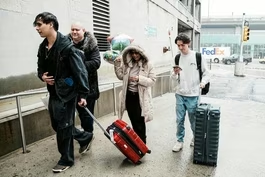
Americans stranded as war erupted struggle to get home
Video has Closed Captions
Americans stranded abroad as Iran war erupted describe struggle to return home (5m 34s)
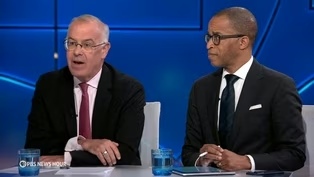
Brooks and Capehart on Trump's decision to strike Iran
Video has Closed Captions
Brooks and Capehart on Trump's decision to launch strikes on Iran (10m 29s)

DOJ releases Epstein files on allegations against Trump
Video has Closed Captions
DOJ releases Epstein files containing sexual assault allegations against Trump (3m 31s)
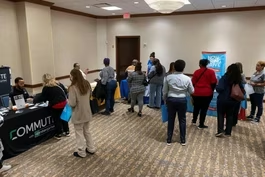
Economy shows signs of strain as war brings more uncertainty
Video has Closed Captions
U.S. economy shows signs of strain as Iran war brings more uncertainty (4m 51s)

'Immutable' follows student debate team finding their voices
Video has Closed Captions
New documentary 'Immutable' follows student debate team as they find their voices (4m 47s)
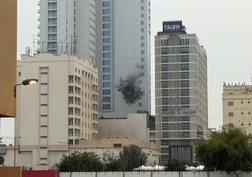
Iran receiving intelligence from Russia, officials say
Video has Closed Captions
Iran receiving intelligence support from Russia, officials say (3m 43s)

News Wrap: U.S. could start refunding tariffs in 45 days
Video has Closed Captions
News Wrap: U.S. could start refunding invalidated tariffs in 45 days (5m 26s)
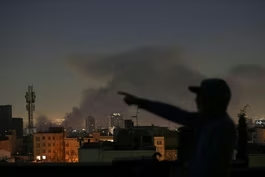
Trump demands 'unconditional surrender' from Iran
Video has Closed Captions
Trump demands 'unconditional surrender' as war on Iran enters new phase (5m 40s)
Providing Support for PBS.org
Learn Moreabout PBS online sponsorship
- News and Public Affairs

FRONTLINE is investigative journalism that questions, explains and changes our world.

- News and Public Affairs

Amanpour and Company features conversations with leaders and decision makers.
Urban Consulate Presents











Support for PBS provided by:
Major corporate funding for the PBS News Hour is provided by BDO, BNSF, Consumer Cellular, American Cruise Lines, and Raymond James. Funding for the PBS NewsHour Weekend is provided by...