
March 2, 2026 - PBS News Hour full episode
3/2/2026 | 57m 46sVideo has Closed Captions
March 2, 2026 - PBS News Hour full episode
Monday on the News Hour, the U.S. and Israel's bombing campaign and Iran's retaliatory attacks roil the region as President Trump vows to keep the war going as long as it takes. Views from on the ground in Iran and in Lebanon, where the conflict between Israel and Hezbollah has reignited. Plus, the global economic fallout and surging energy prices.
Problems playing video? | Closed Captioning Feedback
Problems playing video? | Closed Captioning Feedback
Major corporate funding for the PBS News Hour is provided by BDO, BNSF, Consumer Cellular, American Cruise Lines, and Raymond James. Funding for the PBS NewsHour Weekend is provided by...
Support provided by:

March 2, 2026 - PBS News Hour full episode
3/2/2026 | 57m 46sVideo has Closed Captions
Monday on the News Hour, the U.S. and Israel's bombing campaign and Iran's retaliatory attacks roil the region as President Trump vows to keep the war going as long as it takes. Views from on the ground in Iran and in Lebanon, where the conflict between Israel and Hezbollah has reignited. Plus, the global economic fallout and surging energy prices.
Problems playing video? | Closed Captioning Feedback
How to Watch PBS News Hour
PBS News Hour is available to stream on pbs.org and the free PBS App, available on iPhone, Apple TV, Android TV, Android smartphones, Amazon Fire TV, Amazon Fire Tablet, Roku, Samsung Smart TV, and Vizio.
Providing Support for PBS.org
Learn Moreabout PBS online sponsorshipAMNA NAWAZ: Good evening.
I'm# Amna Nawaz.
Geoff Bennett is away.
On the "NewsHour" tonight: The U.S.
and Israel's# bombing campaign and Iran's retaliatory attacks## roil the region, while President Trump vows# to keep the war going as long as it takes.
DONALD TRUMP, President of the United States:# We continue this mission with ferocious,## unyielding resolve to crush the threat this# terrorist regime poses to the American people.
AMNA NAWAZ: Views from on the ground in Iran and# in Lebanon, where the conflict between Israel and## Hezbollah has reignited, and the global economic# fallout, starting with surging energy prices.
DAN PICKERING, Chief Investment Officer,# Pickering Energy Partners: We should## see relatively littl.. (BREAK) AMNA NAWAZ: Welcome to the "News Hour."
We're in the third day of the American and Israeli# war against Iran, and th.. now calling on Americans to evacuate more than# a dozen countries in the Middle East.
Today was## marked once again by punishing airstrikes# across the Islamic Republic.
In response,## Iran continues to widen the war, sending volleys# of missiles and rockets across the region,## targeting most of its Arab neighbors and Israel.
Meanwhile, the Pentagon announced that at least## six U.S.
service members have# been killed in reprisal attacks.
Nick Schifrin begins our coverage.
Today in Tehran, the epicenter of this# widening war, the plumes of smoke were## massive and the explosions thunderous, some of the# capital's streets engulfed in debris and dread,## entire buildings collapsed, a police# station converted into a carcass.
The## Iranian Red Crescent Society says# the war has killed more than 550.
One explosion hit one of Tehran's most prominent# hospitals.
Nurses evacuated babies in incubators.## The campaign is the largest in Israel's# history, targeting leadership and military.## And American Tomahawk missiles and airstrikes# are targeting Iran's missile infrastructure.
DONALD TRUMP, President of the United States:# We continue this mission with ferocious,## unyielding resolve to crush the threat this# terrorist regime poses to the American people.
NICK SCHIFRIN: The war also# threatens service members,## three American F-16s accidentally# shot down by Kuwaiti air defense.
MAN: No problem.
You are safe.
NICK SCHIFRIN: One female pilot# met by grateful Kuwaiti civilians.
MAN: No problem.
Thank you for helping us.
NICK SCHIFRIN: But U.S.
service# members were killed on this Kuwaiti## base when U.S.
officials say an Iranian# ballistic missile evaded its air defense.
MAN: Oh, my God.
NICK SCHIFRIN: In total, Iran has launched# more than 1,000 drones and missiles into Arab## countries, including its first ever attacks# on Gulf hotels and residences.
And, today, it## expanded those attacks to energy infrastructure,# including Saudi Arabia's largest oil refinery.
And there was another attack today on a tanker# off the coast of Oman.
Today, Iran vowed to shut## down the crucial Strait of Hormuz, through which# roughly one-fifth of the world's oil is traded.## And Israel expanded its own strikes into Lebanon.# After Iranian ally Hezbollah launched an attack## into Israel, Israeli jets pounded Beirut, killing# dozens and setting fire to residential buildings.
Iran has launched hundreds of missiles and# drones at Israel, including this attack## on Saturday west of Jerusalem that killed# nine.
Today, Israeli Prime Minister Benjamin## Netanyahu visited the site and reiterated his# goal, the elimination of the Iranian threat.
BENJAMIN NETANYAHU, Israeli Prime Minister: And# if this regime, this terrorist regime of the## kind we've never seen in the world, if they get# nuclear weapons and the means to deliver them,## ballistic missiles, intercontinental ballistic# missiles, they will threaten all of humanity.
NICK SCHIFRIN: At the Pentagon today, Secretary# Pete Hegseth and Chairman of the Joint Chiefs Dan## Caine made clear the U.S.
military objectives were# limited to Iran's missiles and drones and navy.
PETE HEGSETH, U.S.
Defense Secretary:# This operation is a clear, devastating,## decisive mission, destroy the missile# threat, destroy the navy, no nukes.
GEN.
DAN CAINE, Chairman, Joint Chiefs of# Staff: Our mission is to protect and defend## ourselves and together with our regional# partners prevent Iran from the ability to## project power outside of its borders and be# ready for follow-on actions as appropriate.
DONALD TRUMP: They're never# going to have a nuclear weapon.
NICK SCHIFRIN: But, at the White House,# President Trump listed maximalist goals,## including the destruction of Iran's missile# capabilities, -- quote -- "annihilating## their navy," preventing Iran# from having a nuclear weapon,## and blocking Iran's arming, funding,# and directing regional proxies.
DONALD TRUMP: Whatever the time is, it's# OK.
Whatever it takes, we will always,## and we have -- right from the beginning, we# projected four to five weeks, but we have## capability to go far longer than that.
We also# projected four weeks to terminate the military## leadership.
And, as you know, that was done in# about an hour, so we're ahead of schedule there.
NICK SCHIFRIN: But in multiple# interviews since the weekend,## the president provided# varying timelines and goals.## He called the Venezuela model, where the U.S.# military captured President Nicolas Maduro,## but left intact his entire government, the# -- quote -- "perfect scenario" in Iran.
He said he had multiple choices to# lead Iran, but then he told ABC News:## "It's not going to be anybody that we were# thinking of because they are all dead."
He## told "The Atlantic" he'd agreed to resume# negotiations, but a senior administration## official later clarified the president# would negotiate -- quote -- "eventually."
Simultaneously, Trump said Iranians would# -- quote -- "obviously have an opportunity## to overthrow the government," the exact# opposite of negotiations to keep the regime.
This evening, Secretary of State Marco# Rubio said there were no contradictions## between limited military goals# and expansive long-term vision.
MARCO RUBIO, U.S.
Secretary of State: The# objectives of this operation are to destroy## their ballistic missile capability and make sure# they can't rebuild it and make sure that they## can't hide behind that to have a nuclear program.# That's the objective of the mission.
That said,## abundantly clear we would love for there to be an# Iran that's not governed by radical Shia clerics.
NICK SCHIFRIN: And, tonight, President# Trump warned in an interview with CNN## that the biggest wave of U.S.
strikes,# Amna, is -- quote -- "coming soon."
AMNA NAWAZ: Nick, tell us more about the# goals of this war and some of those varying## contradicting statements you just laid# out.
What are U.S.
officials telling you?
NICK SCHIFRIN: So, the key is what# you just heard there from Rubio.
The U.S.
military is destroying Iran's missiles# drones and navy.
Their mission stops there.## U.S.
officials reject the Colin Powell# Pottery Barn model, if you break it,## you own it.
But the long-term goal is still# regime change.
So how do you square that circle?
U.S.
officials tell me by focusing on a# change in the regime, rather than a change## of the regime.
So if Iran gave in to all of# the U.S.
demands at the negotiating table,## that would achieve U.S.
goals.
Or if the Iranian# people overthrew the government in some kind of## insurgency after the U.S.-Israeli military# campaign, that would also achieve the goals.
And here's the thing.
U.S.
officials# I talked to say they don't have to## choose between these two things.# And that's extraordinary, because,## on the one hand, you have relatively# limited military goals for an operation,## and on the other, you have this vision that# would require some messy, likely long-term,## very difficult insurgency, frankly, that the U.S.# or Israel would have to keep going and fomenting.
So that's the reality, though, Amna, of# the Trump era.
The president wants options,## and so they believe they do not have to# make the choice.
And the criticism of that,## of course, is that Iran shows# no willingness to negotiate.
And## unless there's some kind of plan to help# Iranians rise up, the mission will fail.
AMNA NAWAZ: Meanwhile, you have some new# reporting on a key question in all of this,## which is why the war started when# it did.
What have you learned?
NICK SCHIFRIN: U.S.
officials confirmed# to me the U.S.
intelligence community## provided Israel the location of the# supreme leader on Saturday morning,## alongside some of his most senior leaders.
And so Israel started the war with an initial# strike that hit that compound that we saw## on Saturday.
But Secretary of State Rubio# today also argued essentially the opposite,## that the U.S.
didn't have a# choice when to start the war## because the military had to go when it did# because of both Israeli and Iranian plans.
MARCO RUBIO: We knew that there was going# to be an Israeli action.
We knew that that## would precipitate an attack against# American forces.
And we knew that,## if we didn't preemptively go after them# before they launched those attacks,## we would suffer higher casualties and# perhaps even higher those killed.
And then## we would all be here answering questions# about why we knew that and didn't act.
NICK SCHIFRIN: So, to underline, Amna,## this is now a war simultaneously started# to American intellig.. Israel and a war that Israel would have# started anyway, so the U.S.
had to act.
AMNA NAWAZ: Meanwhile, as we reported# earlier, the U.S.
tonight has issued## evacuation orders for more than a dozen# countries.
What more do we know about that?
NICK SCHIFRIN: Yes, let's# take a look at this graphic,## this tweet that was just# posted by the State Department.
"Depart now from the countries listed below# using available commercial transportation## due to serious safety risk."
Bahrain, Egypt,# Iran, Iraq, Israel, West Bank, Gaza, Jordan,## Kuwait, Lebanon, Oman, Qatar, Saudi Arabia,# Syria, UAE, and Yemen.
That is 14 countries.
I just talked to a former senior official.# As far as this person knows, this has never,## ever been done before.
We are talking about# hundreds of thousands or millions of Americans## who are getting this message tonight, and we# will certainly stay on this to figure out whether## there's going to be any facilitating either by the# military or the State Department to get them out.
But, clearly, the message is,# take civilian transportation,but,## as we have been talking about, many of# these airports in the region already closed.
AMNA NAWAZ: Nick Schifrin,# beginning our coverage once again.
Nick, thank you.
Well, for more now on how the White House# and Congress are responding to the strikes,## I'm joined now by our White House correspondent,## Liz Landers, and our congressional# correspondent, Lisa Desjardins.
So, Liz, kick us off here.
We saw# President Trump make his first public## appearance today since the war began# over the weekend.
What did he say?
LIZ LANDERS: Right.
This was the first public event that the#president has had since this started.
It#was a Medal of Honor ceremony that he had# in the East Room of the White House.
And,## as Nick pointed out in his reporting there, we# really heard for the first time the objectives## that the administration, that the president# is laying out here for these attacks on Iran.
However, the way that the president has gone# about explaining this to the public has been## nontraditional.
He and his allies like to# say he's a nontraditional president.
We## have seen these TRUTH Social videos that# he has recorded and posted over the last## few days.
He's also done a number# of phone calls with journalists.
He's talked with CNN, "The Atlantic."
And# earlier today, he spoke with The New York## Post and saying something that would# impact a lot of people, of course, is,## he was asked if he would send U.S.
troops on# the ground there to the region.
And he said,## if they were necessary, so not ruling that out.
Reporters in the room trying to ask questions# of him as he left.
I tried to ask a question## of the president.
He did not talk to# reporters today at the White House.
AMNA NAWAZ: As you know, Liz, this is# a president who ran on an America-first## platform, no new foreign wars.
How is# all of this resonating with his base?
LIZ LANDERS: This was a huge part# of why people liked him.
And when## I reported on the 2016, 2020, and 2024 campaigns,## a lot of the MAGA base said that they really# supported this part of the president's agenda.
Today, we're seeing some backlash from# some of these MAGA conservative voices## and commentators.
People like Tucker Carlson# called the attack -- quote -- "absolutely## disgusting and evil" in an interview over# the weekend.
We also heard from former## Congresswoman Marjorie Taylor Greene, a very# close former ally of the president, no longer.
She said on X, she said: "We voted# for America-first and zero wars."
He is getting some defense, though, from# far right activists like Laura Loomer,## who we know she does talk to the president# occasionally.
She is defending these actions.## But when you also look more broadly at how# the American public is responding to this,## we're starting to get some polling.
Reuters and Ipsos did a poll post these attacks.# It showed that only 27 per.. approved of the U.S.
strikes that killed# Iran's leader; 43 percent disapproved of## the Iran strikes; 29 percent said that they were# not sure.
More than half, 56 percent of Americans,## said that they believe that the president# is too willing to use military force.
So, Amna, the president definitely still has# some selling to do to the American public.
AMNA NAWAZ: So, Lisa, that's where the# American public is.
What about Congress,## the branch responsible for war?
Where# are they on the U.S.
attacks in Iran?
LISA DESJARDINS: As Nick reported,## Secretary of State Rubio was up on the Hill# talking to the t.. And I want to point out something he# said to the press before he went in.## He made the argument that the president not# only doesn't need authority from Congress,## but he didn't even need to# notify all of Congress.
Listen.
MARCO RUBIO, U.S.
Secretary of State: There's# no law that requires the president to have done## anything with regards to this.
To begin with, no# president, presidential administration has ever## accepted the War Powers Act as constitutional, not# Republican presidents, not Democratic presidents.
That said, we have followed the notification# at 48 hours, and we're here today.
LISA DESJARDINS: Now, the War Powers Act is not## just significant because of# the notification requirement,## but because it limits presidents to having this# kind of conflict power for just 60 to 90 days.
And what Rubio is saying here is what other# presidents said before.
They're ignoring,## that he's going to keep this up as long as# they want.
Now, as for Congress themselves,## it was remarkable that he said this just# days before we expect a vote in the House## over whether Congress should block action# in Iran without congressional approval.
It is a tough vote, especially for some Democrats.# There are some very pro-Israel Democrats that are## nervous about the situation.
They want to support# Israel.
There are others who are Article I kind## of constitutionalist Democrats that are# not sure what to do and on the front line.
Right now, I don't think that# has the votes to pass the House,## but it is going to be a vote to watch.
AMNA NAWAZ: Well, we know DHS funding# is in question right now.
There's a## government -- partial government shutdown.# Will the Iran action impact that at all?
LISA DESJARDINS: The short answer is# no.
It doesn't seem to be.
Democrats## are still digging in.
They say we may have# something overseas that we need to pay very## close attention to that's significant, but# that doesn't change the issues that we have.
Now, what could change is when more people start## missing paychecks.
That is# still a week-and-a-half away.
AMNA NAWAZ: Lisa Desjardins,# Liz Landers, thank you so much.
Let's go now to special correspondent Reza# Sayah in Tehran.
Reza joins us on the phone.
Reza, now this third straight day of# U.S.
and Israeli strikes in Iran.
Just## give us a sense of what you're seeing and# what you're hearing on the ground there.
REZA SAYAH: Amna, as I'm talking# to you right now, I'm hearing the## unnerving sound of jet fighters flying over# Tehran and massive earth-shaking explosions.
They started around 12:00 midnight local time,# and it's continued for the next 90 minutes, so,## again, multiple explosions in what sounds like# anti-aircraft.
And one other thing that I need## to point out is, around 1:30 a.m., the Internet# access was cut off.
And that's kind of unusual.
When this war started, the government cut# off the Internet.
There was only access to## the national network.
It was a closed network.# But using VPN, virtual private network, I was## able to get access to the international network.# That stopped around 1:30 am local time.
Was it## related to these latest airstrikes that started# around midnight?
It's not clear, but no Internet.
That's why I'm talking to you on the phone.# Earlier today, more airstrikes, intense## airstrikes targeting the heart of the city.# Israeli officials have repeatedly said they're## targeting the security apparatus, buildings# related to the military, Revolutionary Guard.
But, increasingly, we are seeing on the# ground non-military targets either being## hit or severely damaged, hospitals.
We had a# school on Saturday.
Earlier today, I went to## a major square here where a# police headquarters was hit.## The police station was destroyed, but surrounding# it were scores of residential buildings.
They too, they were either destroyed or severely# damaged.
I went to a cafe across from the police## station, talked to a patron there who was there# during the airstrike.
He was smoking a hookah## when the missiles hit.
He showed me some gruesome# video of a fellow patron with his head severed.
And he described what sounded like a# double-tap strike, where he said the## initial strike wasn't much, wasn't much# of an explosion, a few minutes later,## massive explosion.
And that gives you an idea# of the cycle of violence we're experiencing.
AMNA NAWAZ: Reza, let me ask you about# what we have heard from U.S.
officials,## because President Trump claimed yesterday# that Tehran had reached out to talk and## to negotiate.
Today, he warned of a -- quote,# unquote -- "big wave" of strikes yet to come,## and he didn't rule out U.S.
troops on the ground.
What's been Tehran's response to all of this?
REZA SAYAH: Tehran's response is no# talks and they're going to keep fighting.
Just keep in mind, from Tehran's point# of view, there's no trust.
This is the## second time they're in the middle# of negotiations.
Without warning,## they have been under attack.
And they# have tried to project resilience.
Ali Larijani, the secretary of# the National Security Council,## in a statement saying they're not going to# negotiate with terrorists.
The foreign minister,## Abbas Araghchi, saying that they have learned# lessons from U.S.
defeats in the region,## and they're going to use these lessons in this# war.
They're going to decide how the war ends.
So they're projecting resilience,# toughness.
And seemingly, in the## region, they're carrying out an aggressive# campaign targeting U.S.
bases, U.S.
assets,## Gulf states, military bases.
And they're also# saying they're targeting hotels because they## have intelligence that U.S.
servicemen# have left the bases to go to the hotels.
AMNA NAWAZ: That is our special correspondent,## Reza Sayah, joining us tonight# on the phone from Tehran, Iran.
Reza, thank you.
Now for a look at the wider region, let's# turn to our special correspondent in Lebanon,## a country being dragged back into conflict# as Hezbollah has resumed attacks on Israel.
Simona Foltyn is coming to us from the# outskirts of the capital city of Beirut.
And, Simona, we know those Hezbollah# attacks on Israel come more than a## year after a cease-fire deal that# went into place after the 2024 war,## a war that left Hezbollah very much weakened.# Why would they decide to attack now?
SIMONA FOLTYN: Well, Amna, Hezbollah would# have weighed its domestic interests with## its desire or duty to support its# main regional ally and backer, Iran.
And based on this reaction, it seems# that the latter interests prevailed.## Now, there is a big question mark about# the military value of this attack.
It## was pretty symbolic.
The rockets were# intercepted and inflicted very limited,## if any damage on the Israeli side, whereas# the IDF's response was much more devastating.
Now, of course, as you mentioned,## Hezbollah has been significantly weakened# in the last full-scale war with Israel.
AMNA NAWAZ: You mentioned that IDF response# to the Hezbollah latest attacks.
They have## killed more than 50 people in and# around Beirut, tens of thousands of## people again being displaced from Southern# Lebanon and Beirut's southern suburbs.
Tell us a little bit more about the impact# and also the reaction from inside Lebanon.
SIMONA FOLTYN: Well, the impact# has been quite devastating,## especially for Hezbollah's own constituents.
There has been, again,# another wave of displacement,## large-scale bombardment of villages in the# south, as well as Beirut's southern suburbs.## So it has caused once again displacement, once# again panic, once again a lot of uncertainty## about whether this country will once# again be plunged into full-scale war.
But what is perhaps most noteworthy is# the governments' reactions.
Earlier today,## following an emergency cabinet session,# Prime Minister Nawaf Salam announced a ban## on Hezbollah military and intelligence activities.# And this is quite unprecedented in this country,## because previously the group was somehow# recognized as the so-called resistance,## as being part of the country's defenses.
So, essentially, with this government# decision, Hezbollah has become somewhat## of an outlawed group, at least# when it comes to its military wing.
AMNA NAWAZ: Simona, we know you also# lived in Dubai for many years.
Of course,## you reported from the region for years.
These fears of a widening regional war,# how big are they?
How real are they?
SIMONA FOLTYN: Well, this is quite# an unprecedented situation in the## region and especially in the Gulf# countries.
If you look at places## like the United Arab Emirates or# Qatar, these are countries that## were considered safe havens for Arabs and Muslims# who were fleeing conflict elsewhere in the region.
So this is something that these countries have not# really seen.
Now, so far, the air defense systems## that have been supplied by the United States# have managed to intercept most of the Iranian## missiles that have been targeting these places.# So the human casualties have been relatively low.
But these countries are being hit where it hurts# the most.
And that's their economic engines.
Just## to give you a sense of -- for example, Dubai's# airport is the second largest in the world.## Its Jebel Ali port is the ninth largest# shipping port in the world.
And now## essentially all of the economic activity# in the Gulf region has come to a halt.
Airspace is closed.
We have seen# footage of five-star hotels being## hit with debris.
We have seen# ports being targeted.
We have## seen oil installations being targeted.# So all of that is quite significant.
AMNA NAWAZ: That is special correspondent Simona# Foltyn joining us from outside Beirut, Lebanon.
Simona, thank you.
Let's shift our focus now to the war's impact# on the global energy market.
Oil and gas prices## spike today as the regional conflict escalated and# shipping was disrupted in the Strait of Hormuz.
About 20 percent of the world's oil and liquefied# natural gas flows through the strait every day,## making it one of the most crucial# oil supply routes on the planet.
William Brangham joins us now with more.
WILLIAM BRANGHAM: Amna, at least five# tankers have been damaged in the vicinity## of the strait since Saturday, and traffic slowed# dramatically there over the weekend.
Separately,## Iranian drones continue to attack energy# infrastructure in different Arab Gulf states.## Today, those attacks damaged an# oil refinery in Saudi Arabia and## halted the production of liquid# natural gas, or LNG, in Qatar.
So to help us understand these impacts# and implications, we are joined by Dan## Pickering.
He's the chief investment# officer at Pickering Energy Partners,## which is a financial services and advisory# firm that is focused on the energy industry.
Dan, thank you so much for being here.
Let's pick apart some of these different impacts,## first on the markets.
What# happened with oil prices today?
DAN PICKERING, Chief Investment Officer,# Pickering Energy Partners: Yes, William,## we had a strong rally at oil pric.. WTI, the U.S.
benchmark, was about $72# a barrel.
It was actually up less than## many people expected.
So the markets did# better, the broad stock markets did better,## and oil didn't rise quite as much# as expected, but still up strongly.
WILLIAM BRANGHAM: And we mentioned the# importance of the Strait of Hormuz and## the attacks and the trickiness of what's going on## there right now.
What do we know is# the latest happening in the strait?
DAN PICKERING: Yes, the latest# is essentially tanker traffic has## slowed to almost nothing.
Some vessels,# primarily Iranian vessels, are continuing## to move through the strait.
But because it's# dangerous, because there have been attacks,## there's not a lot of oil moving through# there.
And as we know, it is a big choke## point for global supply; 20 percent of# global supply comes through the straits.
And it's essentially shut down right now.
WILLIAM BRANGHAM: I mean, obviously, this is# the main route.
That's why everyone has been## using it for so many years.
Is there or are there# any alternate routes to get that oil to market?
DAN PICKERING: For oil, there are# some other pipeline export routes,## maybe five million barrels a day, so, remember,# 20 million through the straits.
Perhaps five## million of it can get to market other ways.
So 15# percent of supply is trapped behind the straits.
On the gas side of the equation, there# really is no other output for Qatar's## liquefied natural gas.
And so that is# kind of 100 percent blocked right now.
WILLIAM BRANGHAM: Do you have# a sense of what Iran could do## to both increase the pressure on the# limited traffic that's going through,## and what might the Americans or allies# do to alleviate that choke point?
DAN PICKERING: When we think# about what could happen from here,## if Iran wants to ratchet up the tensions, it# probably wouldn't be in the Straits of Hormuz,## where they have already had# a big effect slowing traffic.
It would be lashing out at the energy# infrastructure of the other Gulf states,## so attacking Saudi Arabia's capabilities,# attacking Kuwait, Oman, the United Arab## Emirates.
So I think that the actions that# the U.S.
and the allies would likely take## will be to try and safeguard the straits, whether# using doing that militarily with escorts and/or## aerial support, and potentially creating a# financial backstop that would allow tanker## traffic to move through without fear# that the damage would be uninsured.
WILLIAM BRANGHAM: Right.
I mean, you mentioned some of .. those already.
What does this say about# the state of the conflict that Iran is## right now reaching out, trying to attack# those other states and other refineries?
DAN PICKERING: I think it says# this is clearly different than## what we saw in June, obviously, a much bigger## conflict and one in which Iran is prepared# to fight back, and fight back aggressively.
I would say, though, that the first 48, 72# hours are very important, and no significant## infrastructure damage has happened across the# Middle East.
And so I think we have to feel good## that there hasn't been more damage or# more impact.
And my expectation is,## we will probably fix the Straits# of Hormuz within the next 10 days.
And so this is absolutely a flash point# in time, but one that is probably going## to ease in terms of risk as we move# through the next week to two weeks.
WILLIAM BRANGHAM: I want to ask you about this# one.
There was one attack on an LNG facility,## liquid natural gas facility, in Qatar.
And European gas prices surged# quite dramatically after that.## How significant is the loss of that one# facility or an attack on that one facility?
DAN PICKERING: Yes, Qatar, they're# 20 percent of global LNG supply,## and it all flows through the straits.# And so when you take 20 percent offline,## which has happened now, not# damage to the facility, per se,## but just forced to shut in because they can't# export their gas, 20 percent is a big impact.
So, European prices escalated.
A lot of that LNG# goes to Asia.
And so those shortages will be felt## in the next call it month or so.
But European# prices react because the whole global market has## now tightened.
Not a lot of excess LNG capacity# around the world to offset those shut-ins.
WILLIAM BRANGHAM: I mean, I know we are# in early days and all of these things are## predictions at this point.
Do you have# any sense as to whether or not and when## American consumers might feel the# ripple effects of this conflict?
DAN PICKERING: Yes, I think we're# very lucky here in the United States,## from the perspective that, because of the# shale revolution, because of the fact that## the U.S.
has become the world's largest# oil producer at 14 million barrels a day## and a very significant gas producer,# we're pretty self-sufficient here.
And so we should be relatively insulated from# what's happening.
Global prices will impact U.S.## prices, but oil in the 70s, gasoline prices should# stay relatively muted.
So unless things escalate## from here, we should see relatively little# impact in the U.S., unless things escalate.
WILLIAM BRANGHAM: All right, that is Dan# Pickering of Pickering Energy Partners.
Thank you so much for being here.
DAN PICKERING: Glad to be here.
AMNA NAWAZ:## For additional perspective on all the latest# developments, we turn now to our panel of experts.
Holly Dagres is a senior fellow at the# Washington Institute for Near East Policy.## That's a Washington think tank.
She spent her# teenage years in Tehran and now curates The## Iranist.
That's a weekly Substack newsletter.# Alan Eyre served in the U.S.
government for## four decades.
He was part of the Obama# administration's negotiating team for the## Joint Comprehensive Plan of Action, or JCPOA, deal# with Iran.
He's now at the Middle East Institute.
And retired Colonel Joel Rayburn served# in the Army for 26 years.
During the## first Trump administration, he was on the# National Security Council staff focusing## on Iran in the Middle East.
He's now a# senior fellow at the Hudson Institute.
Thank you all for being here.
Holly, I will begin with you because we# have seen in our reporting an.. of messaging from the administration,# President Trump calling for regime## change a couple of days ago, Secretary# of Defense Hegseth now saying it's not## about regime change.
What's your reaction to# that and how is all that resonating in Iran?
HOLLY DAGRES, Senior Fellow, The Washington# Institute for Near East Policy: Well,## the messages, they are conflicting.
And it is a bit disturbing, because the sense# that some Iranians on the ground got was that## they were actually going to see some sort of# change inside the country.
And this was started,## of course, with that unprecedented# massacre in January and President## Trump saying that help is on the# way, take over your institutions.
And it seems that we're hearing from# senior U.S.
officials that they do## want the Iranian people to take control of# their own future, but, at this juncture,## much of the clerical establishment's still# in power, so it's hard to envision that.
And just on the note that President Donald Trump## said that he would very much like to see# a Venezuela model and he's -- granted,## he said three of his top choices were killed# in the past three days, but, in January,## Iranians were really worried about that# prospect because they do not want this regime.
So any kind of deal of that sort with a# different face of the Islamic Republic## would be contrary to what most of the# anti-regime Iranian population stands for.
AMNA NAWAZ: Colonel Rayburn, what do you# make of that, the prospects of someone in## the current regime stepping up to take over?# Is that a potential plan and is it a good one?
COL.
JOEL RAYBURN (RET.
), Former Trump# National Security Council Staff: Well,## whether it's a good one or not I think woul.. couple of weeks goes in terms of whether that# could result -- whether you could actually have## the remnants of the current regime that# actually had the credibility and the capacity## to stabilize the country on terms that would be# acceptable to the United States and our allies.
I think that's a -- that's a serious question.# Militarily speaking, though, the outcome of this## confrontation I think is a foregone conclusion.# So you're going to wind up in any case with## the remnants of a regime there in Tehran that I# think don't have the military wherewithal to do## anything other than capitulate at some point on# the terms that the president is going to offer.
AMNA NAWAZ: Alan, what do you make of# that and also the prospects of people## in Iran rising up?
Do you see that happening?
ALAN EYRE, Middle East Institute: I# think it's a -- possibly.
I wouldn't## characterize it as the remnants of the regime.
The regime is more than just the individuals,# some of whom may live through this,## many of whom will not.
It's institutions.# And I see no indication that currently those## institutions are weak or fraying or that you# can destroy these institutions from the air.
So in terms of regime change, for that to# happen, two things would have to happen.## The current institutions, interlocking# institutions, like the IRGC, the Islamic## Revolutionary Guard Corps, would have to# be destroyed kinetically from the air,## which I think is improbable, and then you# would have to have a substitute, interlinking,## functional series of institutions to plug in its# place.
And I think that's even more improbable.
So I think the most likely outcome# is, after four weeks or so,## you will have a vastly degraded command# structure in the Islamic Republic,## but the core institutions in one# way or another will still remain.
AMNA NAWAZ: Colonel, the U.S.
president has not## ruled out U.S.
troops on the# ground.
Is that a good idea?
COL.
JOEL RAYBURN (RET.
): Well, I think# President Trump is somebody that likes to## keep his options open.
He likes strategic# ambiguity.
He wouldn't like to rule out,## I think, a military option# this early in a campaign.
But I think the objectives that have been laid# out so far by the president, by Secretary of State## Rubio, and then very clearly today by General# Dan Caine, the chairman of the Joint Chiefs,## those are some very clear military objectives of# finishing the elimination of the Iranian regime's## nuclear program, eliminating its ballistic# missile capability, eliminating the IRGC navy,## the part of the regime that has the mission of# just potentially disrupting the Strait of Hormuz## and the Persian Gulf, and then severing# its ties with its militant proxies.
And as Chairman Caine put# it very interestingly today,## I think it's the first time someone stated# what the mission of the theater command is,## the operational command, U.S.
Central# Command.
He said it was essentially to## prevent the Iranian regime or Iran from having# the ability to project power beyond its borders.
That's a very clear kind of end state if you# -- so it says the military phase of that,## you could have, as Alan wouldn't# say, the remnants of a regime in## Tehran that are still there somehow,# somewhat intact, but have no ability## to damage the region beyond their# borders or international security.
AMNA NAWAZ: Holly, we have heard more from U.S.# officials about justification in the original## U.S.
and Israeli attacks.
Does that line up# for you in terms of what they're saying, that## there was a potential imminent threat, that the# U.S.
is acting both defensively and proactively?
HOLLY DAGRES: I mean, we're getting# a lot of mixed messaging right now.## And it just -- I'm not entirely sure what# exactly led to this, because, essentially,## if we remember, there was a massacre# in January, and it was that reason that## Trump wanted to respond to that.
And he sent# assets into the region for that very reason.
AMNA NAWAZ: You're referencing the# regime cracking down on protesters.
HOLLY DAGRES: Yes, the anti-regime# uprising in January.
And, before that,## we heard in December Israeli Prime# Minister Benjamin Netanyahu during## his meeting with President Donald Trump saying# that ballistic missiles were a very big issue.
So it seems like the goalposts are# moving around frequently about what## the modus operandi of this war# was.
And it seems like it's a## very different from why assets were# moved in January to where it is now.
AMNA NAWAZ: Alan, is it clear to you,# three days in now, and as the president## projects that this is a campaign that could go# on four to five weeks, what the objectives are?
ALAN EYRE: I think this administration# is trying to justify the war the same## way Jackson Pollock used to paint.# You just throw a bucket of reasons## up against the canvas and# hope the result looks good.
It said, for example, there's an imminent threat# to the U.S.
Well, the intelligence community said## that the Iranian nuclear weapons program stopped# in 2003.
President Trump said the underlying## Iranian nuclear energy program was obliterated# June of last year, and it's still under rubble.
OK, missiles.
Iranian missiles are a threat# to the United States.
That falls short of the## truth by about 4,000 miles, OK?So you# then go to the other set of reasons.## This is a preventative war because Iran is# hostile and might one day be a real threat.
Well, if that's the case, if# we're doing preventative wars## now to prevent countries that might one# day be a threat, is North Korea in line,## is China in line, is Russia# in line?
I don't think so.
So, as Holly said, I can't make# head or tails out of the reason## this administration has put forward for this war.
AMNA NAWAZ: Colonel, I will ask you# to respond to what we just heard from## Alan.
Are these other countries# in line if this is the reasoning?
COL.
JOEL RAYBURN (RET.
): Well,# no, look, as I have said before,## we're in a post-October 7 environment here.
The Iranian regime posed a very real,# concrete threat to the region around it,## to Israel and other of our allies by joining that# war on October 8.
And really Hamas used on October## 7 the capability that the Iranian regime equipped# it with over a course of more than 15 years.
So I think October 7, October 8, then the missile# attacks in 2024, 2025 by the Iranians on Israel,## this is the culmination of what was Ali# Khamenei's very aggressive, very hostile## foreign policy in the region and beyond.
They# were -- they continued to intervene in European## security by providing the Russians with the# military means to attack Ukrainian cities.
So this is a regime that was posing a# threat to U.S.
interests, U.S.
allies,## not just in the region, but beyond.
So I don't# think they were just sitting there not doing any## harm and then the Trump administration# decided out of nowhere to attack them.
AMNA NAWAZ: Lots more to cover in the# days and weeks ahead, it looks like.
Alan Eyre, Colonel Joel Rayburn,# Holly Dagres, thank you very much.
COL.
JOEL RAYBURN (RET.
): Thank you, Amna.
AMNA NAWAZ:## We start the day's other headlines in Texas.
Authorities are investigating a deadly shooting# at an Austin bar this weekend as a potential## act of terrorism.
The accused shooter,# a 53-year-old naturalized U.S.
citizen,## was wearing a sweatshirt with an Iranian flag# design and the words "Property of Allah."
At least two people were killed and# 14 injured when he allegedly opened## fire from a car window shortly before# 2:00 a.m.
on Sunday.
Law enforcement## said today they're working with# federal officials to determine## a motive and whether there are any# direct ties to the U.S.
war in Iran.
LISA DAVIS, Austin, Texas, Police Chief:# We're thinking about events and what's## occurring in the country as well.
And so in# addition to the fact that this was a huge,## complex scene, we're calling in those federal# partners to take a look at that as well.
AMNA NAWAZ: Police shot and killed the gunman,## with the mayor of Austin saying their quick# response helped to prevent further bloodshed.
The Supreme Court today seemed to lean# towards loosening a federal law that## bars drug users from owning# guns.
During oral arguments,## both liberal and conservative justices# appeared to support a Texas man who argued## he shouldn't have been charged with a crime# because he owns a gun and uses marijuana.
It's the same law that led to Hunter# Biden's conviction in 2024 before he## was pardoned by his father, then-President# Joe Biden.
Critics fear such a ruling could## put guns in the hands of serious drug users.# A decision is expected by the end of June.
In New York today, a court battle got under# way that could have a major impact on the## music industry.
The Justice Department claims# that concert giant Live Nation is running an## illegal monopoly after merging with rival# Ticketmaster in 2010.
Officials claim the## combined company uses its power to limit# competition and drive up ticket prices.
Live Nation denies this, saying that the market is# more competitive than officials have claimed.
The## lawsuit was filed during the Biden administration# in 2024, making this a rare instance of the Trump## DOJ following through on a Biden era case.
The# trial is expected to last at least a month.
The Trump administration is reportedly planning# to abandon its efforts to target a number of## law firms seen as foes of the president.
That's# according to multiple media outlets and represents## a dramatic U-turn for the government.
The Justice# Department is expected to drop its appeals in## four cases after the firms successfully sued to# have punishing measures against them blocked.
The order signed by President Trump last# year would have severely hampered their## ability to do their work, sending# shivers through the industry.
A## number of firms struck deals with the# administration, rather than fight back.
French President Emmanuel Macron says# his country will increase the size of## its nuclear arsenal for the first time in# decades.
Speaking at a military base that## hosts his country's nuclear-armed submarines,# Macron also said France will temporarily allow## the deployment of nuclear-armed jets to# allies like the U.K., Germany and Poland.
His announcement comes amid growing concerns about## Russian military aggression and ongoing# political tensions with Washington.
EMMANUEL MACRON, French President# (through translator): To be free,## one must be feared.
And to be# feared, one .. This increase in our arsenal attests# to this.
As for our American allies,## their recent national security and defense# strategy shows a rearrangement of American## priorities and a strong encouragement for Europe# to take more direct care of its own security.
AMNA NAWAZ: France currently has# fewer than 300 nuclear warheads,## which ranks at fourth worldwide and far behind# the likes of the U.S.
and Russia.
Macron did not## signal how many more France will be adding, but# it will be the first increase since at least 1992.
Officials in South Sudan say at least 169 people# were killed after insurgents raided a remote## village in the country's far north.
The attack# took place yesterday in Abiemnom County near the## Sudan border.
Local officials say 90 civilians# were killed, including women and children.
The U.S.
-- U.N.
mission in South Sudan says# that some 1,000 people sought shelter at its## base after the attack.
Killings are part# of an escalating wave of violence between## forces loyal to the current president# and those backing an opposition leader,## putting the country on the# verge of an all-out civil war.
On Wall Street today stocks raced their# earlier losses to end largely unchanged.## The Dow Jones industrial average posted a# modest loss of just 73 points.
The Nasdaq## managed a small gain of around 80 points.# The S&P 500 closed the day roughly flat.
And we will be back shortly.
But, first, take a moment to hear from# your local PBS station.
It.. to offer your support, which helps to# keep programs like this one on the air.
For those of you staying with us,## tomorrow, voters head to the polls in# Arkansas, North Carolina, and Texas.
But it's in the Lone Star State where competitive## races on both sides of the aisle# have fueled unprecedented spending.
Political correspondent Lisa Desjardins has more# on what's at stake in Texas' U.S.
Senate race.
(CHEERING) LISA DESJARDINS: Welcome to the race# for the U.S.
Senate, Texas-sized,## with two larger-than-life# primaries, one in each party.
SEN.
JOHN CORNYN (R-TX): Character is on# the ballot.
I believe voters still care## about their elected officials, and they# want people who will tell them the truth.
LISA DESJARDINS: The incumbent, Republican# John Cornyn, faces two other Texas lawmakers,## Attorney General Ken Paxton and Congressman# Wesley Hunt.
It's the fight of his 24-year career.
TONY PLOHETSKI, The Austin-American# Statesman: He's tried and true in## the minds of many voters in Texas.
LISA DESJARDINS: Tony Plohetski is a# journalist with The Austin-American Statesman.
Cornyn is running as experienced# and battle-tested.
However,## while he was once ranked among the# most conservative senators, now?
TONY PLOHETSKI: Paxton and his voters# and his supporters have really been## able to nurture this idea that John# Cornyn has not been hard right enough.
LISA DESJARDINS: Paxton's policies are ultra-MAGA.
KEN PAXTON (R), Texas Senatorial# Candidate: I want you to know,## I'm not going up to Washington,# D.C., to join the swamp club.
LISA DESJARDINS: As A.G., Paxton emphatically# enforced the state's abortion ban and filed## the lawsuit challenging the 2020# presidential election result.
MAN: Attorney General Paxton, please rise.
LISA DESJARDINS: But he has faced sharp scrutiny.# In 2023, the Texas House passed 20 articles of## impeachment against Paxton for bribery and# abuse of power with charges that he had an## affair and got the woman a job as part of a quid# pro quo.
The state Senate narrowly acquitted him,## but his wife filed for divorce,# and Cornyn has put out this new ad.
NARRATOR: Crooked Ken Paxton cheated on his# wife.
She's divorcing him on biblical grounds.
LISA DESJARDINS: It is personal,# and Paxton responded so.
WOMAN: My dad is a really good guy.
He loves God,# he loves his family, and he loves this country.
LISA DESJARDINS: With his daughter,# son-in-law, grandkids, and him on FaceTime.
Plohetski says it may work.
TONY PLOHETSKI: He has successfully# dodged and overcome so many allegations,## and yet the MAGA base in particular# has continued to support him.
LISA DESJARDINS: But what about the MAGA chief?
DONALD TRUMP, President of the United# States: Well, thank you very much,## everybody.
I'm thrilled to be# back in the great state of Te.. LISA DESJARDINS: President Donald# Trump seems to be endorsing everyone.
DONALD TRUMP: We have a great attorney# general, Ken Paxton.
Where's Ken?
Hi, Ken.## Hi, Ken.
And we have a great senator,# John Cornyn.
Hi, John.
Thank you, John.
LISA DESJARDINS: For example, Friday.
DONALD TRUMP: And another friend# of mine who's doing very well,## Wesley Hunt.
Where's Wesley?# Wesley Hunt.
Doing a good job.
LISA DESJARDINS: As for Hunt, his dogged,# crisscrossing of the state may mean neither## Paxton nor Cornyn can get a majority, which would# force a run-off in may.
All that is again raising## Texas Democrats' hopes, even as they face# their own brutal battle between electeds,## Austin Statehouse Representative James Talarico# and Dallas Congresswoman Jasmine Crockett.
REP.
JASMINE CROCKETT (D-TX), SENATORIAL# CANDIDATE: You're spending more taxpayer## resources arresting journalists than you# are prosecuting pedophiles.. LISA DESJARDINS: On Capitol Hill,# Crockett is a rhetorical brawler,## known for not pulling punches,# as seen with A.G.
Pam Bondi.
REP.
JASMINE CROCKETT: I completely don't get# how it is that you're sitting at the top of DOJ,## because you don't seem to be good at your job.
LISA DESJARDINS: She argues Democrats in# Texas and across the country want a fighter.
REP.
JASMINE CROCKETT: Right now,## people are not happy with .. want is someone who is going to be unafraid# in the face of what we are facing right now.
STATE REP.
JAMES TALARICO (D-TX),# Senatorial Candidate: We have to## win in November.
I think.. LISA DESJARDINS: Talarico differs# little from Crockett on policy,## but enormously on style.
He leans# into God and does not throw elbows.
STATE REP.
JAMES TALARICO: My faith teaches me# that love is the strongest force in the universe.
LISA DESJARDINS: Talarico rose to# national prominence when he and## other state Democrats left Texas# to delay GOP remapping efforts.
STEPHEN COLBERT, Host, "The Late Show# With Stephen Colbert": It's not the## first time you have caus.. LISA DESJARDINS: More recently, he benefited after# CBS blocked his interview with late-night hos.. Stephen Colbert.
It went on YouTube instead, and# Talarico raised more than $2 million the next day.
For Democrats, it's an important# decision about who is stronger## and who is more electable.
And it could# offer guideposts for Democrats nationally,## including with Hispanic voters, with# whom Trump saw major gains in 2024.
TONY PLOHETSKI: We have seen President Trump's# very aggressive immigration policies.
What we know## is that a lot of those Hispanic voters appear to# be shifting and walking away from the president.
But, in addition to even the immigration issue,## they say is that the president has not delivered# in the way that they were hoping in the economy.
LISA DESJARDINS: Democrats are raising cash# and expectations in a high-stakes year.
INGRID BOND, Voter: I'm hopeful that the country# is going to decide and Texans will decide that## this has gone too far and that there will be# a change in the direction of our policies.
LISA DESJARDINS: But that does not change their## recent reality.
No Democrat has won# statewide in more than 30 years.
TONY PLOHETSKI: There is so much hope# and enthusiasm going into this race that## this may be the time.
But keep in mind,# Democrats in Texas are consistently used## to having their hearts broken.
They think# that, every race, it could happen.
Yes,## there is a path, but that path# is certainly not a straight path.
LISA DESJARDINS: To win, both parties are# pushing the opponent they want.
The governor and## Republican interest groups are sending texts and# ads to boost Crockett.
Speaking with Democrats,## they largely think Paxton gives them the best# chance.
Cornyn, the Republican incumbent, agrees.
SEN.
JOHN CORNYN: If Ken Paxton is at the top of# the ticket, we risk losing the Senate seat, losing## the majority in the House of Representatives, and# it will take the toll on everybody on the ballot.
LISA DESJARDINS: It is a five-way race in# Texas that blares out a signal for 2026.## It will be a rugged and rough road to November.
For the "PBS News Hour," I'm Lisa Desjardins.
AMNA NAWAZ:## We return now to our top story of the# day with an update with Nick Schifrin.
So, Nick, the news this evening that# the U.S.
government is calling for mass## evacuations of Americans for more than# a dozen countries, what's the latest?
NICK SCHIFRIN: Yes, 14 countries.
And we're going to bring up this graphic# again.
This .. because not only is it the countries that# people have to leave, but also numbers and## whatnot of how to get some information,# Bahrain, Egypt, Iran, Iraq, Israel,## Jordan, Kuwait, Lebanon, Oman, Qatar, Saudi# Arabia, Syria, UAE, and Yemen, 14 countries.
A former senior official who worked# on these issues tell me -- and this## person called multiple people who worked with# this person over the years -- unprecedented,## never been done before on this scale.# A U.S.
official tells me tonight,## safe to say this is more than a# million people across the region.
Now, this official also says that we shouldn't# read into too much the language that we just## saw there about safety risks, that this# is more about the momentum of the war,## what we're seeing kind of# crescendoing across the region,## the Iranian attacks spreading throughout# the region and the counterattacks as well.
Also, that U.S.
officials have given# this guidance to diplomatic families## and so they have to by law give it# to all American citizens, but, again,## what appears to be an unprecedented# request for all Americans to leave## across the country -- across the region, and# some of these airports are already closed.
AMNA NAWAZ: Nick Schifrin with the# very latest for us this evening.
Nick, thank you.
NICK SCHIFRIN: Thank you.
AMNA NAWAZ: Meanwhile, that is the# "News Hour" for .. On behalf of the entire "News Hour"# team, thank you for joining us.
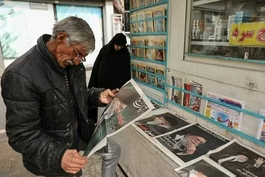
Expert panel breaks down U.S. objectives in Iran war
Video has Closed Captions
Expert panel breaks down U.S. objectives in Iran war (9m 9s)
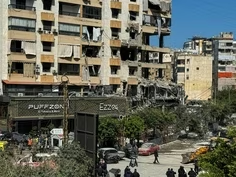
Hezbollah and Israel reignite conflict after Iran strikes
Video has Closed Captions
Hezbollah and Israel reignite conflict in Lebanon after Iran strikes (4m 4s)

How the war in Iran is impacting global energy markets
Video has Closed Captions
How the war in Iran is impacting global energy markets (7m 17s)
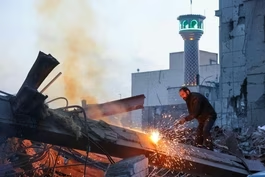
Iran expands attacks, U.S. urges Americans to leave Mideast
Video has Closed Captions
As Iran expands retaliatory attacks, U.S. urges Americans to leave Middle East (9m 19s)

News Wrap: FBI says Texas shooting could be terrorism
Video has Closed Captions
News Wrap: FBI investigating Texas shooting as potential act of terrorism (4m 54s)
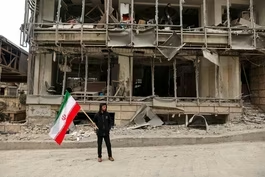
Reporter in Tehran describes tense and volatile conditions
Video has Closed Captions
On the ground in Tehran, reporter describes tense and volatile conditions (4m 10s)
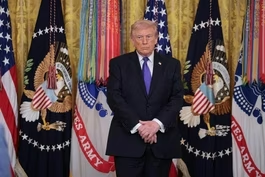
Trump leaves door open for ground troops in Iran
Video has Closed Captions
Trump leaves door open for ground troops in Iran (4m 38s)

What's at stake for Dems, GOP in Texas Senate primaries
Video has Closed Captions
What's at stake for Democrats and Republicans in the Texas Senate primaries (6m 50s)
Providing Support for PBS.org
Learn Moreabout PBS online sponsorship
- News and Public Affairs

FRONTLINE is investigative journalism that questions, explains and changes our world.

- News and Public Affairs

Amanpour and Company features conversations with leaders and decision makers.
Urban Consulate Presents











Support for PBS provided by:
Major corporate funding for the PBS News Hour is provided by BDO, BNSF, Consumer Cellular, American Cruise Lines, and Raymond James. Funding for the PBS NewsHour Weekend is provided by...