
June 17, 2026 - PBS News Hour full episode
6/17/2026 | 57m 46sVideo has Closed Captions
June 17, 2026 - PBS News Hour full episode
June 17, 2026 - PBS News Hour full episode
Problems playing video? | Closed Captioning Feedback
Problems playing video? | Closed Captioning Feedback
Major corporate funding for the PBS News Hour is provided by BDO, BNSF, Consumer Cellular, American Cruise Lines, and Raymond James. Funding for the PBS NewsHour Weekend is provided by...
June 17, 2026 - PBS News Hour full episode
6/17/2026 | 57m 46sVideo has Closed Captions
June 17, 2026 - PBS News Hour full episode
Problems playing video? | Closed Captioning Feedback
Where to Watch PBS News Hour
PBS News Hour is available to stream on pbs.org and the PBS app.
Providing Support for PBS.org
Learn Moreabout PBS online sponsorshipAMNA NAWAZ: Good evening.
I'm Amna Nawaz.
Geoff Bennett is away.
On the "NewsHour" tonight: After days of questions, U.S.
officials read aloud the memorandum of understanding between the U.S.
and Iran.
What's next in the efforts to end the war?
President Trump derails the confirmation process for his own director of national intelligence to pressure Congress to bend to his political will.
And the story of one woman whose own pregnancy changed how she sees abortion.
CHELSEA STOVALL, Mother: The baby was not -- like, it wasn't a matter of if I had to say goodbye.
It was a matter of when.
I wanted to say goodbye to her on my own terms, in my own way.
(BREAK) AMNA NAWAZ: Welcome to the "News Hour."
The Trump administration today shared new details about the agreement struck between the U.S.
and Iran, which aims to end the war, open the Strait of Hormuz, and begin further negotiations on the most difficult details.
Even as a senior U.S.
official provided the exact language of the document to reporters, President Trump on his final day in France made renewed threats to -- quote -- "bomb the hell out of Iran" if it doesn't abide by the deal.
Our White House correspondent Liz Landers begins our coverage.
LIZ LANDERS: After days of secrecy, senior U.S.
officials finally released the terms that make up the memorandum of understanding between the U.S.
and Iran.
The draft begins with a provision that the U.S.
and Iran and their allies will - - quote -- "declare the immediate and permanent termination of military operations on all fronts" and ensure the -- quote -- "territorial integrity and sovereignty" of Lebanon.
The U.S.
will also fully end its naval blockade in the Strait of Hormuz within 30 days and Iran will restore traffic to prewar levels.
In addition, Iran will allow commercial ships to pass through the Strait of Hormuz with no charge for 60 days.
Then, Iran and Oman will decide future administration of the strait.
When it comes to financial relief for Iran, the U.S.
and regional partners will develop a $300 billion reconstruction and economic development fund for Iran.
On nuclear weapons, Iran would agree not to procure them and adhere to a new minimum standard for downblending on site of Tehran's stockpiled enriched uranium.
Finally, the memorandum allows for Iran to immediately after the signing export crude oil and petroleum products without sanctions.
The U.S.
officials read the deal aloud paragraph by paragraph on a press call that began midway through President Trump's press conference capping off the G7 summit in France.
DONALD TRUMP, President of the United States: The past two days have provided a chance to discuss the details of this historic agreement with many of our closest friends and allies.
LIZ LANDERS: Throughout his press conference, Trump himself offered few specifics about the actual terms of the deal, leaving that to briefers on the call.
But he did say the draft had been sent to Israel and in the same breath took a swipe at Prime Minister Benjamin Netanyahu for his conduct in Lebanon, where relentless fighting and Israeli strikes have killed 4,000 people and displaced more than a million since early March.
DONALD TRUMP: In all fairness to Bibi Netanyahu, who happens to be a good man, gets a little excited sometimes.
He's been an amazing prime minister who we have a little dispute over Lebanon.
I say, you can do a little softer touch, Bibi.
You don't have to knock down a building every time somebody walks into it that's from Hezbollah.
But it's been an amazing partnership.
But he will say, we're the big partner and he's the very small partner.
And that's true.
LIZ LANDERS: Trump affirmed that nuclear talks would begin immediately and was asked about Iran's claim that their nuclear program is civilian in nature and if that would be acceptable going forward.
DONALD TRUMP: Well, I've said to them always, I say, look, you have probably the third largest oil reserves in the world.
What the hell do you need nuclear for?
You need nuclear for some electricity?
So -- so I've always felt that way.
So we've been pretty tough on that.
It's also -- it is a little hard, though, when you say that somebody wants it, other people have it, other adjoining states have it, and you're not letting them have it for purposes of electricity or things like that.
It's always a little tough.
You have to use a little common sense.
Please.
LIZ LANDERS: Meantime, the cease-fire has been shaky since announced on Sunday.
A U.S.
source tells PBS News that Iran has continued to fire drones at commercial ships in the Strait of Hormuz in the last few days, and the U.S.
military has shot them down.
But the president said that Iran could maintain their ballistic missile program, a major point of criticism from Hawks of the 2015 Obama-led Iran deal.
DONALD TRUMP: I'm saying that, if other countries have them, it's a little bit unfair for them not to have some.
A ballistic missile is not the same thing as what we're talking about when we talk nuclear.
But if Saudi Arabia and Qatar and they all have some, I would say, in relative proportion, I think it's OK.
That's what I mean.
LIZ LANDERS: While Vice President J.D.
Vance has taken on a larger role in negotiating the cease-fire and is expected to attend the signing on Friday in Switzerland, the president joked that Vance may take the fall if the deal sours.
DONALD TRUMP: I like that idea, sure.
This way, if it works out, I'm going to take the credit.
If it doesn't work out, I'm blaming J.D.
LIZ LANDERS: For the PBS "News Hour," I'm Liz Landers.
AMNA NAWAZ: The Iranian Foreign Ministry said late today that the text of the agreement has now been signed by the presidents of both countries.
Negotiating teams still plan to meet in Geneva on Friday.
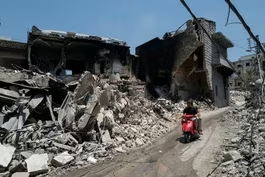
To assess the U.S.-Iranian agreement, we're again joined by two of our Iran watchers.
Alan Eyre worked in the State Department, was a senior member of the Obama administration's negotiating team for the 2015 Iran nuclear deal.
He's now at the Middle East Institute.
And Miad Maleki was born and raised in Iran.
Until last year he was the associate director for sanction targeting in the U.S.
Treasury Department with a focus on Iran.
He's now a senior fellow at the Foundation for the Defense of Democracies.
Welcome back to you both.
Before we jump into the details, I just want to get a quick big picture take from each of you.
Alan, I will start with you.
Is this a good agreement for the U.S.?
If you had to give it a grade, what would you give it?
ALAN EYRE, Middle East Institute: Well, the fact that we got it was fantastic.
I'm hopeful because we have stopped the bleeding.
We have cut our losses.
And, again, the details of this agreement are not as important as the fact that we finally realized we were not getting to where we wanted to go with military action.
In terms of the content, it's clear that Iran got the better of us.
AMNA NAWAZ: Miad, what's your quick take on this?
MIAD MALEKI, The Foundation for Defense of Democracies: Well, I mean, my view here is we had enormous leverage with Iran, militarily, politically, economically.
They were in the worst spot ever been since 1979 revolution.
I think, looking at the text of this memorandum of understanding, I see a level of underappreciation for that leverage that we had.
I think we gave up more than what we should have to just get the Strait of Hormuz open.
AMNA NAWAZ: So, Miad, pick up on that point, just a little more on that.
What specifically should have been in there that's not?
What's most problematic for you in the deal?
MIAD MALEKI: You know, in my view, and I have said this before, if we had just lifted the blockade, Iranian regime would have had to force to open the Strait of Hormuz for most for the sake of their own economy and also because they have to normalize the relationship with UAE, where they have hundreds of billions of dollars in assets and funds to go through, with the Chinese, with the Indians, with Pakistanis.
They have to get back to get their economy back.
I mean, it's an economy that has collapsed.
So, I don't think we should have given a no new sanction type commitment or any kind of authorization for oil sale just to get the Strait of Hormuz open and without getting clear concessions on the nuclear front.
AMNA NAWAZ: Alan, what's your take on that?
The losing of possible new sanctions leverage, easing of existing sanctions, does that allow Iran to build back up its military and nuclear capabilities?
ALAN EYRE: Well, first, I respectfully disagree with my friend and colleague Miad when he talks twice about just reopening the Strait of Hormuz.
The Strait of Hormuz being closed was a sucking chest wound to the world economy.
And the most urgent, exigent thing we needed to do was try to get that open.
This deal does that.
Everything else is secondary.
To be brutally honest, it's highly unlikely that the Trump administration will be able to get a nuclear deal with Iran.
It kicked the can, the nuclear can, down the road with this agreement.
And as I said, I don't think really it's going to get any better than this.
So we will have a de facto cease-fire, neither war, neither peace.
But at least we could begin to get traffic, maritime volume through the strait, back close to what it was before.
Though, with Iranian control of the strait, it's a real question as to whether we will ever achieve the prewar levels, which is one of the many reasons why this war was such a massive strategic blunder.
AMNA NAWAZ: Alan, just to follow up on that though, when the president announced the war, he said the U.S.
was going to completely destroy the Iranian missile program.
When he was asked about it today, he said -- "You don't mind Iran having ballistic missiles?"
He said: "Well, I'm saying if other countries have them, it's unfair for them not to have some."
Is that an acceptable outcome for the U.S.
and its allies?
ALAN EYRE: Well, first, I have given up trying to divinate what U.S.
policy is based on President Trump's statements because they change so radically.
I mean, some of the things he said today, he could have been the IRGC spokesman in terms of justifications for this deal.
But, no, we haven't achieved any war goals.
Iran has maintained a significant missile and drone force.
It will use whatever money it gets to a large extent to rebuild its defense industrial base.
It's going to weaponize and monetize control of the Strait of Hormuz.
So we haven't dealt -- not only have we not dealt with the strategic threat, the very real strategic threat Iran poses; we have made it worse by putting a new militarized, radicalized leadership and making them more likely to actually seek a nuclear weapon.
So, again, massive loss.
AMNA NAWAZ: Miad, did the U.S.
achieve any of its stated war goals?
You heard Alan say we have made it worse.
Do you agree?
MIAD MALEKI: I disagree.
I think I also wanted to add that saying that we need to cut our losses, let's look at the facts.
Before this war, in January, when Iran had $435 million a day in trade through the Persian Gulf, when Persian Gulf and the Strait of Hormuz was open, they had the largest protests in the history of Islamic Republic.
They had to kill 40,000 innocent Iranians to send people back home because of their economy.
Now we're going through a war.
And I think the most punishing thing that you can do to this regime is send it back to deal with the state of economy that is in today.
And for that reason, I think opening the Strait of Hormuz didn't really need a whole lot of sanctions relief or any kind of commitments to the regime, and they would have had to open it.
Now, as far as the objective, just to be clear, I think it was false to say that you can go and topple a regime or bring about serious, meaningful changes in political dynamics within the Iranian regime with a campaign of airstrikes.
I think the reason for that campaign was causing degradation and degrading Iran's missile drone programs and the buildup of their nuclear enrichment program.
I think those have been met.
I think Iran is significantly in much worse position than it was before the war.
It's less of a threat to our national security.
Just in 2023, IRGC targeted water facilities in the state of Pennsylvania.
They were building up drones and missile facilities in Venezuela.
Now they're nowhere close to posing that type of threat to us.
Now I think we should just send them back and have them deal with the reality that they faced in January, but much worse economic situation.
AMNA NAWAZ: Alan, do you agree with that, that the Iranian regime's capabilities have been degraded, no longer as much of a threat to the U.S.?
ALAN EYRE: Well, they never were a threat to the U.S.
Again, part of the pretext for this war was that they posed an imminent threat to the United States.
They don't.
We destroyed their air force.
Air force wasn't a threat.
We destroyed their navy.
Navy wasn't a threat.
What was The threat?
Missiles and drones targeting the Strait of Hormuz, which they have now learned to do.
And they retain that capacity.
It's very easy for Iran to reclose the strait.
So we haven't addressed the existing threat that Iran posed to the U.S.
As I said earlier, we have made it worse.
And, again, if the crux of this was the nuclear issue, this war didn't touch nuclear facilities.
The Iranian nuclear program is about the same as it was after last year's June 12 Israel-U.S.
attack on it.
And, unfortunately, to repeat what I said earlier, the only thing we have done now is incentivized Iran to build a nuclear weapon, which is something they weren't doing before we attacked them.
AMNA NAWAZ: Alan Eyre, Miad Maleki, fair to say a lot of questions remain.
We will have to have you both back to unpack it all some more.
Thank you to you both for joining us tonight.
ALAN EYRE: Thank you, Amna.
AMNA NAWAZ: There was confusion in Congress today after President Trump announced this morning that his pick for director of national intelligence would not show up for his scheduled confirmation hearing this afternoon.
Early today, the president posted -- quote -- "Regarding the approval of our great patriot Jay Clayton, we are canceling the Senate hearing re: DNI today and will not be going forward."
Senate Intelligence Committee Chair Tom Cotton first responded online, saying the hearing would go on.
Two hours later, he said it would be postponed, calling the president's move regrettable.
Meanwhile, the committee's top Democrat, Senator Mark Warner, said he doesn't know whether Clayton's nomination has been postponed or withdrawn.
SEN.
MARK WARNER (D-VA): I wonder whether Jay Clayton knows whether he has been postponed or withdrawn.
And, again, that is a level of chaos, incompetence.
When we're talking about our national security, when we're talking about adversaries around the world, what signals does this send?
AMNA NAWAZ: Senators were hoping for a swift confirmation so they could move forward with a bipartisan deal to reauthorize the powerful FISA surveillance law.
To break it all down, I'm joined by Andrew Desiderio of Punchbowl News.
Andrew, welcome back.
Thanks for being here.
ANDREW DESIDERIO, Punchbowl News: Thank you.
AMNA NAWAZ: Let's unravel this a little bit.
Jay Clayton is Trump's DNI pick because there were so many concerns about the acting DNI, Bill Pulte, who has no intelligence background.
Democrats said they would not renew this surveillance law with Pulte in charge.
Clayton seemed to be moving along.
So, what happened?
ANDREW DESIDERIO: Well, Jay Clayton was on track to be confirmed as soon as tomorrow.
That is a rapid time frame for Senate confirmation for such an important position.
This is a Cabinet-level position as well.
So it would have been one week from nomination to confirmation.
But Democrats were willing to give consent to speed up that process because they have been so concerned about Bill Pulte, who, as you mentioned, has no intelligence or national security experience, taking over that role in acting capacity.
And what Republican senators told me today, as they were dumbfounded and confused and all of that, is that they eventually realized that they think the president did this because the president wants Bill Pulte to serve as acting director of national intelligence for a certain period of time, even if it's a very short period of time.
Bill Pulte was scheduled to take office as acting DNI on Friday.
If the Senate had confirmed Jay Clayton tomorrow, as they were on track to do, Bill Pulte would have never been within 10 feet of the DNI building.
So I think that's what in part led the president to do this and to do it in a way that just, again, he didn't notify the Senate majority leader, John Thune.
He didn't notify Tom Cotton in advance, of course, the Senate Intelligence Committee chair.
It was extremely bizarre.
AMNA NAWAZ: So, if Bill Pulte is still the acting DNI then, what does all that mean for FISA being reauthorized?
What are you hearing?
ANDREW DESIDERIO: Well, Democrats say and they have maintained the position that they are not going to vote to reauthorize Section 702 of FISA so long as someone like Bill Pulte is in charge of the program, because, remember, the director of national intelligence essentially oversees all of FISA and specifically the 702 program, which is a very politically interesting coalition that it brings together, because there are Republican opponents of it.
There are Democratic opponents of it.
They kind of unite forces on the far left and on the far right over civil liberties concerns, privacy concerns, the desire to get a warrant before seeking that type of information.
So, by nature, you need Democrats and Republicans to pass this.
And, of course, in the Senate, you still have the filibuster, so you need 60 votes.
The president wants to get rid of the filibuster, of course.
AMNA NAWAZ: So the president also folded in a few other agenda items to that lengthy post about this morning.
He mentioned the SAVE America Act as something he wants to see passed along with the FISA reauthorization.
Why has that been installed and what's in that we should understand?
ANDREW DESIDERIO: Well, the SAVE America Act is the proof of citizenship and voter I.D.
bill that Republicans have been pushing for months now.
It does not have the votes to pass the Senate, even if they were to get rid of the filibuster, because there are enough Republican opponents of the bill such that it can't move forward.
And, of course, all Democrats oppose it.
So this would be a poison pill, of course, if it were added to something that is considered must-pass like FISA Section 702.
And Republicans are getting mad at their fellow Republicans internally.
I reported earlier today, for example, that during a closed-door lunch meeting, Senators John Cornyn and John Kennedy confronted their colleague Senator Mike Lee, Republican of Utah, who's been the biggest sort of proponent of this legislation, for trying to overpromise and suggest online, as he has to many factions of the MAGA base, that it is possible somehow for the Senate to pass this legislation, and convincing the president that it's possible too.
And that's what's led the president to continue to make these demands.
And so the worry is that they are overpromising and underdelivering, and then, at the same time, this circular firing squad where Republicans are attacking each other, instead of attacking Democrats.
AMNA NAWAZ: In just a few seconds, if you can, how does this complicate life for Senate Majority Leader John Thune?
ANDREW DESIDERIO: Look, his relationship with President Trump has definitely taken a hit.
They had to do a lot of rebuilding before John Thune became Senate majority leader, of course.
But he told us, he told me today that their relationship is -- quote -- "fine."
So read into that as you will.
AMNA NAWAZ: Fine.
Fine is a good word.
(LAUGHTER) AMNA NAWAZ: Andrew Desiderio of Punchbowl News, thank you for being here.
ANDREW DESIDERIO: Thank you.
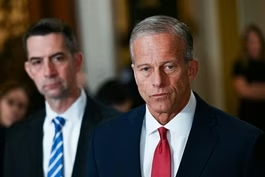
AMNA NAWAZ: Well, joining us now with an insider's perspective is Doug Heye.
He's a Republican strategist with experience operating within the White House, Capitol Hill's leadership circles, and on the campaign trail.
Great to see you, Doug.
DOUG HEYE, Republican Strategist: Good to be with you.
AMNA NAWAZ: So it looks like the president is playing hardball with his own party's Senate majority leader.
What's going on here?
DOUG HEYE: Look, Donald Trump wants to be in control of everything.
And what I have seen today and throughout this week as I hit refresh on Punchbowl pretty much every day is that that's causing a lot of problems within the Senate conference.
I talked to Senate leadership staffers today, who said, we're constantly out of the loop.
And that's been the problem for the president on so many things, if we're talking about Senate Republican reaction to Iran, obviously with the memorandum of understanding.
They have been out of the loop on what the plans are, how we define success.
It changes every day.
AMNA NAWAZ: Yes.
DOUG HEYE: And, certainly, they woke up this morning to find once again plans have changed and they're out of the loop.
It means that we have said for well over a year now that Mike Johnson has the hardest job in Washington.
It might be that John Thune does.
AMNA NAWAZ: Well, there's the sort of discussion about this among senators.
But just in terms of getting the president's agenda in place, John Thune had a plan, right, to get his nominee confirmed, to move forward with authorization of FISA.
Mr.
Trump has now blown that plan up.
What does John Thune do now?
DOUG HEYE: I don't think that their team really knows.
And the reality is, they had all their ducks lined up in a row.
And we always try and focus on what leadership is doing wrong, because we all think that we could do it smarter or better.
Probably not.
But they had all their ducks lined up in a row that they were -- so they were going to move this nomination really quickly and then pass FISA.
Everything looked good and we were going to see a productive Senate.
The reality is, Donald Trump rolled the bowling ball, knocked all the pins down.
AMNA NAWAZ: I want to ask you too about the earlier story we reported, the big story about this Iran deal, because we have already seen some criticism from some Republican lawmakers.
They wanted to see details of this bill before they would sign off on it.
From what we reported and what we have seen, is this a deal that Republican lawmakers can get behind?
DOUG HEYE: You are going to hear a lot of noise against it, in part because we have heard Ted Cruz be really strongly against this.
Obviously, some senators are looking to run for president in a couple of years.
That will certainly have an impact.
But the reality is also, again, they have just not been included in these decisions and discussions that the White House have made.
When the president spoke at the State of the Union address, it was a great opportunity for the president to tell Congress, Republicans and Democrats, House and Senate, but also the American people, here's what we're trying to do, here's how we define success.
He didn't take that opportunity and really hasn't used any time since then to do so.
So, Republicans have very real questions.
And now we're starting to find out what some of the answers are, and they don't like them.
AMNA NAWAZ: All right, I want to tap into your expertise to get your take on some election results and turn to the primaries and run-offs that we were tracking last night.
In Alabama, in Georgia and in Oklahoma, the Trump-backed U.S.
Senate candidates all won, but also in Georgia, Trump's picks for governor and secretary of state both lost.
In Oklahoma, the candidate he was backing came in second, is now heading to a run-off in August.
I know we often look at these and say, what does it tell us about the state of the party and about the president's influence in these elections?
How do you look at it?
DOUG HEYE: I got a call from a New York Times reporter a couple weeks ago who talked about Donald Trump's dominant grip on the party and how none of the Trump-endorsed candidates ever lose.
And I said, well, I'm in Asheville, North Carolina and you may remember Madison Cawthorn represented that district.
Trump endorsed him, doubled down on the endorsement the day before the election.
His candidate lost the next day.
The reality is, yes, any president endorsing in a primary is a huge benefit for that campaign.
Trump does it more than, say, Biden, Obama, Bush and so forth.
But the reality is, candidate quality still matters and how those candidates campaign matters.
So if we're talking in 2026, I would tell you that John Cornyn and Janet Mills, the Democrat in Maine, both had something in common that was just poison for 2026.
They are senior citizens with a long track record of incumbency.
That's not what voters are looking for in 2026.
AMNA NAWAZ: While I have you on, take a closer look at Georgia in particular, because we know Republicans have been eying winning back those Senate seats after the surprise Democratic wins back in 2020.
When you look at the Republican, Representative Mike Collins, how do you think he stacks up against the Democratic Senator Jon Ossoff there?
DOUG HEYE: It's Georgia.
It's going to be a very close race.
Those races have now been close for a while.
But if I'm a Republican in Georgia, I'm nervous because I know that they have two Democratic senators that were basically made senators by Donald Trump by really own goal, to use a World Cup term, really own goal mistakes by Trump that really put Ossoff and Warnock in the Senate.
And Republicans in Georgia, while they want to be as close as they can to Trump, they have real frustrations.
AMNA NAWAZ: We love a good World Cup tie-in any time, by the way.
(LAUGHTER) AMNA NAWAZ: Doug Heye, always great to see you.
DOUG HEYE: Thank you.
AMNA NAWAZ: Thank you so much for being here.
The day's other headlines begin along the U.S.
Gulf Coast, where Tropical Storm Arthur, the first Atlantic storm of the season, could bring deadly flash floods.
The storms that fueled Arthur have been drenching the Gulf Coast for days, inundating vehicles and forcing a number of water rescues.
At least two people have died, including a woman whose car was washed away outside San Antonio.
And nearly 40 million Americans from Texas to Georgia are under flash flood alerts.
In a video briefing, the National Hurricane Center issued a stark warning.
MICHAEL BRENNAN, Director, National Hurricane Center: The main threat from Arthur is going to be a prolonged multiday heavy rainfall event that could produce dangerous to life-threatening flash flooding.
This is the flash flood risk over the next three days.
The area you see here in red is at level three out of four, where it's most likely that we would see the potential for that life-threatening flash flooding.
AMNA NAWAZ: Much of the Midwest is also under threat tonight, with another round of severe thunderstorms and possible tornadoes sweeping across Illinois, Indiana and the Ohio Valley.
In Georgia, Republican lawmakers have rejected their governor's call to redraw the state's 2028 voting maps just hours before a special session was set to begin.
In a letter to Governor Brian Kemp, House Speaker Jon Burns cited concerns about moving too quickly and not giving the public a chance to weigh in.
Also today, demonstrators flooded the state capitol, chanting and carrying signs against redistricting efforts.
It's a setback for President Trump, who has urged Republican-led states to redraw congressional maps to gain seats in the midterms.
In New York, Gilgo Beach serial killer Rex Heuermann was sentenced to life in prison without the chance of parole after admitting to the murder of eight women.
The Long Island architect showed little emotion at today's hearing, during which loved ones delivered emotional statements about the victims.
The judge showed his emotions, at one point calling Heuermann -- quote -- "a despicable man and a coward."
The case gained national attention after the 2010 discovery of human remains near Long Island's Gilgo Beach about 50 miles from Manhattan.
Federal aviation officials are investigating a private jet crash on a Texas highway last night that killed one person.
Police and bystanders in Laredo, Texas, rushed to try and rescue passengers from the wreckage.
Officials say five of the six people on board survived.
Airport officials say, prior to the crash, the pilot called air traffic control to report low fuel and a power outage.
A motorist hit by the plane was taken to a hospital and is in stable condition.
NATO Secretary-General Mark Rutte says the alliance is meeting its military needs despite a decline in U.S.
support.
The Pentagon has recently said it would not commit the same level of air and naval assistance to NATO allies in a time of crisis.
That's part of a broader U.S.-stated shift towards potential threats from China and elsewhere.
Before tomorrow's meeting of NATO defense ministers in Brussels, Rutte said today that member nations are filling the gaps left by Washington.
MARK RUTTE, NATO Secretary-General: This is not primarily about where forces and assets are currently, but about who would do what if our defense plans were activated.
Historically, this was overly reliant on the United States.
Now the U.S.
has adjusted its pledged contributions, and other allies have stepped up to contribute more.
AMNA NAWAZ: America's commitment to the 32-member bloc has become another source of tension with Europe.
President Trump surprised allies last month, announcing plans to send 5,000 more troops to Poland, even as he calls to reduce the U.S.
military presence elsewhere in Europe.
Allied leaders will next meet in July at the NATO summit in Turkey.
On Wall Street, stocks slid today after the Federal Reserve signaled it could raise interest rates later this year.
The Dow Jones industrial average fell around 500 points on the day.
The Nasdaq lost 350 points, or 1.3 percent.
The S&P 500 also dropped more than 1 percent.
And in World Cup news, soccer powerhouse Portugal could only manage a 1-1 draw against the Democratic Republic of the Congo today.
Along the way, both teams made history, with the DRC playing in its first World Cup match in over 50 years.
The last time was in 1974, when the country was known as Zaire and lost to Brazil.
And today's match was a record-tying sixth World Cup for Portugal's 41-year-old superstar Cristiano Ronaldo.
Meanwhile, Argentina's Lionel Messi scored a hat trick last night against Algeria and made history of his own, tying the men's record for most World Cup goals.
That's 16 total.
The overall record of 17 is still held by Marta, star of the Brazilian women's team.
Still to come on the "News Hour": Kevin Warsh addresses the public for the first time as Federal Reserve chair; one mother's reasons for changing her mind on the issue of abortion; and a new book explores the lasting impact of racial inequality in the medical field.
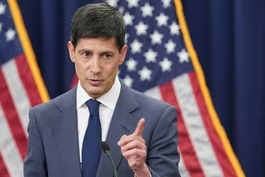
The Federal Reserve held interest rates steady today in the first meeting led by its new chairman, Kevin Warsh.
The decision to maintain rates at a range of 3.5 percent to 3.75 percent for a fourth straight meeting was supported by all 12 members of the Federal Open Market Committee.
But new quarterly projections by some Fed officials anticipate a rate hike by the end of the year.
And Warsh made it clear that he's ready to break in a number of ways from his predecessors.
KEVIN WARSH, Federal Reserve Chairman: I don't share the view that was expressed a few generations ago that Federal Reserve chairmen show up at a podium like this and say, you got to choose, and you're going to have to decide whether you're willing to tolerate higher inflation to put more people at work.
I don't believe in that.
What I believe is, if we do our job, we can make strong growth, low prices, and strong employment mutually compatible.
AMNA NAWAZ: For more on today's meeting and the future of the Fed under Warsh, I'm joined now by David Wessel.
He's director of the Hutchins Center on Fiscal and Monetary Policy at the Brookings Institution.
Great to see you.
DAVID WESSEL, Brookings Institution: Great to see you.
AMNA NAWAZ: So, Kevin Warsh's first press conference since becoming Fed chair.
Before we dive into details, what was the headline for you?
DAVID WESSEL: I think the headline was that Kevin Warsh is very confident.
He didn't make any mistakes, but he's very reluctant to show anything about what he thinks about monetary policy, which, as you pointed out, nine of the 18 people who put dots on their projections, Kevin Warsh didn't, see a rate increase in the next year -- before the year's over.
And that's why -- and the markets saw that.
So Warsh's attempt to, we're not going to tell you what we're going to do, was kind of undermined by the fact that they have a system where the other people are telling the markets what they think that they're going to do.
AMNA NAWAZ: Well, President Trump was asked about that possible rate hike later this year and also the decision to hold rates steady today.
Here's what he had to say.
QUESTION: Did you see the Fed decision?
They held rates today.
Did you see that?
DONALD TRUMP, President of the United States: It's all right.
Whatever.
QUESTION: And it looks like they might even raise them later this year.
It's not clear.
Do you have any comment?
DONALD TRUMP: It could happen.
I mean, it's hard to believe.
It just keeps the country down.
It's so unusual.
But we have a very good guy over there now, so I'm guided by what he wants.
DAVID WESSEL: So I think that Kevin Warsh was not singing the song that President Trump wants him to sing.
AMNA NAWAZ: That helps to explain the president's reaction.
DAVID WESSEL: He emphasized over and over again price stability, price stability, price stability.
DAVID WESSEL: That's a recipe for higher interest rates.
I imagine Kevin Warsh talking to the president -- and I suspect they talk quite a bit -- and Kevin Warsh saying to the president, boss, the European Central Bank raised interest rates.
The Bank of Japan raised interest rates.
I have all these hawks on my committee and I held the line.
So be nice to me on TRUTH Social.
AMNA NAWAZ: Well, the other big question here is inflation, of course, as Warsh mentioned.
And that is still above that 2 percent target the Fed had set.
We just saw last month's Consumer Price Index rise at its fastest rate in three years.
How do you think Warsh handled that?
How do he address those concerns today?
DAVID WESSEL: Well, the members of the Federal Open Market Committee who put projections down said they expect inflation to be worse than they had expected when they did it three months ago.
So I think Warsh is trying to assure people we are going to aim at price stability.
We're not going to tolerate -- he kept talking about we have been over target for five years.
But he didn't say exactly how he's going to get there or what he thinks is causing it.
And so I think he managed a very delicate situation well today without showing very many cards.
AMNA NAWAZ: When it comes to interest rates, as we know that's a focus for President Trump as well, a unanimous vote today says that there's consensus in how they're viewing the current economic situation, right?
But you mentioned that dot plot, where each member sort of says this is where I think things will head down the line.
AMNA NAWAZ: There's a divide.
Some said that they believe interest rates will hold or have a modest cut.
And others said that there could be at least one hike.
How do you read that divide?
DAVID WESSEL: Well, I think that the situation is very uncertain.
And what the Fed is saying is, right now, we seem to be at full employment and inflation seems to be a problem.
And I think that, if inflation doesn't come down, they will have to raise rates.
But people have different forecasts about what's going to happen.
So treading water for now seems fine.
But it's interesting.
Financial markets looked to the whole picture today, and they expect a rate hike.
So it's going to be very interesting to see how Kevin Warsh handles this.
On one hand, price stability is important, maybe even to him more important than full employment.
On the other hand, he's got to worry about Trump going after him.
And he clearly would like to delay that as long as possible.
AMNA NAWAZ: You and I have spoken before about Kevin Warsh coming in and promising regime change and how the Fed operates and even how they communicate.
What signals did you see today about what that regime change means?
DAVID WESSEL: Well, the statement they issued was much shorter.
The press conference was shorter.
And he refused to give any clues as to what he thinks lies ahead.
He's going to try and give less of what the insiders call forward guidance.
He also said, in order to make it seem like he's doing something, he appointed five task forces.
Or he didn't appoint them.
He says he's going to have five task forces.
I kind of expecting someone to say to him, one more question.
Oh, I have a task force for that too.
But I think regime change, as Nick Timiraos at The Wall Street Journal wrote, is kinder and gentler than his rhetoric implied when he was campaigning for the job, and the change is going to be slower.
I think we will get change.
I think these task forces are wrestling with issues that are important to the Fed.
How do we think about predicting inflation?
How do we communicate?
What should we do with our large portfolio?
And so he's sending a signal that we're going to move slowly, we're going to move deliberately.
I'm going to get a lot of advice from outside the Fed and then we will make some decisions, but don't hold your breath.
AMNA NAWAZ: I have just got a few seconds left, but I have to ask.
One of the biggest concerns was about Warsh maintaining the Fed's independence under pressure from President Trump.
If you're an investor looking at this today, what did you see, confidence in that independence?
DAVID WESSEL: I think you see confidence because both he and the other members of the committee seem prepared to raise interest rates if necessary, even though we know and President Trump said today that's not what he wants.
AMNA NAWAZ: David Wessel, always great to see you.
DAVID WESSEL: You're welcome.
AMNA NAWAZ: Thank you so much.
Since Roe v. Wade was overturned, a majority of Republicans continue to oppose abortion.
But there's been a shift in opinion among many Americans.
More Democrats and independents now say abortion should be legal in all or most cases and find it morally acceptable than they did five years ago.
And, in some cases, there are even conservatives questioning their own views in response to state bans.
Special correspondent Sarah Varney brings us the story of one Arkansas woman whose own pregnancy changed how she sees abortion.
So, I wanted three kids, but after going through everything that I went through and the laws the way they are, I don't want to get pregnant again.
I would be scared.
Once I get pregnant, my life stops mattering.
CHELSEA STOVALL, Mother: I'm Chelsea Stovall, 35, live in Fayetteville, Arkansas.
I'm the cook and chef at a day care, mom to two amazing kids.
My son is 7, almost 8.
He has the biggest personality.
He is just wildly energetic.
And then you know my daughter.
She is almost 6 now.
She's going to be a force to be reckoned with when she grows up.
That's for sure.
SARAH VARNEY: Chelsea Stovall was born in Kentucky.
She was one of seven kids.
And after kindergarten, her family moved almost every year.
CHELSEA STOVALL: Growing up was -- it was loud.
It was crazy.
I mean, there was always something going on, always someone to play with.
We could make our own hockey team.
SARAH VARNEY: No matter where the family landed, Chelsea says they were at church every Sunday without fail.
CHELSEA STOVALL: We were sort of evangelical Christian and we would be a part of vacation Bible school in the summer and did a lot of volunteering through church.
It was very much a part of everyday life.
That's really where my values came from.
I mean, that's how I grew up.
Abortion was something that I knew better than to talk about.
It was not talked about, just a taboo subject.
My family didn't talk about it.
My friends' families didn't talk about it.
It was not seen as health care.
It was something bad.
SARAH VARNEY: In 2018, Chelsea gave birth to her son.
And then, two years later, her daughter with her then-husband, Thomas.
THOMAS STOVALL, Father: I literally ran around this island dozens of times screaming yes, yes, yes, yes, yes.
SARAH VARNEY: Thomas served in the military overseas in Kuwait before he met Chelsea.
He'd grown up in a small Mississippi town and was raised in the Southern Baptist church.
THOMAS STOVALL: It was very fire and brimstone.
It was our way or the highway.
That was the very first time I ever heard the word abortion, and that was from a preacher.
I was like, well, what is it?
He was like, oh, it's wrong.
It's a sin.
And that was the end of it.
But I hadn't done my own research.
I didn't really know nothing about it.
I never thought it would affect me.
CHELSEA STOVALL: So when I thought I was pregnant in 2022, I was really excited again.
I mean, I'd always wanted three kids.
And here I was pregnant again for the third time.
And so I went to all of my checkups, my OB appointments, and everything was healthy.
SARAH VARNEY: Two months later, the Supreme Court overturned Roe v. Wade, and Arkansas' near-total abortion ban went into effect.
CHELSEA STOVALL: So, a couple weeks later, I had my anatomy scan, where you find out if you're going to have a boy or girl.
The ultrasound tech was so nice, and she was talking and everything, but then she got really quiet at one point.
And when my doctor came in, she said that it was a girl, but that she had a hole where her diaphragm should have been, and her intestines were in her chest cavity and had been strangling her heart and her lungs, and they had not grown, and that she was not going to make it.
I was devastated.
This life that I thought that I was going to have was no longer a possibility.
THOMAS STOVALL: It was hard.
I still remember her scream.
I still hear her scream to this day.
It made me question everything, my religion.
I completely changed.
SARAH VARNEY: Five days later, a neonatal specialist confirmed the diagnosis and told Chelsea, if her exam was just four weeks earlier, they could have performed an abortion.
CHELSEA STOVALL: I was told that they had a less than 1 percent chance of surviving.
They explained all the surgeries that they would have needed and the recoveries.
And it was just -- it was not an option.
I mean, the baby was not going to make it.
It wasn't a matter of if I had to say goodbye.
It was a matter of when.
I wanted to say goodbye to her on my own terms, in my own way.
SARAH VARNEY: Her options now, continue a risky pregnancy or find care outside Arkansas.
CHELSEA STOVALL: So I had to look at surrounding states, Oklahoma, and Missouri.
I mean, a lot of states around Arkansas had similar laws in place.
And so I had to go to Illinois.
First, I had to call the clinic and make sure that they could -- that I could get an appointment, because they were very, very busy.
I mean, they had an influx of a lot of patients from other states.
And then I had to figure out childcare for my kids.
It was sort of this process of, OK, now what do I need to take care of?
OK, now what's next?
And how much is it going to cost?
And it took all of my savings.
I mean, it was six-hour drive.
I had to get a hotel room, because it was a couple-day process.
There was a security guard at the front door, and they didn't allow anyone in the building except patients for safety reasons.
I was in a pretty bad headspace, because I wasn't at home.
You know, my OB, my doctor, that delivered both my other babies, wasn't allowed to deliver my third baby.
I couldn't have my friends by my side.
I couldn't have my husband by my side.
It was very lonely.
After Chelsea went inside, Thomas waited in the car and protesters yelled at him from the sidewalk.
THOMAS STOVALL: I remember one of them called me a murderer.
And I just looked at him and I was like: "You have no idea who I am, what I'm going through."
SARAH VARNEY: The couple drove six hours back to Arkansas to their two kids and their home and a life that suddenly felt foreign.
THOMAS STOVALL: I lost my head.
I was cloudy.
I was cold, cut off, try to self-medicate.
And all those things were wrong.
SARAH VARNEY: The stress of the experience put a strain on their relationship.
But Chelsea says, after some time apart to grieve and process, she and Thomas are working on reconciling.
Today, Chelsea says she's still trying to figure out where she fits spiritually after her abortion.
CHELSEA STOVALL: It really changed my values.
It changed my opinion on a lot of issues and what people are affected by and what the laws in our country are, because they affect people, whether they realize it or not.
They affected me.
SARAH VARNEY: And though she doesn't have problems with Christianity itself, she does take issue with people passing laws and making policies in the name of the church.
Chelsea is now part of a group of Arkansans suing the state over its abortion law.
CHELSEA STOVALL: If more people knew my story, I think that they would understand that abortion is a medical procedure.
It is used in a multitude of situations.
It's not just used as birth control, which I think a lot of people see it as.
I think that that's how I used to see it when I was younger growing up in the church.
I carried that view until I needed one.
SARAH VARNEY: For "PBS News Hour," I'm Sarah Varney.
AMNA NAWAZ: A century ago, Black physicians built hospitals, clinics and medical schools across the South, only to see them dismantled by policy, segregation, and a single at the time influential report.
Investigative journalist Nicole Carr traces that history through her own family and found the consequences are still being felt today.
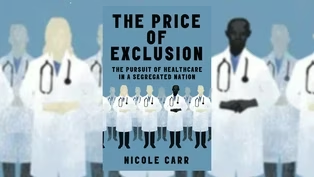
Geoff Bennett recently spoke with Carr about her book, "The Price of Exclusion: The Pursuit of Healthcare in a Segregated Nation."
GEOFF BENNETT: Nicole Carr, welcome to the "News Hour."
NICOLE CARR, Author, "The Price of Exclusion: The Pursuit of Healthcare in a Segregated Nation": Thank you for having me.
GEOFF BENNETT: You open this book with the story of your great-grandfather Dr.
Lawrence St.
Clair Ferguson.
How did his story draw you into this project?
NICOLE CARR: Yes, so I wasn't planning on writing a book.
I was working in local television in Atlanta during the height of the pandemic, the COVID-19 pandemic.
And I got off air one evening.
We had three kids, two in virtual school.
I was four months postpartum, feeling the pressures of everything we were covering at the time.
And I just had a moment one evening and asked myself, how did they get through this 100 years ago?
And I knew we had this ancestor who was a physician maybe during this time, but we didn't know a whole lot about him because of some family dramas, some issues in the family.
But we carried a name, and I wanted to find him.
I wanted to know how he lived during this time.
And I went to Howard University archives to kick this off, because he'd completed medical school there and I thought maybe they'd have some answers.
They had just digitized a new collection of archive material using a Mellon Foundation fund.
And one of the new assets was his medical school yearbook, The Morgue from 1925.
But I found out that he'd come to America from Jamaica during Red Summer after serving in the Great War and, during the pandemic, during the war coming here, during racial terror and strife, finishing premed during the week of the Tulsa Race Massacre, where one of the first casualties is a Black physician, and finishing med school studies and going to a place, to Harlem, when they're trying to integrate the hospitals there.
The same things happening 100 years ago, with socioeconomic and health equity questions, and this question of racial reckoning in America.
We were going through the same thing here a century later.
And so I just felt drawn to him.
GEOFF BENNETT: And you approached his story with your skills and background as an investigative journalist.
NICOLE CARR: Yes.
GEOFF BENNETT: The title of this book, "The Price of Exclusion," what is the price and who is paying it today?
NICOLE CARR: I think we're all paying for it today.
One of the things I remember, I remember being on a Zoom press conference with the heads of the Black medical schools, the four that we have here in the U.S.
And the American Medical Association at some point during this reporting in 2020 apologized for the role it had played in shutting down Black medical schools in the early 20th century.
We know this as the price we paid for the Flexner Report.
So they commissioned this report.
They're with the Carnegie Foundation and they're evaluating these medical schools for efficiency, effectiveness, and what we lose are all the Black medical schools except for Howard University's school and Meharry.
And we're left with those until late '70s, early '80s when Morehouse School of Med comes to be, and then Charles Drew later on.
They were apologizing because we were feeling the effects of the shortage of Black physicians 100 years later from shutting down these schools.
To this day, the majority of our Black physicians are still trained at Black medical schools.
Even with the few we have left, the majority, our supply is from historically Black institutions.
And so it starts with that.
It starts with that.
GEOFF BENNETT: And to your point, Black folks make up 14 percent of the population roughly, Black physicians only about 5 percent.
NICOLE CARR: Yes, right.
GEOFF BENNETT: Yes, and that ratio has not changed for over a century.
What accounts for that?
NICOLE CARR: The education.
It's the education and not the ability, but the access to it, which is very important in this time, especially as we approach July 1 and what we see baked into the Big Beautiful Bill and the loan limits for professional schools.
When you factor that into scholarship funds and endowments and things that are being challenged for racial discrimination, when you combine that with the racial wealth gap, when you combine that with how many institutions are training our doctors, we're effectively seeing the potential for these doors to be shut in a way that they were during what we recognize as a formalized Jim Crow America.
And so we're not waiting to see black and white water fountains or no people of this kind allowed in this school, no policy like that.
But modern-day policy can effectively take us back to the same ratios we were dealing with 50 to 100 years ago.
And that's scary.
GEOFF BENNETT: Your reporting took you to places where hospitals have disappeared, where access to health care has become increasingly scarce.
What did those communities reveal about the connection between health care access and representation?
NICOLE CARR: I really felt folks' loss of hope when they could not access basic care.
So the book opens up in Hancock County, Georgia.
The hospital has been -- the county hospital has been shuttered for decades.
It's almost scary to walk on the property.
It's overgrown with vines.
There's this silence, this energy.
It's like, OK, once, we were getting somewhere and now there's no Medicaid expansion.
There's - - the doors are shut on the hospital.
There's one Black physician.
She's a Spelman graduate.
She's in her 70s, Dr.
Patrice Boddie, that I talk about.
Everybody's trying to get an appointment with Dr.
Boddie because she's culturally competent.
She understands them.
She's come back to her hometown.
She's - - we're dealing with generations.
Her grandfather, father and uncle ran the practice that she's still holding together all these decades later, a Meharry graduate who comes back home.
And she's dealing with the problems that we're always dealing with, high blood pressure, diabetes.
She's trying to stabilize folks in a home hospital setting that her ancestors ran.
And they can't get to a quality hospital quick enough when there's an emergency.
You meet a woman who had a brain aneurysm, a brain bleed.
She took -- it took an hour-and-a-half to get her to Augusta, Georgia, to get the care she needed.
And the consequences of that, I mean, it manifests in her face in a way that she's able -- her mobility.
But had they lived 100 years ago, the hospital that was serving Black folks was right around the corner.
And so there's this question of, what did we lose with the idea of integration?
The policies with integration was, it meant for us to have access to the things that we needed.
What was lost in integration?
And what are the effects of it all these decades later?
What went wrong with policies?
And that is -- I mean, that's something we're exploring here.
GEOFF BENNETT: The book is "The Price of Exclusion: The Pursuit of Healthcare in a Segregated Nation."
Nicole Carr, a real pleasure to speak with you.
NICOLE CARR: Thank you.
AMNA NAWAZ: Remember, there's always a lot more online, including a look at how Americans across the country are celebrating the nation's 250th anniversary.
That is at PBS.org/NewsHour.
And that is the "News Hour" for tonight.
I'm Amna Nawaz.
On behalf of the entire "News Hour" team, thank you for joining us.
 New
NewGOP strategist breaks down Trump’s pressure on Congress
Video has Closed Captions
Trump wants 'control of everything,' GOP strategist says as Congress faces pressure (4m 57s)
 New
NewMideast experts on U.S.-Iran deal and who came out ahead
Video has Closed Captions
Middle East experts weigh terms of U.S.-Iran deal and who came out ahead (8m 3s)
 New
NewNew book explores impact of racial inequality in medicine
Video has Closed Captions
'The Price of Exclusion' explores lasting impact of racial inequality in medicine (8m 25s)
 New
NewNews Wrap: Tropical Storm Arthur brings flooding threat
Video has Closed Captions
News Wrap: Tropical Storm Arthur brings flooding threat to Gulf Coast (5m 37s)
 New
NewPregnancy complication reshapes woman’s view of abortion
Video has Closed Captions
How a pregnancy complication reshaped an Arkansas woman’s view of abortion bans (8m 13s)
 New
NewTrump stalls confirmation of national intelligence nominee
Video has Closed Captions
Trump stalls confirmation process of his own national intelligence nominee (5m 26s)
 New
NewU.S. officials reveal key terms of agreement to end Iran war
Video has Closed Captions
U.S. officials reveal key terms of agreement to end Iran war (4m 39s)
 New
NewWhat Warsh’s first meeting as Fed chair signals
Video has Closed Captions
What Warsh’s first meeting as Fed chair signals (6m 51s)
Providing Support for PBS.org
Learn Moreabout PBS online sponsorship New Episode
- News and Public Affairs

Today's top journalists discuss Washington's current political events and public affairs.

- News and Public Affairs

FRONTLINE is investigative journalism that questions, explains and changes our world.
Urban Consulate Presents
 New Episode
 New Episode

 New Episode
 New Episode
 New Episode
 New Episode
Support for PBS provided by:
Major corporate funding for the PBS News Hour is provided by BDO, BNSF, Consumer Cellular, American Cruise Lines, and Raymond James. Funding for the PBS NewsHour Weekend is provided by...