
July 14, 2026 - PBS News Hour full episode
7/14/2026 | 57m 46sVideo has Closed Captions
July 14, 2026 - PBS News Hour full episode
July 14, 2026 - PBS News Hour full episode
Problems playing video? | Closed Captioning Feedback
Problems playing video? | Closed Captioning Feedback
Major corporate funding for the PBS News Hour is provided by BDO, BNSF, Consumer Cellular, American Cruise Lines, and Raymond James. Funding for the PBS NewsHour Weekend is provided by...
July 14, 2026 - PBS News Hour full episode
7/14/2026 | 57m 46sVideo has Closed Captions
July 14, 2026 - PBS News Hour full episode
Problems playing video? | Closed Captioning Feedback
Where to Watch PBS News Hour
PBS News Hour is available to stream on pbs.org and the PBS app.
Providing Support for PBS.org
Learn Moreabout PBS online sponsorshipGEOFF BENNETT: Good evening.
I'm Geoff Bennett.
Amna Nawaz is away.
On the "NewsHour" tonight: ICE suspends most vehicle stops after two fatal shootings by agents in recent days.
The U.S.
and Iran battle for control of the Strait of Hormuz, where the war and negotiations to end the conflict go from here.
And we speak with one of the independent election officials, President Trump fired as part of his effort to exert greater control over how elections are run.
THOMAS HICKS, Former Chair, U.S.
Election Assistance Commission: I want to assure the American people to still cast their votes and, if they have doubts about the system and other aspects, to serve as a poll worker.
(BREAK) GEOFF BENNETT: Welcome to the "News Hour."
As we come on the air, we are tracking fallout from the latest deadly ICE shooting this time in Maine.
Yesterday, a 26-year-old Colombian national was shot and killed in Biddeford, Maine, after ICE agents attempted to pull him over while he was driving.
ICE says the man, Joan Sebastian Guerrero, seen in this independent video, tried to flee and used his vehicle as a weapon, prompting an agent to fire in what ICE says was self-defense to protect the public.
Video reviewed by the "News Hour" does not on its own confirm those claims.
As questions mount, the administration is also defending ICE's tactics more broadly.
Border czar Tom Homan said the agency has temporarily paused certain vehicle stops while it reviews recent incidents, but insisted agents acted appropriately and expects those operations to resume.
TOM HOMAN, White House Border Czar: I think what they're doing is taking a pause to make sure that, number one, the ICE officers have everything they need to stay safe, because vehicle attacks are up 3400 percent.
And they're going to make sure, is the training sufficient.
Did anything go wrong?
I'm confident they're going to get back to their policy of vehicle stops.
But they're doing what they believe is a necessary short-term pause just to look at it and make sure everything's good.
GEOFF BENNETT: Now, ICE says Guerrero was not the target of the original investigation.
His death comes after another person in Houston was killed by ICE while behind the wheel of a vehicle.
And a third man in Florida who was running away from immigration agents today was hit and killed by a tractor trailer as he tried to cross a busy street.
Senator Angus King of Maine is among a growing number of officials calling for a full investigation into the Maine shooting, and he joins us now from Capitol Hill.
Senator King, thank you for being with us.
SEN.
ANGUS KING (I-ME): Thank you, Geoff.
GEOFF BENNETT: Let's start with the facts as we know them.
I know you have been in conversation with the DHS secretary, Markwayne Mullin.
What do you understand actually transpired on the street of Biddeford, Maine, on Monday?
SEN.
ANGUS KING: Well, that's one of the problems.
We don't know.
You mentioned about video we have seen.
These guys didn't have body cameras on.
Millions and billions of dollars have been appropriated for ICE to have bodycam cameras, and they didn't have them.
And they didn't have them in Houston.
And I don't know where the body cameras are going, but they don't seem to be going to the frontline ICE agents who are endangering many of our citizens, as what happened in Biddeford.
So we start with the premise that we ought to have video, and then we'd know what happened.
Secondly, there should be a thorough, open, unvarnished investigation.
But, importantly, Geoff, it should involve state and local officials, not just ICE, DHS, and the FBI.
To be honest, those institutions just don't have much credibility right now.
And an investigation into this that doesn't have some independent verification is certainly not going to satisfy my people in Maine that the fairness and justice has been carried out.
And I got to say that whoever made this decision at DHS to suspend these vehicle stops, I think, made a good call.
And, hopefully, they will reexamine this policy, because every time something like this happens, they say, well, the vehicle was being weaponized.
But they have said that before in Minneapolis, and we also the video that indicated that wasn't the case.
So bodycams, we need.
They ought to take the masks off.
They ought to do identification.
Pretty simple, Geoff.
They ought to abide, ICE ought to abide by the same rules and guardrails of every police force in America.
And they're not doing that right now.
And what happened in Maine yesterday was an absolute tragedy, 26 years old, young man, family, 3-year-old daughter.
He wasn't the target of the investigation.
GEOFF BENNETT: Well, on the matter of the body cameras in particular, it was back in February when then-DHS Secretary Kristi Noem said that body cameras would be deployed rapidly across the country to every agent.
And, to your point, both officers in Houston and in Maine didn't have them.
How can an agency like ICE, with its funding and the tens of millions of dollars that were spent on these body cameras, how can that be the case, so far as you know?
SEN.
ANGUS KING: Beats me.
I don't understand it.
Now, I have heard from some ICE officials, well, the shutdown slowed down our contracting.
I don't buy that.
They have had their own separate funding since the reconciliation bill last year.
They have also now -- if you can believe it, they have been funded through the end of Donald Trump's term.
So they can't claim lack of funds or lack of authority to contract.
They have -- they have got the money, and this should have been taken care of a long time ago.
But the other -- here's the other point, Geoff.
The whole premise of this operation is phony.
We keep hearing and we heard all winter about the worst of the worst.
We're going to take criminals off our streets.
Well, last winter, they did a surge in Maine.
It didn't get the publicity that Minnesota did, but it was a similar kind of really disruptive presence of ICE in our -- in our largest city.
They arrested over 200 people; 19 of them had criminal records.
That means 90 percent didn't.
So this idea that they're going after the worst of the worst and getting criminals off the street is just -- is just not true.
And this is a shameful period of our history.
I talked -- I was in touch with the mayor of Biddeford this morning, the speaker of the Maine House, who also happens to be from Biddeford.
I said, has there been any crime problem in Biddeford involving immigrants?
The answer from both of them was, absolutely not.
So we don't know exactly what happened at this stop.
We want the investigation to find that out.
But the point is, they shouldn't have been there.
They shouldn't have been there in the first place.
If they want to go after with -- people with criminal records, it doesn't take these roving gangs of ICE agents that are masked and everything else.
Let them do it more carefully, rather than a sort of dragnet that in this case ended up taking down and causing the death of a young man that wasn't even part of their investigation.
GEOFF BENNETT: In the minute that remains, ICE now says they're going to temporarily stop the practice of stopping vehicles.
What needs to change before those operations resume?
SEN.
ANGUS KING: Well, I think the first thing that needs to be changed is what we were just talking about, is body cameras.
They should not be doing these stops unless they're body cameras so that we have definitive evidence of exactly what happens in the course of one of these stops.
That's number one.
Number two is more training for these agents.
Apparently, the agent who shot the young man in Biddeford had just been with the agency, I think, less than a year.
And the question is whether he had the training that it is involved in a traffic stop.
There's a lot of law about shooting at cars by police force and by law enforcement.
You don't do it unless you or some member of the public is in imminent danger.
And that's got to be part of this training.
So I would say body cameras, get rid of the masks, and more training, and then also de-escalate this whole thing.
The final point is, Geoff, these ICE agents are being given quotas from the White House of how many people to arrest a day.
It was 3,500.
Now I understand it's 2,000.
That's a awful way to make this kind of policy, because you're going to get these kind of terrible results.
They ought to quit that.
Let's go after the criminals.
Everybody agrees with that, but let's get out of this dragnet through our cities and our communities.
Maine, Biddeford, Maine, doesn't deserve this.
GEOFF BENNETT: Senator Angus King of Maine, thank you for speaking with us this evening.
SEN.
ANGUS KING: Thank you, Geoff.
GEOFF BENNETT: And a note.
The "News Hour" requested interviews with the homeland security secretary and the head of ICE.
Those requests were declined.
Tonight, the U.S.
is launching the fourth night of strikes in a row, and it's relaunching its naval blockade of all Iranian ports, its most formal step toward resuming full-scale war with Iran.
President Trump says the move is designed to starve Iran's regime of oil revenue.
Iran in return continues to attack ships and U.S.
allies in the Gulf and refuses to reopen the Strait of Hormuz.
Nick Schifrin has more.
NICK SCHIFRIN: Tonight, U.S.
warships are once again blockading Iranian ports.
The U.S.
will prevent all Iranian ships or ships doing business with Iran from either departing or arriving in the ports where Iran exports oil and imports essential goods.
DONALD TRUMP, President of the United States: I gave them a chance.
NICK SCHIFRIN: It's the most formal step President Trump has taken toward resuming the war.
But, today, during a meeting with Iraq's new prime minister, he simultaneously scrapped a different plan.
DONALD TRUMP: Because I don't think anybody should be able to charge a fee for the strait.
NICK SCHIFRIN: The president had raised taxing all cargo passing through the Strait of Hormuz with what he called a 20 percent reimbursement for U.S.
military efforts.
Today, he said Gulf allies opposed that and instead offered him a deal.
DONALD TRUMP: They're going to be making massive investments into the United States, and I like that much better.
NICK SCHIFRIN: It all comes after another night of fire between the U.S.
and Iran.
The U.S.
military says it targeted Iranian air defense, missiles, drones, and maritime capabilities at about half-a-dozen sites, including Iran's main Strait of Hormuz port, Qeshm island.
Iran responded with strikes of its own, targeting several U.S.
allies across the Gulf, including ballistic missiles that appeared to hit Jordan's King Faisal Air Base.
More attacks are coming, vowed Iranian President today Masoud Pezeshkian.
MASOUD PEZESHKIAN, Iranian President (through translator): The people who wanted to turn Iran to pieces, what have they reached?
We respond in action and protect what we believe in, every inch of our soil.
NICK SCHIFRIN: Iran also struck two Emirati tankers that it said was transiting through an unapproved route.
The strikes killed one mariner from India, sparking Indian government outrage.
RANDHIR JAISWAL, Spokesperson, Indian Ministry of External Affairs: We conveyed our strongest protest with the Iranian side on this particular matter, that these attacks, which we condemn, must stop at the earliest.
NICK SCHIFRIN: But, today, there is instead talk of more war, including a threat delivered by Israeli Prime Minister Benjamin Netanyahu in the city that reportedly holds Israel's lone nuclear reactor.
BENJAMIN NETANYAHU, Israeli Prime Minister (through translator): Do not count on it being quiet if you attack us.
Do not count on a rerun, because it will not be a rerun.
And that was already powerful enough.
This will be a different event.
Much more powerful.
NICK SCHIFRIN: The antipathy is equal opportunity.
Today, Iran's Parliament met publicly for the first time in four months.
And lawmakers chanted "Death to America."
And Iran's military maintains its choke hold over the Strait of Hormuz.
Today, the price of oil spiked again, suggesting even traders are not expecting the strait to return to normal any time soon.
And, tonight, President Trump told FOX News that the strikes on Iran will continue until -- quote -- "I say it's enough" and that the U.S.
will save Iranian energy targets for last.
Now, to assess all these developments, we're again joined by two of our Iran watchers.
Alan Eyre worked in the State Department and was a senior member of the Obama administration's negotiating team for the 2015 Iran nuclear deal.
He's now at the Middle East Institute.
And Miad Maleki was born and raised in Iran.
Until last year, he was the associate director for sanctions targeting in the U.S.
Treasury Department with a focus on Iran.
He's now a senior fellow at the Foundation for the Defense of Democracies.
Thanks very much.
Welcome back, both of you, to the "News Hour."
Miad Maleki, let me start with you.
As we just reported, today, the U.S.
relaunched its blockade on Iranian ports.
We're in the fourth straight night of us attacks on Iran again.
And the U.S.
has reimposed sanctions to prevent Iran from selling oil.
What's your reaction to this series of steps the president has taken?
MIAD MALEKI, The Foundation for Defense of Democracies: Thanks for having me again.
Just very quickly, I think what we're seeing happening here is really just U.S.
responding to Iranian regime's decision to go from getting a very generous offer from the U.S.
government to launching attacks again in the Strait of Hormuz.
The memorandum of understanding gave Iran what Iran didn't have since 2012.
And that's selling oil, petrochemicals, petroleum products, and getting paid in U.S.
dollars.
That was a very major leverage that Iran got out of the memorandum for understanding.
Yet, when they felt like they can't really control the Strait of Hormuz, and when they kind of failed to face the reality of the domestic pressure that they have to deal with and the fact that they can operate better in a state of war, and the Strait of Hormuz is something that they kind of view as a U.S.
vulnerability, they went back to this conflict, and I think the U.S.
government is just rightfully responding to that.
NICK SCHIFRIN: Alan Eyre, is the U.S.
government rightfully responding?
ALAN EYRE, Middle East Institute: I think the U.S.
government unfortunately is strategically flailing.
Yes, it is in fact the case that Iran insists on operational control of the Strait of Hormuz because it doesn't trust the U.S.
And so it sees control of the strait as strategic leverage.
And that's why, when it looked at that very ambiguous article five of the MOU, it decided to press its point, because, for Iran, the whole game is strategic deterrence and preventing future attacks.
And it thinks it can only do that by insisting it control the strait, which is why it was attacking those ships hugging the Omani coast that were trying to leave the strait with U.S.
air cover.
NICK SCHIFRIN: As opposed to leaving through the strait closer to the Iranian coast, which is what the IRGC wanted them to do.
ALAN EYRE: Right.
The new normal, right, which, again, we can talk about that.
So it's regrettable, but it's understandable, that once again both sides have fallen back to what they do best, Iran holding international commerce hostage, the U.S.
doing strikes that are tactically efficient, but perhaps strategically insufficient.
NICK SCHIFRIN: Miad Maleki, the U.S.
goal here, stated goal, is to try and prevent Iran from being able to attack these ships, to feel more pain if it decides to keep on attacking these ships in the Strait of Hormuz.
Can these steps actually accomplish that?
MIAD MALEKI: Well, I mean, it's very clear that Iran's ability to conduct these attacks has been on the decline.
As a matter of fact, General McKenzie made it clear... NICK SCHIFRIN: Former Central Command commander who designed, at least in the last decade, some of these Iran war plans.
MIAD MALEKI: Yes, sir.
He made it very clear that, based on the assessments of CENTCOM -- and I remember those -- the expectation was much higher as far as Iran's ability to close the Strait of Hormuz or the scope of the attacks.
So it really shows that CENTCOM has been able to really effectively degrade those operations by the Iranians.
Oil is flowing out of the Strait of Hormuz.
There were -- U.S.
energy secretary today said that 15 million barrels of oil is coming out of the Strait of Hormuz.
There were oil tankers that were coming out of the Strait of Hormuz last night, kind of coming closer to the coast of Oman.
So, Iranians' ability has been degraded to really -- to do what they were able to do at the beginning.
And I think if you continue with these strikes, you're going to see that Iranians kind of that -- the arm of their threat to the Strait of Hormuz being rolled back.
I think CENTCOM has the ability to do it.
I think you're going to see these airstrikes continue to target those launching pads, naval assets, and then it could be possible that CENTCOM, U.S.
Central Command or NAVCENT, they're going to get more involved in escorting the ships out of the Strait of Hormuz.
NICK SCHIFRIN: Alan Eyre, has Iran's ability to attack targets in the Strait of Hormuz been degraded?
ALAN EYRE: Yes, it has been degraded.
I agree with my friend Miad 100 percent.
Has it been sufficiently degraded?
No.
Is it able to be sufficiently degraded, given how little military hardware it takes to threaten ships going through the strait?
I don't think so.
And, again, the U.S.
isn't providing air cover.
It's providing route passage and coordination.
So the question becomes can the U.S.
maintain pressure by degrading these shore assets, rockets, missiles, fast attack craft, enough to allow enough oil and products to come through the strait to keep the world economy going, so that the blockade can take its chunk out of Iran and force Iran to bend the knee and accept moving its red lines?
I don't think so, because we reset -- we reset Iran's ability to withstand the blockade back to effectively zero by this period of the cease-fire.
They were able to export and they are able to empty their storage.
NICK SCHIFRIN: Miad, let me just get both of you in the last minute-and-a-half I have on this.
The president has said this evening that Iran and the U.S.
are talking again.
That presumably means the U.S.
negotiators.
Quickly, you pointed out today you don't -- you believe that Iran is negotiating not to make a deal, but to manage pressure.
Is there a deal that can be had?
And, again, just quickly in the last minute that we have.
MIAD MALEKI: Sure.
I mean, my friend Alan here is probably one of the best spokespersons that I have seen in U.S.
government.
And he's done a great job presenting the case for diplomatic rapprochement with Iran and cutting deal with this regime.
And I got to tell you, they had the best deal they could have gotten.
As part of this MOU, they could have been selling oil now and getting paid in U.S.
dollars, yet they chose a different path.
So, yes, my point is the Iranian regime will never engage in negotiations to resolve problems.
They only engage to manage pressure and continue to export their revolutionary ideology and to compensate for the domestic failure by winning on this side of fighting the Great Satan and the West.
Alan, just 20 seconds left on that.
ALAN EYRE: Yes, I agree with Miad.
Iran loves to substitute process for progress when it comes to diplomacy.
And I also agree that, at this point, it's probably too late for diplomacy, even if we had the best U.S.
diplomats possible at table.
So we're in this sort of bardo and limbo zone of neither war nor peace.
We will see what shifts.
NICK SCHIFRIN: Alan Eyre, Miad Maleki, thank you very much to both.
ALAN EYRE: Thank you.
GEOFF BENNETT: And we start today's other headlines with the state of the U.S.
economy.
The Labor Department says that inflation cooled last month to 3.5 percent when compared to last year.
That was due largely to a drop in energy prices amid what was a pause in fighting between the U.S.
and Iran.
But economists warn that the resumption of hostilities could send prices higher once again.
Still, today's report eases some pressure on the Federal Reserve to raise interest rates.
This morning, Fed Chair Kevin Warsh made his first appearance on Capitol Hill since taking the role in May, testifying before the House Financial Services Committee.
He pledged that inflation will be, in his words, a thing of the past.
KEVIN WARSH, Federal Reserve Chairman: The members of our committee have no tolerance for persistently elevated inflation, and we share a resolute commitment to ensure price stability.
GEOFF BENNETT: Warsh also faced repeated questions about the Fed's independence after President Trump frequently pressured the prior Fed chair, Jerome Powell, to cut rates.
Warsh largely deflected such questions, but vowed that he would -- quote -- "continue to do my job."
The CDC says there are now nearly 7,000 confirmed or suspected cases of cyclosporiasis nationwide.
At least 34 states have reported cases of the parasitic intestinal disease.
More than 140 people have been hospitalized.
There have been no deaths reported.
The CDC says it expects cases to rise through the end of August and has issued a new alert to physicians to recommend testing.
National health authorities haven't identified a source of the illness, though health officials in Michigan have suggested lettuce or salad greens as possible sources.
And Taco Bell said today that it's removing some ingredients as a precautionary measure.
New York is now the first state to issue a moratorium on building new large data centers.
(CHEERING) GEOFF BENNETT: New York Governor Kathy Hochul signed an executive order earlier today that pauses new construction of so-called hyperscale centers for a year.
The delay is meant to give the state time to assess the impact of such facilities on the environment.
They require a massive amount of energy and water to cool the thousands of servers they house.
But tech companies argue that such a pause hurts job growth and has a negative impact on the nation's A.I.
growth.
Summer temperatures are hitting records across parts of the U.S.
as the latest heat dome makes its way east.
Some 125 million Americans were under some sort of heat alert today from California all the way to Maine.
The worst heat baked the Upper Plains and Mountain West, threatening temperature records in places like the Dakotas.
In Northern Minnesota, the high temperatures and dry conditions have contributed to more than a dozen wildfires.
Meantime.
Texas and Louisiana have seen flooding after severe storms fueled by that dangerous heat.
Forecasters say some parts of Texas could see up to 10 inches of rain through Thursday.
In France, a heat wave is fueling wildfires across that country, including two massive blazes just south of the capital, Paris.
The high temperatures have hampered containment efforts for the fires, which have scorched nearly eight square miles and forced 1,000 people to flee their homes.
Water-dumping planes are being used for the first time ever in the areas surrounding Paris.
No deaths or injuries have been reported so far, and the nation's weather service expects to end its red alert heat warning starting tomorrow.
The heat in France tempered some of the nation's Bastille Day celebrations, with authorities canceling fireworks displays and other events.
But the military parade went through Paris as planned.
A large contingent of Ukrainian forces joined French troops in a spectacle French President Emmanuel Macron called a strategic reawakening.
Ukrainian President Volodymyr Zelenskyy received an ovation from world leaders in attendance.
The display of unity comes as Ukraine aims to boost its air defenses with support from European allies.
The holiday marks the anniversary of the storming of the Bastille Prison in 1789, a pivotal moment in French history.
Well, Spain is heading to the World Cup final for the first time since winning the tournament back in 2010.
They beat France today two goals to none, with the first goal coming from the penalty spot.
France had been hoping to play its third straight World Cup final, but will instead appear in a third-place match on Saturday.
As for Sunday's final, Spain will either take on the defending champions, Argentina, or England, who face off tomorrow.
On Wall Street today, stocks posted modest gains following that inflation data.
The Dow Jones industrial average added just nine points, so mostly flat.
The Nasdaq rose around 230 points.
The S&P 500 also ended in positive territory.
Still to come on the "News Hour": groceries and gas prices -- we put the latest inflation data in context; two Supreme Court justices testify on Capitol Hill on their budget request for more security funding; and a look at the unconventional career of attorney general nominee Todd Blanche.
We're shifting our focus now back to today's cost of living report, which showed inflation easing more than expected last month.
It's welcome news for President Trump, who has made lowering prices at the grocery store and at the gas pump a central focus of his economic agenda.
Even so, months of higher-than-expected inflation have continued to squeeze many American households and raised questions about when consumers will feel meaningful relief.
To help unpack what today's report means and the political pressure the president faces over the cost of living, we're joined now by our White House correspondent, Liz Landers.
So, Liz, let's dive deeper into this report.
What does it say about grocery and gas prices?
LIZ LANDERS: So this report is relief for some consumers last month, mostly on items like gas and clothes.
This was the largest monthly drop that we have seen actually in four years.
And President Trump celebrated this earlier today.
DONALD TRUMP, President of the United States: Inflation is way down.
That means prices are coming way down and we're doing a great job.
Remember that for the midterms, I say to that camera.
Remember that, because nobody else could do it.
Prices are way down.
Prices are coming way down, and we're going to bring them much lower yet.
LIZ LANDERS: However, I also spoke earlier today with Phil Lempert.
He's known as the Supermarket Guru, and he says that the Consumer Price Index is a little bit misleading because of shrinkflation.
So the price per unit of what people are paying is not really dropping.
Lempert offered a bit of a reality check on some of these grocery store prices.
PHIL LEMPERT (Founder and CEO, Supermarket Guru): What we're seeing is huge price increases on meat, on steak.
Ground beef is the highest that it's ever been, $7.61 a pound nationally.
And for a lot of people, protein is very important.
We're protein crazy right now in this country.
So we're consuming more protein.
What we're seeing, products that are flat, pork, chicken, just a little bit.
The big savior for a lot of people is, the price of eggs have come down considerably from where they were before.
LIZ LANDERS: Lempert also noted that if the Iran war continues, prices will probably continue to rise because so much in this country moves around on trucks, which guzzle gas.
He also noted that prices are still up 25 percent from the pandemic.
Everything from bread to the packaging that food comes in is also more expensive because of that long tail of tariffs that are still driving prices up.
GEOFF BENNETT: And when it comes to the president, he's not just celebrating lower inflation.
He's also publicly pressuring retailers to cut prices, and then claiming credit when they do.
LIZ LANDERS: Yes, this has been happening now for a while.
He's been talking about this in TRUTH Social posts, also mentioning this in speeches and comments that he's giving.
Wall Street Journal reported last week that the Agriculture Department actually called Walmart and told them to lower beef prices.
You heard that those beef prices are quite high.
Walmart is the country's largest grocery, and they said they were already planning to drop prices, and then they did.
Now, the president, he claimed victory from this online.
He has also been threatening gas companies and gas stations too.
He said in a TRUTH Social post recently that there would be big problems if they don't comply.
He even suggested the price per gallon at $2.50 that retailers should set guy gas prices at.
Lempert, the Supermarket Guru, said that this is not common at all for presidents to do something like this.
And he also said that this is a bit misguided for the president and the administration to do this, because retailers don't really control these prices.
The manufacturers do.
GEOFF BENNETT: So, Liz, one company the White House has highlighted is this regional gas station chain called Freedom Fuel, which has been selling gas well below the national average.
What more do you know about the company and the White House's connection to it?
LIZ LANDERS: Well, the White House and the president have both been touting this.
The White House put out a slickly produced video with people at the pump thanking the president for the lower gas prices there.
As you mentioned, the prices are significantly cheaper.
Last week, they were selling gas for $3.47 cents.
They said that the 47 was in honor of the 47th president, Mr.
Trump.
That is about 50 cents cheaper than the average price of gas in Pennsylvania last week.
But we don't know a whole lot about this company.
We know that they're registered in Delaware.
And they have a Web site that they have put up now, and it has a pointed message on the Web site about media speculation and about misinformation spreading about their brand.
They say that they are privately owned, Geoff.
GEOFF BENNETT: Do we know how long this company has been in existence?
LIZ LANDERS: The Philadelphia Inquirer did some great kind of on-the-ground reporting about this and said that they applied for their trademark on July 1, and there's no evidence that this company existed prior to that.
I reached out to the White House to ask if there is any connection between the White House and this brand.
A White House official told me that the administration is not involved in the company, nor has the administration given the company any funding.
This official also touted it and said this retailer is taking the lead and others should follow.
I reached out to an attorney that is listed for Freedom Fuel Networks on their trademark online.
Anna Vishev e-mailed us back and said that she is not authorized to release any more information beyond what is publicly listed on the trademark office Web site.
GEOFF BENNETT: More questions on that front, for sure.
Thank you for that reporting, Liz.
We appreciate it.
LIZ LANDERS: Of course.
GEOFF BENNETT: Supreme Court Justices Elena Kagan and Amy Coney Barrett testified before Congress today as the nation's highest court looks to increase security funding in the wake of threats.
It's the first time Supreme Court justices have appeared before Congress since 2019.
Our congressional correspondent, Lisa Desjardins, has more on today's hearings.
LISA DESJARDINS: An unusual sight on Capitol Hill, agreement across branches and ideologies.
ELENA KAGAN, U.S.
Supreme Court Associate Justice: I personally have enjoyed our regular meetings together, which have often occurred at the court.
AMY CONEY BARRETT, U.S.
Supreme Court Associate Justice: We work hard to disagree well when we disagree, and we agree a lot of the time.
LISA DESJARDINS: As two Supreme Court justices testified before Congress, something that has not happened since 2019, to make their case for increased security funding.
They're asking for a $14 million increase in their budget for more personal protection, this after a series of threats to the justices, including a death threat to Justice Brett Kavanaugh in 2022, shortly after the justices overturned Roe v. Wade.
Justice Amy Coney Barrett, who has faced threats herself, spoke personally.
AMY CONEY BARRETT: I didn't expect that performing this service was going to put me in the position of explaining to my children what a bulletproof vest was and why I had to wear one.
LISA DESJARDINS: The Supreme Court has its own police force, but that is not large enough for round-the-clock individual protection.
The U.S.
Marshals Service, which provides security for federal judges, has assisted at times.
It reports nearly 300 judges face threats this year alone.
ELENA KAGAN: For some of us, those threats have come very close, and all of us live with the knowledge that they may again materialize.
LISA DESJARDINS: Americans increasingly see the court as political, and lawmakers asked a few questions of accountability, including about ethics.
That topic has come up more since 2023, when Justice Clarence Thomas came under fire for accepting luxury vacations from a conservative billionaire donor.
Democrat Rosa DeLauro pointed out there is no independent check right now.
REP.
ROSA DELAURO (D-CT): We have a committee.
All the federal courts do.
It's just the Supreme Court that doesn't.
LISA DESJARDINS: In a frank discussion, the justices acknowledged a need for an ethics process not run by the court, but they differed on how to do so.
ELENA KAGAN: It would be a good thing to do.
As you say, I think it's really important that it come from the judiciary itself.
There are real complexities about how that would be done.
AMY CONEY BARRETT: But because of the some of the complexities that Justice Kagan identified, I'm just not quite sure.
It's a question of who selects the judges, how is the panel comprised.
LISA DESJARDINS: Some Democratic senators asked the justices directly about attacks on them from President Trump and his allies.
SEN.
JACK REED (D-RI): I think that behavior is very dangerous to the court and to our whole system.
SEN.
RICHARD DURBIN (D-IL): That kind of rhetoric, I think, is unacceptable on either side of the table, Democrat or Republican, liberal, conservative.
It just inflames people.
LISA DESJARDINS: Kagan called criticism of the justices from lawmakers on both sides of the aisle unhelpful.
ELENA KAGAN: They're dangerous in terms of individual justices' security, and they're not appropriate in the way to treat a coordinate branch of government.
When political figures of any stripe are trying to intimidate judges and justices to do things that they like, rather than the things that they don't, that's where we really have crossed the line.
LISA DESJARDINS: The day felt like something from another time, legitimate, respectful questions and focused answers.
The High Court and Congress both are struggling with divide, but, today, not with each other.
ELENA KAGAN: It was a very good session.
LISA DESJARDINS: For the "PBS News Hour," I'm Lisa Desjardins on Capitol Hill.
GEOFF BENNETT: Preparing for an election takes months, sometimes years.
From registering voters to maintaining voting machines, state and local election officials do the work with support from the federal government.
But in the middle of this midterm election year, the bipartisan federal agency that helps coordinate those efforts is effectively unable to function.
The agency lost its remaining commissioners after they were removed by President Trump last week.
Thomas Hicks served on the U.S.
Election Assistance Commission for more than a decade, including as its chair, until he was fired.
And he joins us now.
Thank you for being here.
THOMAS HICKS, Former Chair, U.S.
Election Assistance Commission: Thank you for having me.
I'm sad that it's under bad circumstances.
GEOFF BENNETT: Yes.
Well, take us back to Thursday night.
How did you learn that you were being fired?
THOMAS HICKS: Well, I had just talked to the travel people about going to the National Association of Secretaries of State conference, which is being held here -- in South Dakota this week, and less than 10 minutes later, got a text or e-mail.
I got an e-mail from someone in the White House basically saying that I'm no longer a commissioner and I have been terminated by President Trump.
GEOFF BENNETT: Did you have any warning that something like this might happen?
THOMAS HICKS: No, none at all.
I had not spoken to anyone in the administration, felt that we were doing decent work, and still feel that we could do decent work.
GEOFF BENNETT: You have spent years working with state and local election officials, Democrats and Republicans alike.
What have you heard from them since your firing?
THOMAS HICKS: I have been very surprised, not surprised, but heartfelt outreach of people.
More than 400 election officials and from both sides of the aisle and independents as well have reached out to me and told me that they have enjoyed my work and working with me.
But it's not about me.
It's about the agency.
And so I want to ensure that the agency can still function well and get the things done for the American people for November to ensure that they know that they should still be able to have confidence in the process, that they should be able to cast their votes and have those votes counted accurately because of the work of the state and local election officials.
GEOFF BENNETT: Can the agency function well without sitting commissioners?
THOMAS HICKS: I think it could do pretty well this -- until November or so.
But after the elections in November, I wonder what sort of things can go forward with it.
GEOFF BENNETT: So what does the agency do?
Help us understand its function.
THOMAS HICKS: So the agency basically has a few top-line things that we do, one, the Help America Vote Act.
We basically give out funds to the states to ensure that they can function well.
So -- and we audit those funds.
The other piece is, we serve as a clearinghouse of information, so gathering that information, and then we get that information out to the states, because it's 8,000 jurisdictions, but there's only one or two individuals who work in certain things.
But the main piece that we do is certify voting equipment.
And our fourth piece is that we administer the national voter registration forum, which most folks know is motor voter.
This year, we only got basically less than $50 million to give out to the 50 states and the five territories.
I would ask that the Trump administration reconsider that in terms of they gave more than $400 million during the COVID nineteen crisis and gave some security grants as well to help the election officials.
So this money coming now might not help for this election cycle, but it'll help moving forward.
So, if you are really critical of making sure that the elections function well, fund the elections at an appropriate rate.
GEOFF BENNETT: A recent Supreme Court ruling, as you well know, expanded the president's authority to remove the leaders of independent agencies.
Do you plan to contest your firing?
THOMAS HICKS: I don't know yet.
I think that I want to weigh all options.
There have been some really great outreach from folks, but I want to weigh all my options before thinking about moving forward.
GEOFF BENNETT: Taken together, the firings, the effective neutralizing of this commission, the president's persistent lies about the 2020 election that he lost, the calls to change mail-in voting and voter registration, what do you believe is the president's broader objective here?
THOMAS HICKS: I don't know.
But I think that it might be the anti-voter rhetoric that's going out.
But I want to assure the American people to still cast their votes and, if they have doubts about the system and other aspects, to serve as a poll worker.
I'm really saddened in that I won't be able to participate in a function that we were going to have in NASA down in Houston, Texas, in August, where we were going to work with a group called Vet the Vote to recruit additional poll workers to serve in November.
So veterans are looked at as one of the most trusted sources of civil engagement as possible.
And so to have more veterans serving as poll workers also gives that reassurance that the election is functioning well.
GEOFF BENNETT: The changes now, the fact that the EAC no longer has commissioners, does this present an administrative problem?
Or is this a real foundational issue heading into November and then subsequent elections?
THOMAS HICKS: I think that the commission has functioned without commissioners before, and it didn't do great, and so to the point where members of Congress were looking to get rid of the agency.
But three commissioners came in.
It was two Republicans and one, me, the Democrat, at one point.
But we rebuilt the agency and rebuilt the reputation of the agency, to a point where I think that it's a trusted source of information for election officials now.
And I hope that that continues on with the staff, who I have full faith and confidence in will do the right thing of ensuring that Americans can still count on the EAC for election administration.
GEOFF BENNETT: Do you have a sense of why the administration and the president would target your agency and effectively neutralize it?
THOMAS HICKS: I don't.
But it's sad that we were the first to come out of the box of after the Slaughter decision to be looked at as being eliminated.
GEOFF BENNETT: And you were just a few months away from retirement.
Is that right?
THOMAS HICKS: That's correct.
I should have been able to retire in a few months.
I probably would have gone through the elections process, but come January, I would have been eligible.
That doesn't mean that I would have left.
It just means that I would have been fully eligible for retirement and, since I loved my job, it was one of the greatest jobs ever, to continue on with that.
But, again, it's not about me.
It's about the American people.
GEOFF BENNETT: Thomas Hicks, thanks again for being here.
We appreciate it.
THOMAS HICKS: Thank you for having me.
GEOFF BENNETT: Tomorrow, acting Attorney General Todd Blanche returns before the Senate Judiciary Committee seeking confirmation to serve permanently as the nation's top law enforcement official.
It's his second confirmation hearing for a senior Justice Department role, but the first since overseeing a series of controversial decisions, including high-profile investigations and indictments, as well as the Justice Department's handling of the Epstein files.
Our justice correspondent, Ali Rogin, looks at Blanche's unlikely rise to the department's top job.
ALI ROGIN: The president's former lawyer... TODD BLANCHE, Acting U.S.
Attorney General: I have stood next to and defended President Trump as partisan prosecutors and politicians abused our legal system.
ALI ROGIN: ... now nominated to be the people's lawyer full time after three months as acting attorney general, his path to get here improbable, growing up in a blue-collar Denver suburb, taking night classes at Brooklyn Law School while working as a paralegal, at one time, a registered Democrat who worked in the Southern District of New York's Violent Crimes Division for eight years.
MIMI ROCAH, Former Federal Prosecutor: He was a great teammate, trial partner.
ALI ROGIN: Mimi Rocah was his colleague there.
MIMI ROCAH: He was a tenacious investigator.
He liked to build cases, particularly cases involving drugs and guns and international narcotics and gangs and things like that.
ALI ROGIN: He then moved to private practice, representing Trump's former campaign chairman Paul Manafort in a mortgage fraud case.
Then, following a call from Trump himself, Blanche left his white-collar firm to join Trump's defense in the first ever criminal trial of a former U.S.
president.
Financial Times reporter Joe Miller says, at the time, Blanche was not politically motivated.
JOE MILLER, Financial Times: Todd Blanche wasn't just a Democrat.
He was quite a committed Democrat.
In fact, his children like to remind him that, on the day that Hillary Clinton lost, Todd Blanche even shed a tear.
But he also knew that many of his friends in the white-collar bar had refused to work for Donald Trump and that Donald Trump was running out of options, so to speak.
ALI ROGIN: Trump was found guilty on all 34 felony counts of falsifying business records stemming from hush money payments to adult film star Stormy Daniels.
Blanche led team Trump's outcry and later appealed the convictions.
TODD BLANCHE: I very much believe that the jury should have found President Trump not guilty.
ALI ROGIN: He also represented Trump in the federal classified documents and election obstruction cases, both of which were ultimately dismissed.
JOE MILLER: Blanche started to take on more of the Trump mannerisms, going on long rants within the court, sometimes interrupting the judge, pushing in his briefs the boundaries of legal discourse.
ALI ROGIN: Days after the president's 2024 election win, he announced Blanche's nomination as deputy attorney general.
How has he evolved, in your estimation, since joining President Trump's defense team?
MIMI ROCAH: I wouldn't say it's so much an evolution as what seems to be a transformation.
What we were taught to value in the Southern District of New York was to do the right thing, to seek justice, to serve the public, not any particular person or president.
ALI ROGIN: Blanche defended Trump during his confirmation hearing.
Some senators questioned whether he'd act independently of the president as deputy A.G.
TODD BLANCHE: I don't think that President Trump was going to ask me to do anything illegal or immoral.
So I don't... SEN.
RICHARD BLUMENTHAL (D-CT): But if he does, you would say no?
TODD BLANCHE: I will follow the law, Senator, period.
ALI ROGIN: The Senate confirmed Blanche by a vote of 52 to 46.
Deputy A.G.
Blanche became the face of the highly scrutinized review of files related to late convicted sex offender Jeffrey Epstein.
TODD BLANCHE: Today, we are producing more than three million pages.
ALI ROGIN: He oversaw their turbulent release after Congress passed bipartisan legislation calling for more transparency.
Epstein survivors quickly realized many of their names, images, and other personal information were unredacted.
DANIELLE BENSKY, Jeffrey Epstein Survivor: You don't expect to see your name, of course, right?
And so as you're scrolling to see your name, it just brings up -- it really is a level of PTSD.
ALI ROGIN: And some members of Congress claimed the DOJ withheld some files in order to protect powerful people involved with Epstein.
Blanche called the redaction failures horrible and inexcusable and maintains that three million still hidden files are duplicates irrelevant or covered by privilege.
TODD BLANCHE: We are not sitting on a single piece of paper, nothing that should be released.
ALI ROGIN: Blanche also came under scrutiny when he interviewed Epstein's accomplice, Ghislaine Maxwell, while she was serving a 20-year sentence in federal prison.
Days later, Maxwell was transferred to a minimum security prison camp... KRISTEN WELKER, Moderator, "Meet the Press": Did you have anything to do with it?
ALI ROGIN: ... which Blanche later said he approved.
TODD BLANCHE: There was a tremendous amount of scrutiny and publicity towards her.
And the institution she was in, she was suffering numerous and numerous threats against her life.
ALI ROGIN: In April, Trump fired Attorney General Pam Bondi, reportedly in part because he thought she was too slow to prosecute his political enemies.
As acting A.G., Blanche quickly changed the pace.
TODD BLANCHE: Today, a grand jury sitting in the Eastern District of North Carolina returned an indictment against James Comey on two counts.
ALI ROGIN: Indicting former FBI Director James Comey for a photo he posted to Instagram a year earlier.
Blanche also sped up the investigation of former CIA Director John Brennan over statements he made to Congress on whether Russia interfered in the 2016 presidential election to benefit Trump.
JONATHAN FAHEY, Former Acting ICE Director: He is extraordinarily qualified to do the job for a couple of reasons.
ALI ROGIN: Former federal prosecutor Jonathan Fahey, who served as acting ICE director in the first Trump administration, said Blanche's history with Trump is actually a benefit.
JONATHAN FAHEY: Being someone's lawyer is a good history of working with someone and working effectively with someone.
So I think in many ways that's a positive.
It certainly should be a negative.
ALI ROGIN: But Blanche faces an uphill battle in the Senate, where he will need to be confirmed.
He got a preview when he answered questions about the now defunct anti-weaponization fund for people who allege they have been victims of a weaponized DOJ, including January 6 protesters.
TODD BLANCHE: But I am the acting attorney general, so don't say the president's former personal lawyer will do something.
The acting attorney general will do something.
SEN.
CHRIS VAN HOLLEN (D-MD): Mr.
Attorney General, you are acting today like the president's personal attorney.
ALI ROGIN: Before his hearing, a group of 1,200 former DOJ employees signed a letter urging against his confirmation, citing his degradation of the DOJ's apolitical career work force.
Blanche dismissed their concerns.
TODD BLANCHE: I'm going to still work hard and still work with the Senate, Republicans or Democrats, that have any questions for me about the validity or whether I should be confirmed.
ALI ROGIN: Tomorrow, Blanche faces the Judiciary Committee, which lost one of its most influential members, Senator Lindsey Graham.
Graham's death means Blanche must secure the support of every committee Republican in order to proceed to a full Senate vote.
For the "PBS News Hour," I'm Ali Rogin.
GEOFF BENNETT: Well, after more than 100 games played across three countries, the world's largest sporting event, the 2026 FIFA World Cup, comes to an end this Sunday.
For the latest episode of our podcast, "Settle In," I looked back on the highs and lows of the tournament with a journalist and author Simon Kuper.
Kuper co-wrote the bestseller "Soccernomics," and his latest book is "World Cup Fever: A Footballing Journey in Nine Tournaments."
Here's a clip from our conversation.
Obviously, this is happening in a North American summer.
How do you see the conditions, the heat conditions, affecting the game and the play on the pitch?
SIMON KUPER, Author, "World Cup Fever: A Footballing Journey in Nine Tournaments": I mean, often, it's very clear.
So I was at the England-Norway game in Miami on Saturday, and it was, I think, close to 90 degrees, very humid.
And the players wilt.
Performance weakens.
They can't cover as much space.
the space opens up.
I think Erling Haaland, the great Norwegian, being giant, I think makes you more susceptible to heat.
And he actually went off before time, substituted, which ended Norway's chances.
So, yes, it definitely reduces the quality.
In a way, it increases the drama because the players are not just playing against each other's quality.
They're also playing against the elements.
It's like in a movie.
You're fighting the elements.
But it definitely is probably dangerous, and it reduces the quality of play.
GEOFF BENNETT: How concerned is FIFA about player welfare?
I raise the question because they're set to have a World Cup in Saudi Arabia in 2034.
And one would expect that to be -- the heat to be far more dynamic than it has been here.
SIMON KUPER: Yes, either they will do what they did in Qatar, which is move it to winter.
The Saudi winter, it's in the 70s.
That would be fine.
Or they will air-condition the entire stadiums, which is the case in a couple of U.S.
stadiums this tournament.
And the Saudis would just pay for that.
But then fans would be moving around in 120-degree heat, getting to the stadium, which would just be a complete nightmare.
So I think they will probably move the Saudi World Cup to Winter.
Qatar set the precedent.
Let's talk about the U.S.
men's team, because despite a promising start and an obvious home advantage, they were beaten in the Round of 16.
What did you make of the U.S.
performance?
SIMON KUPER: I mean, the U.S.
has actually not been improving for 20-odd years now.
And we track this in "Soccernomics."
Their peak FIFA ranking, I think, is the beginning of the century, and they're somewhere in the top 10.
And they get worse.
Why do they get worse?
I think one reason is they play more games against North and Central American opponents in the region.
They introduced the Gold Cup.
And North and Central America is not the region of high soccer quality.
So if you're playing against even Mexico, Canada, Honduras, El Salvador, you're not playing the best football.
To get better, you need to learn from the top football.
The U.S.
don't do that anymore.
But also what you're seeing is not just the U.S.
All the countries outside Western Europe and Argentina are failing to catch up.
So that's true of the Asian countries, the African countries.
And why is it?
I think West Europeans have kind of discovered the secret of football, which is about, where should I be?
Geometry.
How do you create space when you have the ball, shrink space when you don't have the ball?
Big question in football action for a player, the player doesn't have the ball 88, 89 minutes.
So his question or her question all the game is, where should I be?
So it's a kind of intellectual question.
Football is a game you play with your head.
And the Europeans are better at answering it, not just better than the Americans, but better than people from anywhere else as well.
So I see the American failure as part of the failure of the entire world outside Western Europe and Argentina for six World Cups in a row now.
GEOFF BENNETT: There's always 2030 for the U.S.
You can watch that full episode of "Settle In" and more on our YouTube page or wherever you get your podcasts.
And that is the "News Hour" for tonight.
I'm Geoff Bennett.
For all of us here at the "News Hour," thanks for spending part of your evening with us.
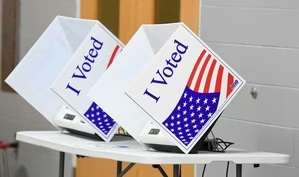
Ex-election commissioner on Trump's effort to control voting
Video has Closed Captions
Ousted Election Assistance Commission chair on Trump's effort to control voting (6m 33s)
Inflation eased in June, but U.S. still faces high prices
Video has Closed Captions
Inflation eased in June, but Americans still feel pressure from high prices (5m 30s)

Mideast experts assess escalation in U.S.-Iran conflict
Video has Closed Captions
Middle East experts assess latest escalation in U.S.-Iran conflict (7m 42s)
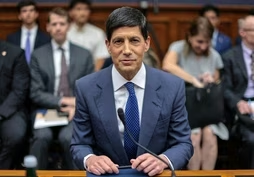
News Wrap: Warsh says inflation will be 'thing of the past'
Video has Closed Captions
News Wrap: Fed Chair Warsh pledges inflation will be 'thing of the past' (5m 34s)
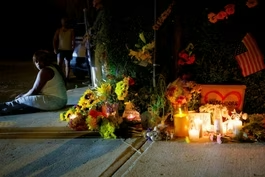
Sen. King: Locals need role in ICE shooting investigation
Video has Closed Captions
Maine Sen. King says feds lack credibility, locals need role in ICE shooting investigation (8m 10s)
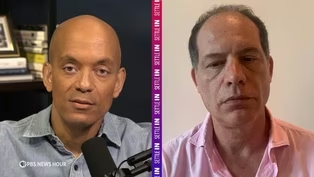
Simon Kuper joins Geoff Bennett on 'Settle In'
Video has Closed Captions
Simon Kuper and Geoff Bennett discuss the World Cup on 'Settle In' (3m 51s)
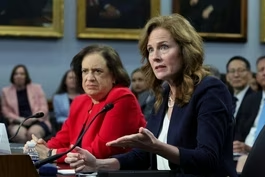
Supreme Court justices make case for more security funding
Video has Closed Captions
Supreme Court justices make case for more security funding (3m 56s)
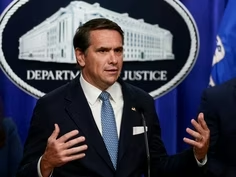
The unconventional career of AG nominee Todd Blanche
Video has Closed Captions
The unconventional career of attorney general nominee Todd Blanche (7m 43s)
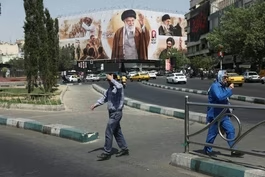
U.S. launches more strikes as Iran hits Gulf allies
Video has Closed Captions
U.S. launches more strikes, tightens naval blockade as Iran hits Gulf allies (3m 15s)
Providing Support for PBS.org
Learn Moreabout PBS online sponsorship New Episode
- News and Public Affairs

Today's top journalists discuss Washington's current political events and public affairs.

- News and Public Affairs

FRONTLINE is investigative journalism that questions, explains and changes our world.


 New Episode
 New Episode
 New Episode
 New Episode
 New Episode
 New Episode

Support for PBS provided by:
Major corporate funding for the PBS News Hour is provided by BDO, BNSF, Consumer Cellular, American Cruise Lines, and Raymond James. Funding for the PBS NewsHour Weekend is provided by...