
Former U.S. officials on chances Iran ceasefire can hold
Clip: 4/8/2026 | 7m 29sVideo has Closed Captions
Former U.S. officials analyze chances fragile Iran ceasefire can hold
For additional perspective on the ceasefire in Iran and the latest developments, Geoff Bennett spoke with Barbara Leaf and Michael Doran. Leaf was assistant secretary of state for Near Eastern Affairs during the Biden administration. Doran was senior director for the Middle East on the National Security Council during the George W. Bush administration.
Problems playing video? | Closed Captioning Feedback
Problems playing video? | Closed Captioning Feedback
Major corporate funding for the PBS News Hour is provided by BDO, BNSF, Consumer Cellular, American Cruise Lines, and Raymond James. Funding for the PBS NewsHour Weekend is provided by...
Former U.S. officials on chances Iran ceasefire can hold
Clip: 4/8/2026 | 7m 29sVideo has Closed Captions
For additional perspective on the ceasefire in Iran and the latest developments, Geoff Bennett spoke with Barbara Leaf and Michael Doran. Leaf was assistant secretary of state for Near Eastern Affairs during the Biden administration. Doran was senior director for the Middle East on the National Security Council during the George W. Bush administration.
Problems playing video? | Closed Captioning Feedback
How to Watch PBS News Hour
PBS News Hour is available to stream on pbs.org and the free PBS App, available on iPhone, Apple TV, Android TV, Android smartphones, Amazon Fire TV, Amazon Fire Tablet, Roku, Samsung Smart TV, and Vizio.
Providing Support for PBS.org
Learn Moreabout PBS online sponsorshipGEOFF BENNETT: And now for additional perspective on the cease-fire and today's developments, we get two views.
Barbara Leaf was U.S.
ambassador to the United Arab Emirates and was the assistant secretary of state for Near Eastern affairs during the Biden administration.
She's now a distinguished diplomatic fellow at the Middle East Institute.
That's a think tank in Washington, D.C.
And Michael Doran was senior director for the Middle East on the National Security Council during the George W. Bush administration and is now a senior fellow at the D.C.-based Hudson Institute.
With a welcome to you both, Barbara, we will start with you.
How confident are you that this cease-fire, such as it is, this fragile truce, can hold?
BARBARA LEAF, Former U.S.
Assistant Secretary of State: I'm very worried.
I think a lot of people are worried, above all, the folks in the Gulf.
I spoke to several senior Gulf officials today.
They all termed the arrangements as fragile.
One said it was less a cease-fire than it was a fragile truce, but that the prospect of escalation was clearly there.
It did give time, which was good.
But another official worried about the fact that this dispute over whether Lebanon was in or out of the agreement was clearly a point of volatility.
GEOFF BENNETT: What about that, Michael?
The fact that the U.S.
and Iran, the negotiations are so far apart, what are the prospects that they can come together?
MICHAEL DORAN, Former National Security Council Staffer: It really depends on how much the Iranians are hurting and how badly they want this deal, I think.
And it's really, really hard to know.
They're clearly trying to pull Lebanon into the deal.
And perhaps that's one of the reasons why they aren't letting ships travel freely through the strait.
Maybe it's part of the reason why they continued to hit the Gulf states today.
We're going to have to see how it goes.
It might just be that this is the messy end to this part of the conflict.
I mean, cease-fires are often messy, but we're going to have to wait and see.
GEOFF BENNETT: The president, Barbara, suggested that Iran has capitulated.
Do you see any evidence of that?
BARBARA LEAF: Not so far.
Not so far.
I think they are getting ready to see what they can get at the table, but they clearly believe they have two really profoundly important pieces of leverage, one, the capacity, still resilient capacity, and will to impose really huge costs on the Gulf in terms of the energy infrastructure and critical infrastructure.
But, more importantly, they have a hold on the global economy's throat through the Strait of Hormuz.
So that is a huge piece of leverage.
GEOFF BENNETT: How do you see it?
MICHAEL DORAN: I think they do have those points of leverage, for sure.
We didn't destroy their - - all of their missiles and drones, and they have this muscle that they can use, but they're hurting very, very badly.
They have -- you have seen their senior leadership has been destroyed.
Some of their repressive apparatus has been destroyed.
Their defense industrial base has been set back.
And think about the situation they were in just before the war began.
Their economy is a completely -- complete basket case.
Their currency is worth nothing.
They're in really horrible shape.
GEOFF BENNETT: Let's talk a bit more about the strait, because President Trump today proposed this idea of a joint venture between the U.S.
and Iran that would charge ships passing through this key trade corridor.
What do you make of the suggestion that the U.S.
and Iran could somehow jointly manage the Strait of Hormuz?
BARBARA LEAF: Well, I was gobsmacked.
I didn't know what to make of it.
And I hardly think that was a reassuring proposition to, again, the Gulf countries or to others who -- around the globe who really depend on that to be an open waterway for the free flow of commerce.
So that is not status quo ante.
And that would suggest something that will be even harder, if anything, to arrange.
GEOFF BENNETT: This idea that Iran is weakened but still dangerous, what does that mean for stability in the months ahead?
MICHAEL DORAN: It's going to be very, very fragile, the whole situation.
But it really does come down to what the new leadership in Iran wants.
There's clearly a current of opinion -- you heard it in the statements of President Pezeshkian -- to go a different way, less support for proxies, some kind of agreement with the United States over the nuclear program.
But the guys who are in control of the missiles don't have that point of view.
We have to see once the dust settles here a little bit if that other opinion that we're hearing through President Pezeshkian can actually have some opinion -- some influence on the IRGC.
GEOFF BENNETT: Yes.
What's your assessment?
BARBARA LEAF: Well, I think the sad truth is that there has not been regime change as such.
There has been a transition in the regime, but it has meant that the IRGC has captured the heights of power, of every element of power.
The supreme leader is visible only through statements.
But in any case, doubtful that he will be less hard-line than his father.
He won't be as powerful as his father was at the end of his life.
And so, as Mike said, it's a very -- it's an opaque system.
It's very difficult to measure where it's going to come out.
I, frankly, believe though, that the true test that will test the regime is not so much what the U.S.
and the Israeli militaries are doing, as brutal a campaign as it's been for the regime, but rather, when the guns fall silent and they have to face their own people and they have to face a shattered economy.
And that's where getting the Strait of Hormuz out of their hands again is so critical, because, otherwise, they have a huge volume of money coming in to fill their coffers.
GEOFF BENNETT: Stepping back, in your view, is the U.S.
better off today after striking Iran?
MICHAEL DORAN: Absolutely.
They were -- the administration faced and the Israelis faced an Iran that was building up a massive stockpile of missiles.
And that was going to protect their nuclear program.
And we can see how serious this -- these weapons are.
They have hit some of our most important radar systems in the Middle East.
They have wreaked havoc with our allies.
It's not easy to eradicate it.
And if we sat back and let them build up a bigger and bigger stockpile, we'd be in a much worse situation than we are now.
GEOFF BENNETT: How do you see it?
BARBARA LEAF: So it really fundamentally depends on what we're able to get for these post-conflict arrangements.
The damage that Mike laid out is truly epic, but it is transient.
What has been destroyed can be rebuilt, especially if they have revenues coming in from their oil and the Strait of Hormuz.
So that all depends.
Whether we're better off or not is really fundamentally driven by what we can arrange at the negotiating table.
And that will take also something that the administration is not fond of doing, but really creating a multilateral coalition, not so much for securing the strait, although there may be a role for that, but rather for the collaborative political pressure on the regime.
GEOFF BENNETT: Barbara Leaf, Michael Doran, thank you so much for your insights.
BARBARA LEAF: Thank you.
GEOFF BENNETT: Deeply appreciate it.
 New
NewA Brief But Spectacular take on how life is a play
Video has Closed Captions
A Brief But Spectacular take on how life is a play (3m 14s)
 New
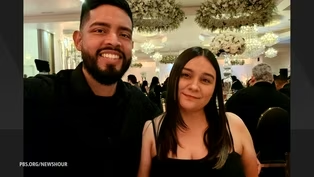
NewICE detains DACA recipient delivering milk to premature baby
Video has Closed Captions
DACA recipient detained by ICE while delivering milk to premature daughter in NICU (7m 10s)
 New
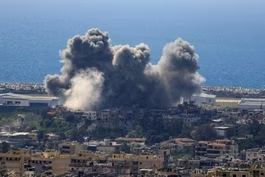
NewIsrael strikes Lebanon without warning, more than 200 dead
Video has Closed Captions
Israel strikes Lebanon without warning, hours after Iran ceasefire announced (4m 54s)
 New
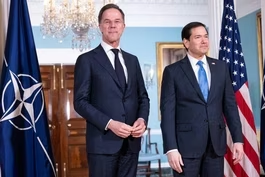
NewNews Wrap: NATO chief meets with Trump amid tensions
Video has Closed Captions
News Wrap: NATO chief meets with Trump in bid to ease tensions (5m 26s)
 New
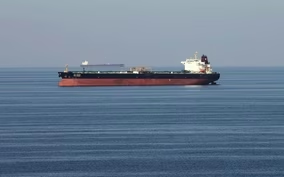
NewOil infrastructure recovery will take months, expert warns
Video has Closed Captions
Expert warns Middle East energy infrastructure will take months to recover (6m 41s)
 New
NewPortland's $1.6B climate fund sparks spending debate
Video has Closed Captions
America’s first billion-dollar climate fund sparks spending debate in Portland (8m)
 New
NewTrump says Israeli strikes on Lebanon a 'separate skirmish'
Video has Closed Captions
Trump says Israeli strikes on Lebanon a 'separate skirmish' not part of Iran ceasefire (2m 58s)
 New
NewU.S.-Iran ceasefire tested by Strait of Hormuz chokehold
Video has Closed Captions
U.S.-Iran ceasefire tested by Strait of Hormuz tension and Israel’s war in Lebanon (6m 23s)
Providing Support for PBS.org
Learn Moreabout PBS online sponsorship
- News and Public Affairs

FRONTLINE is investigative journalism that questions, explains and changes our world.

- News and Public Affairs

Amanpour and Company features conversations with leaders and decision makers.
Urban Consulate Presents











Support for PBS provided by:
Major corporate funding for the PBS News Hour is provided by BDO, BNSF, Consumer Cellular, American Cruise Lines, and Raymond James. Funding for the PBS NewsHour Weekend is provided by...