
February 27, 2026 - PBS News Hour full episode
2/27/2026 | 57m 46sVideo has Closed Captions
February 27, 2026 - PBS News Hour full episode
February 27, 2026 - PBS News Hour full episode
Problems playing video? | Closed Captioning Feedback
Problems playing video? | Closed Captioning Feedback
Major corporate funding for the PBS News Hour is provided by BDO, BNSF, Consumer Cellular, American Cruise Lines, and Raymond James. Funding for the PBS NewsHour Weekend is provided by...
Support provided by:

February 27, 2026 - PBS News Hour full episode
2/27/2026 | 57m 46sVideo has Closed Captions
February 27, 2026 - PBS News Hour full episode
Problems playing video? | Closed Captioning Feedback
How to Watch PBS News Hour
PBS News Hour is available to stream on pbs.org and the free PBS App, available on iPhone, Apple TV, Android TV, Android smartphones, Amazon Fire TV, Amazon Fire Tablet, Roku, Samsung Smart TV, and Vizio.
Providing Support for PBS.org
Learn Moreabout PBS online sponsorshipGEOFF BENNETT: Good evening.
I'm# Geoff Bennett.
Amna Nawaz is away.
On the "NewsHour" tonight: movement on# a crucial sticking point, whether Iran## should be allowed to enrich uranium.
The# latest on the nuclear talks with the U.S.,## as the two countries teeter on the brink of war.
Former President Bill Clinton testifies# before a GOP-led congressional committee,## saying he had no knowledge# of Jeffrey Epstein's crimes.
And with a growing number of people# detained in the Trump immigration crackdown,## the Trump administration looks to an# unexpected place to house them, warehouses.
DOUGLAS MACMILLAN, The Washington# Post: These places were built to## hold goods and ship goods.
They were not# meant to hold human beings.
So there's## a pretty significant renovation# process that has to go under way.
(BREAK) GEOFF BENNETT:## Welcome to the "News Hour."
President Trump said today he was unhappy# with the progress of d.. and suggested he may, as he put it, have to# use the military.
That came in contrast to## a statement from the mediator of the talks, who# said they're making progress.
And's as the U.S.## has deployed the largest military presence# in the Middle East in more than two decades.
Here's Nick Schifrin.
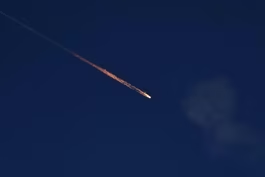
NICK SCHIFRIN: Today, as the U.S.# prepares for the prospect of war,## President Trump did not hide his# disappointment in U.S.-Iran nuclear talks.
DONALD TRUMP, President of the# United States: We're not happy## with the negotiation.
Th.. we're not going to have a nuclear# weapon.
They have to say, we're## not going to have a nuclear weapon.# And they just can't quite get there.
NICK SCHIFRIN: And President# Trump stuck to his demand that## Iran not be allowed to create any nuclear fuel.
DONALD TRUMP: They want to enrich a# little bit.
You don't have to enrich## when you have that much oil.
So,# I'm not happy with the negotiation.
NICK SCHIFRIN: The man in the# middle of that negotiation,## mediating between Americans and Iranians, has been# Omani Foreign Minister Badr bin Hamad Al Busaidi.
Today, he met with Vice President J.D.# Vance and other U.S.
officials and## afterward told CBS' Margaret Brennan# the talks were making progress.
BADR BIN HAMAD AL BUSAIDI, Omani Foreign# Minister: So there would be zero accumulation,## zero stockpiling, and full verification.
NICK SCHIFRIN: That suggests Iran has# agreed not to store any nuclear fuel,## but not necessarily to stop enriching entirely.
Al Busaidi also said that, for the first time,## Iran would agree to Americans# verifying Iran's nuclear program.
BADR BIN HAMAD AL BUSAIDI:# If I was President Trump,## my only advice is just to give those# negotiators enough room and enough space## to really close these remaining areas# that we need to discuss and agree upon.
MARGARET BRENNAN, Host, "Face the# Nation": And if Israel carries out## a strike, or if the U.S.
carries out even# a limited strike on the ball.. do you think that you could# still get a nuclear deal done?
BADR BIN HAMAD AL BUSAIDI: Well,## diplomacy can reach a deal.
I don't think any# othe.. NICK SCHIFRIN: But the momentum# appears to be toward a strike.## White House senior adviser Dan# Scavino posted on social media a## row of B-2 bombers, the same plane# used in last summer's Iran strikes.
And, overnight, also precautions for possible# war.
The U.S.
Embassy in Israel told its staff## to consider leaving the country immediately.
U.S.# Ambassador Mike Huckabee wrote an internal e-mail## obtained by the Associated Press that said there# was no need for panic, but -- quote -- "Those## wishing to take authorized departure should do# so TODAY," "today" written in capital letters.
And the U.S.
official confirms to "PBS News# Hour" the military's top Middle East commander,## Admiral Brad Cooper, briefed President# Trump yesterday on options for a strike.
There are negotiations scheduled for# next week after yesterday's meeting in## Geneva.
Iran says technical# talks are supposed to begin## Monday.
But the U.S.
has assembled what# President Trump has called an armada,## the largest deployment of warships and# aircraft in the Middle East in decades.## And despite the mediator claiming progress,# the U.S.
has set the theater for an attack.
For the "PBS News Hour," I'm Nick Schifrin.
GEOFF BENNETT:## Bill Clinton became the first former president# compelled to testify to members of Congress## today.
At a closed-door session in Chappaqua,# New York, the House Oversight Committee heard## from Clinton about his connections to the# late convicted sex offender Jeffrey Epstein.
Mr.
Clinton said he did nothing wrong, adding --# quote -- "I saw nothing that ever gave me pause."
Republican Chairman James Comer# spoke late this afternoon.
REP.
JAMES COMER (R-KY): I will have to say that# President Clinton answered every question or## attempted to answer every question.
Now, we can# talk about some of his answers in more detail.## And I'm sure once the video is released to the# transcript is released, not only will you, but a## lot of people in America will have more questions# about some of the answers that were given.
GEOFF BENNETT: The former president's testimony# comes a day after the committee questioned## his wife, former U.S.
Secretary of State# Hillary Clinton, for more than six hours.
She said she had no new information# about Epstein and had never met him.
Joining us now is our congressional# correspondent, Lisa Desjardins.
So, Lisa, what did President Clinton# say today behind closed doors?
LISA DESJARDINS: This was extraordinary.
The# former president testified for nearly seven hours.## He did say, as you indicated,# that he knew of no wrongdoing.
And specifically, in his opening statement, I# want to read another quote that he had.
He wrote:## "Not only would I have not flown on# Epstein's plane if I had known any## inkling of what he was doing.
I# would have turned him in myself."
Now, photos in the Epstein files, though,# show some of the relationship between the## two men.
Clinton flew on Epstein's plane# roughly two dozen times.
That was part## of the work for the Clinton Foundation that he# was doing after leaving the Republican office.
Now, Democrats on the committee both defended the# former president, but also sharply questioned him.
REP.
MELANIE STANSBURY (D-NM): President Clinton,# as of today, has not been accused of a crime.## There are not public files available that accuse# him of a crime, whereas there are publicly## available documents that do allege a crime of# President Trump.
But it is very well-established## that President Clinton had a relationship# with Jeffrey Epstein and Ghislaine Maxwell.
LISA DESJARDINS: We will return# to the Trump question in a minute.
But one other thing that Republicans said today# was that they're investigating whether Epstein was## part of some foreign intelligence operation# targeting some public officials in America.
GEOFF BENNETT: So what is known about# Clinton's relationship with Epstein?
LISA DESJARDINS: Right.
Now, this is something that's importan.. had a brief acquaintance with Epstein.
But we know# that they knew each other at least 10 years, going## back to when President Clinton was in office in# 1993.
Ghislaine Maxwell said she introduced them.
There was something transactional.# President Clinton, with his foundation,## needed wealthy donors.
He also# needed a way to travel around the## world.
Epstein and his plane provided# some of those things.
But it wasn't## all business.
There are photos in the# Epstein files that show, for example,## President Clinton in a hot tub with a woman whose# face has been Blacked out to keep her anonymous.
Clinton did also write a note in that infamous# 2003 birthday book for Epstein talking about## friendship in that.
And to this idea that# Clinton never had any inkling that there## was anything wrong, the actor Kevin# Spacey was on one of those flights,## on several flights in Africa# with Epstein and Clinton.
And he said in an interview a few years ago that# he saw young girls on those planes with Clinton## and Epstein, and he was worried about the public# risk for Clinton.
Clinton says he never saw that.
GEOFF BENNETT: On the politics of this, you have# the Republicans who lead this committee trying to,## in some way, make the Clintons the face# of this.
You also have Democrats now## trying to subpoena President Trump,# which would be unprecedented.
LISA DESJARDINS: Right.
There are civil court examples where Clinto.. as president or as former presidents.
But# the subpoena aspect of this is interesting## if President Trump is subpoenaed.
Really,# it could be a constitutional question.
But there's more to it now, because# Republicans are not even asking President## Trump to testify.
We know that he had a long# association with Epstein.
And whether he did## wrongdoing or not -- the Republicans# say no -- they're not saying Clinton## had any accusations of wrongdoing.# They just want to answer questions.
There are questions about why Republicans# still refuse to call President Trump.
GEOFF BENNETT: Any other officials# who could be forced to testify?
LISA DESJARDINS: Yes, Commerce Secretary Howard## Lutnick.
He is a billionaire who had a lot# of association with Epstein... he told Congress that he was mistaken# in at one point saying he didn't speak## to Epstein after his arrest.
And, in fact, we# know that he saw him in 2012 on his island.
So there are questions from Congress about him,# and it does look like he could be subpoenaed.
GEOFF BENNETT: Lots of questions, lots to track.
Lisa Desjardins, always on top# of all of it, thanks so much.
LISA DESJARDINS: You're welcome.
GEOFF BENNETT:## In the day's other headlines: Pakistan's defense# minister says his country is engaged in an open## war with Afghanistan after the neighboring# countries exchanged attacks last night.
Pakistan accused the Taliban government in# Afghanistan of harboring militant groups,## which it says launched strikes# across the border in Pakistan.## For its part, Afghanistan denies# enabling terrorism and says Pakistan## broke a previous cease-fire agreement# the two sides reached back in October.
ZABIHULLAH MUJAHID, Taliban Spokesman (through# translator): Whenever aggression has occurred## against Afghanistan, the Islamic emirate has# always tried to resolve the issue through## dialogue and mutual understanding.
However,# each time, the aggression has persisted.
GEOFF BENNETT: In Pakistan's# largest city, Karachi,## residents there voiced support for the strikes.
AKHTAR SHAHEEN, Karachi, Pakistan, Resident# (through translator): The point is,## when faced with aggression, you have to respon.. Pakistan is a sovereign state.
And# our nation expects us to defend it.
GEOFF BENNETT: Tensions between# the two sides have been boiling## for months after border clashes in October.
Israel's high court ruled that aid groups# can continue operating in the Gaza Strip.## The ruling reverses an earlier# government decision that barred the## groups for refusing to comply with new# Israeli rules.
It comes as five people## were killed in Israeli drone strikes on# two separate police checkpoints today.
Israel says they were in response to a violation## of the fragile cease-fire by Hamas.
At a# funeral today for some of those killed,## family members said that the truce# has done little to stop the violence.
AHMED GOUDA, Relative of Palestinian# Killed (through translator):## Those three dead are among a number that continues# to rise every day.
As Israel.. they have not stopped since the# signing of the truce agreement.
GEOFF BENNETT: Meantime, some Palestinians from# the West Bank were denied entry into Jerusalem## for the second Friday of Ramadan prayers.# Israeli authorities had said they would## only allow up to 10,000 Palestinian worshipers# and they'd tighten security across the city.
Defense Secretary Pete Hegseth# says that Scouting America will## change several policies to# maintain Pentagon support,## including one targeting transgender youth.
The# Texas-based organization is keeping its new name,## rather than returning to Boy Scouts, and it will# continue its service for some 200,000 girls.
But in a video posted to social media,# Hegseth said the group will require its## members to use their -- quote -- "biological# sex at birth and not gender identity" and## that the Pentagon will end its support of# the organization if it fails to comply.
PETE HEGSETH, U.S.
Defense Secretary: These# and other changes that Scouting America's## leadership committed to will hopefully result in# a rededication to the foundational ideals that## have defined scouting for generations,duty to God# and country, leadership, character and service.
GEOFF BENNETT: Meantime, in Kansas today, two# transgender men are suing the state over a new## law that requires that gender markers on a# driver's license or birth certificate match## a person's sex at birth.
The Kansas law# is the first such measure in the nation.
Democratic lawmakers say they are stunned# and deeply alarmed following yet another## instance of a laser being used to shoot down a# drone near the U.S.-Mexico border.
It happened## yesterday near Fort Hancock in West Texas.
The# drone belonged to Customs and Border Protection,## and the incident prompted the FAA# to temporarily suspend flights.
In a joint statement, the agencies# and the Pentagon described the drone## as a -- quote -- "seemingly threatening# unmanned aerial system operating within## military airspace."
It follows a# similar incident earlier this month## that grounded commercial flights# in nearby El Paso for a few hours.
NASA's plan to send astronauts back to the# moon is getting a revamp.
The agency says## it's adding an extra practice mission# to its Artemis flight lineup next year,## with the goal of one or even two# lunar landings in 2028.
The shakeup## comes just days after NASA's Artemis II moon# rocket returned to its hangar for repairs.
JARED ISAACMAN, NASA Administrator: We# shouldn't be comfortable with the current## cadence.
We should be getting back to# basics and doing what we know works.
GEOFF BENNETT: NASA Administrator Jared Isaacman# said the new plan will inject momentum into the## program by reducing yearslong gaps in between# flights.
In that way, it will be similar to NASA's## fast-paced Apollo program, the first that brought# humans to the moon more than a half-century ago.
The financial technology company Block is# cutting 4,000 of its 10,000 employees as it## embraces the use of artificial intelligence.
The# 40 percent cut is one of the most dramatic steps## taken by a tech company directly because of# the use of A.I.
Investors welcomed the news,## though, with Block's shares# ending nearly 17 percent higher.
Elsewhere, on Wall Street today,# stocks slumped amid worries about A.I.,## inflation and a possible war with Iran.
The# Dow Jones industrial average fell more than## 500 points.
The Nasdaq dropped more than 200# points.
The S&P 500 also ended the week lower.
And there was an unusual scene at Washington's# Reagan National Airport today, as a former U.S.## president joined with his fellow travelers in# waiting out a flight delay.
Joe Biden's Secret## Service detail gave him away as people lined up# to take pictures with the nation's 46th president.
Mr.
Biden was flying to South Carolina for an# event.
The flight was delayed by fog.
Once on## board, the former president greeted his# fellow passengers as they filed past.
His## seatmate only realized who he was when she sat# down.
She told a reporter she felt like she was## about to cry as she shook hands with the former# president.
The two chatted throughout the flight.
And we have a passing of note from the world of# music.
Singer-songwriter Neil Sedaka has died.## Known for his hits, including "Breaking# Up Is Hard to Do," "Calendar Girl," and## "Oh!
Carol," Sedaka's work was a staple# of radio stations in the '60s and '70s.
A Brooklyn native, Sedaka initially pursued# classical music, but as a teenager fell in love## with the pop songs of the era.
He went on to forge# a six-decade career in the business, racking up## hits and five Grammy nominations.
Luminaries like# Elvis Presley, Frank Sinatra covered his work, And Sedaka continued performing# well into his 80s.
His family## said they are devastated by his sudden# passing.
Neil Sedaka was 86 years old.
Still to come on the "News Hour": Paramount# outbids Netflix, paving the way to take over## the Warner Bros.
media giant; a leading# A.I.
firm pushes back on the Pentagon,## why the tech company refuses# to remove safety guardrails;## and David Brooks and Jonathan Capehart# weigh in on the week's political headlines.
The standoff between the artificial# intelligence firm Anthropic and the U.S.## government escalated sharply today.
President# Trump lashed out at the company's leadership## and directed all federal agencies to# stop using Anthropic's products.
And## the Pentagon designated the company a# supply chain risk to national security.
William Brangham joins us# now with more -- William.
WILLIAM BRANGHAM: That's right, Geoff.
Anthropic had long said that it didn't want the# U.S.
military usin.. fully autonomous weapons systems or for any mass# surveillance of American citizens.
Negotiations## were ongoing this week, but the president's# order seems to have brought them to an end.
The Pentagon's designation would bar# any company that does business with## the Department of War from doing any# commercial business with Anthropic.
For more on what this could mean, we are# joined by the University of Pennsylvania's## Michael Horowitz.
He previously# worked in the Defense Department,## where he wrote the Pentagon's policy on# artificial intelligence weapons systems.
Michael Horowitz, so good to have you here.
I wonder if you could just give me your first --# your reaction to this, to the president saying,## we are wiping Anthropic completely out# of the federal government and that any## Pentagon contractor that also has dealings# with Anthropic has to stop those as well.
MICHAEL HOROWITZ, Former Defense# Department Official: What a day.
I think that the -- my initial thought, frankly,# .. seemed like a needless dispute between Anthropic# and the Pentagon has hit crisis proportions.
I say needless dispute because Anthropic# was the first of the frontier A.I.
labs## willing to work with the Defense --# willing to work with the Pentagon in## a classified environment.
And all of# the projects that the Pentagon has## asked the Anthropic to work in,# Anthropic was happy to work on.
This was a theoretical dispute about future# possibilities that between -- between Anthropic## and the Pentagon that has now really escalated.# The president's order, in combination with the## order from Secretary Hegseth, could not just# be devastating to the Pentagon's ability to## use Anthropic's technology, but could be# devastating to Anthropic's core business,## depending on how it's interpreted by the# markets and whether Anthropic is able to## get -- I'm not a lawyer, but Anthropic is able# to get a stay of the supply chain designation.
WILLIAM BRANGHAM: What does this do to# America's ability to keep up a robust defense?
I mean, Anthropic was already being# used in many parts of the Pentagon,## according to reports.
So, now# if the president is saying,## get it all out of there, what does that# do to our ability to maintain a defense?
MICHAEL HOROWITZ: Anthropic's technology# wasn't just being used in parts of the## Pentagon.
It was being used in other# parts of the government as well.
So this could be pretty devastating in some ways.## The only thing that mediates that is the# six-month time period that appears both## in the president's announcement and in the# supply chain designation by Secretary Hegseth.
If you wanted to be an optimist about the# chances that the two sides will come to a deal,## the optimistic read would be, in some ways,## this sets a six-month clock for negotiations# between Anthropic and the government.
But## that -- you have got to squint real hard# in some ways to see that optimistic read.
And the winner, in some ways, if Anthropic# and the Pentagon can't make it work, frankly,## is China, because the -- in a world where there's# been intense A.I.
competition between the United## States and China, and that includes the military# realm, it should be all hands on deck for the## American frontier A.I.
labs to work with the# Pentagon to improve American national defense.
And Anthropic's have been willing to do# that.
Over a six-to nine-month period,## then you would imagine some of the other# A.I.
labs will try to cycle in and pick## up some of that business if nothing can# be done.
Note that Elon Musk's xAI has## already stepped up to the plate and# said last week that they were willing## to now work in the classified environment# with the Pentagon on defense challenges.
WILLIAM BRANGHAM: That's right.# It's hard to imagine that there's## not a whole slew of other companies# willing to step into the breach there.
I want to ask you about this request, though,# that Anthropic was making.
They were saying,## we're happy for you to use our product,# except in these two instances.
And I wonder## what you make of that request.
It's hard# to think of another defense contractor,## a Northrop Grumman, saying, we will sell you# jets, but you can only use them in certain ways.
MICHAEL HOROWITZ: Absolutely.
I mean, this was what really escalated the# dispute .. was Anthropic's insistence that their technology# not be used for mass surveillance or autonomous## weapon systems, although, to be clear,# this did not bother the Pentagon when## Anthropic -- when they signed the original# contract with Anthropic less than a year ago.
This is something that really escalated# after Anthropic asked Palantir,## actually another leading technology company,# about whether Anthropic's technology was used## in the Maduro raid in January, where some -- where# Palantir's Maven Smart System technology was used,## and that platform incorporates# some of Anthropic's technology.
And so we were off to the races from there.
In# some ways, this is a dispute about personalities## and about the role of government masquerading as# a policy dispute, because, in a normal atmosphere,## Anthropic would decide they want to# work on some issues for the Pentagon,## but not other issues, and the Pentagon# would hire Anthropic to work on some things,## but not other things.
It would find other vendors.
But this escalated to the point where the# department was threatening to either compel## them with the Defense Production Act or# impose that supply chain designation.
WILLIAM BRANGHAM: As you said, what a day.
Michael Horowitz from the University of# Pennsylvania, thank you so muc.. MICHAEL HOROWITZ: Thanks for having me.
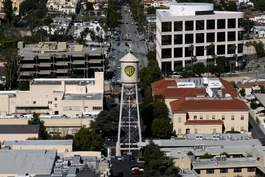
GEOFF BENNETT:## Paramount and Warner Bros.
Discovery reportedly# signed an agreement today on a $110 billion deal,## a merger that will make Paramount one of# the largest media empires in the world.
It happened after a dramatic turn of events and# after Netflix walked away from its proposal to buy## out Warner Bros.
Paramount could now control two# key movie studios, multiple streaming platforms,## major intellectual property brands,# along with television and cable channels,## and two of the biggest news operations# on television.
That's CBS and CNN.
But this isn't a done deal yet, as it's now under# investigation and awaiting regulatory approval.
For more on all of this, we're joined now by Roben# Farzad, host of public radio's "Full Disclosure."
It's always great to see you, Roben.
ROBEN FARZAD, Host, "Full# Disclosure": Thank you, Geoff.
GEOFF BENNETT: So we will ge.. but on the specifics of the deal itself,# when Netflix said that this offer was no## longer attractive, what was that really# about?
Was it just about the price or## deeper concerns about taking on Warner# Bros.'
debt and its market exposure?
ROBEN FARZAD: I think Netflix got every# signal from this White House and the FCC## and Donald Trump being explicit in# both with background persuasion that## by far he prefers Paramount and# the Ellisons taking this over.
He's obviously cast aspersions on CNN,# which is a small part of the economics of## the broader Warner Bros.
Discovery franchise,# but it's a lightning rod for him.
And he'd## like to see CNN under new ownership, ideally# friendly to the persuasions of Donald Trump.
GEOFF BENNETT: So this wasn't# about the offer price.
It was## about Trump putting his thumb on a scale.
ROBEN FARZAD: Yes, because Netflix# has so much money.
And, by the way,## this ceased to be uneconomic a# while ago, like a bidding war.
And it's happened in the history of LBOs and# massive mergers and acquisitions.
Indeed,## Warner Bros.
Discovery itself is like -- they say## there's something about Mary.# There's something about Warner.
For 25, 26 years, everybody has been mega-merging,# acquiring, stripping, flipping it off to other## people.
It was AOL.
It was AT&T.
It was AT&T,# this Discovery disaster, and now it's being## sold off to another multibillionaire.
It's# been certainly an ill-starred asset to own.
GEOFF BENNETT: So what does# Paramount get by acquiring it?
ROBEN FARZAD: You get this Holy# Grail of a mega streaming app,## right?
Paramount+ or whatever it# is, and it's predecessors' app,## Showtime and the other things, they're# known as the kind of the third-tier apps.
But if you smash HBO Max or whatever# they're going to call it into this,## think about "Game of Thrones," "Sex and the# city," "The Sopranos," that superior I.P.,## you suddenly have a value proposition vis-a-vis# a Netflix or an Amazon or an Apple to say, hey,## we're big players, we deserve your 25 or 30 bucks# a month.
You should cancel the other players.
So this is something that Disney is# currently duking out.
It had acquired## massive FOX assets.
Amazon and Apple obviously# have unlimited amounts to play in this, Google,## which owns YouTube.
It's a whole different# Hollywood than it was just even 10 years ago.
GEOFF BENNETT: The Ellisons' close# proximity to President Trump drawing## scrutiny, could that relationship# shape the regulatory process?
ROBEN FARZAD: I think it could, in that every# indication has been that it's going to get## smooth sailing, right?
The FCC is OK with it.
You saw what the acquisition of Paramount and# maybe kind of the hush money paid out, what it## was for CBS News.
And there are potentially some# scalps that are going to have to be delivered in## this with CNN.
There's fear there.
Again, CNN by# itself is hugely profitable.
It's diminishing,## but its competitive bogey right now is The# New York Times.
It's not these other issues.
It's not this bottleneck of leadership# or ownership or big tech money coming in.## The bigger perception is that this was done for# political reasons, to fast-track the acquisition## of much more important and profitable# film and studio and streaming assets.
GEOFF BENNETT: And what does it mean that## one family potentially could own# so m.. ROBEN FARZAD: And to say nothing else of TikTok,## which Larry Ellison and# Oracle control 15 percent of.
GEOFF BENNETT: Right.
ROBEN FARZAD: We.. about Elon Musk coming in and making# an uneconomic acquisition of Twitter,## did it matter in the end?
Did it bankrupt him?# He might have a trillion-dollar SpaceX IPO.
Washington Post and Jeff Bezos, was $250 million# supposed to be meaningful to a person maybe worth## $200 billion?
He still gutted that.
It's# a really treacherous time.
As you see with## the stewardship of the Ellisons and CBS# News, they're willing to cut where others## didn't cut before.
And there's going to be# no shortage of debt and cost saving synergy## expenses in this and a tremendous amount# of fear and loathing in Hollywood, in CNN.
It's just been a pretty lost decade# for all of media and entertainment.
GEOFF BENNETT: Roben Farzad,# always good to speak with you.
ROBEN FARZAD: My pleasure.
GEOFF BENNETT:## For months now, ICE has been quietly buying# industrial warehouses around the country,## reportedly with plans to turn# them into a network of immigration## detention and processing centers to# hold tens of thousands of detainees.
Our White House correspondent, Liz Landers,# begins our coverage with a look into how the## national and at times local controversy is# playing out in one small Maryland community.
LIZ LANDERS: A national controversy lands on the## agenda of a small Maryland city during# an otherwise mundane weekly meeting.
The Hagerstown City Council and mayor# represent about 45,000 residents, but## the broader community is bracing for the arrival# of as many as 1,500 mostly undocumented migrants.
This huge warehouse right here was# recently purchased by Immigration and## Customs Enforcement as a detention facility.# This is more than 800,000 square feet, and,## if it opens, it could be one of the largest# detention facilities of its kind in the country.
During a couple of visits over a week, we saw# anti-ICE vandalism, but no visible signs of## ICE itself.
We ran into Doris Keil-Shamieh# and her husband, Greg, as we left the site.
DORIS KEIL-SHAMIEH, Maryland Resident: The# administration is ruining this country,## and it's tearing apart communities,## tearing apart communities that we need.
And# they're good people.
This has got to stop.
LIZ LANDERS: Locally, the facility# will be primarily regulated by the## Washington County Board of Commissioners.
MAN: All in favor by saying aye.
MAN: Aye.
(BOOING) LIZ LANDERS: Protesters interrupted# their meeting earlier this month## shortly after the board unanimously# agreed to a resolution welcoming ICE.
MAN: Nobody ever expected it# to become a place of residence.
LIZ LANDERS: We listened last week# as the city's utility director## briefed the council on its limited, but# critical role governing the facility.
WOMAN: Our authority starts# and stops with the water.
LIZ LANDERS: In the audience, community members on# both sides of the national and now local debate.
ARTHUR LARUE, Hagerstown, Maryland,# Resident: I don't think it's a good## thing for Hagerstown if we get .. JANE PAGE THOMPSON, Hagerstown,# Maryland, Resident: I think it's## a great thing.
Hag.. the income per person.
Having this# facility will do that with jobs.
LIZ LANDERS: If there are people that are# being held in this facility who haven't broken## the law other than being in this country# illegally, are you OK with that happening?
JANE PAGE THOMPSON: I am engaged to a man who was## a political refugee from Bolivia who was# naturalized as an American citizen.
So,## for me, it's really personal that# people come to this country legally.
ARTHUR LARUE: With the things I have heard that# are going on in some of the other ICE facilities,## I definitely don't want that in my community.# I'd love to see the city do everything they## can to fight this.
Given our council and# our mayor, I'm not sure that they will.
LIZ LANDERS: ICE already spent $102 million# purchasing the warehouse.
The Department of## Homeland Security responded to our questions# with a statement touting its economic benefits## and reading in part -- quote -- "These will be# very well-structured detention facilities meeting## our regular detention standards.
Sites will# undergo community impact studies and a rigorous## due diligence process to make sure there is no# hardship on local utilities or infrastructure."
BILL MCINTIRE, Mayor of Hagerstown,# Maryland: We know who bought it,## but we don't know what is# actually going to ha.. LIZ LANDERS: Bill McIntire, Hagerstown's# nonpartisan mayor, notes that, while the city## does have limited authority over water and the new# facility will almost certainly need to secure a## greater allowance, he's not eager to pick a fight# between his small town and a giant federal agency.
BILL MCINTIRE: We have never denied water to# anyone, so if you do deny this, does the federal## government look at this as a political move# and are we opening ourselves up to litigation?
LIZ LANDERS: Earlier this week, Maryland's# attorney general sued the Department of Homeland## Security and ICE, saying that the administration# failed to conduct an environmental review or seek## public input or provide explanation for# the purchase, which is required by law.
Joining us now is Douglas MacMillan,## a reporter for The Washington Post who's done# extensive reporting about these ICE facilities.
Thank you for joining us.
DOUGLAS MACMILLAN, The Washington# .. LIZ LANDERS: Let's start with# the .. Can you give us an idea of ICE's efforts to## create this system of detention# centers throughout the country?
DOUGLAS MACMILLAN: Yes, so they're# going all around the country.
We're seeing this happen all the way from# all the way up in New Jersey, New Hampshire,## all the way down to Orlando and Florida, all# the way out West.
They're trying to build## places in Kansas and Oklahoma.
This# is all over the country.
They're## focusing on warehouses they can find# a little bit outside of large towns.
So we're finding these about 45 minutes to an# hour outside of large city centers.
And they're## trying to fix these near logistics hubs, where# it's easy to move people in and out of the city.## So we think that they want to -- they# have -- ICE officials have stated that## their objective is to make the system of# detention and deportation more efficient.
And the current acting director of ICE, Todd# Lyons, has actually compared his aspiration## to Amazon's system of moving packages.
He said,## we want to be able to move humans around the# country as efficiently as Amazon ships packages.
LIZ LANDERS: What's the overall cost of this?
How## much is the Department of Homeland# Security and ICE spending on this?
DOUGLAS MACMILLAN: So they're# projecting to spend $38 billion.
That involves buying the warehouses.
Many of# them cost around $100 million.
That involves## significant upgrades in retrofitting these# warehouses to basically turn what are empty,## vacant shells of buildings into a# kind of functioning detention center## with housing units, recreation areas,# kitchens, outside basketball courts.
They want to kind of, like, build# these out and spending a lot up to## $150 million for a single facility in some cases.
LIZ LANDERS: Many of these warehouses are# currently just massive empty buildings.
We saw## this one in Hagerstown.
And, apparently, there are# four toilets in this huge 800,000-square-foot-plus## facility.
What is the process going to look# like for making these habitable for people?
DOUGLAS MACMILLAN: Yes, I mean, these# places were built to hold goods and ship## goods.
They were not meant to hold human# beings.
So there's a pretty significant## renovation process that has to go under# way.
And ICE wants it done really rapidly.
So it's going to be a challenge.
For one# example, a lot of these are distribution## centers built for a company like Amazon# where a lot of trucks would have been## pulling up to these large bay doors.# And so many of these facilities have## dozens of bay doors around the perimeter# of the building.
That's not a very secure## feature if you want a detention center to hold# people who are not going to be able to escape.
So one of the first things they might have# to do is brick up all those bay doors.## Another thing that a lot of these facilities# have that is going to be a challenge is that## they are built on a thick concrete slab,# which is going to make it extra hard to## install plumbing and to install wiring# and to install kind of the workings of a## building that you're going to need when you're# talking about holding thousands of people.
So it's going to be a pretty complex job.
LIZ LANDERS: What's your reporting on# the timeline that ICE has for this?## How long is it going to take them to# be able to convert these warehouses?
DOUGLAS MACMILLAN: So it's really rapid.# They want this whole system of up to## 24 facilities to be up and running# by the end of the year essentially.
And we have heard internally there's been# a lot of debate over that time frame and## that even some companies that they have# worked with for many years like GEO Group## and CoreCivic, who are the two largest# detention contractors in the country,## that they have been pushing back and saying# that this timeline is too aggressive.
LIZ LANDERS: The administration has found some# of these warehouses that they have purchased## in areas that are Republican communities.# What has been the reaction in those places?
DOUGLAS MACMILLAN: Yes, so I spent time in# one of these facilities down in Social Circle,## Georgia.
It's a small town# 45 minutes east of Atlanta.
It's projected to be one of the first# mega-detention centers.
Like, they're going## to turn one of these warehouses and turn it into# a detention center holding up to 8,500 people.## The people there were really worried and scared# and nervous about what this means for their town.
A lot of them say that they support the president# and they voted for the president, and they## generally agree with his immigration agenda and# they agree that illegal immigrants should be## locked up and deported from the country, but that# they don't think that this makes sense for them.
LIZ LANDERS: And, just quickly,## how has the administration ha.. DOUGLAS MACMILLAN: So, very# different.
In some places,## they have just been completely quiet and# they have gone about their business just## simply buying the facilities and moving# forward with their plans to put these up,## not really kind of being any mind, giving# any mind to the protests and the pushback.
In other places, it sounds -- it seems like they# have acquiesced and they have actually come to## the table.
We have seen a few examples now.# Just this week, Marsha Blackburn in Tennessee## announced that ICE was canceling its plans# to host a detention center in her state in## Tennessee.
We have seen similar announcements from# state leaders in New Hampshire and Mississippi.
So it looks like that some Republican# leaders who have juice with DHS are## striking deals to get these facilities# not in their areas.
But in other places,## including many Democrat-led areas, there# isn't kind of that ability and that the DHS## has not really come to the table and# meaningfully engaged with the local community.
LIZ LANDERS: Doug MacMillan, thank you# so much for sharing your reporting.
DOUGLAS MACMILLAN: Thanks for having me.
GEOFF BENNETT:## President Trump is visiting Texas today, where# three of his supporters are battling it out in## that state Senate primary election# set for next week.
That's as the## president also considers military# action in Iran.
Lots to discuss.
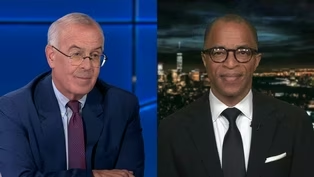
And we turn now to the analysis# of Brooks and Capehart.
That's## with "The Atlantic"'s David Brooks# and Jonathan Capehart of MS NOW.
It's good to see you both.
So, as we said, President Trump in Texas, where# three Republ.. Cornyn, they're locked in this competitive# GOP primary.
The president has yet to make## an endorsement.
The fact that he's inserting# himself early and forcefully in this race, does## that suggest that he's still the GOP kingmaker# or that he's trying to demonstrate that he is?
DAVID BROOKS: A little of both,# maybe a little more of the latter.
The Texas race to me is the most# interesting Senate race in both parties,## because it gets at the core debate right at the# middle of both parties.
On the Democratic side,## you have Jasmine Crockett, who's an aggressive,# progressive fighter.
And then you have James## Talarico, who is more moderate, is# trying to revive the religious left.
And so the argument on the Democratic side# is, do we want somebody who will just go to## the mat and take down these Republicans, or# do we want somebody who will be conciliatory## and win over people from the center?
And that# is the core debate in the Democratic Party.
On the Republican side, you have got Ken Paxton,# who has been scandal-plagued since nursery school.
(LAUGHTER) DAVID BROOKS: And he's -- and# then you have got John Cornyn,## who is not the most exciting bulb in the# Senate, but a standard-issue Republican.
And so the Paxton race in particular,# and he will probably come out first,## but not -- but force a run-off -- shows# that there's still some juice if he does## really well in MAGA.
If he doesn't do really# well, and if Wesley Hunt or Cornyn do well,## then that's a sign the Republican# Party is beginning to move on.
GEOFF BENNETT: So, Jonathan, what stands out# to you in the Crockett v. Talarico matchup?
JONATHAN CAPEHART: Well, look,# the one thing I will say is that,## no matter which candidate wins the Democratic# nomination, they will be infinitely better## than whomever the Republicans decide to# nominate.
So I will just put that out there.
But, in this race, the polls seem to be a# bit all over the place.
There was one poll## that came out from U.T.
Tyler that had# Congresswoman Crockett up by 12 points,## but the sample size is small.
And other# polls that I just took a look at have## state Representative Talarico up by single# digits, maybe six points, eight points.
I think both candidates are trying to win in two# different ways, but I think in two legitimate## ways.
Congresswoman Crockett, she is going for# disaffected voters, African American voters,## voters who may not have voted in previous# elections.
In a lot of ways, she's taking a page## out of Donald Trump's book, playbook, when he ran# in 2016, when he what I called fracking for votes.
He pulled people out who had not voted before.# That's who Congresswoman Crockett's trying to go## after.
But then state Representative Talarico,# he's going after more middle-of-the-road,## but really setting his sights on# disaffected Republican voters who## might not be too keen on what the president# is doing, and they might be gettable.
So, on Tuesday, I'm looking to# see which tactic actually won,## and whether they can win enough votes to# not be in a primary -- in a primary run-off.
GEOFF BENNETT: Well, let's shift our# focus back to this previous Tuesday,## the State of the Union address.
David, was there anything# in that speech that stands## out to you as meaningfully changing the# landscape or President Trump's standing?
DAVID BROOKS: Yes, I mean,# the question I'm asking is,## has Trump -- is he losing the country?# A lot of people have been waiting since## 2016 for him to lose the country.
But# there's clearly some sign of slippage.
My colleague Ross Douthat issued a# video at The New York Times saying## he's losing the country and conservatives# have to adjust.
Is he losing the country,## or is this just another wish fulfillment# for people who don't like him?
I think there's evidence that he is, that# if you look at particularly at independents,## they have swung sharply away from him.# And then if you look at Republicans,## does -- there's a Pew Research, does# he -- does Donald Trump respect the## country's democratic values?
The number of# Republicans who say that is down sharply.
Should Republican members of Congress# feel obligated to support Donald Trump?## Sixty-one percent of Republicans say they# do not have any responsibility to support## Donald Trump.
These are all changing# numbers.
And so clearly there's a sense,## whether it's Minnesota, whether it's just# general mishegoss, which is Yiddish for crazy.
(LAUGHTER) GEOFF BENNETT: I'm familiar.
DAVID BROOKS: Just for the -- for Jona.. (LAUGHTER) JONATHAN CAPEHART: No, oh, I know.
Oh, come on.
DAVID BROOKS: No, Jonathan's a New Yorker.
JONATHAN CAPEHART: I know.
GEOFF BENNETT: Tha.. DAVID BROOKS: He.. (LAUGHTER) DAVID BROOKS: And so.. it's not going anywhere, but# it's getting demoralized.
GEOFF BENNETT: Yes.
Yes.
Jonathan, I will say the contrast in that# spee.. one way sounding like a conventional# policymaker talking about making tech## companies pay for their own electricity bills# because of the A.I.
plants that they operate,## and then, in the next breath, he# would be shading the Supreme Court## or calling Democrats crazy.
There was# governance and grievance side by side.
JONATHAN CAPEHART: Geoff, I think you're being# charitable.
I had actually forgotten about what## he had said about A.I.
paying its own electricity# bills, because the rest of the speech was nothing## but a variety show where he trotted people out,# used them as prompts, handed out medals like PEZ.
Now, that's not to take away from the# people who got the medals.
They deserve## them.
They deserve to be celebrated by# the American people, but not like that,## not in the way that the president# did it.
And, also, I thought there## was a meanness to his address, and also the# dabbling in just the language of violence,## getting into just infinite detail about what# people went through, their horrors and the trauma.
I came away from the, was it 107 minutes of that# speech, just feeling worn down and wanting the## 107 minutes back and longing for the days of,# what, that long State of the Union address that## President Bill Clinton gave in the way, way back# that was just chockful of policy proposals and## ideas, to the point where Washington reporters# were like, my God, this guy is so boring.
I long for that kind of boring.
GEOFF BENNETT: In the time that remains,## I want to have you both weigh in on Warner# Bros.
Discovery reportedly agreeing to be## acquired by Paramount Skydance.
This is after# Netflix walked away from the negotiations.
And if the deal closes, it means that one family,# in this case, the family that has been so far## deferential to President Trump, would control# CBS, CNN, HBO, and TikTok.
How do you see it?
DAVID BROOKS: Yes, I have found media business# incredibly boring and pointless.
And I have## been able to do that because I worked at Dow# Jones, News Corp, New York Times, PBS.
I have## worked at all these agencies.
And the business# structure of the business had no effect on me.
There's never been a moment in my career where I# had the sense that somebody on the business side## of things was going to try to influence anything# I ever did.
But that seems to be changing.## And the malefactor here is Donald Trump.
Once# Trump starts playing political favorites among## whether it's Anthropic versus OpenAI or# whether it's Netflix versus paramount,## then, of course, the companies# have to be mindful of that.
And I'm a guy who -- I don't know Bari# Weiss particularly, but I support what## they're trying to do.
I think it's time to mix up# the media, that we got a little too progressive,## a little too elite, and if Bari Weiss can# change the mind-set, all power to her.
But if this is being done# for lobbying and business,## which it sure looks like it is, then that's the# real deterioration in the business we're in.
GEOFF BENNETT: How do you see it, Jonathan?
JONATHAN CAPEHART: Well, I would argue that the# media isn't necessarily liberal, when you look at## the fact that the number one cable channel and the# number one viewing channel is FOX News Channel.
This idea that there are liberals# out there running around through## the media indoctrinating people and# changing -- setting the narrative,## I just think is wrong.
I think bringing# a FOX-like mentality and demeanor to CBS## News and potentially to CNN, I think in the# end makes the American people worse off.
Our job as journalists -- and I'm speaking# specifically of CNN in this case in this## deal.
Folks turn to CNN for news.
They# turn to them for just what is happening## in the country.
And if what's happening at# CBS is bound -- could happen at CNN, then## our country and our profession# will be in worse shape.
GEOFF BENNETT: David?
DAVID BROOKS: Well, the one reason# FOX exists is because all the other## mainstream networks don't have Trump supporters.
I do think we have made a mistake over decades# in shutting out working-class folks and in not## letting more Trump voices -- and it's hard to# get Trump voices on the air.
I understand that.## But if you tell half the country that your# voices aren't worth heard, they will rebel.
And that's a bit on us.
Trump is not to be# defended, but he's never completely wrong.
GEOFF BENNETT: David Brooks and# Jonathan Capehart, thank you both.
JONATHAN CAPEHART: Thanks, Geoff.
GEOFF BENNETT: And now a# lighter story to end the week.
In a zoo outside Tokyo, one monkey# has pulled heartstrings around the## world after forming an unexpected friendship.
Stephanie Sy has the story.
STEPHANIE SY: It's a story# of rejection, vulnerability,## and the animal instinct for companionship.
It helps that the central character is an# terribly cute monkey, a seven-month-old## macaque in Japan's Ichikawa City Zoo named Punch.# Abandoned by his own mother shortly after birth,## zookeepers handed Punch a stuffed animal.
Never## mind that the orangutan is a different# species, he's hardly let go of it since.
KOSUKE SHIKANO, Zookeeper (through# translator): This soft toy has quite## long fur and several easy places to hold.# And it looks like a monkey.
We thought that## it looking like a monkey might help Punch# integrate back into the troop later on.
STEPHANIE SY: Watch as baby Punch# is dragged around like a chew toy,## escaping to the comfort of his# protector, using him for cover.
Videos like these have sparked an outpouring## of love and sympathy from the# more evolved primates among us.
WOMAN: Nobody wants to be a friend.
STEPHANIE SY: But he has plenty of friends# on TikTok.
#HangInTherePunch has gone viral.
The spectacle has drawn massive crowds to the zoo,# and there's a run on the stuffed animal at Ikea.
MIYU IGARASHI, Nurse (through translator):# He's become such an idol-like figure already,## so I hope he stays lively# and continues being an idol.
ALISON BEHIE, The Australian National University:# It's not by any means a replacement for a mother,## and it's not going to give the animal the# attachment that it sort of needs in order## to develop.
But it does give sort of an avenue to# retreat to that might in the moment reduce those## stress responses a little bit, allowing him to# feel a little bit less of that anxiety and stress.
STEPHANIE SY: Alison Behie is a primatology# expert at Australian National University.## She says the other monkeys' ornery# attitude toward Punch tracks.
ALISON BEHIE: Japanese macaques, they live in# very strict matrilineal dominance hierarchies,## which means there are dominant families and# there are subordinate families.
Dominant animals## show aggression.
Subordinate animals respond# appropriately with sort of a subordinate signal,## and then everyone stays happily# in their place in the hierarchy.
So while it does look like bullying, and# it looks quite confronting because it's an## infant and because their mother has rejected# or abandoned them, it is just a sort of a## normal part of a macaque society to have that# sort of aggression as normal social behavior.
STEPHANIE SY: But there are# reasons to hope.
More recently,## Punch seems to have made a breakthrough.# He's starting to make actual monkey friends## and taking cues from adult monkeys# on how to shelter from the rain.
ALISON BEHIE: It's actually really reassuring that# Punch is already sort of shown -- being groomed,## being integrated into the group's# structure, because it does suggest## that hopefully any potential negative impacts of# the abandonment will in fact sort of dissipate.
STEPHANIE SY: Zookeepers say Punch# is showing signs of resilience.
KOSUKE SHIKANO (through translator): It depends# on how Punch is confidence develops going## forward.
But, recently, he's been spending# less time with the stuffed toy day by day,## and he's interacting with the other# monkeys more.
If things carry on like this,## I think there will come a day when# he no longer needs his stuffed toy.
STEPHANIE SY: As cute as their relationship is,## they will know Punch is really OK when he# finally gives up his beloved surrogate.
For the "PBS News Hour," I'm Stephanie Sy.
GEOFF BENNETT: Well, be sure to tune into## "Washington Week" tonight, a look# at the growing calls for one of## President Trump's top Cabinet members to# testify about his ties to Jeffrey Epstein.
This week on "Horizons," our William Brangham## and his panel examine the risks and# rewards of having an A.I.
companion.
And coming up on "Compass Points" this# weekend, Nick Schifrin sits down with## President Trump's former envoy to Ukraine,# the retired Lieutenant General Keith Kellogg,## as the war starts its fifth year.# Here's part of that conversation.
NICK SCHIFRIN: You often argue that Russia is not# winning in Ukraine, and you recently said that## Russian President Vladimir Putin is looking# for a way out, but he can't psychologically## get there.
Why do you think Putin's looking# for a way out and what could that look like?
LT.
GEN.
KEITH KELLOGG (RET.
), Former Special# Envoy to Ukraine and Russia: Well, I think## when you look at just the sheer# numbers alone, f.. when I say he can't get his way out of it, he's# not winning.
And what I mean by not winning is,## he's really never gone beyond# the land he's got right now.
He's suffered between 1.2 and 1.4 million# casualties, dead and wounded.
So I think## he's got himself to a problem where he can't# really get out based on the losses he's taken,## the equipment he's taken, and he's driven himself# to be a regional power, not a full power.
So I## think he does want to become a Nicholas II, the# last czar of Russia, where somebody shoots him.
But I think he's worried about the fact# that he's had those losses.
The people## haven't turned on him yet.
But if you keep# sustaining losses like that, eventually,## you're going to move into the area which we# call White Russia, which is west of the Urals.
NICK SCHIFRIN: Yes.
LT.
GEN.
KEITH KELLOGG (RET.
): And then# the people are going.. hey, what's going on here?
And you start to# see the military blogg.. what's going on and what's our strategy?
And I think they have reached a point after# four years of war where their frontline units## have been mauled.
They don't have the military# capacity to be able to continue the offensive## beyond where they have gone.
And it's sort of# like a trap.
And he's going to say, well, I have## got to get a victory.
If I don't get a victory,# somebody's going to probably try to eliminate me.
GEOFF BENNETT: A fascinating# conversation.
You can watch the## full discussion on "Compass Points" on your# local PBS station or on our YouTube page.
And that is the "News Hour"# for tonight.
I'm Geoff Bennett.
For all of us here at the "PBS News Hour," thanks## for spending part of your evening# with us, and have a great weekend.
Brooks and Capehart on the Senate primaries in Texas
Video has Closed Captions
Brooks and Capehart on the Senate primaries in Texas (9m 45s)

Clinton testifies he had no knowledge of Epstein's crimes
Video has Closed Captions
Clinton testifies he had no knowledge of Epstein's crimes: 'I would have turned him in' (5m 1s)

ICE turning warehouses into migrant detention facilities
Video has Closed Captions
ICE spending billions to turn warehouses into migrant detention facilities (9m 38s)
The implications of Paramount's Warner Bros. buyout
Video has Closed Captions
The concerns and implications of Paramount's Warner Bros. buyout (4m 45s)

Punch the monkey melts hearts with unlikely zoo friendship
Video has Closed Captions
Punch the monkey melts hearts after rejection and unlikely friendship (3m 29s)

Trump administration's clash with Anthropic escalates
Video has Closed Captions
Why the Trump administration is clashing with AI firm Anthropic (6m 22s)
U.S.-Iran mediator says 'diplomacy can reach a deal'
Video has Closed Captions
With U.S. on brink of Iran attack, mediator asks for 'enough space' to reach deal (3m 28s)
Providing Support for PBS.org
Learn Moreabout PBS online sponsorship
- News and Public Affairs

FRONTLINE is investigative journalism that questions, explains and changes our world.

- News and Public Affairs

Amanpour and Company features conversations with leaders and decision makers.
Urban Consulate Presents











Support for PBS provided by:
Major corporate funding for the PBS News Hour is provided by BDO, BNSF, Consumer Cellular, American Cruise Lines, and Raymond James. Funding for the PBS NewsHour Weekend is provided by...