
Feb. 11, 2026 - Full Show
2/11/2026 | 26m 49sVideo has Closed Captions
Watch the Feb. 11, 2026, full episode of "Chicago Tonight."
New evidence in the shooting of a Chicago woman by federal agents. And Democrats grill Attorney General Pam Bondi.
Problems playing video? | Closed Captioning Feedback
Problems playing video? | Closed Captioning Feedback
Chicago Tonight is a local public television program presented by WTTW
WTTW video streaming support provided by members and sponsors.
Feb. 11, 2026 - Full Show
2/11/2026 | 26m 49sVideo has Closed Captions
New evidence in the shooting of a Chicago woman by federal agents. And Democrats grill Attorney General Pam Bondi.
Problems playing video? | Closed Captioning Feedback
How to Watch Chicago Tonight
Chicago Tonight is available to stream on pbs.org and the free PBS App, available on iPhone, Apple TV, Android TV, Android smartphones, Amazon Fire TV, Amazon Fire Tablet, Roku, Samsung Smart TV, and Vizio.

WTTW News Explains
In this Emmy Award-winning series, WTTW News tackles your questions — big and small — about life in the Chicago area. Our video animations guide you through local government, city history, public utilities and everything in between.Providing Support for PBS.org
Learn Moreabout PBS online sponsorship>> Hello and thanks for joining us on Chicago tonight.
I'm Brandis Friedman.
Here's what we're looking at.
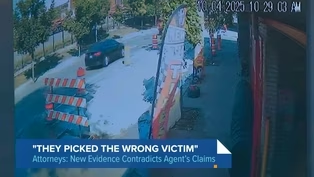
>> But they picked the wrong victim in this case.
>> Attorneys say new evidence contradicts a Border Patrol agent's claims in the shooting of a Chicago woman.
just cannot be reform.
>> It must be dismantled.
And something must take its place.
>> Congress members at odds over how to reform the Department of Homeland Security has a funding deadline looms.
And the one 100th anniversary of Black History Month.
A look Chicago roots as well as the past present and future of teaching black history.
First off tonight.
>> New evidence is being released today in the shooting of a Chicago woman Marty.
Marty Martinez.
She was shot 5 times by a Border Patrol agent in Brighton Park back in October after agent said she, quote, ambushed them and rammed them with her car.
Martinez was charged with assaulting the agents, but those charges were dropped and she's now pursuing legal action of her own.
Here's one of her attorneys earlier today.
>> I think ICE was hoping that they would get.
>> Some individual so that they could, you know, support some some of their false claims.
But they picked the wrong victim in this case to mess with.
>> Our Matt Masterson joins us now with more.
Matt, remind us about the federal claims that agents and the Department of Homeland Security we're leveling against Yeah.
Basically from the start, Homeland Security has labeled Martinez of 30 year-old Montessori school teacher as a domestic terrorist who ambushed these agents in Brighton Park.
She >> rammed them with her vehicle after she was pursuing them for 15 minutes.
The agents themselves say that they were boxed in by Martinez and other agents.
They use that justification for the shooting that when when the agents got out and did fired these shots at her, this all, despite the fact that federal prosecutors who did charge her with assaulting agents, drop these charges with prejudice just weeks later mean, these charges can never be refiled in federal court.
>> So like we said, those charges, as you just said, they were dropped.
Many Martinez is pushing to get the evidence in her case released.
What have we learned today from that evidence?
Yeah.
So today we saw some body camera footage from inside the vehicle that the agents were driving.
that showed that the agents did not appear to be rammed by Martinez.
Instead, the driver of that vehicle appeared to swerve to his left into the path of Martinez.
>> the agent who fired the shots, Charles also claim that he had fired all 5 shots through the windshield of Martinez's car, claiming that she was driving street.
Adam, some of the evidence released today, though, showed that appeared that a bullet was fired through a passenger window and then another bullet came from the rear of us passenger seat into the front coming from the back of the vehicle, which contradicted his claims as well and surveillance footage from nearby businesses appear to show that that the agents were not boxed and that they claim that there are these vehicles in front of them, preventing them from moving further, which is why they got out and started firing.
But the surveillance footage showed that there were no vehicles in front of in front of them and that they were able to drive forward if they needed to send text messages were also released today.
What we learned Yeah, these attacks were sent to or from.
>> Jackson who fired the shots and the pure show broad support from his fellow agents for the shooting.
One agent texted him calling him a legend among his fellow colleagues and saying that appears to be on him.
Next time you saw him.
>> He also got this wide support from his superiors, Border Patrol Chief.
Craig, if you know, basically offered him a promotion within hours of this saying he wanted to extend him past his retirement date.
He said in another text that he had received support from DHS Secretary Kristi Noem and meet a possible reference to Donald Trump supporting him as well on this.
There was previous tax that came out as well from eczema, which he also bragged about the shooting.
He said that he had fired 5 sept 5 shots but caused 7 wounds Martinez calling heat use firearms instructor and basically bragging about his accuracy with us.
>> Matt was next in this case.
So today Martinez's attorneys filed a federal tort claim.
This is basically the first step in filing the filing a federal suit claiming personal injury from a federal agent.
>> But they need to wait several months before they're able to get a response from DHS to move forward with civil suit, which is what they intend to do, what they want to file that later this year.
And they said they plan to to force a trial in that case as early as October later this They were to come on this case.
Of course.
Matt Masterson, thank you so much.
>> And you can read Matt's full story on our website.
It's all at W T Tw Dot com Slash news.
>> Chicago tonight is made possible in part why the Alexandra and John Nichols family.
The Pope Brothers Foundation.
And the support of these donors.
>> Tense exchanges today on Capitol Hill as Attorney General Pam Bondi face heat from lawmakers over the Epstein files and more.
>> Glad you finally made it here after hiding for 4 months from this committee.
And I writing it my chairman, you're one of the worst attorney generals in our history and then instrument of Donald Trump's lawless authoritarian agenda.
Democrats must impeach and remove lawless officials like you and Christine on.
>> Yeah, know this comes as lawmakers continue to negotiate funding for the Department of Homeland Security, which Democrats are holding up over proposed reforms to immigration enforcement efforts.
Joining us now on zoom from Capitol Hill is Congressman Jesus Chuy Garcia, who is not seeking re-election.
We were hoped to be joined by Congresswoman Delia Ramirez, who is not facing an opponent opponent in next month's primary election.
But I think there's a vote going on right now.
And I think that's where she is.
We hope she joins us.
We should mention we also invited Republican Congressman Mike Bost and Darin LaHood but have not heard back.
Congressman Garcia, thank you for filling us.
know, there's lot going on right now.
Good evening join your Brent's.
So you sit on the House Judiciary Committee.
This is, of course, where we heard Attorney General Pam Bondi testifying today in sparring with Congress.
People.
What's your reaction to her performance today?
>> Even though she had acted this way in the Senate, I thought she might change her approach in the House of Representatives.
I can't believe that an attorney general would conduct herself in the disrespectful.
The vases, the lack of empathy for Epstein, assault survivors that we're in the audience and essentially coming to debate instead of to answer questions and engage in serious debate.
A total disrespect for the institution for the process of law.
The Congress doing its oversight responsibility.
>> So yesterday congressional leaders said that a deal to fund the Department of Homeland Security is possible.
This is before a potential partial shutdown could happen this weekend.
funding measure is not passed in time, would you say that you all are still far apart and that that partial shutdown is likely?
>> As of this moment where final the offer that Democrats made to the White House?
The response from the White House vague adequate and unserious in terms of specifics minorities are to end war?
Lis enforcement, the rates that have going on violating people's rights in masks were asking for respect for sensitive locations like schools and clinics and houses of worship, places with the community should be able to gather peacefully without interruption.
And of ending the racial profiling.
That has been a prime feature the violence that we've seen were ever ice Customs and Border Protection appear in country and disrupt cities and disrupt the life and terrorize communities with their masks dogs as they do this aggressive, unlawful enforcement.
>> So what agencies would be impacted, Congressman, if a partial shutdown should happen?
>> In addition to the Department of Homeland Security, Ice and Customs and Border Protection, TSA airports would be affected as would the federal Emergency Management Agency.
There's no reason for shutdown to Republicans are insisting because they refused to relent and abiding by the constitutional by the Constitution.
And of course, the rule of law.
And of course, ending the reign of terror that we've seen everywhere with ICE presents itself in cities across America.
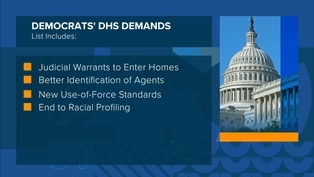
>> So you named a few of the demands that Democrats would like to see judicial warrant or the use of judicial warrants versus administrative warrants for entering homes and other places.
Better identification of DHS officers or ICE and immigration officers like not wearing masks or wearing name tags, something identifiable.
You're asking for a new use-of-force standards on and to stop racial profiling.
Now yesterday, your colleague Representative Ramirez on on the House Homeland Security Committee.
They heard from 3 leaders of Customs and immigration agencies within DHS and some of what we've heard DHS.
Is that unmasking or being able to identify those agents in the field could possibly lead to their doxing.
Their information being posted online are out in public.
Why shouldn't the agency, though, protect them from that kind of harassment or potential harassment, agents are protected just police officers and sheriffs and other law enforcement are protected across the country.
There is no difference in seeking people that they want to detain, apprehend place under deportation proceedings.
>> If police officers in communities in Chicago or anywhere else do wear a mask.
If state police don't wear mask, why should ice and CBP agents wear a mask?
Even our military doesn't wear a mask only in the most extraordinary circumstances.
>> Again, your colleague, Representative Ramirez, we heard in a sound bite earlier.
She's calling for the abolishment of ice.
She has introduced what she's calling the Melt Ice But you feel Do you think that the agency or you don't think that the agency should be dismantled entirely?
What are the reforms that you'd like to see?
How do you think it can be seen on oil eye?
On the contrary, the Department of Human part the Homeland Security was created almost 25 years ago.
They've trampled.
>> And the Constitution, they've a disservice to our country, their term rising communities.
It is impossible for this agency as we know to have any type of standing or trust in many communities across the country.
That's why public opinion has turned especially over the past several months.
The enforcement that they have done is in a defensible and they've murdered people.
You cannot rehabilitate an agency like that.
I believe that it needs to be dismantled.
It needs to be structured restructured that essentially calls forth.
Also a separation of agencies like the and Federal Emergency Management Agency to be placed elsewhere.
within this department, it's gone rogue and it's turned against the people and now its acting as mask.
The for Donald Trump.
>> All right.
Thank you for the clarity on that.
So I'm a you Gov of report.
Survey shows that 46% of people polled support abolishing ICE while 41% oppose 12% are unsure.
Additionally, a think tank called 3rd Way says that that kind of language hurts your argument with Republicans.
Is it not Congressman an extreme position kind of like Defund the police back in 2020.
Does that?
>> Make it difficult to actually achieve reform?
>> I think we can get a debate around semantics and different descriptions of what needs to happen.
What I think does need to happen is we need to re-establish a solid foundation and the rule of law and rebuild departments that are going to comply with the law and where there will be accountability.
Is these agencies have gone totally broke and violated the Constitution and have produced the shootings over 12 people.
Some of them fatally, as we've more recently.
But above all, we do never seen agency act the way that they had over the past several months.
All right.
That's where we'll have to leave it.
I know there's a lot going in your office.
>> tonight and the rest of this week.
Thank you.
Congressman triggers for joining us.
Thank you.
Up next, 100 years of celebrating in teaching black history.
>> Reflecting the people perspectives that make up This story is part of Chicago tonight.
Not the >> A century ago, History Week was established to commemorate the contributions.
Black people need to American society.
It has since expanded into what we now know as Black History Month.
But on this one 100th anniversary, federal efforts to diminish black history include dismantling a slavery exhibit in Philadelphia.
Removing portions of the home monument in Mississippi for civil rights icon Medgar Evers.
And taking down a 19 th-century photo of a formerly enslaved man scarred by with things from his enslave are.
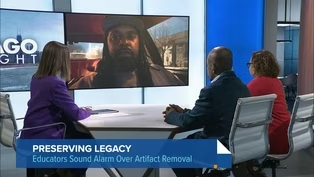
Joining us to discuss all of that and more are Robert Hansard and associate professor of African-American studies and historian at Columbia College, Chicago.
Crush on David, an AP African American Studies teacher Gwendolyn Brooks High School in Roseland and Sherman.
Dylan Thomas, the brand ambassador and social media chief at the Dusable Black History Museum and Education Center.
Thanks to all Happy Black History Month lecture here professor, want to start with you.
Remind us how Black History Month at the time Black History Week how it started or History Week, how it started 100 years ago.
It's a Burkhart, I Carter G Woodson.
It's his effort to celebrate and draw attention to value of >> African-American and African contributions to the broader history uses.
The boys sort of idea of contributing to the great sort of cultural narrative of our experience.
think that's critically important on just a moment to reflect just for for black people, but also put put a wider gold for the wider nation.
House observance of Black History Month changed over the years.
>> For me as a as a someone who's teaches at Columbia College and works with creative students.
I think it's just more and more emphasis trying on the expertise some of experiences local folks.
I talk about winds about Turner and the Gullah language in that connection to Africa.
Talk about practicing Nesbitt and all the work that he did in terms of bringing attention to anti apartheid movement.
So for me, it's about localized it to Savile really get into a story people understand his African origins through Haiti developing those kinds of complications conversations next.
>> Chris, on this is your 4th year teaching African American studies and at a predominantly black high school on what does it mean for students to have that kind of access to their own history and especially level of advanced placement level.
>> I can only tell you that I've seen magical things happening with students.
They feel empowered.
They have new established voices.
They feel like their presence is wanted and needed.
And I think that just the understanding history has now giving them more purpose in how they're going to move into their future.
So I mean, obviously the black students are giving us access to because it is a predominantly black school, not a lack, of >> But what are we what we know about the kind of black history learning and lessons that students throughout Chicago and Chicago public schools are getting?
Well, I think at my school it's predominantly black, but I actually work with multiple teachers who teach this course.
>> Chicago, public schools and the demographics are very different.
They offer the course that Walter Payton, they offer the course at Kenwood.
They offer the course at Westinghouse.
So there are a multitude of demographic populations that have access to this course.
And I think the one thing that we know is that black history cannot be a course only black students in.
So all are welcome to engage in this ridge and rigorous American history, Absolutely.
Thank you.
So De Welcome You often tell us that everything dope comes from Chicago.
>> Tell us about Chicago's place in in shaping black American identity.
>> Manahan brand.
good see you again.
And yes to everything that about America, including black history comes from Chicago.
As of the professors what we now today call asylum.
>> You're responsible for a team and we can start off as the association for the Study of Life and History.
>> They come from Chicago.
But most of our great minds, I can say most, but a lot of them spend time learning here.
Chicago, Dr Benjamin Mays, who goes on to be the longest serving president at Morehouse was educated here in Chicago.
Hardy was an educated here in Chicago so many others part here in Chicago.
John Hope Franklin and I was there when the most important books to African-American history is up before the main power by Robin in Julian.
And he had officers right here and Johnson, Johnson building right there on Michigan Avenue.
>> Professor, of course, black history or a black culture predates, you know, we know about the great migration with course.
We know about chattel slavery.
You've mentioned a little bit of, you know, Chicago's connections to Africa.
Tell us a little bit more about that.
>> You know, looking at history of Dusable looking his starting with thought the groups of folks who come from Haiti and coming to Illinois country up through Louisiana territory.
I've done a lot of research on some of those very ships where folks have arrived in common number.
Do ships come from places?
Congo in West Central Africa, the sum of the year of the caught region.
So it's important to draw on those sort of cultural history, culture and history.
I think too often we look at slavery in captivity as the origin point to start to investigate African-American history and culture.
But we need to start at Africa.
We need to start with these early stretch of experiences.
These early cultures.
I call kind of a look at cars mileage because you're trying to get into the world view and a perception and a perspective of these cultures.
>> All of that said we are seeing the dismantling of of all of this history for African-Americans across the country.
As we mentioned in the open professor Han what's your reaction to what's happening?
>> Just fortunate.
I mean, I it's it's it's an easy shot quit.
Okay.
to focus on black culture and black heritage with on patriotism or an American is in.
But think about something Gordon Parks trying to go and take pictures of the Tuskegee Airman and, you know, him being prohibited to do so.
At the same moment.
if you know, FDR Green to have executive order at a to to you know, discrimination because he doesn't a Philip Randolph to march in Washington, right?
So it's just the sort getting a feel for dynamic understand how how valuable all this is What we need to know about America.
This is our story.
This is an American story.
So we do what we do.
Want to miss it, right?
Right.
We often hear that, you know, black history is American history and American history black history as well.
>> Still a same question to you.
What is the reaction?
We see instances alterations at at the home of Medgar Evers and the like.
>> My reaction is one of sadness, right?
I think you can fix anything that not willing to acknowledge.
Meantime, we're trying to erase what happened to my folks here in America.
pushes us backwards in our ability to rectify it and move forward.
also encourages me, though.
It makes me realize that my work in the work of the panel is is so so important and also makes me want to challenge all of us because we don't right now.
The history making today.
We know right now the family has 3.
If we don't try to disseminate that history and eventually that history can be erased.
And so, you know, on the one hand, I'm Sam.
On the other hand, it empowers me to continue to work hard and I can make sure that I'm preserving black history for future generations.
>> Christiane, how do you talk to your students about administration's efforts to?
Rewrite history to change history, to erase it?
>> Well, I have to be honest, I have to be very careful.
I mean, I am in a school right.
One thing that I do is I encourage them to use their voices and to share their insights about what is happening.
And it's quite surprising to see the students are well aware of some of the injustices and inequitable practices that are happening now.
Many of them are impacted by some of the current policies personally.
And oftentimes those stories will come up in discussions in the class.
Okay.
>> The founder of Black History Week, as you mentioned, Carter G Woodson.
He intended for black history to still be a year-round pursuit to not just a week, not just a month.
Professor, how can we continue?
That happened keep that up.
>> Just kind of what we're doing here, panel from diverse backgrounds coming and speaking different elements and different approaches and different perspectives to understand this history and just carrying that discussion the on Feb.
I mean, for great, you know, there was short month, but the reason is because of, you know, I've Lincoln's birthday, but also Frederick Douglass has backed is the reason why the month was chosen.
But there's so many other contributors to a black experience you know, born in other So, So it's just important to get, you know, as much as we can.
a year-long process.
It's it's about bringing in these diverse perspectives continuing to contribute and adding develop this conversation for John, what can we be doing the rest of the year to acknowledge or or history not just in February?
Well, I think what educators could be doing is you know, incorporating more.
>> Diverse perspectives.
More of those stories that are.
>> You know, related to people who look like they're students into their curriculum.
I think that we also can take opportunities to celebrate by going outside of our buildings into the communities where our students live travel every day.
I also think that we can continue to encourage, you know, ethnic studies courses that promote educating students our rich culture and history globally.
>> Dilemma, give you the last word.
Got about 40 seconds left, you know, same question.
How can we do this year-round?
But also, you know, to someone who's looking for an interesting way to Mark Black History Month.
What do you recommend?
>> Well, I'm not going in trouble with my boss and not say come to the dusable.
concern have an education center.
We have a beautiful exhibit, Paris and black that teaches you about the black experience overseas and then real quickly when I think we ought to do is take the Spike Lee, do the right thing approach.
We approached one that is not African-American act in their favor.
Musician favors for favorite athlete and one of those answers going to be an African-American.
You can take that point to further educate them on the impact we've had on this nation.
>> All right.
I love that sparked a conversation.
Professor Robert Hansard crash on Davis or David excuse me Thomas things, everybody.
Thank you.
And we're back to wrap things up right after this.
>> Reflecting the people and perspectives that make a buck This story is part of Chicago tonight.
Black Voice.
>> And that is our show for this Wednesday night.
Join us tomorrow night at 5, 30 10.
How a bill requiring proof of citizenship to vote could impact elections.
Now for all of us here in Chicago Brandis Friedman, thank you for watching to healthy and safe and have a good night.
>> Closed caption News made possible by Robert a cliff and Clifford ball on Chicago personal injury and wrongful
Attorneys Say New Evidence Contradicts Federal Agent’s Claims in Shooting of Chicago Woman
Video has Closed Captions
Clip: 2/11/2026 | 3m 47s | Marimar Martinez was shot five times by a Border Patrol agent in Brighton Park in October. (3m 47s)
Congress at Odds Over How to Reform Department of Homeland Security
Video has Closed Captions
Clip: 2/11/2026 | 8m 54s | A partial government shutdown could be coming if lawmakers don't reach a deal. (8m 54s)
This Year Marks the 100th Anniversary of Black History Month
Video has Closed Captions
Clip: 2/11/2026 | 10m 53s | A look at its Chicago roots as well as the past, present and future of teaching Black history. (10m 53s)
Providing Support for PBS.org
Learn Moreabout PBS online sponsorship
- News and Public Affairs

Top journalists deliver compelling original analysis of the hour's headlines.

- News and Public Affairs

FRONTLINE is investigative journalism that questions, explains and changes our world.
Urban Consulate Presents











Support for PBS provided by:
Chicago Tonight is a local public television program presented by WTTW
WTTW video streaming support provided by members and sponsors.