
December 16, 2025 - PBS News Hour full episode
12/16/2025 | 57m 46sVideo has Closed Captions
December 16, 2025 - PBS News Hour full episode
Tuesday on the News Hour, signs of a slowing labor market from the latest jobs report. Congress considers a massive spending bill for the military that would give the Trump administration even more money than it asked for. Plus, we speak with physician and Republican Sen. Bill Cassidy about the impending spikes in health care premiums and his decisive vote to confirm Health Secretary Kennedy.
Problems playing video? | Closed Captioning Feedback
Problems playing video? | Closed Captioning Feedback
Major corporate funding for the PBS News Hour is provided by BDO, BNSF, Consumer Cellular, American Cruise Lines, and Raymond James. Funding for the PBS NewsHour Weekend is provided by...
December 16, 2025 - PBS News Hour full episode
12/16/2025 | 57m 46sVideo has Closed Captions
Tuesday on the News Hour, signs of a slowing labor market from the latest jobs report. Congress considers a massive spending bill for the military that would give the Trump administration even more money than it asked for. Plus, we speak with physician and Republican Sen. Bill Cassidy about the impending spikes in health care premiums and his decisive vote to confirm Health Secretary Kennedy.
Problems playing video? | Closed Captioning Feedback
How to Watch PBS News Hour
PBS News Hour is available to stream on pbs.org and the free PBS App, available on iPhone, Apple TV, Android TV, Android smartphones, Amazon Fire TV, Amazon Fire Tablet, Roku, Samsung Smart TV, and Vizio.
Providing Support for PBS.org
Learn Moreabout PBS online sponsorshipGEOFF BENNETT: Good evening.
I'm Geoff Bennett.
AMNA NAWAZ: And I'm Amna Nawaz.
On the "News Hour" tonight: signs of a slowing labor market from the latest jobs report.
GEOFF BENNETT: Congress considers a massive spending bill for the military that would give the Trump administration even more money than it asked for.
AMNA NAWAZ: And we speak with physician and Republican Senator Bill Cassidy about the impending spikes in health care premiums and his decisive vote to confirm Health Secretary Robert F. Kennedy Jr.
SEN.
BILL CASSIDY (R-LA): We clearly differ on things like immunizations.
On immunizations, they are safe.
They do not cause autism.
(BREAK) AMNA NAWAZ: Welcome to the "News Hour."
The U.S.
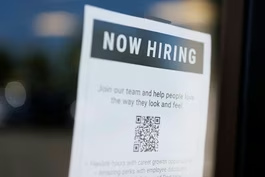
labor market is showing further signs of cooling, as the latest jobs report shows unemployment rising to 4.6 percent.
That's the highest level in the last four years.
There was some good news, as payrolls climbed by 64,000 new jobs last month, better than forecast, but the report also showed a net loss of 105,000 jobs in October.
That marks the third time that the economy has shed jobs in the last six months.
GEOFF BENNETT: And the biggest losses have been felt at the federal level amid mass firings affecting nearly 168,000 positions over the last two months.
The delayed report was due to the six-week government shutdown.
For analysis, we're joined now by David Wessel, director at the Hutchins Center on Fiscal and Monetary Policy at the Brookings Institution.
Thanks for coming in.
DAVID WESSEL, Brookings Institution: Good to see you.
GEOFF BENNETT: So the unemployment rate, as Amna said, is now at 4.6 percent.
Is that a meaningful sign of labor market weakening or is this just normal volatility?
DAVID WESSEL: I think it's a meaningful sign that the labor market is weakening.
There's more than the usual uncertainty this time.
I know people are always saying one month doesn't matter, because the government couldn't do the usual collecting of data, surveying people during the shutdown, the government shutdown.
But we started the year with unemployment at 4 percent, and now it's at 4.6.
So that's a sign that the labor market is weakening.
GEOFF BENNETT: And you pointed our team to this chart that shows the unemployment rate over the last three years rising steadily.
So, in 2023, it was at 3.4 percent as the economy recovered from the pandemic, then was steady at 4.1 in late 2024.
Now it's climbed back to levels we haven't seen since 2021.
So how do those rates compare in terms of job quality, labor force participation, underemployment?
DAVID WESSEL: Well, we know that labor force participation was up a little bit in the last report.
We know also, interestingly, that there's a growing number of people who are working part-time who say that they would prefer full-time work.
Now that number might be a little messed up by the federal employees.
Some of them may have not worked a full week.
So, when you look at all the numbers, the readiness of people to quit their jobs has fallen a lot.
That's a sign that they're worried about finding jobs.
It all points to a labor market that's weakening, but not falling apart.
GEOFF BENNETT: We're also seeing job gains in health care, but losses in manufacturing and transportation.
So what does that mix say about the economy and President Trump's stated desire to rebuild domestic manufacturing?
DAVID WESSEL: Well, in the good news department, we did see that private sector employment was steady.
And it's actually increased, the pace has increased a little bit since the summer.
Manufacturing, as you point out, continues to lose jobs, despite all the president's promises to bring it back.
I think that has to do -- some of it has to do with tariffs.
Some of it has to do with automation.
And so what it suggests is that the economy is a little bit -- it's very uneven.
Health care, education, social services, they have been strong, but the private sector, manufacturing and other service jobs, have not been.
GEOFF BENNETT: And federal employment, as we mentioned, has dropped sharply this year.
How much is that weighing on the overall jobs picture?
DAVID WESSEL: Well, we lost 168,000 jobs at the federal level over the last couple of months.
Some of that's because people who got laid off as part of the DOGE campaign were still being paid.
And as long as they were being paid, they didn't count as unemployed.
So it all shuts out now.
The number of federal employees is now at the lowest has been for a decade.
The White House is bragging about that today.
It's definitely a minus, particularly in the Washington, D.C., area and other places with a lot of concentration of federal employees.
But we still created over the last couple of months, two months, about 40,000 jobs.
And that may be enough to keep us close to full employment.
GEOFF BENNETT: A number that stands out to me is the long-term unemployment number, people who have been out of work for 27 weeks or more.
That number is rising, affects nearly two million Americans, about a quarter of the unemployed.
Why does that matter in particular?
And what warning signs does that rise -- raise?
DAVID WESSEL: Well, it matters, obviously, because those people are really not just temporarily laid off.
They have been off for a while.
In human terms, it makes a big difference.
Some of them may be running out of unemployment benefits.
It's one of the panoply of indicators that suggests that, as we see through the fog of the delayed reports, it suggests that the labor market is deteriorating.
And that's why the Federal Reserve cut interest rates last week.
And they made a point of, even though they're above target on inflation, they're more worried, most of them, about the weakening job market.
GEOFF BENNETT: Does it strengthen the case for another cut in January?
DAVID WESSEL: I don't think that this changes the picture.
I think it wasn't bad enough to cause the Fed to cut rates in January.
We will get another jobs report before then.
I think they think they have done enough for now, but we will have to see.
GEOFF BENNETT: So, taken together, what does this all suggest about the labor market and the health of the economy overall?
DAVID WESSEL: It suggests that the economy is weakening, that the labor market, which is where most of us earn our income, is slowing down.
And we don't know how much more lies ahead, but it is a very worrisome sign.
But as my friend Jason Furman, the former White House -- Obama White House economist said, by -- even by usual standards, there's more uncertainty here.
And we will have to wait and see another month how bad things are.
GEOFF BENNETT: David Wessel, thanks for helping us make sense of all this.
We appreciate it.
DAVID WESSEL: You're welcome.
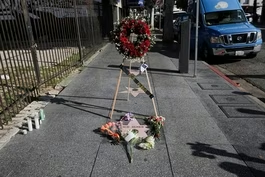
AMNA NAWAZ: In the day's other headlines: Prosecutors in Los Angeles say they will charge Nick Reiner with two counts of first-degree murder for allegedly killing his parents, award-winning actor and director Rob Reiner, and his photographer and producer wife, Michele Singer Reiner.
The 32-year-old was arrested on Sunday just hours after the Reiners were found dead in their Los Angeles home.
At a news conference this afternoon, L.A.
's district attorney called the case challenging and heart-wrenching.
NATHAN HOCHMAN, Los Angeles County, California, District Attorney: Rob Reiner was a brilliant actor and director, an iconic force in our entertainment industry for decades.
His wife, Michele Singer Reiner, was an equally iconic photographer and producer.
We will commit ourselves to bringing their murderer to justice.
AMNA NAWAZ: Nick Reiner's attorney, Alan Jackson, said today that his client was unable to attend a planned court hearing due to medical reasons.
Reiner is currently being held without bail.
He has yet to enter a plea.
If convicted, Nick Reiner could face the death penalty or life in prison without parole.
The Trump administration is expanding its travel ban to include five more countries.
That means citizens of Burkina Faso, Mali, Niger, South Sudan, and Syria are prohibited from entering the U.S.
Officials are restricting travel completely for people with Palestinian Authority-issued travel documents.
And they're adding partial restrictions for more than a dozen other countries, including Malawi, Nigeria, and Zimbabwe, among others.
The announcement comes after Trump signed an initial travel ban targeting 12 countries in June, arguing such measures are vital for national security.
A federal judge in Washington says he's not inclined to stop construction of President Trump's $300 million White House ballroom.
That comes in response to a lawsuit from the National Trust for Historic Preservation last week aimed at halting the project.
The nonprofit group is calling for a thorough review process, saying the project needs congressional approval.
The administration argued that the president has the authority to modify the White House and that construction must continue for national security reasons.
But officials did not cite specific concerns.
Turning overseas, police in Australia say that Sunday's mass shooting at a Hanukkah celebration was a terrorist attack inspired by the Islamic State.
At a news conference in Sydney, officials said they found two homemade Islamic State flags in the car of the suspects, a 50-year-old man who was killed in the attack and his son, who's being treated at a hospital.
Authorities also recovered improvised explosive devices.
In the meantime... (SINGING) AMNA NAWAZ: ... hundreds have been gathering at Bondi Beach to honor the 15 people killed during the rampage and to show solidarity with the city's Jewish community.
The victims ranged from 10 to 87 years old.
More than two dozen others are still in the hospital.
In the U.K., a man who drove his car through a sea of soccer fans in Liverpool earlier this year has been sentenced to more than 21 years in prison; 54-year-old Paul Doyle had pleaded guilty to 31 counts last month.
MAN: The footage is truly shocking.
AMNA NAWAZ: Today, the judge cited graphic footage that showed Doyle -- quote -- "deliberately accelerating" time and time again as the crowd celebrated Liverpool's Premier League championship in may.
Prosecutors said he was - - quote -- "in a rage" because he couldn't get to his destination fast enough.
More than 130 people were injured, including several children.
FIFA is slashing prices for some World Cup tickets following a global backlash over the cost of attending a game.
Officials will offer around 1,000 tickets per game at just $60 each.
They will go to each country's soccer federation, and it's up to them to distribute the tickets to loyal fans.
This new supporter entry tier comes as the 2026 tournament is shaping up to be the priciest in World Cup history for fans.
Still, FIFA said today that it's received more than 20 million ticket requests in its latest round of sales.
On Wall Street today, stocks ended mixed following that monthly jobs data.
The Dow Jones industrial average lost about 300 points on the day.
The Nasdaq managed a slight gain of about 50 points.
The S&P 500 ended about 16 points lower.
Also today, lawmakers at the U.S.
Capitol unveiled a statue of Barbara Rose Johns, the Virginia teenager who helped bring an end to school segregation.
(CHEERING) AMNA NAWAZ: Her 16-year-old likeness holding a tattered book above her head was unveiled in Emancipation Hall this afternoon.
In 1951, Johns led a student strike in Farmville, Virginia, to protest her school's conditions compared to the town's white high school.
Notably, Johns replaces the statue of Confederate General Robert E. Lee, which was removed from the Capitol in 2020.
And Joe Ely has died.
The singer-songwriter from West Texas helped shape the genre known as Americana.
In songs like "I Had My Hopes Up High," Ely fused honky-tonk, bluegrass and rock, serving as an alternative to the more polished so-called Nashville sound.
Ely said he was inspired by the vast spaces of the American heartland and toured tirelessly, earning him the nickname Lord of the Highway.
And he was known for his collaborations with legends like The Clash and Bruce Springsteen.
His family says Joe Ely died of pneumonia.
He was 78 years old.
Still to come on the "News Hour": why it's been so difficult to locate the suspect in the Brown University shooting; and a rare look at Hezbollah's highly secretive bunkers seized by Lebanon's military.
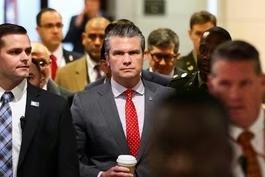
Today, Defense Secretary Pete Hegseth rejected calls to publicly release the full video of a boat strike that the military carried out in early September.
That attack was the first of more than two dozen strikes on what the administration calls narco-terrorists, but it has become the most contentious.
At the same time, the Senate is debating and is expected to pass its largest annual bill to authorize the Defense Department.
Nick Schifrin and Lisa Desjardins are here.
They have been covering this all.
So, Nick, let's start with you.
What did Secretary Hegseth say today?
NICK SCHIFRIN: Well, Amna, as you just said, Hegseth shot down the idea of releasing the second video from September the 2nd publicly.
Now, a reminder, this was the very first strike in what the administration called today a highly successful counterdrug mission.
On September the 2nd, the U.S.
military says it fired a single missile that killed nine people and a second strike some 30 seconds -- 30 minutes later that killed two people who were not killed in the first strike.
Now, many Democrats -- you see the first strike there.
Many Democrats and former military lawyers have argued that the second strike killed shipwrecked sailors.
That would make it illegal.
But, today, Hegseth called the whole video classified.
PETE HEGSETH, U.S.
Defense Secretary: In keeping with longstanding Department of War policy, Department of Defense policy, of course we're not going to release a top secret full, unedited video of that to the general public.
NICK SCHIFRIN: Some Democrats today argued that President Trump himself released the first part of this video and the administration could take the very same steps to release the second strike video.
AMNA NAWAZ: And, Lisa, some in Congress are seeing this as a very important moment when it comes to the balance of power.
Why?
LISA DESJARDINS: That's right.
Congress has the power to declare war.
And this is a question of basic oversight by elected members of Congress over how we conduct war, how we conduct major military operations, which are fatal in this case.
Now, the administration is not showing this most contentious part of the video to every lawmaker in Congress.
They're holding it back right now.
And there are real questions about whether they should do that or not.
There are questions because many members of Congress think there could be some human rights violations in those in that video.
Here's Democrat Tim Kaine today: SEN.
TIM KAINE (D-VA): Is this what we want to be known for, giving a green light to overturning decades of human rights precedent, decades of laws of war precedent?
That's what this administration is now pushing America to be known for.
LISA DESJARDINS: Again, this is about oversight.
I spoke with sources of longtime sources in Congress who say senators do have clearance.
Members of Congress do have clearance as being members of Congress.
It's not an issue of the classification.
It's an issue of whether the Department of Defense chooses to show them this video, but they have that oversight.
AMNA NAWAZ: So, Nick, let's turn now to that $900 billion defense authorization bill.
Walk us through the highlights.
NICK SCHIFRIN: Yes, in any bill this big, there are many highlights, and so Lisa and I are going to try and go through just a few.
And let me begin with that boat strike.
In fact, the NDAA, the authorization bill, cuts Hegseth travel budget by 25 percent until he provides the unedited video to the Senate and House Armed Services Committee, which he said he would do by tomorrow, also providing the committees the execute order for that strike.
Other provisions restrain some of the president's threat to reduce support to allies and partners, including what you see there, restricting the withdraws of troops from Europe or South Korea.
The bill also authorizes U.S.
money for weapons to Ukraine.
It really portrays Russia as an adversary, requiring reports on Russia's activities and limiting the administration's ability to recognize Russian sovereignty over any parts of occupied Ukraine.
In addition, it repeals the authorizations of the use of military force related to Iraq in 1991 and 2002 and initiates the most ambitious reform in a generation for how the Pentagon procures weapons.
AMNA NAWAZ: Lisa, what stands out to you in terms of what's in here that may not be usual defense policy?
LISA DESJARDINS: All this is why you have come to "PBS News Hour."
You're not going to see this stuff anywhere else, but it is important.
Number one of two things, DEI.
This bill codifies the Trump administration policy.
And look, here's what's in page 728 of the bill.
It would say that the Pentagon can no longer establish a diversity office or have any plans related to diversity, equity, or accessibility.
That would be in law.
This not only puts that in law, but it is obviously a big cultural moment.
Secretary Hegseth says this is about unity at the Pentagon, but Democrats and others, including some Republicans, say they worry that this undermines what has been a long history of inclusiveness and in fact, anti-racism at the Pentagon itself.
The second thing I want to raise that's not really related to the military, the Lumbee Tribe of North Carolina, that is a tribe that has tried to get federal recognition for years.
That is in this defense authorization bill.
Funny enough, that tribe is in an important county in a swing state, and President Trump promised them federal recognition.
When this passes, they will get it.
AMNA NAWAZ: So, Nick, Lisa's pointing out here this becomes a grab bag, this NDAA, every year.
There's a significant step in here, though, when it comes to these administration's Syria policy.
Tell us about that.
NICK SCHIFRIN: Yes, this is the repeal of the Caesar Act.
That was a package of sanctions aimed at Bashar al-Assad for killing some half-a-million of his people during more than a dozen years of war.
But it has been one year since Ahmed al-Sharaa became the president of Syria, overthrowing Assad.
And Syria recently overcame resistance on the Hill to repeal Caesar.
And that is vital, because, after about 13 years of war, the World Bank says Syria needs $215 billion to rebuild and facilitate the return of millions of displaced.
Take a listen to Mouaz Moustafa, the executive director of the Syrian Emergency Task Force.
MOUAZ MOUSTAFA, Executive Director, Syrian Emergency Task Force: The remainder of Caesar was shattering to Syria's future.
Simple as that.
And in order to give Syria a chance, Caesar had to be lifted.
What that means is now Syria can rebuild.
How can we expect 14 million refugees in this place to come back from within Syria and from the borders and from Europe and from even the United States if they can't rebuild their homes?
That's what Caesar allows.
NICK SCHIFRIN: The administration had provided temporary waivers, Amna, to Caesar, but only Congress could repeal.
And now expect private investors, regional partners to send investments into Syria.
AMNA NAWAZ: Meanwhile, Lisa, as you have been reporting, we'd expected passage of the bill by now, but it has been snagged, not by military concerns, but with something related to air safety.
Tell us about that.
LISA DESJARDINS: Right.
This is what Nick and I think are getting at.
This bill touches so many facets of American and world life.
And this -- we thought this bill would have passed by now, but it's snagged because of an air safety issue in Washington, D.C.
Folks may remember the crash January 29 of this year over the Potomac with a military helicopter in training and a commercial air flight.
After that crash, where 67 people died, the military agreed to use specific technology so that those military training flights would geolocate.
This bill, Ted Cruz, a senator, and others are worried that this bill has a waiver, that training flights could have to -- could waive out of that kind of technology.
And that's why this is held up right now.
That is in the bill.
We're watching to see what happens with that provision.
So this bill will pass.
It's a question of when.
AMNA NAWAZ: It's a lot of money.
It's a big bill.
Lisa Desjardins, Nick Schifrin breaking it all down, thank you both.
LISA DESJARDINS: You're welcome.
NICK SCHIFRIN: Thank you.
GEOFF BENNETT: House Speaker Mike Johnson said today he will not call for a vote on extending enhanced subsidies for people buying insurance through the Affordable Care Act.
That effectively guarantees the subsidies will expire at the end of the month and premiums will spike substantially for some 20 million Americans who get their coverage that way.
In a moment, we will hear from Republican Senator Bill Cassidy, who's a key player in this debate.
But, before we do, we turn to the first of two reports on the subsidies and alternative ideas.
William Brangham focuses tonight on how the subsidies work and what's at stake if they expire.
JOE BIDEN, Former President of the United States: Because tens of millions of Americans will be a whole lot healthier from this moment on.
WILLIAM BRANGHAM: It was March 23, 2010, and Vice President Biden whispers in President Obama's ear, "This is a big effing deal."
(CHEERING) JOE BIDEN: This is a big (EXPLETIVE DELETED) deal.
WILLIAM BRANGHAM: And it was, signing of the Affordable Care Act into law.
BARACK OBAMA, Former President of the United States: Today, after all the votes have been tallied, health insurance reform becomes law in the United States of America.
(APPLAUSE) WILLIAM BRANGHAM: It was complicated to pass and complicated in its structure, but the ACA, which was quickly dubbed Obamacare, had a fairly straightforward goal, expand health care coverage and keep costs down.
And over the ensuing 15 years, the ACA has been mostly successful on that first front by expanding Medicaid and by helping people buy insurance.
All of that helped cut the uninsured rate in half.
But that promise of lower prices, what President Obama often called bending the cost curve, that has been a much harder nut to crack.
CYNTHIA COX, Program on the ACA Director, KFF: In the United States, we spend twice as much money on health care as many other countries do.
WILLIAM BRANGHAM: Cynthia Cox analyzes the Affordable Care Act at KFF.
CYNTHIA COX: The ACA worked by using taxpayer dollars to reduce the cost of health care for individuals that qualify for those programs, but it didn't do a whole lot to address the underlying reasons why health care is so expensive.
WILLIAM BRANGHAM: As health care prices keep rising across the system, health care premiums do too.
With the ACA, to soften the blow of those higher premiums, targeted subsidies were built into the law.
Avik Roy co-founded the Foundation for Research on Equal Opportunity, and he has served as an adviser to past Republican presidential candidates.
AVIK ROY, Foundation for Research on Equal Opportunity: Part of the rationale of the subsidies was, well, if we're going to regulate what these plans can offer and how they can be designed, they're going to be more expensive.
And if they're going to be more expensive, then some people will have trouble affording them.
WILLIAM BRANGHAM: Despite those subsidies, by 2020 enrollment had stalled.
For some Americans, the plans still cost too much.
So during the pandemic, then-President Biden boosted those subsidies and expanded who was eligible for them to higher income brackets.
And they worked, cutting costs for consumers and driving a surge in enrollment.
While those enhanced subsidies got more people covered, they were also very expensive and temporary.
Congress gave them an expiration date, December 31, 2025, hence this New Year's Eve deadline that we are all talking about.
SEN.
JOHN THUNE (R-SD): This is a failed program.
SEN.
THOM TILLIS (R-NC): The Democrats created the problem.
We have got to solve it.
SEN.
CHUCK SCHUMER (D-NY): Are they going to vote for this bill and bring health care costs down for the American people, or block this bill and send premiums skyrocketing?
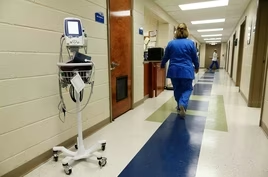
WILLIAM BRANGHAM: Here's how the subsidies work.
What someone has to spend for an insurance policy is capped at a certain percentage of their income on a sliding scale.
So, for example, and there's different plans and deductibles to consider, but, generally speaking, let's say I make under $22,000 a year.
I'd pay nothing for the basic benchmark health insurance plan.
But as my income grows, so does the percentage I'd have to pay, up to 8.5 percent of my income once I start making $65,000 a year.
The remaining cost of that policy, no matter how expensive, is paid for by the federal government.
And though they are sometimes referred to as tax credits, in most cases, the money goes straight to insurance companies.
CYNTHIA COX: What most people opt to do is to have their tax credit dollars sent directly to the insurance company that they pick for their insurance.
And then that way it lowers their monthly premiums directly so that person doesn't have to pay the full premium up front.
WILLIAM BRANGHAM: In 2025, the total cost of the ACA subsidies was an estimated $138 billion.
That's 5.5 times NASA's entire budget.
AVIK ROY: The plans are much more expensive than people believed they would be in 2013-2014.
And as a result, the subsidies have become more needed because fewer people can afford the plans in the ACA.
And that's what creates the policy debate that we're having now.
WILLIAM BRANGHAM: If the subsidies are not renewed, nearly all of those 24 million enrollees, overwhelmingly low- and moderate-income households, will see huge spikes in their premiums.
CYNTHIA COX: On average, people are going to pay about twice as much next year as they do this year.
WILLIAM BRANGHAM: Forty-five percent of Obamacare recipients, almost 11 million people, can currently get their coverage at no cost.
But that will change if these enhanced subsidies go away.
For example, a family of four making $45,000 a year will see their premium increase from zero to around $1,600 a year.
CYNTHIA COX: It is a lot of money to someone who's maybe barely making it to me to begin with.
WILLIAM BRANGHAM: People like Crystal Akers in Kentucky.
CRYSTAL AKERS, Kentucky: For the current plan that I have now, it showed that my monthly premium would be about double what I'm paying.
As far as I'm concerned right now, I don't have insurance.
I turned off my payment for November.
WILLIAM BRANGHAM: Cox also says some older Americans will be especially hard-hit.
CYNTHIA COX: So, that big spike is going to happen for older people who have incomes just above four times the poverty level.
So for an older couple, this might be an income of $85,000.
They actually, because it's two of them, might see their premium costs go up by almost $20,000.
WILLIAM BRANGHAM: Avik Roy argues this crisis is a moment to reassess some fundamentals about the ACA.
AVIK ROY: I think the question that a lot of people are asking is, do we just throw more subsidies at the problem and paper over the fact that the ACA has led to these much higher prices for health insurance or do we try to reform the design flaws in the ACA, so that we can actually have not just lower health insurance for those individuals, but for everybody who has to shop for coverage on their own?
WILLIAM BRANGHAM: But time is running out for that kind of compromise.
The Congressional Budget Office estimates, without an extension, 2.2 million enrollees will drop their coverage in 2026 alone.
People like Melissa Ruff of Jacksonville, Florida.
MELISSA RUFF, Florida: Here I am, 57, seven years out from Medicare, facing being uninsured with a cardiac condition.
I can't afford it.
It prices me out of health care.
WILLIAM BRANGHAM: And, in Tennessee, Tenika Mason says she has to have insurance.
TENIKA MASON, Tennessee: Our daughter is a brain cancer survivor and we have to go with the insurer that covers the specialists that she needs.
So not having insurance is not an option for us.
It would ruin us financially.
WILLIAM BRANGHAM: And that's the trade-off at the heart of this standoff.
Keeping health care affordable for Americans on these plans is very expensive, but leaving people with no coverage at all has costs of its own.
For the "PBS News Hour," I'm William Brangham.
GEOFF BENNETT: Tomorrow, our Lisa Desjardins will break down the main alternative plan many Republicans prefer.
That's an expansion of health savings accounts.
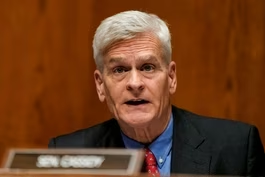
We're joined now by the author of one such GOP plan, Louisiana Republican Senator Bill Cassidy, chair of the Senate Health Committee, who also happens to be a physician.
Welcome to the "News Hour."
SEN.
BILL CASSIDY (R-LA): Thank you.
GEOFF BENNETT: I know you said there's a deal to be had on health care, and I understand a bipartisan group of senators met last night to hash out an agreement.
At this point, what does a compromise look like?
SEN.
BILL CASSIDY: First, let me just say what is important to me.
We have to make these policies affordable to the enrollee, to our fellow American.
And so it's not just about containing premiums, although that's important, but also about making sure that somebody has the money in their pocket to pay the out-of-pocket for the policy, if you will, giving power to the patient, not profits to the insurance company.
There's your deal.
We will do something to address the high cost of premiums for some, and do something else to address that need to have money for the out-of-pocket for as many as possible.
That could be a deal.
GEOFF BENNETT: In the meantime, though, health care premiums for more than 20 million people in those marketplace plans are set to spike in the new year, with the House speaker, Mike Johnson, saying he's not going to call for a vote on extending the enhanced subsidies.
So what can be done in the here and now to help people keep their coverage?
SEN.
BILL CASSIDY: So people are opting for the lower-cost plans on the Affordable Care Act, so-called Affordable Care Act exchange.
They're going from a silver plan to a bronze plan, and they're trying to make it affordable.
What our plan does, by the way, which I think we could maybe not implement for next year, but for the following year, is to give them that money in an account, their pocket, their purse, if you will, that would help address that higher deductible.
It may be that the deductible turns out to be the same between the bronze and the silver plan, but the premium on the bronze plan is lower.
You get more affordability.
You get money up front to pay for those out-of-pocket costs.
That's really making things more affordable.
GEOFF BENNETT: So the only option for Americans, absent action from Congress, is to reduce their level of coverage right now?
SEN.
BILL CASSIDY: So you're speaking only of that 7 percent of Americans who are on the exchange and you're speaking about a minority of those.
Let's first be clear.
For those less than 400 percent of federal poverty level, they still have a lot of subsidies going towards it.
For those who are above, it depends.
But I can tell you what the alternative is just to have people continue to subsidize premiums, so they still have a $6,000 deductible, is not really an option.
Most people are living paycheck to paycheck.
They don't have money for a $500 medical bill, much less a $5,000 medical bill.
So what we have to do is help Americans where they are.
And that is yes, make the premiums affordable for those for whom it's not, but also help all folks on the exchange with their out-of-pocket.
And that's, I think, the better way forward.
GEOFF BENNETT: Critics on both sides argue that the current options either maintain an expensive status quo, ACA, or shift burdens onto patients.
So how does your proposal strike the right balance without reducing coverage or increasing uncompensated care?
SEN.
BILL CASSIDY: The plan I am proposing takes financial burden off the patient.
Consider the alternative.
Democrats are advocating we give $26 billion to insurance companies for next year and they take 20 percent for profit and overhead.
But if you give money to the patient, she's going to use 100 percent of that money for the care that she needs.
Now, she may choose a less expensive bronze plan.
It's less expensive because it has a higher deductible.
But we're putting in some cases up to $5,000 into an account for her to pay that deductible.
That actually could lower her net deductible, if you will, lower cost premium, lower net deductible.
That's how my plan is a sweet spot.
Maybe we can't get it for this coming year.
We absolutely should get it for the next year because the Obamacare exchanges have become unaffordable for too many.
GEOFF BENNETT: Where's the White House on all of this?
SEN.
BILL CASSIDY: The president has made it clear he will not sign a law giving all the money to insurance companies.
He wants money to go to the patient.
And the president's intuition is correct.
I said it earlier.
I will say it again.
If you give the money to the insurance companies, they take 20 percent for profit and overhead.
They have to give you permission to get the care you know you need.
If you give the money to the patient, she gets 100 -- she uses 100 percent of the money for the care she knows she needs.
She doesn't have to ask permission.
She's got the power, power to the patient, not profit to the insurance company.
GEOFF BENNETT: Beyond the matter of health care coverage and costs, there's also the question of public health and public health leadership.
You explicitly said that you would support RFK Jr.
's nomination as health secretary, you delivered that decisive confirmation vote, in exchange for serious commitments, that he would meet with you on a regular basis, consult with you before making changes to vaccine safety monitoring, not remove language from the CDC Web site saying vaccines don't cause autism.
He's made all of those changes.
Have you actually received any consultations from him?
SEN.
BILL CASSIDY: We -- he and I have spoken.
And in part of our agreement, he will come back to speak to the Health, Education and Labor and Pension Committee on a periodic basis.
We're right now in the process of when that next time would be.
So, to answer your question directly, yes.
GEOFF BENNETT: Well, do you believe the actions at the CDC reflect the agreement that was struck before you voted in favor of him?
SEN.
BILL CASSIDY: I think you can look at the agreement and you can look at what has been done.
There's clearly a difference between the two.
GEOFF BENNETT: Would you vote to confirm him again if you were presented with the opportunity?
SEN.
BILL CASSIDY: Reporters love to ask that question.
But, right now, it is what it is.
We have to live life going forward.
And so let's live life going forward.
GEOFF BENNETT: Well, you called the federal panel of vaccine advisers handpicked by him, you said it was totally discredited.
So does he still have your support?
SEN.
BILL CASSIDY: You know, there's things we agree on, ultra-processed.
I just have to hand it to the secretary.
He's made an issue of something that has, frankly, never been an issue before.
But we clearly differ on things like immunizations.
On immunizations, they are safe.
They do not cause autism.
It is clear that we're having an outbreak of vaccine-preventable diseases and even death from people who have chosen not to vaccine -- vaccinate their child or themselves.
We have a flu season which is kind of one of our worst in a while.
And the end and flu immunization is at a low point.
We have got a measles outbreak in South Carolina, and we had two that died in West Texas.
Clearly, the safety, the effectiveness of vaccines should be emphasized now.
There should not be spurious claims made about their safety.
And I think that kind of says it all.
GEOFF BENNETT: So what can be done now?
I mean, for Americans who look to the CDC for clear science-based guidance, what assurance can you give them under RFK Jr.
's leadership?
SEN.
BILL CASSIDY: I think most Americans talk more with their personal physician than they do look at the CDC Web site.
Indeed, I have never seen anybody look up on the CDC Web site unless the mother is a pediatrician.
And so speak with your physician.
Your physician will reassure that vaccines are safe, that the benefit from them far outweighs the risk.
They are not associated with autism in any credible study.
And so -- and, by the way, if you don't get vaccinated, unfortunately, you're at risk of vaccine-preventable diseases and even death.
I say that as a physician, as a doctor who has seen patients die from vaccine-preventable diseases or disease get transmitted and that transmission could have been stopped if the person had been vaccinated, either one of the two.
So do yourself a favor.
Speak to your physician, get your vaccines, and your life -- that's how you make yourself healthy.
GEOFF BENNETT: Senator Bill Cassidy, Republican from Louisiana, thanks again for your time this evening.
SEN.
BILL CASSIDY: Thank you.
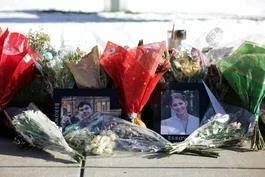
AMNA NAWAZ: Authorities are still searching for answers and for the alleged gunman in the shooting at Brown University four days ago.
Two students were killed and nine others injured.
Officials have released photos and video showing a person of interest walking near the campus hours before the shooting.
The FBI is offering a $50,000 reward for information leading to an arrest.
There's still concern in Providence about the whereabouts of the shooter.
Providence Mayor Brett Smiley tried to provide reassurance to residents this evening.
BRETT SMILEY (D), Mayor of Providence, Rhode Island: The best information we have is that there is no credible, actionable, specific threat that has occurred since Saturday.
And in order to enhance and ensure the safety of our community, we have stepped up law enforcement efforts throughout the city in a precautionary measure.
AMNA NAWAZ: For more, I'm joined now by Juliette Kayyem.
She's a professor at the Harvard Kennedy School of Government and former assistant secretary at the Department of Homeland Security in the Obama administration.
Juliette, thank you for joining us.
JULIETTE KAYYEM, Former U.S.
Department of Homeland Security Assistant Secretary: Thanks for having me.
AMNA NAWAZ: So you heard officials there asking for the public's help, releasing these images.
From your experience, how helpful could this be, these images in particular?
And what do you make of the fact that they still have not identified or found this suspect?
JULIETTE KAYYEM: Yes.
I mean, in some ways, this isn't really a manhunt because they don't know who the man is.
A manhunt is generally you have an image or even a name and you're going after them, talking to family and friends.
It is remarkable and unusual in this day and age, with that many cameras, with students with phones, that they cannot get, seem to get a great picture of his face.
He was, of course, masked through -- in some of these pictures or in all the pictures.
So this will be helpful for the sole purpose of convincing someone who recognizes him, who already knows him to come forward.
He has a unique gait.
He has a unique physique, a stocky walk.
If you knew him, you might be able to identify him.
So that, with the -- the pictures, with the ransom, is simply trying to lure family and/or friends to come forward.
But if you just pass this guy on the street, you would not know who it was.
AMNA NAWAZ: In these kinds of cases though, the longer it goes on, does it make it less likely that they will find this person?
JULIETTE KAYYEM: Well, there's two pieces to that.
One is, look, they had a course-correction about a day-and-a-half ago, right, with this person of interest not being the person.
And so they lost some time.
And losing time means that he has -- he can get away and get away further.
It also means that evidence that he might have left -- he was sort of around the area for a couple hours before -- could be destroyed.
There was a lot of snow.
I was in Providence.
There was a lot of snow that came down after the killings.
But this time, they are using now to collect videos from people who probably didn't know they had them.
There's lots of Ring camera videos and other videos that may at some stage give them a better identification.
AMNA NAWAZ: I'm sure you have seen too there have been some reports about tensions between officials in Providence and the FBI,who are also, of course, on the ground investigating, some questions about responsibility.
I want to play for you a piece of sound from President Trump yesterday who spoke to this when he was asked about why he was taking the FBI so long to identify the shooter.
Take a listen.
DONALD TRUMP, President of the United States: But you really have to ask the school a little bit more about that, because this was a school problem.
They had their own guards, they had their own police, they had their own everything.
But you would have to ask that question really to the school, not to the FBI.
We came in after the fact.
And the FBI will do a good job, but they came in after the fact.
AMNA NAWAZ: Juliette, what do you make of what the president had to say there?
JULIETTE KAYYEM: The school has no arrest or investigatory authority.
I think there are great questions about the university, to the university about, essentially, its accessibility.
What has it learned from this?
How is it going to protect students when they come back?
But the investigation is clearly led by local, state, and federal law enforcement agencies, including the FBI.
I'm not disclosing anything.
The Rhode Island attorney general said it, that the FBI basically got way ahead of the investigation.
FBI Director Kash Patel has just a very destructive habit of putting things on Twitter before they can be verified.
And so what happened is, when they had that person of interest, all focus went there, because the FBI essentially announced it, and then they had to unwind it.
The challenge, of course, as I said, is not only did they lose time.
You're really beginning to have a community lose confidence.
And that you cannot have.
It looks like they're too divided.
They did a regroup press conference about an hour ago.
FBI was back at the table.
Everyone was talking about unity of effort, and one can hope that they find this guy, or identify him at least, so that the hunt can begin.
AMNA NAWAZ: Meanwhile, Juliette, I want to tap into your expertise to ask you about the other mass shooting that we are following.
That was the one targeting Hanukkah celebrations at Bondi Beach in Australia.
We reported authorities are now calling it a terrorist attack.
The Australian prime minister said it appears to be inspired by ISIS.
We reported they found homemade Islamic State flags in the shooter's car.
From your expertise, is there a resurgent ISIS threat to be worried about here?
JULIETTE KAYYEM: Yes.
I mean, I think there's no question about it.
It's been one that we have been watching through 2025.
It's not as organized.
There's not the same kind of leadership.
But, basically, about four months ago, ISIS said or put statements out about targeting Jewish organizations or Jewish meetings, anything that would be public.
We saw this now in Australia.
But we can't forget also two service members were killed in Syria on Friday by someone who -- by ISIS.
And so we do worry in the counterterrorism field about this resurgence, as ISIS looking at a world destabilized, and much of the world, Europe, Russia, China and the U.S., are focused on other things.
So it's a tragedy and might -- and is a sign of what ISIS wants to happen in 2026.
AMNA NAWAZ: Juliette Kayyem of Harvard Kennedy School of Government, always good to speak with you.
Thank you.
JULIETTE KAYYEM: Thank you.
GEOFF BENNETT: The Lebanese army is on a tight deadline to comply with an American demand to dismantle Hezbollah's military infrastructure as part of a cease-fire agreement.
Israel dealt the terror group destructive blows over the last two years after Hezbollah attacked Northern Israel following the Hamas strikes of October 7.
Special correspondent Simona Foltyn and videographer Adrian Hartrick were given exclusive access to Hezbollah's military installations recently seized by the army south of the Litani River, as the military works to retake territory long held by the Iran-backed group.
SIMONA FOLTYN: We are with the Lebanese army a few miles north of the border with Israel, about to gain unprecedented access to one of Hezbollah's core areas of operation.
For the first time in decades, the Lebanese government is asserting sovereignty here.
On the edge of Yater Village, we disembark and leave the cars behind.
The rest of the trip must be made on foot.
Hezbollah's military installations are hidden from sight tucked away deep in the valleys.
CAPT.
CHRISTIAN ABOU CHAAYA, Lebanese Armed Forces: So we know that there is facilities from these telephone wires and these water pumps.
SIMONA FOLTYN: Captain Christian Abou Chaaya part of the army's engineering unit tasked with dismantling Hezbollah's weapons.
CAPT.
CHRISTIAN ABOU CHAAYA: We are going to see a rocket launcher.
The type is THAAD-2.
It has eight barrels with eight rockets.
SIMONA FOLTYN: When did you discover or when did you search this area?
CAPT.
CHRISTIAN ABOU CHAAYA: Last week.
SIMONA FOLTYN: Last week?
So this is pretty recent?
CAPT.
CHRISTIAN ABOU CHAAYA: Yes.
SIMONA FOLTYN: It's inconceivable that anyone but Hezbollah could have set foot here before the war, not the Lebanese army, not civilians, and certainly not journalists.
That these areas are now in the hands of the state speaks to decisive power shifts the war has brought upon Lebanon and the region.
We descend along the steep muddy slope down into the ravine.
The facility blends so seamlessly into nature, we might have walked past it.
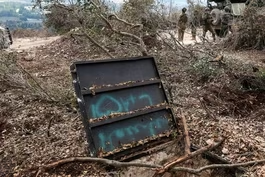
But right there carved into the southern ridge of the mountain lurks one of Hezbollah's signature weapons.
So, this is a 240-millimeter rocket launcher that was hit in an Israeli air raid.
We don't know exactly when, but the strike did manage to take it out by damaging the fuse.
Now, the warheads, the rockets, are still inside and they're still active.
The site offers a rare glimpse into how Hezbollah operated.
The way this weapon system would have been used is, a Hezbollah fighter would actually have to come down here.
There was a generator in the back that they would have to turn on, then pull the rocket launcher out of this cave using these rail tracks, then enter the coordinates of the target they wanted to strike in Israel, and then use this starter over here to launch the rockets.
The weapon components were likely brought here one by one as Hezbollah secretly built its capabilities over many years.
But Israel managed to infiltrate the group and, in the span of a few short weeks, wipe out a significant portion of its infrastructure.
The Lebanese army is dismantling what's left.
CAPT.
CHRISTIAN ABOU CHAAYA: It's a part of our routine job.
Every day, we inspect a new area.
SIMONA FOLTYN: What are some of the challenges you face in this difficult terrain?
CAPT.
CHRISTIAN ABOU CHAAYA: The nature, the climate.
It's raining.
Now it's winter.
And not just the nature.
We have also -- we faced a lot of mines, IEDs, cluster munitions, so the work here is very dangerous.
SIMONA FOLTYN: Do you know if there might be other similar facilities around here?
CAPT.
CHRISTIAN ABOU CHAAYA: We will neutralize this one and go forward, but I think, yes.
From the dirt road, I think we should find something else down there.
SIMONA FOLTYN: The army has combed through 124,000 acres of land and seized more than 230,000 weapons across 460 Hezbollah facilities in the south.
General Jihad El Khazen is the deputy commander of the sector.
BRIG.
GEN.
JIHAD EL KHAZEN, Lebanese Armed Forces: We started this on the 5th of September, and we're still continuing that.
Until now, we have already completed between 90 to 95 percent.
SIMONA FOLTYN: The IDF claims that Hezbollah is rebuilding its military infrastructure, including south of the Litani River.
BRIG.
GEN.
JIHAD EL KHAZEN: There is no evidence now that Hezbollah is rebuilding its infrastructure.
SIMONA FOLTYN: The army has until the end of the month to complete the process south of the Litani River, the first of five phases to disarm the Iran-backed group.
The Trump administration has complained about lack of progress, which the army is keen to disprove.
They take us to another site where the engineering unit is about to detonate a rocket launcher.
CAPT.
CHRISTIAN ABOU CHAAYA: We are using here TM-57 mines, anti-tanks, because they contain a large quantity of explosive.
SIMONA FOLTYN: This facility was also damaged in an Israeli strike.
So what is the reason why you destroy these weapons, rather than storing them?
CAPT.
CHRISTIAN ABOU CHAAYA: So, usually, when we find an item, we check if it's in a good condition or not.
If it's in a good condition and it's safe to move, we just collect it and move, transport it to be inspected by a specialist.
If it matches with the weapon system, the army weapon system, we take it, we store it.
SIMONA FOLTYN: Would you say that most of the weapons you find are compatible with the army's weapon systems or not?
CAPT.
CHRISTIAN ABOU CHAAYA: Most of the weapons we find are not compatible with our weapon system, because our weapon system is Western, and most of the weapons that we find are Eastern.
SIMONA FOLTYN: Hezbollah was Lebanon's most powerful armed actor.
The destruction of its equipment means the country will be left with few defenses.
Safety protocol dictates that we must withdraw 500 yards as the engineers rig the site.
So we drive uphill to watch the explosion alongside the local population.
Many here remain loyal to the resistance, as Hezbollah is called here.
In the absence of a robust state, the group was seen as their protector, as the only bulwark against repeated Israeli incursions.
The army is trying to win their trust, an uphill battle in light of Israel's near-daily cease-fire violations and ongoing occupation.
BRIG.
GEN.
JIHAD EL KHAZEN: We need also that the Israeli side give some positive steps by withdrawing, by stopping all their attacks.
SIMONA FOLTYN: Squeezed between demands of the U.S.
and Israel on the one hand and concerns of Lebanon's Shia population on the other, the army is walking a tightrope, and they must walk it fast if they want to avert another war.
For the "PBS News Hour," I'm Simona Foltyn in Southern Lebanon.
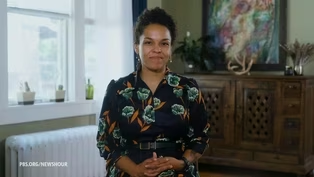
AMNA NAWAZ: Kayla Stuart is a Tennessee-based urban forester who leads the organization Tree CPR to create healthier, stronger communities as climate change escalates.
She shares her Brief But Spectacular take on the power of trees.
KAYLA STUART, Program Director, Tree CPR: My fondest memories outdoors were with my grandparents in the Great Smoky Mountains National Park.
We would look for crawdads and salamanders and birds.
My grandfather was an ecologist, so we had a walking encyclopedia with us who fed us all this information that I didn't realize would have such a huge impact on my life.
I unfortunately lost him to cancer, and ever since then I have been looking for ways to continue his legacy and really make him proud of the person that I'm becoming in our natural world.
Memphis sits along the Mississippi River in the Delta region, and it's got some of the most beautiful big trees I have ever seen in my entire life.
Trees provide protection for us, and, sometimes, we forget that.
They can cool cities up to 20 degrees sometimes in times of extreme heat.
There's a lot of inequities in neighborhood to neighborhood across Memphis.
You can tell which neighborhood is more vulnerable just by looking at how their vegetation is managed, if there are any trees that have been planted recently.
And a lot of times, those communities that are more vulnerable and have historically faced discrimination tend to have lesser-quality tree canopy.
I created Tree CPR.
Tree CPR is a work force-based program that teaches individuals primarily from underserved communities the technical skills, as well as the soft skills, they need to get jobs in natural resources.
I want the students in my class to understand how important it is for us to be stewards of the vegetation in and around our communities.
It's important for people from these, like, historically disadvantaged communities to have a seat at the table so they can make decisions for their own neighborhoods, to say, hey, we need more shade here, we need higher-quality tree canopy here.
They will reduce their communities' vulnerability because they're present in those conversations, and that's important.
I hope to not only make my grandfather proud, but I want people who look like me and who have had similar experiences in life as myself to really feel like they can take control of their own communities through urban forestry.
My name is Kayla Stuart, and this is my Brief But Spectacular take on creating a cooler future.
AMNA NAWAZ: And a news update before we go.
President Trump says he's designating the Maduro regime in Venezuela a foreign terrorist organization and is imposing a -- quote -- "total and complete blockade" of all sanctioned oil tankers going into and out of Venezuela.
GEOFF BENNETT: We will continue to follow this story online and right here tomorrow on the "News Hour."
And that is the "News Hour" for tonight.
I'm Geoff Bennett.
AMNA NAWAZ: And I'm Amna Nawaz.
On behalf of the entire "News Hour" team, thank you for joining us.
A Brief But Spectacular take on the power of trees
Video has Closed Captions
Clip: 12/16/2025 | 2m 47s | A Brief But Spectacular take on the power of trees and creating a cooler future (2m 47s)
How the ACA subsidies work and who depends on them
Video has Closed Captions
Clip: 12/16/2025 | 7m 37s | How the Affordable Care Act subsidies work and who depends on them (7m 37s)
Jobs report reveals 'uneven economy,' analyst says
Video has Closed Captions
Clip: 12/16/2025 | 5m 42s | Jobs report reveals cooling labor market and 'uneven economy,' analyst says (5m 42s)
A look inside secretive Hezbollah bunkers seized by Lebanon
Video has Closed Captions
Clip: 12/16/2025 | 7m 6s | A rare look inside Hezbollah's secretive bunkers seized by Lebanon's military (7m 6s)
News Wrap: Nick Reiner facing first-degree murder charges
Video has Closed Captions
Clip: 12/16/2025 | 6m 26s | News Wrap: Nick Reiner facing first-degree murder charges in killing of his parents (6m 26s)
Sen. Cassidy on health care costs and expiring subsidies
Video has Closed Captions
Clip: 12/16/2025 | 8m 32s | GOP Sen. Cassidy on addressing rising health care costs and expiring subsidies (8m 32s)
What’s in the massive military spending bill
Video has Closed Captions
Clip: 12/16/2025 | 7m 34s | What’s in the massive spending bill giving the military more funding than requested (7m 34s)
Why investigators are struggling to find Brown Univ. gunman
Video has Closed Captions
Clip: 12/16/2025 | 6m 48s | Why investigators are struggling to find the Brown University gunman (6m 48s)
Providing Support for PBS.org
Learn Moreabout PBS online sponsorship
- News and Public Affairs

FRONTLINE is investigative journalism that questions, explains and changes our world.

- News and Public Affairs

Amanpour and Company features conversations with leaders and decision makers.
Urban Consulate Presents











Support for PBS provided by:
Major corporate funding for the PBS News Hour is provided by BDO, BNSF, Consumer Cellular, American Cruise Lines, and Raymond James. Funding for the PBS NewsHour Weekend is provided by...