
Trump’s struggle to find an off-ramp from the Iran war
Clip: 5/8/2026 | 11m 56sVideo has Closed Captions
Trump’s struggle to find an off-ramp from the Iran war
Is the United States still at war with Iran? If the war is over, who won and who actually controls the Strait of Hormuz now? The panel discusses these questions and whether Trump has an exit strategy from the fighting he initiated.
Problems playing video? | Closed Captioning Feedback
Problems playing video? | Closed Captioning Feedback
Major funding for “Washington Week with The Atlantic” is provided by Consumer Cellular, Otsuka, Kaiser Permanente, the Yuen Foundation, and the Corporation for Public Broadcasting.
Trump’s struggle to find an off-ramp from the Iran war
Clip: 5/8/2026 | 11m 56sVideo has Closed Captions
Is the United States still at war with Iran? If the war is over, who won and who actually controls the Strait of Hormuz now? The panel discusses these questions and whether Trump has an exit strategy from the fighting he initiated.
Problems playing video? | Closed Captioning Feedback
Where to Watch Washington Week with The Atlantic
Washington Week with The Atlantic is available to stream on pbs.org and the PBS app.
Buy Now
10 big stories Washington Week covered
Washington Week came on the air February 23, 1967. In the 50 years that followed, we covered a lot of history-making events. Read up on 10 of the biggest stories Washington Week covered in its first 50 years.Providing Support for PBS.org
Learn Moreabout PBS online sponsorshipJeffrey Goldberg: The Iran war is in a kind of state of suspended animation.
On Thursday, U.S.
forces actually struck Iranian targets after two U.S.
destroyers were attacked in the Strait of Hormuz.
But President Trump called this U.S.
response a, quote, love tap, and said that the exchange of fire did not represent a break in the ceasefire, even though ceasefires, in general, don't include two warring parties firing missiles at each other.
What we can take away from this episode is that Trump, who initiated the latest round of fighting in the 47-year-old war between Iran and the U.S., would like to do something else now.
I'll talk about this confusing situation, as well as some large domestic political developments, with Peter Baker, the chief White House correspondent at The New York Times, Jonathan Lemire is a staff writer at The Atlantic and a co-host of Morning Joe on MS NOW, Amna Nawaz is a co-anchor and co-managing editor of the PBS NewsHour, and Vivian Salama is a staff writer at The Atlantic.
Thank you all for joining me.
Amna, thank you for staying up late.
I appreciate it.
Amna Nawaz, Co-Anchor, PBS NewsHour: You're outing me as an old person on T.V.
Jeffrey Goldberg: I'm not outing you as an old person.
I just think w - -, you know, the NewsHour audience needs you to be rested.
Amna Nawaz: That's right.
Jeffrey Goldberg: So, I appreciate you being here.
Amna Nawaz: Thank you.
So, let me start with you, give you the first question.
Amna Nawaz: Great.
Jeffrey Goldberg: So, am I wrong to say that the Iranian regime has won this war first by surviving and second by maintaining more or less control over the Strait of Hormuz?
Amna Nawaz: I mean, that is their main leverage point right now, and I think it depends on who you ask, who's winning or who's losing.
Certainly, you can't say the United States has won the war, as President Trump has said.
And, look, the president has become sort of an unreliable narrator to all of this, right?
As you mentioned, he calls these strikes a love tap.
He said it's a diversion, a military incursion.
We are at war, and I think we need to be clear about that in whatever this state of a ceasefire actually is.
And I think we need to look at what we've actually seen happen rather than what the president says is going to happen, which was a punishing U.S.
bombardment.
The ayatollah killed, his successor put into place, and the Iranian foreign minister told me as a continuation of the Ayatollah Khamenei.
So, that wasn't really a regime change.
But we've also seen a throttling of the Iranian economy.
The president says it's going to cripple them soon, and now we have a new analysis that suggests that the regime could actually last months in this new phase of sanctions and the blockade on their economy.
Jeffrey Goldberg: So, Vivian, if it does -- it does only last for months, and Trump has the staying power to see through the throttling of the oil economy, wouldn't that then count as a victory for the United States?
Vivian Salama, Staff Writer, The Atlantic: It depends how you measure victory, right?
I mean, politically, he is suffering.
The longer this war goes on, the more that he and, ostensibly, the GOP suffers.
You have midterm elections later this year, and they could really take a shellacking if they do not have the ability to lower oil prices, lower gas prices specifically, and just moderate the impact of this war.
But even just the depletion of assets, military assets, the sort of mental state of the country in terms of having to go to war at a time where a number of people, especially many of Trump's supporters, did not support this war.
All of that has a cost, ultimately.
And so President Trump is and the GOP will have to reckon with that moving forward regardless of whether or not there is an end date to this war.
Jeffrey Goldberg: So, the question here is staying power.
Jon, you just wrote in The Atlantic today, quote, Trump is left with a vexing question, how do you end a war when your opponent won't budge?
And while Trump grasps for an exit, the hardliners in Tehran have used the war to tighten their grip on power.
Iran seems hell-bent on pulling off something it's historically done well, humiliating an American president.
So, to win here, does Iran just have to outlast a person with a historically limited attention span?
Jonathan Lemire, Staff Writer, The Atlantic: Yes.
And President Trump is very ready to turn the page.
As one former adviser told me, he's bored of this conflict, but also because it's not -- Jeffrey Goldberg: The word they used was literally bored?
Jonathan Lemire: Bored, in part because it's not going the way he thought it would.
He thought this a matter of days, a matter of weeks at most, and it would be a resounding victory like he says we saw in Venezuela.
That has not been the case, and instead he's been made to look sort of weak on the global stage.
Already, Iran has -- even if the war were to end tomorrow, which it will not, that Iran has more control of the Strait of Hormuz now than it did at the start of the conflict.
They have shown they can shut it any time, and the pain that would accompany that to the global economy, as Vivian said, the president is in a tough political situation here at home.
Gas prices are up.
His poll numbers are down.
Very few of the U.S.
military goals have actually been accomplished there in Tehran.
And the president is looking desperately for an off-ramp, some sort of deal here, and that's why in part we see him continuing to extend the ceasefire even with incidents like this week where, clearly, you know, there was hostilities, but he won't escalate.
He keeps pushing it further on.
Jeffrey Goldberg: Right.
Amna, very interested in how Iran is responding to his idiosyncratic methodology here, but I'm also interested in understanding how China is understanding this.
Amna Nawaz: China's clearly watching this very closely, right?
And talking about how the Iranian economy continues to chug along, all those other countries like China continuing to buy that oil.
This also really complicates the president's upcoming visit to China.
There's a lot of other conflicting narratives and issues that they have to deal with at a time that the U.S.
and China have other things that they need to be talking about that deal directly with the U.S.
economy.
That's a real challenge for the president.
Jeffrey Goldberg: Right.
And, Vivian, from a defense standpoint, obviously, the U.S.
is depleting its stocks of weapons that could be used theoretically to defend Taiwan.
So, China has to be looking at that.
Vivian Salama: China is definitely looking at that, realizing also military assets that had been stationed in the Asia Pacific that had been shifted to the Middle East so that it could support the war effort in Iran.
A number of, you know, just diverted interest that China sees as a door opening.
And its intense interest in securing its position in Taiwan especially since President Trump has not been sort of orthodox about wanting to outwardly defend the sovereignty of Taiwan even though officials tell me that privately the administration's policy hasn't changed.
He hasn't really been bullish on that because he's so keen to maintain good relations with China, perhaps extend some sort of a trade deal with China.
And so he's looking at the economic, the transactional opportunities with China less so than, say, the future of Taiwan all the while this war in Iran is going on, and it really opens the door for China to do what it wants to do.
Jeffrey Goldberg: Peter, stipulating that it can go any way and that Iran could collapse tomorrow and et cetera, et cetera, the story is not done, stipulating all that, who in the White House now has a realist view of what's going on, or a realistic view of what's going on in terms of the duration, the impact on America's global standing, the depletion of assets, et cetera, what's the fight inside the White House?
Peter Baker, Chief White House Correspondent, The New York Times: Well, I mean, have to believe Dan Caine, the chairman of the Joint Chiefs, has a pretty realistic view of this.
And he told them from the beginning it wouldn't be as easy as the president said it was.
Jeffrey Goldberg: He's getting the numbers.
Peter Baker: He's getting the numbers, and he's the one who told the president even before this started that the Iran could take the Strait of Hormuz and create problems.
The president brushed it off, according to reports saying, well, that won't happen.
They'll collapse before that happens, and even if they do, you guys can take care of it.
Obviously, that's not the case.
You have to look at J.D.
Vance who said from the beginning he didn't want this war, he didn't think it was a good idea.
He has stuck to that even as he has been publicly supportive of the president and participated in these peace talks.
But I think that his point of view looks a little stronger in some of these internal discussions to this point.
But he doesn't have an out for them either.
I don't think that any of them has the clear path to a resolution of the war that allows the president to claim victory, given the things that Jonathan just outlined, given the intelligence reports we've seen saying that they still have most of their ballistic missiles, they're still as close to a nuclear weapon as they were when the war started, and they have increased control over the Strait of Hormuz, what does that look like?
Jeffrey Goldberg: Right.
Jon, when did the president decide that he was done?
Jonathan Lemire: He's been done for a few weeks now.
I mean, I think -- Jeffrey Goldberg: I mean, the war's only been going on for a few weeks.
Jonathan Lemire: Well, as you say, legendary short attention span, he thought this would be days.
I mean, he's looking for a deal even now.
Washington awaits a response to a - - from Iran on a one-page memorandum, which, at best, is like kicking the can down the road.
It just extends the ceasefire further.
They're nowhere near any sort of negotiation, and it's not clear that Iran is incentivized to deal with him right now, that they think, yes, maybe there will be economic pain.
Maybe the people will suffer.
Well, the IRGC running the place don't really care about that.
They feel like this is a moment to make a stand, and they are making the president of the United States look weak.
Vivian Salama: And Jonathan and I have actually written together that, you know, President Trump explored an off-ramp weeks ago, but of Gulf allies in particular had been extremely alarmed at the situation that he would have been leaving behind had he pulled out a few weeks ago because it's right on their doorstep.
Jeffrey Goldberg: Well, we'll stay on that.
If he continues in the pattern that he's going, in the direction he's going, which is finding any reason in the world not to reengage, and even when he has to reengage, calling it a love tap, where does that leave Saudi Arabia, United Arab Emirates, Qatar, Israel for that matter?
Vivian Salama: All of them have been shown the very harsh realities of their vulnerability is with the closure of the Strait of Hormuz and the inability for them to export oil, which is their -- the primary generate fund generator for their economies.
And so this has been an eye-opening experience for them.
But beyond that, even if the Strait of Hormuz were to open tomorrow, they still have to reckon with the fact that Iran's nuclear program is still an open question.
And that is not going to be solved any time soon.
There could be a migrant flow at any moment because of the battering that Iran has taken.
They're right there on their doorstep.
Bahrain is less than 60 kilometers from Iran.
They have a very real -- a very harsh reality in front of them after this war ends of what the future of Iran looks like in the region as a whole.
Jeffrey Goldberg: One more question on this.
Peter, I assume this is the subject of your next book in 2029 or whatever, but you try to answer it now.
Peter Baker: Pre-order now.
Jeffrey Goldberg: But pre-order it now, yes.
But how did this happen given -- and answer it in 12 seconds if you can.
How did this happen in the sense that Iran is very good over the last four decades, almost five decades of messing with American presidents, the Iraq War, which was extremely well planned compared to this.
Peter Baker: Yes.
Jeffrey Goldberg: How do they just drive right into this cul-de-sac?
Peter Baker: I think what you see here in his second term is a president who feels more comfortable with power, emboldened to do the things he didn't do in the first term.
Remember in the first term, he launched a strike against Iran over a relatively modest incident, and then pulled back ten minutes before the bombs were to hit because he just felt uncomfortable about it.
This time he feels comfortable.
He's emboldened by Venezuela.
He thinks that worked out really well.
He's emboldened by the strikes last June, which did seem to work out pretty well.
He did it for 12 days.
No damage, much damage anyway, to America or its allies.
And in theory, according to him, he obliterated the nuclear program that we now had to go back in and do again.
So, I think he felt emboldened, I think he felt empowered, and I think they obviously misjudged the total cost of how this was going to work out.
Amna Nawaz: Jeff, I'll say one more thing, because a former U.S.
negotiator with Iran put it to me this way.
There's two different pain clocks, right, on Iran.
They are fine to cause pain to their own population.
That's not an issue for the regime.
Here, the president has to deal with surging energy prices, low approval numbers, and midterms in about six months.
Jeffrey Goldberg: It's interesting.
Our definition of pain is gas at $4.50 or $5 a gallon.
Their definition of pain is mass death.
But even there, the regime does not care about mass death on the part of their people.
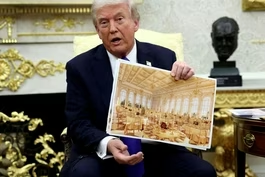
What’s driving Trump’s push to leave his mark on Washington
Video has Closed Captions
What’s driving Trump’s push to leave his mark on Washington (11m 20s)
Providing Support for PBS.org
Learn Moreabout PBS online sponsorship New Episode
- News and Public Affairs

Top journalists deliver compelling original analysis of the hour's headlines.

- News and Public Affairs

FRONTLINE is investigative journalism that questions, explains and changes our world.

 New Episode
 New Episode
 New Episode
 New Episode
 New Episode
 New Episode

 New Episode

Support for PBS provided by:
Major funding for “Washington Week with The Atlantic” is provided by Consumer Cellular, Otsuka, Kaiser Permanente, the Yuen Foundation, and the Corporation for Public Broadcasting.