
Canada Tariff Fight, $10 Billion in Farm Aid and a Cattle Market Squeeze - July 24, 2026
Season 51 Episode 5149 | 26m 45sVideo has Closed Captions
New tariffs heighten U.S.-Canada trade tensions, USDA backs $10 billion in emergency farm aid.
On this edition of Market to Market ... President Trump announces new 50 percent tariffs on many Canadian imports, raising concerns about retaliation and disruptions to agricultural trade. USDA Secretary Brooke Rollins supports $10 billion in direct assistance for farmers facing high input costs and losses during the 2026 growing season.
Problems playing video? | Closed Captioning Feedback
Problems playing video? | Closed Captioning Feedback
Market to Market is a local public television program presented by Iowa PBS
Canada Tariff Fight, $10 Billion in Farm Aid and a Cattle Market Squeeze - July 24, 2026
Season 51 Episode 5149 | 26m 45sVideo has Closed Captions
On this edition of Market to Market ... President Trump announces new 50 percent tariffs on many Canadian imports, raising concerns about retaliation and disruptions to agricultural trade. USDA Secretary Brooke Rollins supports $10 billion in direct assistance for farmers facing high input costs and losses during the 2026 growing season.
Problems playing video? | Closed Captioning Feedback
Where to Watch Market to Market
Market to Market is available to stream on pbs.org and the PBS app.
Providing Support for PBS.org
Learn Moreabout PBS online sponsorshipComing up on Market to Market.
A tariff war with Canada is heating up and it could shake up agricultural trade.
Rollins presses Congress for $10 billion in emergency aid for U.S.
Farmers.
A closer look at the forces squeezing the American cattle market and commodity market analysis with Don Roose.
Next >> [MUSIC] >> I wouldn't be here without my customers.
>> Yeah.
I'd like to thank the customers there.
They're very dear to our hearts.
>> It's about the people that you're working with and the relationships that you have.
>> Thank you, thank you, thank you.
>> Thank you from the bottom of my heart.
>> [MUSIC] >> Tomorrow for over 100 years, we've worked to help our customers be ready for tomorrow >> [MUSIC] >> Trust in tomorrow.
Information is available from a Grinnell Mutual agent today.
>> Family owned and operated for more than 60 years.
Sukup Manufacturing is a full service provider of grain handling, storage and drying equipment, helping farmers feed and fuel the world.
>> Support for Market to Market has been provided by a bequest from Philip Leeds of Alta, Iowa, in recognition of public television's commitment to agricultural programing.
>> Market to market is made possible in part by a grant from the Corporation for Public Broadcasting >> This is the.
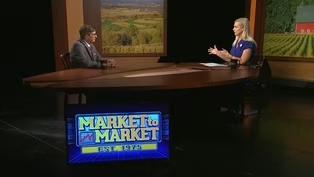
Friday, July 24th edition of Market to Market, the weekly Journal of Rural America.
>> Hello, I'm Brooke Kohlsdorf Paul Yeager is on assignment as the war in Iran went into high gear this week.
So did prices for oil and gasoline.
The average price for a gallon of gas rolled over $4.10, up from $2.98 when the war began in February.
A gallon of diesel fuel now averages $5.20, up nearly $2 from the same date four months ago.
Despite higher fuel prices that affect deliveries to job sites for new homes.
Sales were up 1.6% over May, but down 5.6% from this time last year.
In the early hours of Friday morning, an old set of tariffs expired and a new set putting a 12.5% duty on goods from 60 countries went into effect.
The tariffs cover 90% of the goods imported from the United States.
Earlier this month, the administration announced it will not renew the trilateral USMCA, which covers 1.6 trillion worth of trade between the U.S., Mexico and Canada.
On top of the newly minted 12% duty just put into effect, President Trump announced that in 30 days he will impose sweeping tariffs four times that amount on Canada.
The move got the U.S.
Uninvited from a ribbon cutting on the Gordie Howe Bridge that crosses between the U.S.
And Canada.
Laurel Bauer has the details on the growing trade dispute.
>> This week, President Trump heightened trade tensions with America's second largest trading partner, announcing new 50% tariffs on many Canadian imports.
The administration says the move is designed to protect the nation's industries and push back against what it calls unfair trade practices.
>> Canada has been very, very tough on us over the years.
For many years, and no other president has done anything about it.
>> Canada is also America's second largest agricultural export market, purchasing billions of dollars in U.S.
Farm products every year.
Some in the agriculture sector worry the latest trade dispute could invite new Canadian retaliation or further disrupt markets already facing tight margins and higher production costs.
>> We will look at all options in terms of how we would respond.
If they do come into effect.
This is part of the negotiation.
So the first objective is to get a comprehensive agreement.
The benefits obviously of both countries.
>> Agriculture is one of the first industries to be caught in the middle.
When international trade disputes start.
The new tariffs target alcoholic beverages, dairy products and certain food items.
Potash used for fertilizer is exempt from the duties.
For Market to Market, I'm Laurel Bauer.
>> The global trade war has cost U.S.
Farmers billions in losses, and the USDA has sent money to producers in order to offset some of that burden.
This week, Agriculture Secretary Brooke Rollins was back in front of lawmakers to appeal for more funds.
As part of the hearing, the secretary made her case, but there was some pushback over some of her previous policy decisions.
Peter Tubbs has more.
>> Inside facilities and hidden in.
>> This week, the Senate Committee on Appropriations heard testimony on the Pentagon's need for an additional $67 billion to continue the war with Iran and $10.
Billion for direct aid to farmers facing losses due to high input costs for the 2026 growing season.
USDA Secretary Brooke Rollins opened the hearing promoting the administration's successes in improving finances in farm country.
>> But that's why this supplemental is so important.
It provides a bridge and extends a hand to Americans who need it.
It buys the nation the security that we need, and it buys us time to deconstruct and then reconstruct a new system, putting our farmers and ranchers first, and to restore the system that originally made America great for our farmers.
The defense of American freedom continues.
They only ask to be free to fight.
Thank you so much.
>> Please update me on where we are in terms of getting that buy up option for crop insurance reinstated.
>> We are 100% supportive of that and are moving forward to execute that buy up option.
>> You have cut over 160,000 New Yorkers have been kicked off.
Snap.
What do you have against hard working New Yorkers?
Children who need Snap and seniors who need snap?
>> Well, first of all, diesel is Down under Biden versus today.
581 versus 480.
Gas is down from Biden today from 484 to 386 today.
Fertilizer is down 56% from Biden highs.
So this >> Narrative that you took office, well, of those prices are higher than when you took office.
>> For Market to Market.
I'm Peter Tubbs.
>> Will Harris, a fifth generation farmer, has seen a lot of things in his career as a cattle producer from Georgia.
He's been taking a value added journey that goes from raising animals to selling the finished product directly to consumers.
Harris is concerned about the hurdles new producers face when entering the industry, including purchasing land, raising the animals and fighting market forces.
He recently talked to our Paul Yeager as part of the M to M podcast.
Their discussion is our cover story.
>> Which I think that since my dad industrialized this farm post World War Two, the space that he lived in, raising calves and shipping them was was pretty good.
And he did well.
I think that that space economically has tightened and tightened and tightened and tightened until it's not much fun anymore.
And, you know, we got four big packers in this country that are packed with 80%.
And I don't know, the number is I think it's about right.
It's about right.
We're in, you know, the the, the cattlemen out here in the field raising calves is in.
We've worked ourselves into a position where we can just be squeezed so easy and so hard.
And I think that's why the, the cow calf cow numbers in this country are lower than they've been since World War Two.
Is that about right?
50 to 50, maybe.
I think that and, you know, cows are record high, but the numbers are not going up much.
And I think it's because of that situation I said.
And people have just been squeezed to the point that they don't want to do it anymore.
Raising cattle is a incredibly capital intensive business.
Land equipment, herd, et cetera.
You know, the the gestation period is still 283 days.
I don't care what you do.
283 days.
And then you, you, you won't have a marketable product for two years after that.
I'm edible marketable product.
So I think it's just become easier and easier for subsequent generations to say, you know, I'm just not going to do it anymore.
I'm just not going to do it.
And the demand for land.
>> But it's hard not to sell something that's profitable into the system right now.
If you have it.
This is going to be a little while right before this stabilizes.
And the consumer doesn't have to hear the headlines of high prices and beef, right.
This is not going to happen any.
This is not going to get solved anytime soon, is it >> I'm amazed that we hadn't opened the borders for importation of of beef.
And I knew the the screw fly in Mexico.
That's not what I'm talking about.
But you know, there's there's still a lot of countries in the world, South America, Australia, New Zealand, Uruguay that have beef.
And I think it's I think the market's pretty high up there, but it's not as high as it is here.
And I'm surprised that we hadn't seen a lot more.
I'm not I'm not advocating for it.
I'm just we just talking about what is.
I'm surprised we haven't seen more of that than than we have.
And I don't I don't know.
I'm not enough of a political student to know why it is.
And I don't I don't follow that, but I fully expect sooner or later our politicians to get intimidated enough by consumer dissatisfaction that they found a way to bring the price down.
And sadly, when that happens, it doesn't usually ease down.
It falls like a rock.
And I mean, I don't know enough about the international Economy supply to know why that hadn't happened or when it's going to happen.
But historically, that's what happens.
I can't imagine politicians telling consumers just wait 283 days and then two more years and it'll it'll all be fine.
>> You've heard that before, haven't you?
>> Yeah.
That's right.
So I, I know I don't have a crystal ball, but I'm just responding to your question because of course I'm just speculating.
And I guess I guess what I'm saying is what what I do know is that even with these record high prices, we don't see expansion blowing up in this country.
And I think that's very telling.
I don't know, maybe we we may have we may never get back to where we have been in terms of producing beef, live cattle in this country Money doesn't seem to make it come back.
Certainly high enough to incentivize expansion.
>> Is there one reason why it hasn't ticked the other way?
We haven't expanded.
Do you see one?
>> Well, I think the things we've said and and if you are, let's just say you sold some business somewhere and you got a lot of cash and you want to go into the cattle business, by the time you buy land, you improve it to show that it's a reasonable cattle operation.
By Broodstock and get get it all started and forget fencing and fencing and equipment and and then, you know, while cattle are higher level ever been they may not be all that high.
I mean, they may not be.
Clearly it's not high enough to incentivize people to do these things.
I just said >> The full MtoM podcast is available now.
>> Next, the Market to Market report >> A wet weather forecast.
A neutral USDA report, and late week profit taking pushed the markets lower for the trading week ending July 24th.
The nearby wheat contract lost a nickel and the September corn contract added $0.20.
The weather, both dry and wet, along with renewed Chinese buying, helped push the soy complex higher.
The September soybean contract added $0.47 and September meal increased $13.70 per ton.
December cotton gained $1.35 per hundredweight.
August class three milk futures fell $0.46.
The livestock market ended the week on a high note.
October cattle put on $1.80.
September feeders rose $2.10 and the October Lean Hog contract gained $1 eight.
In the currency markets, the U.S.
Dollar Index added 71 ticks.
September crude oil gained $7.10 per barrel.
Comex gold found $51.50 per ounce, and the Goldman Sachs Commodity Index added more than 39 points to settle at 71299.
And here now to lend us his insight on these and other trends is regular market analyst Don Rose.
Good to have you again, Don.
>> Good to be back.
>> Thanks for being here.
So we saw a lot of storylines this week in agriculture.
There were a lot of them.
Which one was most influential on the grain markets?
>> Well, I tell you, that's one thing.
There's a number of things.
And I think from a highlight standpoint, that's what's pushing the market up.
So into new highs.
And we made new contract highs on soybeans at the end because we have a we were in a dry drought pattern in Europe.
We were in a dry drought pattern here in the U.S.
And our temperatures warm.
You know, keep cooling and warming.
And, you know, we're in a dry drought pattern starting to set up here.
Also going forward with the heat.
Then we have the Russian Ukraine war, and then we have the Iran U.S.
War.
So it's adding it's one thing after another.
And, you know, I haven't seen this for a number of years where we don't just have one.
We have a number of things.
Brooke.
>> Yeah, it has been so with wheat.
Wheat was leading the way.
What was the thing pushing wheat this week?
>> Well, you know, I think the biggest thing on the wheat is, you know, of course, we had a dry drought pattern going on continuing in Europe.
And it looks like that's going to continue for at least another ten days.
And Europe as total, all the countries that are the largest wheat producer exporter in the world.
So a big issue over there.
Then we had the Russian Ukraine war continues to heat up.
So I think it's that combination is pushing us to the upside.
And then of course, you can't say enough about it's an El Nino year.
And going forward we could have some problems with some of these other countries.
Australia is supposed to go into a drier pattern.
So adding premium to these markets we did at the end of the week, Brooke, we had a hook reversal, a key reversal, if you will, on wheat, a little bit of a warning sign.
But we were extremely overbought.
So it's reasonable.
>> With all of that said, then will we see wheat go higher?
>> Well, you know, I think when you look at it, you're at some pretty lofty levels up here.
At the same time, when you're in contract highs, we did have that little reversal on Friday.
I think it's reasonable to say that we probably hold this value.
Let's see what the weather does going forward.
I always say, brick, this is more like a card game.
It's how the cards come out and then you'll be a little bit smarter as they come out.
But you know, right now a lot of bullish cards coming out with the things we just talked about.
And I think you have to anticipate as long as these trends are up, you get these setbacks.
But they're probably ones that find some good support.
>> Okay.
Was corn just following Wheat's lead this week?
>> Well, I think when you look at the corn market, number one, you know, go back to these weather problems, dry drought condition in Europe, Europe as a whole raises about 2.3 billion bushels of corn.
They import 800 million.
So I think with their dry drought, we probably have a chance for our imports to go up.
And then I think when you look at the growing conditions here in the US, we've had some real heat coming at us again next week in some of these key areas.
I mean, the heat is really from Texas all the way to South Dakota.
Temperatures spike into the high 90s, low 100 seconds.
So I think it's one of those that we don't know the size of the crop yet.
Look, Monday, I think we're going to see this time of year.
What I always tell people is look at how things are going week by week.
Is the crop getting bigger or smaller.
So look at the crop ratings on Monday and see if they go down.
That's a sign that we're getting smaller.
And typically, you know that tries to ratch us to the upside.
And you got to be a little bit careful, Brooke, with these markets right now.
Because seasonally this is the time of year.
This last week was when you put in a top and we drop into the fall.
That's typically that happens about 85% of the time.
But if you get into a contra seasonal, which we could be in, it's a very dicey situation.
Everything is just the opposite.
You crops get smaller and you ending stocks get smaller and you go higher into the fall.
So we're right at a critical point.
We'll see going forward.
>> No, a little more maybe next week or in two weeks.
So my next question kind of plays in well to what you just said, Phil, in Ontario is wondering December corn is within striking distance of $5 with crops burning up in the Western Europe and grain movement compromised in the sea, along with higher oil prices.
How much corn should farmers have contracted?
Or will $5 be a speed bump on the road ahead?
That's a long question, but what do you say?
>> Yeah, it is it's a it's a good question, actually, because I think this is a year like we haven't seen for a long time.
Typically.
Remember last year we went down into the the fall.
We never had a decent rally the year before.
We topped out in February.
But I think this is a year from a farmer standpoint that I think a person can give himself a chance to see if we're in a contra seasonal market.
And by that, I mean we're at some places where producers can rather lock in tight prices.
You can do some things with some of these creative options to lock in a price.
And that's what we're seeing people do.
And then given the upside, because there's a lot of unknowns going forward, it looks like to us that the crops getting smaller in the U.S., you know, we got hurt early in the year with too much rain in the east now, too much heat in the far west.
The middle of the corn Belt is probably okay.
So I would be not so aggressive and wait and see how these cards come out.
Brooke.
>> What about beans?
Are we going to see prices in the teens?
>> Well, the one thing about the soybean market, it can run pretty fast.
And we're in contract high.
So you have to be very careful when you get a market that's in contract highs.
And it's running to the upside.
And there again, you know August is a month for soybeans.
And sometimes we forget the real heat that is coming at us.
We were too wet.
Like we said early in the Eastern Corn Belt.
Now in the far west we're going to be too hot.
It looks like at a critical time frame, we forget North Dakota is the fourth largest soybean producer, acre wise in the in the nation in South Dakota is about number six.
So you've got this Nebraska, North Dakota, South Dakota, a lot of beans out there.
That's going to be a critical time for.
In fact, we forget North Dakota, South Dakota, acre wise is larger than Ohio.
Indiana.
That's a big switch.
So I guess I answer your question squarely.
Let's see how far we run to the upside.
But China's underneath the market buying soybeans also.
>> Yeah.
Let's talk about China.
How much did China's buying this past week play into corn soybean prices?
>> Well, if you really look at it, the Chinese were kind of slow buyers this week.
But it looks like we have the late September meeting between Trump and XI.
And we expect they're probably going to pick up the pace buying soybeans they need to buy about 37 million bushels a week.
So there's some big buying.
They've been slow so far.
So that means they've got a lot of buying to do going forward.
So you know and we're getting very competitive you know with South America right now.
And back to an El Nino.
It's an El Nino year.
And in the strongest El Nino in 75 years is the forecast.
And an El Nino year.
Brazil is supposed to be dry.
So they between Brazil and Argentina they produced twice as many soybeans as the U.S.. So.
Big card out there that we don't know.
But certainly I think it's.
Sellers beware.
At the same time.
>> What about the.
Let's move on to cattle.
It was the cattle on feed report was out today.
Did you see anything in it that interested you?
>> Well, the placement figures were down about 3%.
So, you know, I don't think a little bit supportive for some of those deferred months on out, five months out.
So maybe a little bit supportive there.
Cattle inventory report, semi cattle inventory report was also out.
It showed calves slightly under a year ago.
So a little bit positive there.
Probably the standout on it was actually the cold storage report.
And it had beef down about 11% versus a year ago.
Of course we know things are tight on the supply, but it had pork up 39%.
So big pork supplies trying to work through those and tight cattle supplies, beef supplies.
>> With pork.
Is that a consumer driven story?
I mean, are people turning more to pork now instead of beef because it continues to be so high?
>> Well, you know, that's a good question.
In fact, actually, that's been the big problem.
We have not seen the consumer he's been willing to pay up for the high priced beef at the expense of both pork and chicken.
But the last week and a half, two weeks, I think there's been a real switch where the consumers started to pick up his buying pace a little bit on the pork, back and away for a little bit from the cattle.
But that's a seasonal situation also, because usually demand on beef slows down during the summer just because of it's hot burger, hot dog and hamburger time frame, cheaper cuts this year, not so much, but I think late in the season, particularly when it got hot, we started to see some of those consumer changes.
>> Okay, I want to talk a little bit about crude oil too, because we saw it spike again this week.
It hasn't been this high in a couple of months.
So do you think it's going to go higher like higher higher in the coming weeks.
>> Well well one thing about it, I think it's concerning because it looks like we don't have the US Iran war anywhere as close to being solved, at least from what it looks like today.
Of course, that can change very, very fast.
But yeah, I think it's one of those that you need something to change out here before.
And is it going to so and it's a real question for the producer, because part of the reason the producer is not so aggressive on selling the crops, if he isn't, is because he's not sure what his not only diesel price, but also what's going to happen to fertilizer prices going forward.
So I would say that crude oil is very and energies are very, very overbought, but there's still no signs that we've got any kind of a top again, in the market.
>> Yeah.
And that fertilizer story is certainly something that we'll be paying attention to in the next few months.
We can probably talk a little more about that in Market Plus.
Don.
Thank you.
It's been a pleasure.
All right.
Well, you've been watching the analysis portion of our program, and in a moment, we'll continue our discussion in an online only segment.
You can find it by searching Market Plus with Don Roose wherever you get your podcasts.
You can also go to our website of Markettomarket.org to listen.
Don and I covered a lot of ground today, and if you want to go over everything again, just subscribe to our YouTube channel.
Be sure to click notifications so you'll know when we've posted the show, our stories and podcasts next week.
Surviving a record smashing fire on the Great Plains.
Thanks so much for watching and have a great week.
>> [MUSIC] >> Market to market is a production of Iowa PBS, which is solely responsible for its content >> Market to market is made possible in part by a grant from the Corporation for Public Broadcasting.
>> Support for Market to Market has been provided by a bequest from Philip Leeds of Alta, Iowa in recognition of public television's commitment to agricultural programing >> [MUSIC] >> Family owned and operated for more than 60 years, Sukup Manufacturing is a full service provider of grain handling, storage and drying equipment, helping farmers feed and fuel the world >> I wouldn't be here without my customers.
>> Yeah, I'd like to thank the customers.
They're they're very dear to our hearts.
>> It's about the people that you're working with and the relationships that you have.
>> Thank you, thank you, thank you, thank you from the bottom of my heart.
>> [MUSIC] >> Tomorrow for over 100 years, we've worked to help our customers be ready for tomorrow.
>> [MUSIC] >> Trust in tomorrow.
Information is available from a
 New
NewCorn and Soybean Markets May Be Turning Bullish – Market Plus with Don Roose
Video has Closed Captions
Clip: S51 Ep5149 | 9m 37s | Weather concerns and global conflict are adding risk to corn and soybean markets. (9m 37s)
Providing Support for PBS.org
Learn Moreabout PBS online sponsorship New Episode
- News and Public Affairs

Top journalists deliver compelling original analysis of the hour's headlines.
 New Episode
- News and Public Affairs

Today's top journalists discuss Washington's current political events and public affairs.
Urban Consulate Presents

 New Episode
 New Episode
 New Episode
 New Episode

 New Episode

 New Episode
Support for PBS provided by:
Market to Market is a local public television program presented by Iowa PBS