Community Town Hall: Workforce Ready - The Future Is Now
Special | 57m 4sVideo has Closed Captions
Brick by Brick Community Town Hall explores SW Ohio's preparation for the future of work.
Is our region "workforce ready"? In this town hall, join host Hernz Laguerre Jr. as he connects with educators, employers, workforce leaders, and community members about emerging opportunities, skilled talent needs, and innovative approaches to workforce development. What will it take to build a stronger workforce? Watch to find out the solutions underway, and the work still ahead.
Problems playing video? | Closed Captioning Feedback
Problems playing video? | Closed Captioning Feedback
Brick by Brick is a local public television program presented by CET
Community Town Hall: Workforce Ready - The Future Is Now
Special | 57m 4sVideo has Closed Captions
Is our region "workforce ready"? In this town hall, join host Hernz Laguerre Jr. as he connects with educators, employers, workforce leaders, and community members about emerging opportunities, skilled talent needs, and innovative approaches to workforce development. What will it take to build a stronger workforce? Watch to find out the solutions underway, and the work still ahead.
Problems playing video? | Closed Captioning Feedback
Where to Watch Brick by Brick
Brick by Brick is available to stream on pbs.org and the PBS app.
Providing Support for PBS.org
Learn Moreabout PBS online sponsorship(light music) - [Announcer] "Workforce Ready: The Future Is Now" is part of the "Brick by Brick Community Town Hall Series," brought to you by the generous support of: Tipp City Foundation, George & Margaret McLane Foundation, and more.
Thank you.
(light music fades out) (no audio) (light music) - [Hernz] Every morning across our region, thousands of people go to work.
They construct, they care for people, they create, they invent solutions, and now, increasingly, they're preparing for jobs and careers that may look very different from those in the workforce a generation before them.
This, indeed, is a brave new world.
- There's a lot of jobs out there.
There's still a lot of competition out there.
So it's trying to find the right people to fill the right positions.
- We have a lot of healthcare programs that are great.
I feel like there's a lot more opportunities around this region where we're at in Ohio.
- [Hernz] The region's economy has momentum, but as in-demand fields grow, they're facing a potential shortage of skilled workers.
- It comes down to a supply and demand issue.
The available labor supply does not meet the demand for that pool.
And so as we think about the changing demographics of our region, as we think about what those pressure points are, how do we continue to ensure that those companies and those employers have the workforce that they need?
- [Hernz] But workforce readiness is bigger than filling open jobs.
It's about creating opportunity.
It's about helping people see a future for themselves right here in our region.
And it's about making sure that education, business, government, and community organizations are not working in isolation, but working together.
- The really good news in our region is that we have a very robust pipeline.
And our challenge is trying to figure out how to keep that pipeline here.
- We invite industry to our classrooms, so it's ever-changing and it's always evolving.
It's about breaking down barriers for students and developing seamless pathways.
- Whether it's electrical, mechanical, hydraulics, pneumatics, machining, all the different areas, we really encourage the students to get an internship or a co-op where they're out working at an actual employer.
The strongest connection is the hands-on stuff.
- I went from being a press operator for many, many years on a production line to deciding that I wanted to become a robotics engineer.
- I talk to a lot of students who tell me that they didn't realize that whatever career path was a possibility for them, because they couldn't see it.
I think it's critical to give young folks an opportunity to see a variety of career pathways.
How can we scale that up?
- I've had a 25-year career in healthcare and decided to pivot and move towards HVAC.
There's a desperate shortage of HVAC workers right now because people are going for office jobs.
What excites me the most about the future is just the possibilities are endless.
- The folks that we get in the door here that are local to the Dayton area are as good or better than any talent anywhere.
And they're able to turn that capability and motivation into being excellent interns and employees later on.
- [Hernz] So what does it really mean to be workforce ready?
Are we preparing students for the jobs that exist today, as well as the ones that will exist tomorrow?
Are employers communicating what they need?
Are we giving young people enough opportunities to experience careers before they're asked to choose one?
And as we push to strengthen our economy, how do we make sure that everyone has a pathway to be a part of its future?
- Education and training is not some isolated thing.
It's for a purpose.
- As we continue to grow this sector, be it in aerospace and defense and manufacturing, you name the sector of the industry, finance, medicine, that is innately good for us no matter what.
- The future of work is already taking shape across Southwest Ohio, bringing opportunities and challenges, as well as strategies about how to prepare for what's next.
Over the next hour, we're bringing together educators, employers, and community leaders to explore, along with a live studio audience, what it will take to build a skilled and ready workforce.
I'm your host, Hernz Laguerre, Jr.
Welcome to the "Brick by Brick Community Town Hall Series."
Lets dive in.
(light music continues) (audience applauding) Welcome again to this "Brick by Brick Community Town Hall Series" event, looking at workforce readiness.
We're excited to have you all along with us, along with our live studio audience in Downtown Dayton.
Give yourselves a round of applause.
(audience applauding) Later on the program, they'll be asking all the questions of our expert panelists during a question and answer portion.
But first, we have two guests who are both regional leaders at the intersection of education, industry, and the community.
Dr.
Cassie Barlow is the executive director of SOCHE, the Strategic Ohio Council for Higher Education, which for 60 years has been connecting those stakeholders across the region and statewide.
We also have with us Joe Sciabica, chair of The Dayton Foundation's Workforce Coalition.
The group formed in 2023 to help address talent development gaps through school and industry collaboration, along with real-world experiences.
Outside that, Joe has spent his career in the tech field in a variety of leadership roles.
Thank you both for joining us today.
- Thank you.
- Thank you.
- Thanks for having us.
- Cool.
- Yeah.
- So you know, I wanna start out with, you know, the macro view.
I wanna look at the bigger picture.
For our audience here and at home, what would you say are the major gaps and gains in our industry, and where are the needs trending?
- So I would say overall that there are gains when you look at our region at-large from where we were at in 2007, 2008, with NCR and General Motors that were departing the area, to where we're at today, Sierra Nevada Corp, Joby Aviation, Electra.
You look at Wright-Patterson Air Force Base, where myself and Dr.
Barlow spent a large part of our career and time.
We've doubled in size over the last 20 years there.
And we're on a trajectory to continue to grow in that area as well.
And so those are the gains.
Gaps, I mean, we are blessed in this community, in this region, with a large number of educational institutions.
We have a large number of community-based organizations that are focused on workforce and people.
And our ability to come together and talk and discuss and do things just like you're hosting here tonight are what is gonna make this region continue to be strong.
So.
- Dr.
Barlow?
- 100%, those partnership are really critical.
With the demographic drought that we're working through right now, it is absolutely critical for every one of our students in K-12 to get through the process and cross the finish line.
We absolutely need each and every one of them.
And we have some big demands right now in terms of manufacturing and in healthcare and in skilled trades.
So our educators are doing a fabulous job of exposing students at a very young age to career pathways.
What do those look like?
And what's within the realm of the possible?
So that they can then get to the point of going into work-based learning opportunities and figuring out what's right for them.
So a lot of gains, as Joe mentioned, a lotta wonderful gains, but we have some work to do.
We're not done.
- Cool, and before we get into that work, I wanna take a second and just look at both of your backgrounds.
Could you tell me your role within your organizations, and also, what role are your organizations playing in helping fill this workforce?
- Sure.
- Dr.
Barlow, we'll start with you.
- Sure.
So I'm the president of the Strategic Ohio Council for Higher Ed.
We're a consortium of 31 universities and colleges across the state and into Northern Kentucky.
And what our focus is on is primarily on workforce development.
That means high school juniors and seniors, all the way up through postdoctorate level students and getting them the opportunity for work-based learning and fellowships at the most senior levels.
We are also very engaged from a job seeker standpoint and helping job seekers find what's next for them.
And then engaging with employers and making sure that we really understand what the employers' needs are and how we can best help them.
- [Hernz] Great, Joe?
- And so I'm the executive director of the Employers' Workforce Coalition, which is hosted under The Dayton Foundation here in Dayton, Ohio.
We're focused on 14 counties in our region, predominantly the Western Ohio section of JobsOhio, plus Warren and Butler County, which make up the kinda commuter circle down the I-75 corridor.
Our focus is on the 18 to really 42-year-old and beyond, as we define workforce, so that we pick up the youth that has come through the educational system.
And then there might be folks that are out there in gig economy jobs or working and they need an opportunity to, you know, upskill or reskill themselves.
So we're focused on participation, retention, and being able to bring people, migrate people into the community for the new jobs.
- And speaking of bringing people into community to fill those jobs, I wanna know what are the hurdles and barriers that's affecting the next generation of workers.
And also, what are the opportunities that are coming from these challenges?
- Yeah.
- Dr.
Barlow?
- Yeah, there are so many opportunities, but I will tell you that there are parts of our community that we really need, as Joe mentioned.
We need them in the workforce.
So for instance, our justice-involved individuals have a 29% unemployment rate.
And that's not okay, because we need them to be in the workforce.
And the same with people with disabilities who have a high, 8% unemployment rate, compared to the rest of the population, which is at 4%.
So we have to do better at engaging everybody and getting everybody involved in our workforce and making sure that we're helping them with their challenges.
Whether those are transportation or childcare or upskilling in some way, we have to figure out how to solve those challenges together.
- Sure, Joe?
- Yeah, I will just footstomp that.
I mean, we can create and we have created the pathways.
And just because we have a pathway, you know, doesn't mean that it'll work for an individual.
So a lotta the work that we collectively, across this community and folks that are gonna be coming up after Dr.
Barlow and I step off the stage here tonight, are focused on making sure that we're coming to where the people are, wrapping around them, providing the services and the capabilities and the products to help them be successful.
- I think a big part of them being successful is, you know, training and education.
We have about a minute left.
But I would love to get your take as to why the training and education is so essential to this process.
Joe, you first.
- Yeah.
So we're doing things where we're giving the exposure.
So through Sinclair College, where I'm a trustee, we're looking at the Integrative Technology Education Center where they're actually getting to hands-on understand the applicability of AI and cybersecurity and all those elements into like how's it go into manufacturing, healthcare, et cetera.
Through Dayton Public Schools, Ford Next Generation Learning Community, we are focused there on, you know, every student, developing academies, all means all, giving every student a guaranteed experience to understand what it is to commit to and understand a pathway and be able to work in those areas.
- Dr.
Barlow- - And I would just add to that really quickly.
- Your response.
- That it's important for our students to understand there's a lotta pathways for them.
- Yeah.
- And for some of those students, it's a industry-recognized credential.
For other students, it's an associate's degree.
And then for others, it's a four-year degree or higher.
And there's a space for everyone in our work.
- Love that.
Dr.
Cassie Barlow, Joe Sciabica, thank you so much for your responses.
We'll see you both again towards the end of our program.
So as we've been hearing, exposure is key to helping young people imagine and plan their career pathways.
That work starts early, from kindergarten through high school.
Dayton Public Schools is putting that idea into action using a career academy model as part of the Ford Next Generation Learning Initiative.
The intent is to connect is nearly 13,000 students to real-world opportunities and future careers.
Take a look.
(light music) It's a new day at Dayton Public Schools as a new year begins and a new approach has taken hold.
- Back to our conversation of like a math teacher, the English teacher, the history teacher, the science teacher, how might they teach through the lens of that career field and make it more relevant in real life?
- [Hernz] After months of partnering with the Ford Next Generation Learning Initiative, Dayton's faculty and staff are now a year into implementation of the career academy model, which connects students directly with career pathways, an aspect that's already winning the hearts and minds of some students.
- I'm in Allied Health (person laughing) at Ponitz, guys.
and I love my pathway.
I'm in my senior year.
I get my SCNA in December and I get my PCT as well.
So that's a new thing that we added on.
But we go in and we work with our mannequins that's in the bed, and it's so fun, like just doing everything to get my certification.
- [Hernz] The career focus spans all grade levels, pre-K through 12, connecting students with career pathways, work-based learning experiences, and direct exposure to training like never before.
- Dayton Public Schools has partnered with Ford Next Generation Learning to implement academy models across our high schools.
We're well underway with connecting with community members, staff, parents, students, and businesses and organizations who are going to help us make this a success.
- [Amy] I love the idea of having a guaranteed career experience for all of my children.
So that is pre-K through first grade, second, and we might not necessarily think of them as career ready, but they won't be until we get them there.
- Students decide which high school they wanna go to based on the pathways offered there, with most pathways being in growing fields.
Students don't have to decide an exact pathway until sophomore year, but as a freshman, they'll get extra support in order to make sure that their transition from junior high is successful.
Underneath the focused scholastics and cohort-like learning experience are the principles that DPS wants every student to embrace in their journey toward the world of work, higher ed, or the military.
(audience applauding) To provide more insight on this new model at the Dayton Public Schools, as well as other efforts within the K-12 space, we have two local educational leaders respond to the workforce need head-on.
Dr.
David Lawrence, superintended for Dayton Public Schools, whereas we just saw, they've become one of the newest Ford Next Generation Learning Districts, the second in Ohio.
And joining him is Dr.
Shannon Cox, superintendent of the Montgomery County Educational Service Center, which provides a variety of services to 16 school districts and more than 140 educational organizations across the Miami Valley.
They also have one of the leading Business Advisory Councils in the state, connecting industry directly with students in a number of ways.
Thank you both for joining us.
- Thanks for having us.
- You're welcome.
Thanks for having us.
- Cool.
So before we dive into the Dayton Public School new academy, you're both on the front lines of creating career pathways for students.
I wanna know, when did you guys make this shift, and also, what triggered this shift in education?
- So I think globally, for our region, we really noticed that changed after Ohio started recovering from the 2008 recession.
The jobs that our parents once could see out of the schoolhouse doors when they graduated from high school didn't exist anymore.
And so we knew that we were gonna have to work backwards, but we really weren't certain how to get there.
The age-old question of, "What do you wanna be when you grow up?"
that question was no longer an appropriate question, because kids really didn't know what they could be when they grew up.
So Montgomery County ESC, we focus on a future self vision, making certain that every student, regardless of their circumstances, can close their eyes and see themselves in the future.
When students couldn't answer that question, we knew it was time to take action.
- [Hernz] Dr.
Lawrence?
- I think, for me, being a Dayton native and a Dayton Public Schools graduate, Paul Laurence Dunbar High School graduate, I remember Patterson Cooperative, John H. Patterson.
And that was one of the best schools in the nation.
There were educators who would travel from all over the world to come to Patterson.
And at the time, students went to school for two weeks and then they had a trade or a pathway or were in the workforce, anywhere from Downtown, to the base, to any of our major corporations.
And they went on to do some fantastic things.
They could see, as Joe and Cassie said earlier, they could see what they wanted to be, and they did that all year with a five-week break.
So from a child, I knew that, hey, this is a model.
I just was never in charge to be able to implement it until now.
(laughing) - Well, awesome, you know?
And I wanna know about the implementation of the Ford Next Generation Learning program.
Can you talk about the approach in addressing the need of over 13,000 students?
- I think, for us, first of all, I wanna say this community is amazing.
You just talked to Dr.
Barlow earlier.
Joe Sciabica was sitting here.
They were two of the first people I called when I wanted to begin this Ford Next Generation Learning Initiative.
So we have these deep relationships.
Dr.
Cox was also involved.
Almost everybody on that sheet has been involved in some way, shape, or form in this partnership to say that we wanna transform how we do school in the region, in general, and specifically, Dayton Public Schools, with the Health and Human Services, Industry & Design pathways, and then our Freshman Academy.
- Cool, well, I wanna take a step outside of the Dayton Public School system.
Dr.
Cox, could you please share how these connections are successful in Montgomery County Educational Service Center in general, especially with the business and school partners?
- Absolutely.
So in the State of Ohio, every public school district is required to be part of a Business Advisory Council, and they can do that either on their own, and we have examples of that all across the state.
Or they can be part of one as a consortium.
So Montgomery County ESC brings together the 16 public school districts in Montgomery County, three public school districts in Warren County, but more importantly, we work with our trade organizations, we work with our policymakers, and we bring everybody together to sit down at the table and have really real conversations about what do we need to do differently in order to make certain that our students can graduate from any school within Montgomery County or in Warren County or in the State of Ohio and make certain that they've got a real, viable outcome for a living wage opportunity to stay right here in the State of Ohio.
Those Business Advisory Council efforts help us really break down the barriers.
When we talk about partnerships and we talk about the community wrapping their hands and arms around our students and our families, we had to redefine and shift mindsets.
You know, it used to be that you thought a partnership between an industry partner and a school district was that, "Here's a check for $3,000.
Can you put my name on the scoreboard?"
And it shines the lights on Friday night.
That's not it.
We have to see from an employer standpoint that their investment in helping young people see what opportunities actually exist here in this region is really an investment in their own workforce.
From there, we've really been able to just make great strides when it comes to making certain that young people know what those opportunities are.
- Well, I think, with getting young people to know what those opportunities are, I think assessments are pivotal.
Could you talk about how you guys go about doing your assessments, especially with YouScience, and other self-assessment programs?
How do you guys go about using those resources to help evaluate the students' abilities?
Dr.
Lawrence, we'll start with you.
- I think, for us, again, a partnership with ESC, we do use YouScience, and it's this combination of understanding what the aptitude is, in addition to what you want to do, marrying those two pieces.
And so we use that information to drive some of our pathways and with our Ford Next Generation Initiative to say, "Hey, these are pathways that students are interested in, and they also have the ability to do those things."
So I think it's important to begin by starting having a baseline of understanding where you are before you can go somewhere else.
- Dr.
Cox?
- Absolutely.
So one of the things that I think has just been a real game changer, a catalyst for the work that we've been doing is this assessment.
For a long period of time, I think everybody probably in the studio audience and those who are watching could probably remember that interest survey that somebody made you take.
And it was like, "Do you enjoy working with your hands?
Do you like to build a birdhouse?
Oh, you should be a carpenter."
Quite honestly, I think we've just lied to generations of kids that they can be anything they wanna be when they grow up.
(Hernz laughing) Because that's not quite true.
Now, we don't wanna be dream squelchers, right?
We want kids to have goals and aspirations.
But they need to be realistic, and they need to understand themselves.
So as Dr.
Lawrence mentioned, helping students really understand not just what you're interested in, because what you're interested in is what you're exposed to.
And quite frankly, we don't have a talent gap in this region.
We have an exposure gap in this region.
So in order to be able to connect students with opportunities and gain their interest, they have to really understand what do they have a talent for, what are their natural aptitudes in, and then putting those two things together.
Likewise, those same assessment results then can make certain that we're inviting kids to opportunities at our higher ed organizations, at our community-based organizations, that really make a difference, and students walk into those environments and feel like, "I'm meant to be here.
I belong here."
- For sure.
I think what helps with that is higher ed partnerships.
Our next question has to deal with that, how they play a role with students, especially with K-12.
But first, a quick look at an offer from Edison State Community College that recently did just that, offering high schoolers, even a seventh grader, a summer Manufacturing Bootcamp.
Take a look.
(light music) Held over the summer, the Charge Your Future Manufacturing Bootcamp is a hands-on learning experience for junior high and high school students.
It's put on by Edison State Community College and Honda.
- So at Edison State, we have camps for youth ages 12 to 16 dealing with the manufacturing sector, because there is a huge skills gap.
So we started out with the 12- to 16-year-olds, and that was very extremely successful.
- [Hernz] For the teens taking part, the camp is real-world exposure to engineering and machine tools, as well as an introduction to positions with Honda, which can serve as a springboard for each student.
- I liked doing the FANUC robots and programming them to move a few things and the welding.
I thought that was one of the better things, because it was a pretty good experience.
- I think over the past 20 to 30 years, it's really changed from, you know, less, you know, there's more menial task in the past.
Now everything is very highly automated.
It takes a lotta skill to operate a lotta these machines.
- [Hernz] Over the two-week camp, these students aren't just gaining memories.
Edison and Honda providing them with another step in their potential career journey.
- We wanted to add more hands-on activities, project-based learning.
We added an industry-recognized credential, which is a Certified Manufacturing Associate.
And we also emphasized the importance of professional development, the importance of communication, teamwork, critical thinking.
(light music fades out) - Programs like the Charge Your Future Bootcamp, I think, point to the need for a solid bridge between K-12 and higher education.
We have about a minute left.
But I would love to get responses from both of you guys as to why this transition is so important in stabilizing the workforce pathways.
Dr.
Cox, we'll start with you.
- I think the real crux is that we have done a good job of making certain that students understand what higher ed is for, but we don't necessarily, we help them get college application ready, not necessarily degree attainable ready.
- Okay.
- We need to make sure that they have not just a warm hand-off, but they really have the support to be able to get to and through to that degree.
- Dr.
Lawrence?
- I think for us in Dayton Public Schools, and I'm gonna use this word attack because that's aggressive, and Erin Dooley is the chief of our College and Career Readiness Division, and we are dedicated to, Ford Next Generation Learning in its essence is dedicated to the type of experiences that we just saw earlier in terms of having kids have hands-on experiences.
And then also, we were just at Wright State yesterday dealing with what Dr.
Cox said, the hand-off, and understanding what the gaps are between what we do in K-12 and what happens when students get to the universities.
So Dr.
Sue Edwards, Dr.
Steve Johnson, and Eric Spina, Dr.
Spina, who I consider a friend, they help us work closely by working with their staff to understand what those bridges are and how we close those gaps.
- Cool, well, Dr.
David Lawrence, Dr.
Shannon Cox, unfortunately, we ran out of time, but we'll see both of you guys again during the Q&A session.
There is still a lot more to get to, like: What comes after K-12 to set you or your young learners up for career success?
And right now, in colleges and universities and in higher ed in general, the focus is on work-based learning experiences, which connect students to the workforce in the most tangible way possible right as they prepare to enter it.
(light music) The higher education and career training experience has changed across the state, with more alignment between institutions and more focus on employer-school connections.
- We're not going to get the job done if we're working in silos.
We all need to work together: K-12, community college, universities, communities in general.
- [Hernz] On most campuses, students are seeking and colleges are creating more work-based learning experiences, internships, co-ops, and industry partnerships that provide students the ability to earn while they learn, or just test drive a career.
- That co-op is a four-month on-the-job interview with their employer, and vice versa.
If the student's like, "Hey, yeah, I learned a lot, but this isn't really the type of thing I wanna be doing."
- [Hernz] The level of partnership between schools and many big and small industry partners is robust.
- For all of our built environment students, it's critical that they have a real-world work experience.
They really need to have that hands-on experience working side by side with a professional to make sure that this is the career for them.
- Our biggest employer for since I've been here has been Honda.
So we will typically have six or eight co-op or interns at a time up there working.
And many of them will then go on full-time.
But we also have students working for Copelands.
We have students working for KTH, Michigan Metals.
- [Hernz] Students, younger and older, are benefiting from the increased focus, and for them, return on investment.
- Sinclair is very hands-on.
That's one of the best parts about their HVAC program.
(light music) I'll be out working in the field at peoples' homes.
I'll also be continuing more education at Sinclair, working towards an Associate's degree in HVAC.
- I went from stamping presses to be a CNC operator, to coming into robotics and falling in love with robotics and how they work and how they program.
I'm the oldest one in my class, but it was the greatest decision that I've ever made.
- [Hernz] Today's students are tomorrow's workforce.
- Education is a lifelong process.
Life is changing.
The world is changing, and education is something that people need to keep pursuing.
- It's all about economic mobility.
As educators, I feel like we have the opportunity to help individuals learn what their purpose is.
The more youth we can get to participate in work-based learning opportunities, it's the better we'll be.
(light music fades out) (no audio) - We now welcome in a new set of expert panelists from some, not all, of our fantastic regional colleges and universities.
With us, we have Dr.
Chris Spradlin, who is the president of Edison State Community College, Dr.
Jason Anderson, vice president of Military & Veteran Workforce Engagement and founding director of the Wright State University Center for Civics, Culture, and Workforce Development, Dani Heeter, who serves as the director of Work-Based Learning at Sinclair College, and last but not least, we have Jason Eckert, acting assistant provost for Experiential Learning and executive director of Career Services at the University of Dayton.
Thank you all for joining us.
- [Panelists] Thank you.
- So this first question I'm gonna ask to Jason Eckert.
You know, what changed your strategy for preparing students to become the workforce for tomorrow?
- So part of our job, part of our mission is listening to the voice of the employer and asking what needs are developing and how can our curricula change as a university campus.
That's done through formal ways, like surveys and involving employers, through advisory councils for different academic units, and also through career services, as well as examining needs and bringing employers in to curriculum design.
- Cool, now, this next question is for all of you guys.
We'll start with Dr.
Jason Anderson.
You know, the real emphasis that we've been talking about this whole conversation so far is the work learning experience model, especially in higher education.
Can each of you speak to the initiatives at your institutions and how you guys are currently creating the work-learn environment?
- I appreciate that.
The way that I would characterize it is that it's a degree plus.
And the plus is a portfolio of experiences that are directly associated with your degree.
They're not different jobs.
They are directly associated.
So in each one of our programs that we have at Wright State, we are reaching out to those sponsors, we are making sure to provide those partnerships so that they can actually solve those problems for those sponsors and get more work hands-on experience in that function.
- [Hernz] Chris?
- Yeah, so Edison State Community College is a career connector really.
Our focus is on hands-on, applied learning.
We're an industry leader in registered apprenticeships, for example.
We really try to emphasize internships and those learning experiences for students in all of our degree programs.
Students are required to have some sort of field experience.
And so we work hard on that.
Our instructors are working with students and business partners every day to help students learn about that career that they're about to enter.
- Cool, Dani?
- So similarly, Sinclair has been fortunate for several years now to have an Office of Work-Based Learning that's dedicated to just work-based learning, right?
And so, also like they said, we're bringing together the employers, we're bringing together the students, and we're bringing together the faculty.
And to give those students the very best experience that are making them career ready and partnering with some professional skills coaching to make for sure that even from the interview, on to the end of that experience, is the very best experience.
- Jason?
- Like other schools in the region, the University of Dayton involves experiential learning into the curriculum for each and every academic major.
We've recently created an experiential learning guarantee through which every student will have an experience in one of seven categories, with the heart of those experiences being work-based learning.
- Well, you know, one of the barriers to these experiences, I would say, is high cost.
High cost for these students could be a barrier into experiencing some of the opportunities that you guys are talking about.
Chris, I'm gonna target this question to you.
Can you explain how the College Credit Plus program and programs like it could help offset these costs and also, you know, just create this opportunity for them to experience this work-based pathway?
- Sure, so affordability in higher education is a major issue, and it's something that we focus on every day at Edison State.
A great example is that College Credit Plus program.
At Edison State, we try to align high school students with a college pathway and a pathway then to a career.
We work with students in the high school, with parents, with guidance counselors, trying to give them that sense of, you know, what their career will be five years, 10 years, 15 years down the road.
The College Credit Plus program is a wonderful opportunity for students to get up to 30 credits a year totally free, 30 credits of higher education work.
That gives them that exposure to higher ed, helps them to know that they can do it and that they can be a true college student.
And so there's so many different ways in which College Credit Plus helps students with affordability, and there's so many other programs, both federal, state, and local, that help students pay for college.
- Cool.
You know, one thing that's really helping within this workforce space is the cooperation and collaboration between so many different organizations and institutions.
Dani, could you speak to the importance of this cooperation?
And then I'm also curious to know if like, if this cooperation and collaboration is being recognized by the public.
Are they noticing the work that's being put in and acknowledging, I guess, the effort?
- Sure.
- Yeah.
- So it's actually been kind of exciting to see the other panelists that you've had here today.
And so between SOCHE and Dayton Foundations, Employer Workforce Coalition, and let's see, who else am I forgetting?
So there are so many wonderful partners, Dayton Regional Manufacturing Association, and of course, Montgomery County ESC.
When we've been able to collaborate at times, like even for, and you've heard about Edison's Manufacturing Bootcamp, but when we hosted something like that too.
And so it's not only working with those partners to establish what the workforce needs, but also helping to give that short-term training relief for students.
And maybe it's even a non-credit option that can be articulated credit down the road so that those students can kind of build that path to a degree if that's their intended goal.
But I would like to think that the community is seeing all that we're doing, and hopefully after they see this segment, they're going to hear that we are all working together.
And it's not just with the partners I mentioned, but it is making for sure too that there's a path into the four-year schools as well.
- For sure.
You know, you mentioned Dr.
Barlow with SOCHE, and you know, earlier she said that there are a lot of populations that are overlooked.
You know, for lack of better words, you know, a lot of non-traditional students.
And I wonder how your organizations are responding to them, how they're helping out the modern elder, the mid-career pivoters, those who are disabled, military vets, or those who are formerly incarcerated.
You guys can each take this question.
We'll start with Jason Eckert and work our way down, cool.
- Thank you, Hernz.
Because the population in Southwest Ohio is not currently growing, we all have to look at ways that we can draw additional learners into our institutions, be that military veterans who are perhaps recently have completed their service to our country, perhaps learners who started a college degree earlier in life and now can be called back to us.
And so all of us, including the University of Dayton, work to attract learners to help create talent for the workforce in Southwest Ohio and also to help regarding enrollment in our programs on our campuses.
- Cool, Dani?
- Yeah, so I would tell you the non-traditional student is probably most community colleges' sweet spot, but I can definitely say for Sinclair that it is our sweet spot.
But I would also tell you that Sinclair has departments that actually represent all of the categories that you have mentioned.
And so those departments are not only helping to kind of recruit, but definitely to support those students.
And so everybody at Sinclair finds it a priority to be as accessible as possible.
- Cool, thank you, Dani.
Chris?
- Yeah.
So one population is to think about the incumbent workers, so the adult students over 25 who probably have a family.
They're working full-time.
What Edison State tries to do is to meet them right where they are.
We have that relationship with their company, and we try to provide training.
We do it even in a non-academic sense to offer workforce credits to those employees and show them that there is a pathway, to look at their career beyond just the first couple of years.
And then, you know, that gives them the transition to possibly do a degree or academic work.
So kinda meeting them where they are is really important for us.
- Jason Anderson.
- Yean, and the two parts I talk about for the disability services, we have about 1,200 on campus.
We have underground tunnels.
Everything about Wright State has been thought through for any type of disability that you would have.
So in terms of accommodating them in the classroom for testing, for any of those provisions, as you're trying to go through classes has been thought through and work very well.
For the veteran population, we have about 850 veterans there, in which, you know, work through not only their benefits, but also really strategically looking at the work studies program to be able to upskill them and provide them the opportunity for them for tomorrow.
- For sure, and speaking about opportunity for tomorrow, I think, you know, we gotta get into an idea of lifelong learning.
A lot of these jobs that are out here require a lot of upskilling, you know what I mean?
You know, they have to get their skills reassessed maybe every like five to 10 years.
Dr.
Anderson, I'm gonna go back to you.
Could you tell me, I guess, what parents and students, what they're saying in regards to having to have that outlook?
And also, especially with this ever-changing world with, you know, jobs changing constantly, how should we approach learning these new set of skills?
- Well, I think the biggest thing is that anything that you look at from an education stat needs to be stackable.
So you could look it from modules that are from like Coursera, professional license, PMP, Black Belt Lean Six Sigma.
You could look at it as a course, a minor, or certificate, but being able to provide a pathway for anybody to get onboarded and then offramp of their choosing is a great path for them.
- For sure.
Thank you all for your responses.
We're gonna take a quick pause on this part of the conversation so we can get into the meat and potatoes, the town hall Q&A session.
To do that, we're gonna bring back all of our panelists onto the stage and open up the mic to this incredible live studio audience.
Stay tuned for that, next on "Workforce Ready: The Future Is Now."
(light music) (audience applauding) Okay, we're back and we've brought back our wonderful experts from education and industry to answer some questions from our studio audience.
That means we wanna hear from you.
We have a little time left, and we wanna get as many of your questions as we can.
When you're called on, please share your name and keep your questions focused and brief.
Give our panelists a chance to respond so we can hear from as many voices in the room as possible.
With that, let's hear what's on your mind.
What questions do you have about the future of the workforce?
- Jim Fountain, Beavercreek, Ohio.
- Cool.
- Just down the road.
Question on technology in curriculum and the workplace, and specifically, artificial intelligence.
In the last few years, as I've talked to many of you earlier, it's exploded in its impact on education and in the starting of students that are graduates.
And I wanna know your thoughts on how you've woven the technology as a tool into the curriculum and as a tool and an enabler that they launch their careers, and they don't look at it as a disrupter that it's often being portrayed as in the last couple of years.
- That's a great question.
Who wants to tackle that one?
- Yeah, I'll get us started.
So the Strategic Ohio Counsel for Higher Education, as you mentioned earlier, is focused on employing students in internships.
We wanna make sure that they're comfortable utilizing AI within their companies that they're working for.
So we are working with each of those students on an AI credential so that we can make sure that they have the basic skills to be able to succeed utilizing AI within their company.
- Anyone wanna add?
- And I'll follow on from Dr.
Barlow.
I'm a trustee at Sinclair College, and there, we also are ensuring that every student has an opportunity to interact with AI, understand its use, its limitations, what it's capable of, how to use it as an effective tool in their workplace.
Same with the faculty and staff in terms of them using it as part of the educational process as well.
- From a policy standpoint, I'll just add that every public school is required to have an AI policy.
It was due to be board-approved by the end of July this past summer.
The Department of Education and Workforce also gave us a model policy template to follow.
What we're finding, though, is those policies are compliance policies, and it doesn't necessarily help us operationalize how to utilize the tools, regardless of the tools.
The policies are really tool-agnostic.
But regardless of the tools, how do we have staff that know how to appropriately use AI within their classrooms to help reclaim time, talent, and resources?
And then how do they reinvest that time, talent, and resources into the humans in the building?
And so we're working on that as an Educational Service Center to make certain that school districts have the resources they need to have staff with an appropriate AI literacy that can then pass that on to the students, because those students are gonna need it when they go into those higher ed and workforce areas.
- Sure, wanna add on to that?
- I just wanna say quickly, Dr.
Stacy Worley, he's in the audience, he and Dr.
Kurtz Miller, they lead our AI initiatives in Dayton Public Schools.
We are, without a doubt, on the cutting edge as a district in terms of utilization of it from a employee standpoint and student.
They've created a whole scope and sequence from pre-K through three, four, five, six, seven, eight, and high school in terms of its appropriate uses.
And we're really leaning into that space.
It's here, it's not going away.
- For sure.
- Yeah.
- Sure, we'll get to our next, oh, sorry.
- Hi, my name is Micah Fells.
I am a student from Stivers School for the Arts and also a Sinclair student.
- Yay.
(Micah laughing) - My question is: Have you ever felt that students after they graduate, that they won't come back to pour into the communities?
If so, what would you do to help improve that?
- Well, I'll tell you what we're doing right now to improve that, and that is to engage students in work-based learning.
We believe that if students can get connected to employers and to work opportunities, that there is a much higher chance of them staying here in the community with us and reducing that brain drain.
So we make sure that we've got that talent here in our region and we can keep that talent here.
- For sure.
- That's very important, especially then on the transfer side of things.
That's an area where we emphasize transfer to our local universities and our partners.
That is a tremendous help for students, that they can see the end path and connect with that career through our universities as well.
- For sure, cool.
Got our next question?
- Hi, I'm Meryl Whitmer, and I'm from Oakwood, Ohio.
And my question is specifically for K-12 programs.
How are you choosing to prioritize some careers and career fields over others when making opportunities for high school students?
- That's a great question.
- That's an excellent question, excellent question.
- Yeah.
- So we typically will start with the data.
We know what our in-demand fields are, and I would argue that, post-COVID, there really isn't a field that isn't in demand at this point, just because of the shortage of humans that we have.
But we start with the data.
So we look at our in-demand fields.
We look at the projections of how those particular occupations will grow over the next five years.
But we also then do the inverse, and we will look at the data of the students that we have here in the communities.
So typically we'll start with a data walk, and we'll make certain that every high school, every junior high knows what their data is when it comes to the students' interest and aptitudes.
And provide programming, we will never leave a student out.
We will find a way to meet their needs.
But when we are making very big purchases and resources being allocated to certain programming, we're gonna do that based on where we have the largest population of students.
- Cool.
- For us, ditto, and then we have a wonderful relationship, I see County Commissioner Mary McDonald out here, and we have a wonderful relationship with them, the county.
And we have our first guaranteed experience with 1,000 freshmen who will be Downtown, and they'll be experiencing each one of the county's many job opportunities.
So we use student input.
We use our partner input.
Joe Sciabica and I co-chair a steering committee, where we ask questions from the business community, from the university community, and from the community writ large to help determine what our pathways are.
And they're not static.
What they are today may not be what they are three years from now.
- That's right.
- Sure.
- That's right.
- Next question?
- Hello, I'm Colburn Riffel.
I wanted to know, what programs are you putting in place, especially at higher education, for work-based learning?
- Yeah, I'd love to take that one.
So one of the ones that we started recently, as you know, Wright-Patt Air Force Base has 38,000 strong.
We're looking at about 81,000 jobs on the outside of the fence for that.
And so there's a big need for workforce for there, you know, for on-base, as well as for the students to learn that enterprise.
And so one of the programs we just recently launched, we have four now projects sponsored by the base and by affiliates with them, is specifically called the Raider Immersion Program.
And we take students, we solve industry's problems, we work potentially within a controlled and classified environment, potentially getting them a clearance.
So that on day one, the sponsor has already had that portfolio of students, all the way up to team lead and a technical strategist, to be able to solve those problems, but more importantly, that student then has a great resume, has the relationship with the company.
And already we've seen some of our students get hired from those companies, which is a great success.
- Amazing, cool.
- At the University of Dayton, we are in the second year of a program called the DAY One Experience, in which students coming into the university can apply for high-impact experiential learning focusing on work-based learning as they're coming in to the university out of local and regional high schools.
We're also leveraging on-campus student employment.
Universities, all of us on the stage are major employers in this region.
And UD hires approximately 3,000 students a year to work for the university in hourly, part-time paid opportunities.
And we're looking for ways to make those connected to educational objectives so that working on-campus can be a ladder to local internships and other opportunities.
- Cool, awesome.
Next question?
- Hi, Jenni Lough Watson, Miami County, Ohio.
I'm wondering, what would you recommend to encourage business leaders in the local community to lean into providing early exposure for workforce?
- So we have created through our Business Advisory Council an employer engagement menu that allows employers to really see what the opportunities are at a very low level of commitment to a very intensive level of commitment.
Basically, we had to teach employers like, this is how you can engage with us and this is the time that it'll take, this is the commitment, but this is what the school will also do and what we will help you be able to offer to students.
In addition to that, we have career navigators that are in, they're working now in, I guess now, five different counties within our region, that help bridge that gap and sort of interpret (laughing) between the employers and what their needs are versus what the schools can offer and the resources that students can offer to employers.
So it makes a nice little partnership, but it took a while to get there, right?
Because we didn't all speak the same language.
Cassie was very helpful.
When we send students to SOCHE to participate in internships, there has to be a job description created so that students know exactly what is expected of them, but also what employers can expect of those students.
And it just, once you have that same communication and kind of a level playing field, the landscape is very clear and it makes people feel more comfortable to participate.
- Yeah, I guess I would also say too, it's important for employers to really recognize the return on investment in the corporate social responsibility as well.
So at the end of the day, you know, we have about 200,000 juniors and seniors in high school here in Ohio.
And by engaging with those juniors and seniors in high school, the employers can get firsthand view of their potential next employee.
And we know, the research shows that engaging with students in that way, those students have better retention rates in the companies, and therefore, the companies are spending less on recruitment and attraction.
So all sorts of great return on investment for that engagement.
- Cool.
- That's an important one for Edison State, helping the employers to just take that chance, take a chance on an internship, you know, a job shadowing experience.
And you're right, they might see that future employee that they can have.
So it's a great connection.
That's why we're kinda stepping into that space.
- I wanna add to commit resources to it from the employer side, it seems very simple.
Hey, Honda's around the corner.
We have students, there's a major corporation.
It never works that way.
There are always tremendous barriers, obstacles, policies, logistics that are involved in that.
And you're gonna have to commit a person or people or department to process that.
We do it on our end.
We need the same thing on theirs.
- Cool.
- I do think that that's important, though.
We wanna acknowledge the fact that the Dayton region is, again, especially after the recession, when some of those large employers went away, we have a lot of small businesses.
We have a lot of hometown, homegrown businesses that do really great work.
And so when they look in the depths of their employees and there's 15 to 50 people, that's a commitment that they're making when they do provide those resources.
I will also say that the barriers are real.
They're real for the students.
They're real for the employers.
Transportation is a big deal.
But that turns into policies.
So we were lucky enough to get a pilot, a transportation pilot in this last biennium budget at Montgomery County ESC that allows us to actually transport students from schools to employer opportunities that we would've never been able to do before.
And now we show that it actually works, we can get those three kids from Thurgood to their internship, and then Dr.
Lawrence doesn't have to take a driver out of his fleet, take a bus out of his fleet to reroute things.
So again, it's that small-town crowd, but we have to remember that that small-town crowd is small-town employers also.
So the barriers are real on both sides.
- Yeah, sure.
Well, thank you for your question, yeah, thank you.
- My name's Baraka.
I'm from Meadowdale High School, and my question is: Jobs are demanding among teenagers, but there's a whole long waitlist.
Like what do you guys gotta say about that?
'Cause most teenagers, like, they wanna work, but you know, there's a whole waiting list.
So what do you gotta say about that?
- All right, yeah.
- Yeah.
- It's a great question.
Anyone wanna take a stab at that?
Dani?
- I would say, from Sinclair- - Yeah.
- I would say, one, for students, what is it going to do or what are you going to do to be able to set yourself apart from that long list?
And so it's by preparing yourself with the professional skills.
So having the best resume.
If you've taken YouScience, you can put some of the aptitude and your interests on there, as well as they'll give you some other descriptors to help you kinda complete that resume.
But go in for mock interviews, and that's a way you can use an AI tool even to practice some of that stuff if need be.
Do mock interviews with those friends or even people at the school.
So just practice and be confident.
But find the ways to set yourself apart.
But also, if you can have that work-based learning experience prior to that, that also will write the resume and it'll give you the professional skills on the job.
- Awesome.
- I've seen you in action at Meadowdale.
- Yeah.
(Hernz laughing) - Chillin' with my people.
Continue to do what you do there.
- Yeah.
(David laughing) - I love that.
- People skills, you're very affable.
You're not afraid to ask the question and look for the opportunity.
You'll be fine.
And all these people here have cards.
You can take their cards.
- Awesome, there.
(Hernz and David laughing) Coming to this event was the answer to that, you know?
- That's right.
That's right.
- Yeah, I love it.
I love it.
- Great.
- Thank you so much for your question, yeah, that was great.
I don't know about you, but I could talk about this topic for hours.
But unfortunately, that's all the time we have for this "Brick by Brick Community Town Hall" special.
We'd like to thank the many colleges, universities, and area agencies and companies that assisted in this production.
The work you do is absolutely amazing.
And thanks to our expert panelists: Dr.
Cassie Barlow, Joe Sciabica, Dr.
David Lawrence, Dr.
Shannon Cox, Jason Eckert, Dani Heeter, Dr.
Jason Anderson, and Dr.
Chris Spradlin.
We're so thankful for your insights and the work that you do.
We'd also like to thank our fantastic studio audience for being part of our first "Brick by Brick Town Hall" specials.
Give yourselves a round of applause.
(audience applauding) We're planning to do more of these community events, so stay tuned for our next one in November that will be focused on housing.
More info on that to come.
To wrap up today's conversation, as we've heard, building a workforce that's ready for the future takes all of us.
It means connecting peoples' interests and talents with education, real-world experience, and meaningful career opportunities.
The goal is simple: good jobs, good wages, and a strong economy where people can build a life and thrive.
Because Southwest Ohio is where we wanna live, work, and play.
And building that future is something that we are all doing together.
For ThinkTV and CET, I'm Hernz Laguerre, Jr.
We'll be back again soon with another community conversation.
Until then, take care.
(light music) (audience applauding) That was awesome, one and done.
That was good.
(light music continues) (light music continues) (light music continues) (light music continues) (light music fades out)
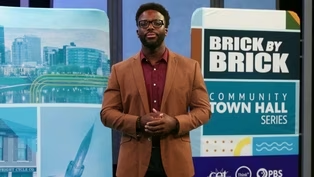
Community Town Hall: Workforce Ready - The Future Is Now Promo
Video has Closed Captions
Preview: Special | 30s | Community Town Hall: Workforce Ready - The Future Is Now. Premiere: October 15, 2026 (30s)
Providing Support for PBS.org
Learn Moreabout PBS online sponsorship New Episode
- News and Public Affairs

Top journalists deliver compelling original analysis of the hour's headlines.

- News and Public Affairs

Today's top journalists discuss Washington's current political events and public affairs.
 New Episode

 New Episode


 New Episode


 New Episode
Support for PBS provided by:
Brick by Brick is a local public television program presented by CET