
Breaking the Deadlock: How to Fix an Election
7/7/2026 | 55m 34sVideo has Closed Captions
Nine voices, one election crisis. How far would you go to defend democracy?
At America’s 250th, moderator Aaron Tang guides nine panelists through a gripping hypothetical election crisis where civic integrity is on the line. As tensions rise, a provocative question emerges: what would you risk to defend the democracy? The scenario reveals deep divides over protest, principle, and truth — challenging what it will take to sustain democracy’s future.
Problems playing video? | Closed Captioning Feedback
Problems playing video? | Closed Captioning Feedback
Funding for this program was provided in part by grants from The Rosalind P. Walter Foundation and by a grant from Anne Ray Foundation and by contributions from viewers like you. Thank you. Location furnished by The New York Historical.
Breaking the Deadlock: How to Fix an Election
7/7/2026 | 55m 34sVideo has Closed Captions
At America’s 250th, moderator Aaron Tang guides nine panelists through a gripping hypothetical election crisis where civic integrity is on the line. As tensions rise, a provocative question emerges: what would you risk to defend the democracy? The scenario reveals deep divides over protest, principle, and truth — challenging what it will take to sustain democracy’s future.
Problems playing video? | Closed Captioning Feedback
Where to Watch Breaking the Deadlock
Breaking the Deadlock is available to stream on pbs.org and the PBS app.
Buy Now
Providing Support for PBS.org
Learn Moreabout PBS online sponsorshipThe best way to inject doubt and problems into an election process is to disrupt that process in the middle of it.
AARON TANG: The president's party is trying to keep control.
10,000 troops.
I don't like it.
Feels like a misuse of the military.
That's not the way it works, sir.
If he costs lives by playing these kinds of games, we're going to hold him accountable.
People are going to die-- fix this (bleep).
How many stress tests does a country need before it all falls apart?
Voting is too precious.
We're not going to cancel the election.
It's not assured that every vote will count.
This is about silencing dissent.
You guys want to make it seem like our country is destroyed.
MARK CUBAN: I'm not saying I don't want to protect democracy.
It's, what is the path to do that?
If democracy dies in the darkness, then protest is telling the truth out loud in public-- it brings the light.
Disagreeing without war, that's the whole point.
TANG: Panelists, welcome.
This year marks the 250th anniversary of our Declaration of Independence, a revolutionary document that announced founding principles for our democracy.
Government by the people.
Our question today is whether those principles can still survive in the face of modern challenges.
We'll start in the state of Middlevania, in a large city called Bigton.
It's June, just months before a heated midterm election, in which the president's party is trying desperately to keep control over Congress.
Mark Cuban.
You're driving to work, stopped at a red light.
What are you driving these days, by the way?
- A Kia EV6.
TANG: Kia EV6, okay.
You're sitting in your lovely new Kia at a stoplight, when all of a sudden, you hear loud shouting.
You see a dozen black S.U.Vs.
surrounding a nearby building-- the Bigton Motel.
You see teams of men swarming that building.
FBI body armor, guns drawn.
A woman runs from the motel up to your car, bangs on your window.
She asks you for help.
What do you do?
- I let her in.
TANG: Just like that.
- Mm-hmm.
TANG: Are you worried about anything?
- Yeah.
(laughs) You know.
TANG: What are you worried about?
- No, of course, you just don't know in any given circumstances, and obviously, something with a lot of intensity and legal impact is going on.
TANG: Dan Crenshaw, Brittany Packnett Cunningham.
- Mm-hmm.
TANG: The two of you are members of the same church here in Bigton.
You're actually carpooling this same Monday morning to a food pantry where you both volunteer.
On the way, you stop at the same red light as Mark Cuban.
You see the same scene-- S.U.Vs., men, FBI agents, guns drawn.
A man runs from the motel, knocks on your window, speaking Spanish, asking for help.
What do you do?
What are we doing, Dan?
(laughter) - We are staying out of this.
I do have a tactical background, and I know the last thing that a tactical team needs is uncertainty, and that will get you killed.
Woman, man, running to your car, stay out of it.
That's my suggestion.
Yeah, I, I come from a people that film the police, so I'm probably going to hop out if you're not going to let him in.
Probably try to drag him back to a place where we can both safely see what's happening, and I'm pulling out my cellphone.
You don't know why they're, they're raiding, that... CUNNINGHAM: I don't, but I do know he's running, and I have to ask myself what I would want somebody to do for me if I was running out of this motel.
- Yeah, but would you be breaking the laws?
Would you be, would you have committed a crime that... - We don't know that he is, either.
Well, you don't know-- well, there's a pretty good chance, considering there's an FBI raid.
We don't, you know, we, we still live in a country where FBI doesn't go on raids for no reason.
- Hm.
- Oh, oh, oh, my God.
- That's an... (laughter) - That, that's the facts.
TANG: You may find out what's going on with this raid in due course, but... - It's an interesting assumption, yeah.
- It's a, it's a pretty good assumption.
TANG: The clock is ticking.
The red light won't stay red forever.
Mm-hmm.
Well, chances are, I've probably already asked Jesus about it.
(chuckles) But I believe in praying with my feet, so, Dan, I'll see you on the other side, brother.
(laughter) - (chuckling): See, see you on the other side, and I'll be just fine.
And I am not risking getting shot and making my daughter fatherless just to help somebody who, we are just presuming some sort of innocence, and I don't know why we're presuming that.
TANG: Mark Cuban, this sounded a lot harder for our carpool buddies than it did for you.
Has either of them said something that moves you in one direction or the other, changed your mind?
- Well, they dealt with a male, first of all.
TANG: Oh.
- And that changes the circumstances.
Is he big?
What's the look on his face?
Is he looking over his shoulder while he's running?
You know, as opposed to a woman-- now, she may be big and strong or whatever, but it does change the circumstances.
TANG: If it had been a man running to... CUBAN: It might've been different.
- You might... If I had my family in there, I wouldn't have done it.
TANG: Okay.
Mark Esper.
What do we owe to someone asking for our help who we don't know in the situation we've just heard?
You know, my mom and dad taught me, don't let strangers into your car.
Don't pick up strangers, right?
So here we are in a situation where a stranger is running toward my car being pursued by law enforcement.
I'm where Dan is.
I'm not about to sacrifice myself or my well-being or leave my children fatherless on a presumption that this person is innocent.
TANG: Claire McCaskill, same question to you.
- Well, I got to tell you the truth.
It weighs on me that it says FBI and not ICE.
Okay.
How so?
Well, because having been at raids on motels with the FBI back in my days as a prosecutor, I know sometimes those raids are about drug trafficking.
That would worry me... TANG: Okay.
MCCASKILL: ...whether it was a man or a woman that was running towards the car, especially if I was alone.
TANG: Aaron Parnas.
I mean, if my two-month-old daughter was in the back seat, I, I would definitely think twice about it, for sure.
I mean, I'd probably freeze in the moment.
TANG: Okay.
Later that day, the president of the United States, a man named Victor Pike, makes a major announcement.
It turns out what some people may have assumed was an immigration raid was something very different.
The president says, "Earlier today, under my orders, "the FBI just captured "the head of a major foreign drug cartel "at a motel hideout in Bigton.
"I promised I would take down the cartels, and I have delivered."
The woman and man fleeing from the scene were hotel workers, not the targets of law enforcement.
Folks, we trust our president with a lot of power.
As we've just seen, sometimes the president uses it to keep us safe.
Chris Christie.
It's now July 4, America's 250th birthday.
You are at a huge parade where you're going to be giving the keynote speech, because you are the governor of Middlevania, which as you know, is one of the original 14 colonies.
Sure.
(laughter) First off, I hate parades.
So, this would have to be, you know, has to be a special person inviting me to this-- I... TANG: It was Mark Cuban.
(laughter) As long as I get to ride in the Kia with him, I'd be, be okay with it.
(laughter) TANG: The governor is giving his speech when an aide whispers in your ear.
She says, "Governor, the Bigton Dam is on the verge of collapse."
This dam is property of the federal government, built, maintained by the U.S.
Army Corps of Engineers.
Governor, what do you do?
Well, I'd want to make sure that my homeland security and preparedness chief was on the phone, and say to them, "Okay, "what's the chance of risk of life?
"Do we have to evacuate all of Bigton?
"What are the environmental ramifications for this in terms of the dam breaking?"
TANG: Okay.
You're coordinating this response.
All of the endangered areas where there's any risk of loss of life are being evacuated.
The good news, there are three U.S.
Army Corps heavy repair fleets in operation.
The bad news is, they are all currently on other projects elsewhere in the country.
You know somebody who could get those fleets sent your way fast.
It's President Victor Pike.
He's a member of the same party as you.
Would you give him a call?
- Okay, sure, um, Mr.... TANG: Governor.
- Yeah?
Happy Fourth.
(laughter) Same to you, Mr.
President, um... Mr.
President, as you know, the dam in Bigton is at risk.
We're hearing that it may, in fact, be breached.
We need your help to mitigate this or repair it.
What do you got for me?
Governor, we're on it.
I'm going to have the Army Corps fix your dam.
But while I've got you, there is something that I need from you.
You know there is this big midterm election coming up.
Our party has to keep the Senate.
All of it depends on this open seat in your state, Middlevania.
I'm going to be endorsing somebody before the primary in the next couple of weeks.
If you endorse together with me, that person's going to win.
Thumbs up?
- Um, Mr.
President, let's get back to the dam for a second, um... (laughter) I'm going to fix your dam, Governor.
Well, I need to know how quick you're going to fix the dam, because we're about to get flooded here.
And my first job is to worry about making sure that I protect the people... TANG: Absolutely.
- ...who elected me, so... TANG: That's why you're so popular.
As soon as I get off the phone and get a yes from you on this endorsement, I'm going to get this prepared for you.
- Mr.
President, those two things are completely different topics.
I'm not necessarily in favor of the person you're looking to endorse, but I might be able to be persuaded.
But I'm not going to be persuaded right now, because what I'm focused on is the dam in Bigton and what could happen to my state and its people.
So if that's a prerequisite for getting the help, that's fine, I totally understand it, and I'll be sure to mention that in my press conference when I walk out.
(laughter) (applause) And by the way, I didn't say I wouldn't endorse him.
I'm just not going to endorse him today.
The president says, "I'm not sure who it is today.
"I just want your word.
If you can give me your word "that you'll come out and endorse who I pick a few days from now..." - No, that's not the way it works, sir, and you know that.
I wouldn't ask you to do that, and, and asking me to do that at the end of a pointed gun, quite frankly, as members of the same party, we should be treating each other with a little, a little more respect, in my view.
- Governor, I get it.
You're a principled man.
Okay, on the endorsement.
I've got something else that you can do that I think is a no-brainer.
We can't win in Middlevania if all of these people vote illegally.
So, my Department of Justice can take care of it.
All we need is your state to send over your private voter information files to my Department of Justice-- we'll take care of the problem.
Deidre Henderson, you are the secretary of state here in Middlevania, elected by the people to run the state's elections.
First, are a lot of people voting illegally?
And second, why doesn't the federal government already have access to voter information files?
- Well, first of all, there is no evidence that there is any sort of widespread, um, voting by people who are ineligible.
And the federal government doesn't have access to our voter files, because the U.S.
Constitution expressly reserves the right to states to choose the time, times, places, and manner of elections.
TANG: Secretary, I'm curious, what's the worst-case scenario?
If you've already purged the voter rolls of ineligible voters, is there harm from the federal government having access to the voter files, too?
- Well, yes.
What sort of harm it is hard to say, because we're not entirely sure what it is they're trying to do.
TANG: Melissa Murray.
You live in Bigton, too.
You are a leading scholar of constitutional law.
Do you have worries about what might happen if the state were to share voter files?
What's the worst-case scenario?
- Sure-- there could be harassment of voters at their polling places, because the information is incredibly granular.
It can identify individuals by their addresses.
So there's a reason why the Constitution commits this particular function to the states and not the federal government.
TANG: Sounds like this is an easy no, but I do have to ask.
Secretary.
You know that you could've made a difference, fixed the dam before it was too late, just by saying what the president wanted to hear.
You'd be willing to live with the impacts, the suffering, in order to stand in principle?
- Look... TANG: Is it hard?
- Of course it's hard, of course it's hard.
It's, it's definitely hard to see trade-offs for something that, that is imminent and much needed versus standing on principle and following the rule of law.
But I also say, if we don't have the rule of law, we don't have anything.
We don't have a country, we don't have freedom.
And, and if we're willing to trade those things in the moment, then we're willing to risk an awful lot for temporary gains.
This is a tough situation, though.
TANG: You say no to the president.
You can guess his reaction.
Claire McCaskill.
You are the mayor of Bigton.
A member of the opposing party to Governor Christie, the opposing party to President Pike.
I'm wondering if you would get on the phone with your governor to talk, make sure everything that's possible to get this dam fixed before it's too late.
- Yeah, I-- listen.
I, I really appreciate that you're willing to expose how immoral the request is that's being made of you, that to save people's lives, you've got to make some kind of political endorsement.
And I'll have your back, as long as you go to the mat with the president and make sure he understands that if he costs lives by playing these kinds of games, we're going to hold him accountable.
Yeah, look, why don't we just both go out there now, so that people understand this is a bipartisan issue?
And, let's both go out.
I'll take the heat for exposing what he asked for.
TANG: Mayor McCaskill, one of your aides shows you something that the president has just posted on social media.
The post says, "While I'm working to fix Bigton's dam, "Middlevania should fix its elections.
"Most states have proof of I.D.
requirements to vote.
Time for Middlevania to do the same."
You are a leader of your party in the state of Middlevania.
If you express some support for voter I.D., it could happen.
Worth considering to make sure your city isn't underwater.
I, I don't want anybody to vote who shouldn't be voting, but this is a problem that is a made-up problem.
And there's a lot of problems I gotta deal with every day for the people of this community.
They are hurting, and that's not a problem that's even on the top-50 list in terms of being real.
So I can't divert my attention away from the stuff that really matters to something that's being made up for political stuff.
CRENSHAW: I see this as two wins.
You fix the dam and you put into, and you support a policy that 80% of Americans are in favor of.
I certainly don't believe this is a made-up problem.
It is not a made-up idea that people don't have perfect faith in their elections.
It might be made up in your minds-- you might have very few cases of voter fraud, and there are few cases of voter fraud, but indeed there are cases of voter fraud.
The fact is, it's a thing.
So, what is the problem with voter I.D.?
TANG: Final decision-- Mayor, you have a chance to write back something to the president.
"Yeah, we can talk about that.
There's some kind of proof of I.D.
I would support."
Or do you not write back at all?
- It makes me feel very uncomfortable to do it at a moment when I'm worried that people are going to die.
I'll be honest with you.
It just makes me feel like I need to take a shower.
(laughter) I don't know that I'd want to have that conversation right now.
I would hope that, between the governor and the secretary of state, somebody could influence the president to understand that this is really tacky.
Ah, there is somebody who could influence the president.
It's the president's sometimes friend, perhaps, Mark Cuban.
(laughter) Mark Cuban, as Middlevania's wealthiest and, let's say, most well-known resident, you own business interests throughout the state, but none better than the Bigton Ballers, professional basketball team, just won the NBA championship.
You know President Pike.
You could send him a text message, see if there's anything you can do to speed along this dam repair.
Would you do that?
- Yeah.
TANG: What'd you say?
What would you text him?
- "People are going to die-- fix this (bleep)."
(laughter) "People are going to die-- fix this (bleep)."
Yeah.
TANG: He writes back.
"Always good to hear from you, Mark.
(laughter) "I'm going to fix your dam.
"But while I've got you, "there's something you can do for me.
"People love the Bigton Ballers in Middlevania.
"You know we've got this midterm election.
"I'm going to endorse a candidate.
"Here's what we should do: in October, "opening night of the season, "just give me ten minutes, I'll come with my candidate, "I'll give him a citizenship award.
"We'll take some pictures with the players.
Can we do that?"
You can come to the game, no matter what.
Bring whoever you want.
TANG: Great.
- No matter what.
Courtside seats?
CUBAN: Yeah, I don't care.
We'll give you courtside seats, um... You know, are we going to present you in the middle of the game, other than the normal celebrity cam?
No.
If you want to take some pictures, that's up to the players, but you're more than welcome to come to a Baller game anytime.
With my candidate?
Yeah, with your candidate.
You can bring anybody, you know... Any candidate can bring... Anybody can bring whoever they want.
Can I stay after the game?
Talk for a couple of minutes, give this award?
I mean, after the fans are gone, sure.
(laughter) If they know I'm talking, they won't leave.
Well-- okay, great.
Then you have nothing to worry about.
TANG: Aaron Parnas, you are a resident of Bigton, as well, and you are a independent news content creator.
Great.
(laughs) TANG: Huge following on social media, six million followers on TikTok, Instagram.
- Mm-hmm.
TANG: You get a tip that the president of the United States demanded from the governor, as a condition of fixing this dam, a political endorsement.
PARNAS: Mm-hmm.
TANG: Access to voter files.
Is that information you think your followers would want to know?
PARNAS: Oh, 100%, yeah.
TANG: Why?
- Well, I, I think it's information that the American public would want, would want to know, for sure.
Would you do a story on it?
I'd call the governor's office first to see if they'd have a comment.
And then, when they said, "No comment," I'd do a story on it.
That might not be what we'd say, but... TANG: Oh!
Well, talk to, talk to... Would you... - No, I, like, you know, I'd get my communications director on the phone with Aaron and say, "Aaron, we're going to be talking about this in 30 minutes."
Um, "And you'll get the first question "at the press conference.
"Governor will call on you, "if you're willing to just, you know, hold off for 30 minutes, so you're not jumping the story."
I mean, I think I would take that, but I would need that confirmation, 100%... Oh, sure, then I'll get on the phone with you and talk... Yeah, yeah, I would take that.
CHRISTIE: That's fine.
Good.
- Yeah.
Aaron-- first question.
I think my first question would be, is... Is this an impeachable offense, for the president to use something where potentially hundreds of thousands of lives are on the line for political gain?
Certainly not something I would do.
Then, if I were in Congress, I probably would vote to impeach him, but... But only if he followed through on the threat.
You know, if he refused to fix the dam, that's not something a responsible president of the United States does.
TANG: Would you do a story now, based on this press conference, direct to your followers?
- Yeah, 100%.
TANG: What would you say?
- I, I mean, I'd whip out my phone and just kind of say, "Breaking news-- the president of the United States "threatened to withhold aid to Bigton "when hundreds of thousands of lives were on the line, "threatened the governor "if he wouldn't endorse his preferred political candidate, "threatened the secretary of state if she wouldn't hand over the voter rolls."
And I would just lay it out just like that.
TANG: You lay it out, and you now have seven million followers... PARNAS: Great.
TANG: ...on TikTok and Instagram.
- Score.
(laughter) TANG: The story goes viral.
People are listening to you.
Somebody else is listening.
It's President Pike.
(Parnas chuckles) He's furious.
He calls you a liar.
Threatens a Department of Justice investigation.
Moments later, you get an email from his personal lawyer threatening a $10 million defamation lawsuit, unless you retract your story, admit you lied, say he's not impeachable, that question he didn't like.
What do you do?
- Oh, I would respond to his lawyer and I'll just say, "See you in court."
TANG: I have to ask, as an independent news content creator, do you have the resources to fight the president's unlimited legal team, the Department of Justice... - Yeah.
...his army of personal lawyers?
I do-- I have the American people.
And when the American people hear what the president is going to do to go after someone like me, they'll step up and they'll help me with the resources.
I also have insurance to back me up, so... (chuckling) We'll be fine.
TANG: Melissa Murray.
Even if Aaron Parnas wins in court, is the president accomplishing something by going after his critics?
MURRAY: Certainly.
This is not just about Aaron, it's about any other independent journalist or any other affiliated journalist that wishes to speak out or to criticize the government.
This is about silencing or deterring dissent.
These were the sorts of things that the framers thought about, not just in the aspirational Declaration of Independence, but also in the Constitution itself, this idea that a thriving democracy has to be able to not just tolerate, but indeed encourage dissent.
TANG: Okay.
Folks, I have news.
The Bigton Dam does not collapse.
Delighted with Mr.
Cuban's offer and, frankly, a little chagrined after this press conference, the president sends the repair fleet just in time.
Time passes.
It's now November 1, two days until Election Day.
Mark Esper.
You are a United States Army general and the commander of a joint task force that operates against foreign drug cartels.
You've just received a stunning intelligence briefing.
A foreign drug cartel has claimed responsibility for the Bigton Dam's near-collapse.
This cartel is officially a foreign terrorist organization.
The foreign cartel says they attacked the dam in retaliation for the president's arrest of their leader at that Bigton motel, and now they're threatening attacks throughout Bigton, all public places, until their leader is released.
Yeah, well, first of all, thanks for the promotion.
The furthest I got was lieutenant colonel, so... (laughter) I appreciate what, what you gave me there.
Um, look, my first reaction is, obviously, we have a crisis on our hands, but as a, as the military commander of a joint task force, I also recognize the fact that we are operating in the United States.
So, the lead for this is actually the FBI.
The president says, "General, "I took out the leader of this cartel "at that Bigton motel, but they won't go away.
"First, they murdered thousands of our people "with their fentanyl, now they've attacked this dam.
"We can't take any more risk that they will "blow up a polling precinct "on voting day, with people lined up.
"I'm ordering you to take 10,000 of your troops.
"Deploy them in Bigton to keep the people safe.
"Station them in public places, a show of force, "close to polling precincts as we can, "to make sure our, our voters don't get hurt.
"I need you, General.
Can you do that for me?"
- Well, yeah, I'd say, "Mr.
President, thank you.
"I, I appreciate your concern.
"But let's look at a way to do this using law enforcement.
"Because this responsibility is, first and foremost, "a law enforcement action.
You don't need me, Mr.
President..." TANG: General, I don't know that you're hearing me.
There's no such thing as too much security for the people of Bigton when they vote.
I want 10,000 troops under your command.
Yes or no?
If it's a lawful order, then I'm, I'm obligated to obey it.
Really?
You can't resign?
We like to say there's lawful orders and then there's awful orders.
And this may fall in the awful camp, right?
I don't think we want the expectation among the officer corps to be that I'm going to resign just because I don't like the order.
Because now you're making judgments on every single legal order that comes your way, and what we want is the military, under the traditions of 250 years, is civilian control of the military, and the flip side of the civilian control is that the military obeys the legal orders of the civilians appointed above them.
CUNNINGHAM: I find it fascinating that the timing of these 10,000 troops comes right behind the demand for a political endorsement and the demand for voter rolls.
The truth of the matter is, there's a reason why these situations are not federalized.
There is also a deep history over these last 250 years of voter intimidation tactics coming from federal governments that are hostile to the votes of certain people and certain communities.
HENDERSON: There's only one person in the state that has the constitutional and legal authority to oversee an election, and that is me.
And our state constitution says that we don't put military at polling places.
So, I have a lot of concerns about this, and a lot of questions, and my number-one goal is to make sure that every eligible voter can cast a ballot without fear on Election Day, or even better, maybe turn in their vote-by-mail ballots early and avoid the whole thing altogether.
And to be clear, there is a statute against troops at polls.
I'm deploying 10,000 troops to go after the bad guys, not to sit at polling stations, right?
But the president did ask you to put troops in the streets, show of force, any public place where people gather.
So, they would be in the vicinity of polls, that's part of the order.
A lot of people in Bigton are thankful for the extra protection from what they are worried is a terrorist threat.
But a lot of people in Bigton are deeply upset that this might be a pretext to suppress the vote before the election.
It's now the day before Election Day.
U.S.
troops are now stationed throughout Bigton.
They don't go into any polling places, but it's virtually impossible to get to a polling place without passing armed soldiers.
It's also hard to get anywhere in the city without passing one of a growing number of protesters who are angry that the military has entered their city this close to an election.
Brittany Packnett Cunningham.
I'm wondering if you would consider joining these protests to make your voice heard.
Don't you think I already organized them?
(laughter) TANG: It's hard to get anywhere without passing a protest organized by Brittany Packnett Cunningham.
(laughter) Why?
- In community with many others.
TANG: Talk to us about why the protest.
- Some of us don't have the luxury of assuring and assuming all good intent when military shows up on our streets, especially in and around an election.
And I think that it's critically important that when people potentially try to abuse their power, that they hear from the people who are being abused by it.
It's not something we can allow to go quietly in the night.
It's not something that we can allow to simply pass without us saying something.
If democracy dies in the darkness, then protest is telling the truth out loud in public.
It brings the light.
TANG: Melissa Murray, you get an email from an enterprising student.
"Professor Murray, "we'd all like to go to the protests, and we're wondering if you could join us there instead of class."
It depends on how many makeup classes I have this semester.
(laughter) I think for something like this, it would be pretty important.
I think maybe I would go, as well.
TANG: As you're getting ready to go, your teenage daughter, 16 years old, let's say, sees you leaving and says, "Where are you going, Mom?"
To the protest.
TANG: Are you sure it's safe, Mom?
There's troops, guns in the streets.
Protesters are peaceful now, but you never know.
Will you be safe?
I'm worried about you.
- I'm not sure if I'll be safe, um... These are often volatile situations, and, you know, I know people who look like me may be particularly vulnerable, may face certain risks.
I'm okay with that, because I think this is really important.
I think elections are critically important, and I want my voice to be heard, because I know that one of the things the founders of this country feared most was the fact of standing armies being deployed to the cities, where they could run roughshod over the rights of the people.
This seems so far beyond what the Constitution would permit that I feel compelled to be there.
Mom... MURRAY: Now, if you're asking if you can go... How did you know, Mom?
(laughter) Can I go?
- No.
No.
(laughter) No, you cannot.
TANG: And your daughter knows well enough to leave it alone.
Everybody does, yes, correct.
TANG: Mark Cuban, one of the protesters is a person you know well.
The star of the Bigton Ballers... CUBAN: Mm-hmm.
- ...your professional basketball team, Julius Shuttlesworth.
(laughing): Okay.
(laughter) TANG: It's all over social media.
CUBAN: Mm-hmm.
- He's in the streets protesting.
He's holding a sign that says, "F the troops."
Are you comfortable with the face of your franchise making such an overt political statement?
- Yes.
He's an American first, or even if he's not an American, he's got to, you know, live up to his conscience first.
CUNNINGHAM: Hm.
So even if your finance team comes and says, "It's been 30 minutes, we've already got hundreds "of phone calls from season ticket holders saying, "'We're not going to renew.
"'If the Bigton Ballers are against the troops, "'maybe we don't agree, but, "F the troops?"'"
Can you afford his political activism?
Fortunately, yes.
(laughter) Hm.
CUBAN: And I've been in that situation before.
TANG: General?
ESPER: I just want to know why we resorted to, "F the troops."
I mean, haven't we learned this lesson from Vietnam?
It's not the troops' decision.
We, nobody knows more than the United States military the importance of supporting our, our citizenry, our civilians.
We were there to defend civil rights.
We don't want to be there for political purposes, and we're not there for political purposes.
And so now it's resorting to, "F the troops"?
By the way, many of these troops are from the community, because they're in the National Guard.
So they're your neighbors.
CUBAN: And I didn't get a chance to finish, but what I would also do is have a conversation with him.
TANG: Huh?
- Because I've had, I've had this happen before.
With Julius?
CUBAN: I've... Yeah, with, with Julius and other players, you know, for the Ballers in previous years, um, where you do have to have a conversation.
Where you allow them to speak their mind, but you talk about the consequences and you talk about the lives that are involved.
And if they still feel that strongly, then that's their right to speak up, as... ESPER: Yeah, and I'm saying, protest, protest against the policy, their politics, or the politicians, but don't attack the troops.
TANG: More than 100,000 protesters are now in the streets of Bigton.
Brittany, you're there at the lead.
- Mm-hmm.
TANG: Peacefully demonstrating, when you notice a man acting suspiciously.
CUNNINGHAM: Mm-hmm.
- He ducks behind a garbage can, he's holding what looks like a wine bottle.
And you see this man stuffing a long rag into the wine bottle.
- Hm.
It's a Molotov cocktail, dangerous explosive device.
What do you do?
I tell a team of people who we've asked to keep our protest secure from the inside to ensure that somebody does not come along and create a dangerous situation for everybody, and I get them over there.
TANG: Would you alert law enforcement, troops?
They're, you're standing close to a member of the Army.
Would you alert him about this threat?
- That's a good question.
I would alert someone of authority.
ESPER: Why, why the hesitation to alert one of our soldiers?
CUNNINGHAM: Because I'm trying to make sure that I'm selecting a person who wouldn't put everybody in danger.
I've seen disproportionate responses to one person's behavior be turned toward hundreds of thousands of people.
So my hesitation is not a hesitation about protecting people.
My hesitation is about ensuring that I'm asking the right person to keep as many people safe as possible.
TANG: Here's what happens-- you're startled by a loud series of explosions, fires around you, rocks being thrown.
Several protesters you see are doing what you've always feared.
You see a couple of troops hurt.
Other troops are now firing tear gas to disband the protests.
A canister lands at your feet.
You can't see, you can't breathe.
You're staggering away, make it about a block, you need medical help.
And that's when you see a car nearby, a woman driving it.
Would you knock on the window?
- (chuckles) TANG: Ask her?
- Yeah, and I'd hope Dan wasn't in there.
(laughter) - Nope.
Out of here.
TANG: In that situation, Dan, would you help somebody?
CRENSHAW: A bunch of bombs just went off and a bunch of tear gas just got thrown at... And then someone's, someone's running in, into my car, and I... - She's, like, "I need to go to the hospital."
Not someone, Dan-- me.
TANG: Well, if it was Brittany... CRENSHAW: I know her?
Okay, I know her?
I mean, look... TANG: Right.
There's a lot of the pieces of that puzzle to assess.
If my, if my daughter's in the car, hell, no.
TANG: Just by yourself, you wouldn't-- it's Brittany.
Let's actually make it as clear as possible.
Like, I actually know this person?
TANG: It's Brittany.
- Yeah, we go to church together.
- Oh, okay, okay, yes.
- We do the food pantry together.
You left me to protect the hotel worker by myself when we were together-- it's me.
- She can get in the car.
She, she can get in the car-- she can get in the car.
TANG: What about the decision to protest in the first place?
CRENSHAW: Well, I have some questions... TANG: You criticized... Sure.
-... as to what exactly we're protesting.
I mean, we, we've established this is a very dangerous cartel.
The intelligence suggests that there's more needed than just law enforcement.
TANG: Right, okay.
- Therefore, what exactly are we gaining from this?
TANG: Moments after the attack, President Pike goes on national TV.
He says, "People of Bigton, "my number-one job "is to keep you safe.
"But I can't do that job if you are out in the streets "protesting, interfering with our troops.
"People of Bigton, "go home.
"If you don't, "I'll have to call in more troops.
"We might even have to cancel the election.
Go home."
- (whimpers) TANG: Secretary Henderson, first of all, can the president do that, cancel an election?
- No.
TANG: Hard no?
- No, we're not going to cancel the election.
TANG: Okay-- but General Esper, as somebody who wears the uniform, I'm wondering if you agree with the president's broader message.
In this really divisive, heated moment, should the protesters get out of the way so the troops can keep the public safe?
- Well, I don't think you want the protesters impeding legal, credible law enforcement, but they have a right under our Constitution to protest, and we support that-- the military supports that.
As long as it's done peacefully.
So I think we want to-- if they want to protest, they should be allowed to protest.
TANG: Okay-- all of this leads to a hard dilemma for you, Mayor McCaskill.
I'm wondering if you would tell the protesters to go home for a day or two.
No.
Um, I think that I would have been, from the beginning, doing a really aggressive effort about preaching the gospel of nonviolence.
If you are not peaceful, you are playing into a scenario that's going to deny people their right to vote, and you don't want to do, do that.
I think if, if calling on the protesters to go home the day before an election day would ensure that they have an easier time getting to the polls on the next day, sure.
If it's getting out of hand, if there's violence that's occurring, taking a breath is, is fine, but if it's peaceful protests, there should be no problem with that.
TANG: Governor, would you ask them to go home?
- No.
I don't think you give in to the fact that, you know, a person or a small group of people came to the protest and committed violence.
I'd probably go there myself to, to send the signal that it's not that dangerous to be there, and to walk around and to try to calm it by being a presence there, as well.
TANG: Aaron Parnas, ever since the president called you a liar, your life has been pretty tough.
One of his zealous supporters found your address, posted it online.
You received death threats, suspicious packages to your door.
You and your family have had to leave.
You're now living at hotels throughout the city.
But you're about to get another tip, and this one's a doozy.
One of your now eight million followers is a member of the United States Army Corps of Engineers.
Sends you a private message and says, "Aaron, "I was down there at the dam when it was getting fixed and I didn't see any signs of a terrorist attack."
Is that important information your followers might want to know?
- I think it's, it's definitely important context.
I 100% would do the story.
TANG: You would do that story?
- I would 100% do the story.
CRENSHAW: With one source?
- A source who was there.
(indistinct) CRENSHAW: One source, uncorroborated?
TANG: One source?
- I, if the source wants to go on record and have this... CRENSHAW: Is this good journalism?
- ...I, I would run the story.
ESPER: One source, you get that story wrong and you've, you'll never unwind that.
That, that will, and, and that has huge political ramifications, huge social ramifications.
I, I think it's very dangerous.
CUBAN: Yeah, I mean, you can't just go with one source.
I've been on the other side of one source... CRENSHAW: Yeah.
Every single day.
- ...that wasn't such a good source.
TANG: Well, the service member says, "I was at that dam.
I didn't see any signs of a terrorist attack."
That's what he says to you.
- That's it?
TANG: That's it.
- Okay, I mean, I'd have more questions... TANG: You'd have more questions for him.
- Yeah, for sure, yeah.
So you wouldn't do the story?
I would... I would 100% investigate the story and then see what happens.
TANG: Ah.
So you wouldn't do the story until you investigate it?
If the only statement I have is, "I was there and I didn't see anything," then there's, there really isn't a story, because there, there could have been plenty of people there who didn't see anything-- doesn't mean that didn't happen.
TANG: Well, he was down there fixing the dam, he was... Not enough for you?
- It's, it's just, it's one, it's one sentence.
TANG: Now not enough for you, okay.
PARNAS: Yeah, I mean, at the end of the day, uh, credibility is important.
Integrity's important.
If someone else wants to run a story, they can, they can run it.
TANG: Folks, Bigton is a powder keg, protests in the street.
They're not listening to the president.
They're not going home.
Aaron Parnas, you are now two blocks away from the hotel where you're staying when you hear glass shatter.
You see masked men breaking into local storefronts-- coffee shop, convenience store.
Would you do a story on this?
Is this something your followers would want to hear?
- I, I think it's news, I think people should see it, yeah.
TANG: Are you sure your followers are going to be excited to see this information?
- I don't really care what my followers... TANG: Is that right?
- ...whether they're excited or not.
I don't read my followers' comments.
TANG: Is that right?
- Yeah, for my own mental health.
TANG: Oh, interesting.
I'll read your followers' comments for you.
PARNAS: Please.
(laughter) Good, good luck.
Some of your followers are upset.
PARNAS: Sure.
- They say that you are feeding the narrative on the other side.
The vast majority of these protests are peaceful, but now, thanks to your highly publicized footage, they're accusing every protester of looting, being violent.
Some of your followers want you to take the story down, and they say, "If you don't, we're going to unfollow you."
- They can unfollow me.
I mean, at the end of the day, my story is... It's the facts.
TANG: Another progressive content creator reposts it with a very different twist.
He says, "Protesters in Bigton, stop looting mom-and-pop shops.
"Go hit large corporations-- Wall Market, Amazing.
"The rich aren't playing by the rules.
Why should you?"
That content creator is doing great.
Some of your followers want to know if you agree.
What do you say to them?
- I, it's not my responsibility to agree or disagree.
That's not journalism.
If I'm going to espouse my opinion, I'm going to be a commentator, not a journalist.
TANG: Mark Cuban, you've owned a large corporation or two.
- I know you're coming this way.
Yeah.
TANG: What do you think about this other progressive voice out there talking about micro-looting large corporations?
CUBAN: I would go to Brittany, because I'd want to hear from her who the leaders are of this movement, and what can we do together to communicate, so that she feels like she's making progress and we're overcoming some of these problems.
Because I think the challenge, when you have a lot of civil disobedience and not-so-civil disobedience, a lot of people try to take credit, and it's hard to know who the, who the actual leadership is.
I think these are wise questions.
I think, especially in the age of the internet, we have to understand that there are a lot of people looking to fuel a lot of fires and their motives aren't always clear.
But the point of all of this is to secure the voice of the American people in all the ways that that means, in First Amendment protests, in elections... CUBAN: And we know that, right?
But how do we-- who's communicating that and how?
HENDERSON: I am.
Right?
But still, I guarantee you, the, the kids on TikTok who are showing up there, and Melissa's daughter, and the people that... MURRAY: She's not on TikTok.
CUNNINGHAM: But this is my... (laughter) CUBAN: She's on Instagram?
MURRAY: She's studying, Mark.
CUBAN: That's what she tells you.
(laughter) But the people who are communicating all these things, right, there's no centralized point, and there won't ever be.
It's very distributed.
And so you, you know, even though everybody's intentions, at some level, are pure, right?
How do you, how do you communicate to all of them?
And you know what else I'd do in the, in this conversation with you?
TANG: Yeah.
- I'd say, "You got a lot of power here."
CUBAN: Mm-hmm.
- So if we're on the same team for democracy, then let's work together-- you have money... Well, that's why I'm reaching out to you, right?
Yeah, and I'm, and so let's have that conversation.
CUBAN: Mm-hmm.
- As you're reaching out to me.
We're on the same page.
We want to protect democracy-- you got Homeboy's... We may or may not be on the same page, though, right?
I'm not saying I don't want to protect democracy.
It's, what is the path to do that, right?
I'm-- let me offer you one.
CUBAN: Sure.
- You got Homeboy's phone number?
TANG: The president?
CUNNINGHAM: The president, yeah.
CUBAN: Right.
- Yeah, President Homeboy.
(laughter) And you've got... You've got influence, you've got power, and you've got money.
So how can I get you and your corporate friends to stand up and say, "Either we protect election security "for all Americans, "or, as a group of leaders and business leaders "in this country, we will withdraw our support from this president"?
CUBAN: So I would tell you, when we read the comments, you're not seeing anybody who's listening to me.
Right?
They're listening to you.
And what you're doing is, you're assigning me too much power.
I'm trying... Oh, no, I'm, I'm recognizing that we have collective power.
And when we recognize that there are folks who have access and power to the halls of policymakers... CUBAN: I'll give you his number right... We, we can both call him.
CUNNINGHAM: No, no, no.
- We can do a, we can do a Zoom, right?
CUNNINGHAM: Sure, just let me finish for a second.
- Sure.
All I'm saying, right, is that if the ultimate goal is protecting democracy, I'm asking for your help in securing that on a broader level.
And then we can stop talking about which creator's happening over here and what this person is saying over there, because we can really get the thing done.
See?
That's where we disagree.
TANG: Okay-- folks, Election Day comes and goes.
Thankfully, there are no terrorist attacks.
Turnout in Middlevenia is higher than in any recent midterm election.
But we're not in the clear yet.
The ballots have yet to be fully counted.
(panelists chuckling) (laughter) - Great.
CUNNINGHAM: Here we go.
(laughter) TANG: It's now 6:00 a.m.
on November 4, the morning after the election.
We don't know yet who will win the Senate.
It'll all depend on Middlevenia's race and Bigton's ballots.
Secretary Henderson, you're at your office bright and early-- maybe you never left-- when you get an urgent alert.
A source tells you that the Pike administration Department of Justice is applying for a search warrant to seize the ballots at Bigton's central facility, where they're being counted.
- Well, thankfully, we've tabletopped this exercise with the county clerks and all the local election officials and local sheriffs and law enforcement, and nobody gets to touch ballots.
We have a very strict chain of custody, and, and that does not get broken.
TANG: And why is that so important, if the federal government were to come to seize these ballots?
- You don't, you can't seize ballots in the middle of the process of, of counting them.
You lose chain of custody, you lose any credibility that those ballots might contain.
You don't know what's happened to them.
You don't know if some have been lost or, or hidden, um, so... I'm curious, though, the federal search warrant application says they need these ballots to look for evidence of election crimes.
Is there some other way, if not the federal government, to detect fraud, miscast ballots?
- Absolutely-- we, we've got a process.
We, we follow the process, and the best way to inject doubt and, and insecurity and, uh, and problems into an election process is to disrupt that process in the middle of it.
We've got poll watchers, we do audits.
We, we do all sorts of things during the counting process that should give people confidence.
And we'd welcome the Department of Justice to come and, and watch.
TANG: Okay.
- They'd have to stand behind the line, but they could watch.
TANG: Governor, Mayor McCaskill.
Would either of you consider sending in law enforcement to create a protective barrier around this counting facility to make sure those ballots are secure, they can be counted?
- No, I'd go to court.
- I, I think that escalates a problem.
I would rather see this play out in the courts.
TANG: Okay.
- Because I think more guns on site is just a way to heighten the temperature, and I think we need to lower the temperature right now.
TANG: Okay-- Brittany Packnett Cunningham.
You get a message on your church group text chain.
Somebody's heard a rumor that the Department of Justice might be applying for a search warrant to seize your city's ballots before they can be counted.
I'm wondering if you would consider leading a citizen blockade to surround this counting facility.
Make sure the ballots are secure.
Hm.
TANG: Would you consider that?
- Well, I'd have a lot of questions.
I'd want to understand exactly how we got to where we got, whether or not this tip was very true, but most certainly, there are communities that have gotten together to protect health clinics.
There's no reason why a nonviolent group of disciplined people couldn't do the same here.
TANG: Okay-- you realize as you're driving to this counting facility, you're going to pass by Dan's house.
Would you knock on his door and see if he'd join you in this hard decision, a citizen effort to make sure Bigton's votes can be cast?
You gonna let me in this time?
- Yeah.
(stammers) (chuckles) You can come in.
- Dan, are you coming with me?
- Wait, wait, no, the question was, would you even bother asking me?
(laughs) - Oh, I'm here-- knock, knock, knock.
(laughter) Knowing, knowing our history.
No, I mean, you couldn't be, we just couldn't be more opposite personalities, I mean, the activist and the, you know, somebody... - What church is this that we're going to, by the way?
It's a big church-- it's a big church.
I don't know what preacher is preaching to both of us the same way.
- That's the wonderful thing about church and eternal moral frameworks.
But I see zero positive outcomes coming from the activism of, of literally impeding federal law enforcement.
TANG: Okay.
Brittany, final word.
- That's not going to get me anywhere.
TANG: Okay.
- If we're talking about standing quietly around a building to make sure that nobody comes in to impede the act of democracy, one of the most sacred acts of democracy that there is-- just let me finish.
- I just saw a contradiction in the sentence.
- Just let me... - Peacefully, but ready to impede.
Which one is it?
CUNNINGHAM: Standing outside of a building, ready to be arrested, should someone come with a search warrant to impede the most central act of democracy, to me, feels like one of the most moral acts an American citizen could make.
So the idea that the institutions are going to hold up is simply something that we can't all count on, and I ask you, what is wrong with standing next to somebody that you're willing to share a pew with and potentially get arrested to make sure that everyone has a voice?
Simply because your, your actions will not have the outcome you think they will.
TANG: Dan does not get in the car, it sounds like.
CRENSHAW: Well... TANG: You could pick up another friend, Melissa Murray.
Melissa, would you join Brittany, a year of jail potentially on the line?
- It was "Letter From a Birmingham Jail," not "Letter From a Birmingham Four Seasons."
CUNNINGHAM: Hello!
- So yes, I would ride with you.
CUNNINGHAM: My sister!
(laughter) TANG: Okay, folks, here's what happens.
A coalition of Bigton residents join arms peacefully around the central counting facility.
Department of Justice attorneys and FBI agents show up with a search warrant.
There's a standoff, and just as FBI agents are prepared to charge through this peaceful crowd, a woman emerges from the counting facility with a piece of paper.
Federal judge has approved an emergency order to block this search warrant.
The ballots are safe.
They can be counted, vote by vote.
Did our system work as we saw it play out today?
MURRAY: I think our system was stress test in a profound way.
It has held together, but literally held together just with, with Scotch tape.
It's not assured that every vote will count, so, we are at an unsettled time, a really dangerous time, I think, for democracy.
The whole point of democracy is not simply about the people speaking, but about restraints on government.
PARNAS: At some point, a stress test will fail.
And if the judge in this case did not issue that last-minute order blocking the search warrant, it would have failed, and the ballots would have been seized.
And there is a real plausible scenario in which that would have happened, right?
So at some point, you have to ask yourselves, "How many stress tests does a country need before it all falls apart?"
- That's right.
CRENSHAW: Did our system uphold?
Of course it did.
And, um, first of all, I've never met a stress test that didn't make me stronger.
That's sort of the American story.
Not sort of-- it is the American story.
It's one of fortitude.
And if we're going to talk about the 250th, that is the American story.
One of the problems with our extremely ungrateful modern society is that we have so little stress tests compared to the past that we're looking for them around every corner, and maybe that's something that should be considered.
Okay-- one final... CUNNINGHAM: I can't respond to that?
- (chuckles): Go ahead.
TANG: I'm sorry.
- Tell me how bad we have it.
TANG: You have, you'll have a... Tell me how bad we have it.
TANG: For the final question, you'll have the final... CUNNINGHAM: Are you okay?
(laughs): I'm just wondering how bad... No, I'm fine, I'm, I'm the optimist here.
- Okay-- okay.
- You guys want to make it seem like our country is destroyed.
- All right.
- We can't stand one more stress test.
- I don't know who "you guys" is-- go ahead.
TANG: One... One final question-- we've lived through a harrowing story today.
As we think about it, as we think about the conditions that led us to declare our independence 250 years ago, I'm wondering, what can we do as ordinary citizens, elected officials, to make sure our democracy survives for 250 more?
CUNNINGHAM: I'm actually quite the optimist.
CRENSHAW: Sounds like it.
- And I think it's unfortunate that it felt a little difficult for you to hear the optimism.
Because in real life, I actually am a believer, and I'm optimistic because I'm descended of those who survived.
I remain optimistic because the solution to our problem is to support people who have enough optimism to lift their voices even when it's hard, even when it's under threat, even when it can get you sued, destroyed, or killed.
Because if this is supposed to be a government and a country of the people, for the people, then it's time to actually listen to the people, especially the people who know America better than she knows herself, because we've had to survive it for all 250 years.
CRENSHAW: The question is how we survive another 250 years.
Our founders created a very, very stable legal framework, which is why we've survived for this long, and they put defining principles at the very beginning that allowed us to evolve and keep evolving.
And excuse me for not hearing all of the optimism.
I think we're optimistic about maybe the same things, perhaps.
Politics is the art of, of disagreeing without war.
That's the whole point, and our Constitution has upheld, has been upheld remarkably well.
It's the oldest in the world, for being one of the youngest countries.
PARNAS: I think that when we look to the next 250, but even to the next 25 years, the current leadership needs to empower the next generation, needs to lift up the next generation, needs to really show a good example for the next generation, because we live in such a divisive time.
Young people are more divided than ever before.
And it's, if you truly want to live by the idea that you're going to leave this nation better off than how you found it, do it.
MCCASKILL: So I think you're right about the older generation in power.
They don't truly understand how young people are getting their information.
- Mm-hmm.
They truly don't understand how distorted their world can become because of the way they're getting their information.
If we can't agree on what the facts are, then democracy becomes impossible, because we have to pass on to the next generation a respect for facts and how they can get them.
CUBAN: I think the system held, but it taught us a lesson that leadership is as important, if not more important, than the system itself.
And if we don't understand that, then we can really have fundamental democratic problems.
CHRISTIE: In the end, the only thing that will determine whether we survive the stress tests are the character of the men and women who we put into leadership.
And that's why Franklin said, after the Constitution, when the woman asked him, "What kind of government have you given us, Mr.
Franklin?
", he said, "A republic, if you can keep it."
"A republic, if you can keep it."
And that's going to be up to everybody who votes and chooses what the criteria is for who your leaders should be.
(applause) TANG: And with that, we bid farewell to Middlevania until the next time.
Thank you all.
(applause) ♪ ♪ ANNOUNCER: For more about "Breaking the Deadlock," visit us at pbs.org/deadlock.
"Breaking the Deadlock" is available on Amazon Prime Video.
♪ ♪
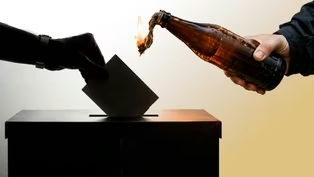
Breaking the Deadlock: How to Fix an Election — Open
Video has Closed Captions
Panelists face a dramatic hypothetical scenario against the backdrop of America’s 250th anniversary. (56s)
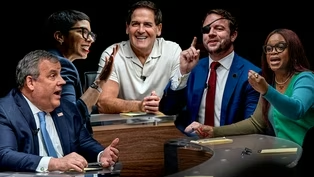
How to Fix an Election: Preview
Video has Closed Captions
Nine voices, one election crisis. How far would you go to defend democracy? (30s)
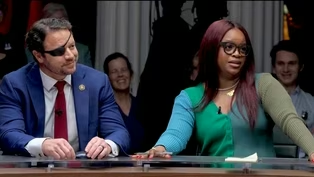
Protect the Vote — or Step Aside?
Video has Closed Captions
Would you risk arrest to protect the democratic process? A tense, hypothetical showdown over protest (2m 18s)
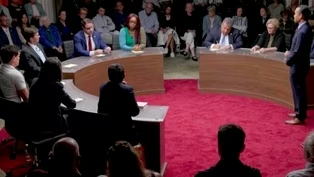
A Republic — If We Can Keep It
Video has Closed Captions
How can democracy last 250 more years? The Deadlock panel wrestles with the question. (3m 36s)
Providing Support for PBS.org
Learn Moreabout PBS online sponsorship New Episode
- News and Public Affairs

Top journalists deliver compelling original analysis of the hour's headlines.

- News and Public Affairs

Today's top journalists discuss Washington's current political events and public affairs.



 New Episode

 New Episode

 New Episode
Support for PBS provided by:
Funding for this program was provided in part by grants from The Rosalind P. Walter Foundation and by a grant from Anne Ray Foundation and by contributions from viewers like you. Thank you. Location furnished by The New York Historical.