
August 6, 2026 - PBS News Hour full episode
8/6/2026 | 57m 46sVideo has Closed Captions
August 6, 2026 - PBS News Hour full episode
August 6, 2026 - PBS News Hour full episode
Problems playing video? | Closed Captioning Feedback
Problems playing video? | Closed Captioning Feedback
Major corporate funding for the PBS News Hour is provided by BDO, BNSF, Consumer Cellular, American Cruise Lines, and Raymond James. Funding for the PBS NewsHour Weekend is provided by...
August 6, 2026 - PBS News Hour full episode
8/6/2026 | 57m 46sVideo has Closed Captions
August 6, 2026 - PBS News Hour full episode
Problems playing video? | Closed Captioning Feedback
Where to Watch PBS News Hour
PBS News Hour is available to stream on pbs.org and the PBS app.
Providing Support for PBS.org
Learn Moreabout PBS online sponsorshipAMNA NAWAZ: Good evening.
I'm Amna Nawaz.
GEOFF BENNETT: And I'm Geoff Bennett.
On the "News Hour" tonight: The Trump administration unveils plans to overhaul Head Start, scrapping many requirements for the early education program that serves low-income families.
AMNA NAWAZ: Safety concerns arise after a passenger plane was allowed to take off while the president's helicopter was flying nearby.
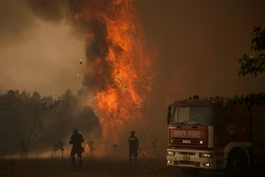
GEOFF BENNETT: And Greece tries to combat deadly wildfires with a new satellite detection system.
COL.
ZISOULA NTASIOU: So, if we have more time, (BREAK) GEOFF BENNETT: Welcome to the "News Hour."
The Trump administration is proposing a major overhaul of Head Start with new guidelines that could fundamentally change how the program is run nationwide.
AMNA NAWAZ: The proposal released today would strip many of the federal requirements currently in place.
Launched in 1965 as part of President Lyndon Johnson's war on poverty, Head Start today serves 700,000 children ages 3 to 5 and some 160,000 infants and toddlers through what's known as Early Head Start.
There are currently 1,600 Head Start providers across all 50 states.
Joining us now to sort through the proposed changes is New York Times correspondent Coral Davenport.
Good to see you.
Thanks for being here.
CORAL DAVENPORT, The New York Times: Sure.
Great to be with you.
AMNA NAWAZ: So let's just start.
For context, how significant an overhaul would these proposed changes mean for the program?
CORAL DAVENPORT: So early childhood educators say this is the biggest overhaul, the biggest change to the program since its creation in 1965, this kind of -- and it's not -- overhaul, it's not quite right.
I mean, it really is essentially an erasure, an elimination of hundreds and hundreds of standards and regulations that sort of govern and dictate the very distinctive and unique requirements that make Head Start different from any other kind of child -- childcare or early education or anti-poverty program in the United States.
AMNA NAWAZ: It's moving a lot of those decisions from the federal level to the state level, the administration argues, correct?
CORAL DAVENPORT: It does.
It says that it's taking away all the requirements that are imposed at the federal level, and the administration says essentially giving control back to the states.
And the states can choose what they want to do.
If the states want to continue to have some of those rules and regulations, they can do so.
But hundreds, again, hundreds of these rules, requirements to follow them are gone.
AMNA NAWAZ: So critics of the program are arguing that the entire program is just not worth the cost.
They say these changes are going to be better both for taxpayers and for kids.
That's an argument we heard from someone at The Heritage Foundation.
That's Jonathan Butcher.
Take a listen.
JONATHAN BUTCHER, The Heritage Foundation: What the Trump administration is trying to do is to deregulate the program, turn responsibility back over to states.
The program has failed to meet achievement expectations.
It has failed to prepare students in terms of behavior to enter elementary school.
I think at least deregulating the program, making it more cost-effective for taxpayers, and, most importantly, making it more effective for students is exactly the kind of policy agenda that we should be following.
AMNA NAWAZ: So let's just take each of those in turn briefly here.
The program is overseen by Health and Human Services, HHS, we should say.
The current federal budget is about $12 billion.
Would these changes save costs?
Do we know that?
CORAL DAVENPORT: The budget is going to stay the same.
The biggest change, the most significant change is going to be eliminating a requirement for small class sizes.
So Head Start has -- the federal requirements for class sizes for preschool and childcare are some of the tightest in the country.
For example, under Head Start rules, the ratio for a class of 2-year-olds would be one teacher for four 2-year-olds.
States have different requirements.
By comparison, the state of Idaho, the requirement is one teacher for nine 2-year-olds, state of Ohio, one teacher for eight 2-year-olds.
So the argument is effectively, by lifting these ratios, you get more kids in the classroom.
And so you keep the same budget, but you get -- the estimate is that they could potentially bring in about 200,000, 250,000 more children into the program just with these higher ratios.
The other side of that potentially is a possible lowering of quality.
AMNA NAWAZ: And the other point that was made there about there's no evidence that the program helped kids to meet the achievement standards, is there evidence behind that?
CORAL DAVENPORT: There's various studies.
There's a lot of different studies on Head Start.
I think the one that Jonathan Butcher is referring to is there's one that shows that, by third grade the advantages that Head Start kids gain start to fade out, that essentially they have those advantages, but as they get into the later elementary school years, you can't really measure the difference.
AMNA NAWAZ: You mentioned the concerns over class sizes that could grow.
That's something we heard from the head of the Washington State Association of Head Start, Joel Ryan.
Take a listen.
JOEL RYAN, Washington State Association of Head Start: Head Start is not going to serve more kids if you weaken the quality of the program, if you undermine the people in the classroom, because not only are Head Start teachers not paid like they should be, but if you start adding more kids that have significant trauma, that are living in poverty, those teachers are not -- they're not going to stay.
They're going to leave.
AMNA NAWAZ: Is that something you're hearing from other Head Start providers?
CORAL DAVENPORT: That is a huge concern.
I talked to teachers, providers, Head Start managers, parents, and I think that that really is the number one concern.
And the point that he made as well that it's important to remember Head Start is -- again, it's not just a preschool program.
It is a poverty -- it is an anti-poverty program, and it is designed to serve children who live below the poverty line.
So they come into the program a lot of cases with a lot of additional needs.
And so teachers say those requirements that compel them to make sure that kids get medical screenings, dental exams, the teachers actually are -- Head Start workers provide visual and hearing screenings in the class.
They do at-home visits.
So with all of those requirements gone, teachers say they're really worried that this program just isn't going to function and it's going to be harder for them.
AMNA NAWAZ: I want to ask you really briefly in the time we have left about a family connection here.
We have a photo to prove it.
In this photo, that is actually the HHS secretary, Robert F. Kennedy Jr., on the left with his uncle, the late Sargent Shriver, who helped design this program over 60 years ago.
Secretary Kennedy referenced that in a statement today.
He said he's honoring Sargent Shriver's legacy by, in his words, returning Head Start to the roots, removing unnecessary bureaucracy.
How is that resonating among the folks you talk to?
CORAL DAVENPORT: I talked to a lot of Head Start providers who hope that Secretary Kennedy is sincere in wanting to continue the legacy of his uncle in designing this, but they really fear that what this ultimately does is end that legacy.
AMNA NAWAZ: And we just want to point out too, for families who rely on the program, we're still months away from this taking effect.
So we will see what happens.
Coral Davenport of The New York Times, thank you so much.
CORAL DAVENPORT: Thanks for having me.
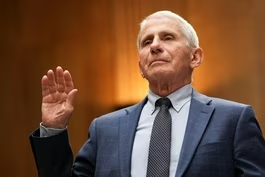
GEOFF BENNETT: In the day's other headlines: A Republican-led Senate committee voted today to hold Dr.
Anthony Fauci in contempt of Congress after he declined to answer lawmakers' questions during a contentious hearing about his response to the COVID pandemic.
WOMAN: On this vote, the yeas are eight, the nays are five, and the motion is agreed to.
GEOFF BENNETT: The vote fell along party lines.
The resolution accuses Fauci of failing to comply with a congressional subpoena, a charge that carries a maximum sentence of one year in prison.
Rather than sending the matter to the full Senate, where it would likely fail to reach the 60 votes needed for approval, committee Chairman Rand Paul is recommending the Justice Department pursue criminal charges directly.
SEN.
RAND PAUL (R-KY): Seeking the truth is not a witch-hunt.
Accountability is not vengeance.
Accountability is what stands between the American people and a repeat of the mistakes and the very real consequences of the past.
SEN.
GARY PETERS (D-MI): This resolution will not provide the committee with any additional information or compel Dr.
Fauci to provide answers to our inquiries.
Criminal contempt is punitive.
GEOFF BENNETT: Dr.
Fauci justified his actions at last week's hearing, explaining in his opening remarks that he believed some Republicans would try to use his testimony to prosecute him.
In a statement, Fauci's lawyer called the vote a crude political stunt intended to punish Dr.
Fauci for exercising his constitutional rights.
Meantime, the same mRNA technology that made the COVID-19 vaccine possible will soon be used in flu vaccines for older Americans.
The FDA has approved a new shot from Moderna called mFLUSIVA for adults age 50 to 64.
The company is also seeking full approval for adults 65 and older.
Compared to traditional shots, mRNA vaccines are quicker to manufacture, and experts say that could help protect against future strains of the flu as they emerge.
The FDA had initially refused to consider Moderna's application amid the Trump administration's heightened scrutiny of vaccines.
Federal health officials are investigating a salmonella outbreak linked to jalapeno peppers sourced from Mexico.
The CDC says at least 345 people across 27 states have gotten sick since mid-June, most of them in Minnesota and Colorado.
Investigators say a company called Coast Citrus Distributors supplied the peppers to the Mexican food chains Chipotle and Qdoba.
Both restaurants say they have stopped serving them, and the CDC says neither establishment poses a risk to consumers.
Meantime, the agency is investigating a separate salmonella outbreak, this one tied to eggs from Texas.
The CDC says nearly 100 people have fallen ill across at least 17 states, and more than 1.5 million cartons have been recalled.
President Trump signed executive orders this afternoon targeting birthright citizenship about a month after the Supreme Court rejected his bid to limit the practice.
DONALD TRUMP, President of the United States: We had a very unfortunate decision in the Supreme Court concerning birthright.
It was close, but a very, very unfortunate decision.
So we're making adjustments because it's very unfair.
GEOFF BENNETT: Mr.
Trump announced the orders this afternoon in the Oval Office with adviser Stephen Miller looking on.
He's a longtime critic of birthright citizenship.
The two orders would expand the list of those considered ineligible for birthright citizenship and ban the practice of so-called birth tourism.
The White House expressed confidence that the new orders would be able to pass any potential legal challenges.
Republican Senator Mitch McConnell says he's been discharged from a rehabilitation center where he's been recovering from a fall in mid-June.
In a statement, the 84-year-old said he's heading home and would "continue to engage with my staff and colleagues on important Senate business," though he did not provide a timeline on returning to the Senate.
McConnell's extended absence from Washington has led to calls for transparency about his health status.
He's suffered a number of health challenges in recent years and is set to retire at the end of this term.
The FCC voted today to eliminate a cap on the size and reach of TV broadcasting companies.
In a 2-1 vote, the FCC repealed a 22-year-old rule holding that a company cannot own stations that reach more than a combined 39 percent of the U.S.
television audience.
The ownership limit will be replaced by a case-by-case approach.
The move was widely expected, with FCC Chairman Brendan Carr writing an op-ed last month that called the earlier policy outdated.
But critics say it opens the door to mass consolidation in the industry, giving larger players more say over what viewers see.
Israeli prosecutors have charged a settler with killing a prominent Palestinian activist last year in the occupied West Bank.
It's the first such indictment since the October 7 Hamas-led attacks led to an outburst of Israeli settler violence.
Yinon Levi can be seen in this cell phone video drawing a weapon on Palestinian villagers last summer.
He's accused of reckless manslaughter and faces up to 12 years in prison.
His lawyers have said he was acting in self-defense.
The victim, Awdah Hathaleen, was an activist featured in the 2025 Academy Award-winning documentary "No Other Land."
His brother said the rare charges send a message.
KHALIL HATHALEEN, Brother of Palestinian Activist (through translator): I hope this will deter the settlers.
Any settler who wants to kill or attack a Palestinian will think twice after this.
GEOFF BENNETT: Meantime, the Israeli military says two of its soldiers were killed in an explosion in Southern Lebanon on Wednesday.
One of them was laid to rest today.
They're the first Israeli deaths since a shaky cease-fire with Hezbollah began two months ago.
And, in Yemen, government sources say that Iran-backed Houthi rebels carried out attacks in two provinces, killing at least 30 troops.
Yemen's Defense Ministry vowed to retaliate -- quote -- at the appropriate time and place."
The escalating violence threatens a fragile truce that was reached in 2022.
On Wall Street today, stocks ended lower after the latest batch of corporate earnings rolled in.
By the close, the Dow Jones industrial average was down about 460 points.
The Nasdaq posted a smaller loss of just 15 points.
The S&P 500 slipped a bit from its recent all-time high.
Still to come on the "News Hour": a murder trial sparks a debate over treatment for postpartum depression; donors push to get refunds from a Maine Senate candidate after he dropped out of the race; and how summers by the sea shaped the work of three great American painters.
AMNA NAWAZ: As we reported last night, the Federal Aviation Administration is investigating why a commercial plane was allowed to take off at the same time President Trump's helicopter approached the same airport on Tuesday.
The incident at Washington Reagan National Airport is again raising questions about the safety of the capital's busy airspace.
It comes after a nearby midair collision last January between a passenger jet and a military helicopter that killed 67 people.
For more on this, we're joined again by aviation correspondent Miles O'Brien.
Miles, it's always great to see you.
I want to underscore here the White House emphasizes too the president was never in any danger.
The two aircraft did not appear to be on a collision course.
But this did seem to break some new safety protocols that were put into place after that last fatal collision in January.
So, when you look at this, how serious was this incident?
MILES O'BRIEN: Well, that's the thing about aviation, Amna.
You have to be really attentive to tiny little details.
And when a few of those tiny little details are overlooked, that's when you have real trouble.
In this case, what appears to have happened is, there was a communication failure between the Marine aviation contingent that was responsible for lifting off Marine One from the White House and the control tower at National -- Reagan National Airport.
Now, typically, what should happen is, three minutes before that helicopter lifts off on the White House lawn, the Marine crew will send a radio signal to the tower saying, we're three minutes away.
Or, actually, they use a little bit of code saying, as briefed, so as not to tip off anybody and cause a security concern.
And that should prompt the controller in the tower cab there at Reagan to stop departures or arrivals, depending on which way the airport is flowing that day, in order for there to be a bubble around Marine One and its contingent as it flies to Andrews Air Force Base.
That did not happen in this case.
There was some miscommunication on the radio.
The radio was a little bit scratchy.
But, for whatever reason, that controller did not stop the departure, and that's what caused the airliner to take off as Marine One was.
There was no near-collision, but it does violate the bubble around Marine One and the rules for that and, in the wake of that collision in January of 2025, raises questions about, once again, communication between military aircraft and the civilian airspace and how that can be improved.
AMNA NAWAZ: So, Miles, this incident was specific to D.C.
's airport, to the president's travel, but are there broader safety concerns that this raises to you?
MILES O'BRIEN: Yes, the concerns are that the communication has to flow fluidly and every little detail has to be attended to in the world of aviation.
And while this one particular incident didn't really raise a safety concern, it is troubling in the fact that something like Marine One, with all the capability of communicating to Reagan National Airport to indicate it's about to lift off, if that can't get through, and that signal and that communication can't get through, it raises concerns about other, more routine flights.
AMNA NAWAZ: While we have you, I want to ask you, miles, about another air safety incident that's making headlines.
The NTSB says it's now investigating the crash of a medical plane in New Mexico in May in which all four people on board were killed.
And the U.S.
military has said that they were testing GPS jamming technology in the area and that disrupted the plane's navigation system.
What do we know about what happened here?
MILES O'BRIEN: Well, first off, GPS has become revolutionary in aviation.
It's something that pilots rely on heavily now for navigation, from getting from point A to point B, with a lot of situational awareness in a way that we didn't used to do it.
Now, that is not the only way that aircraft navigate.
There are ground-based radio beacons, which all pilots learn to use as a backup in this case after GPS.
Now, GPS spoofing and jamming has become a huge problem worldwide, more likely to occur around Ukraine or the Middle East.
In December of '24, there was an Azerbaijan Airlines crash after an airliner was trying to approach an airport.
The GPS was jammed.
It was unable to land safely.
As it tried to land again and again, it was hit by shrapnel, ultimately led to a crash.
These incidents happen really thousands of times, and most of the time pilots go to those backup systems.
But, in this case, it was a moonless, dark night.
And the crew, -- even though the military ultimately turned off that jamming capability to the GPS nearby, the crew was not able to get its situational awareness back and unfortunately flew into a mountain.
AMNA NAWAZ: It's a terrible tragedy there, making a lot of headlines.
Miles O'Brien, we're so glad you can join us to help us make sense of it all.
Thank you so much.
MILES O'BRIEN: You're welcome, Amna.
GEOFF BENNETT: Earlier this week, we brought you a story of how specialized cameras and satellites are helping to spot and contain wildfires in the American West.
Now, similar satellite technology is being used in Greece to help fight another vicious wildfire season there, as Europe suffers blazes across the continent.
From the town of Mati, near Athens, here special correspondent Malcolm Brabant.
MALCOLM BRABANT: Every summer, the people of Mati float lanterns out to sea to commemorate victims of the devastating 2018 wildfire.
Officially, 104 people were killed in and around this beach resort.
Some victims drowned after wading into the bay in a frenzied effort to escape flames and suffocating smoke.
Others were incinerated in their cars after the police made a catastrophic error by sending traffic directly into the inferno.
KALLI ANAGNOSTOU: The only thing that you could hear was the wind and the fire reaching each one of us, and after other screams, the screams of help, the screams of terror, and the last screams of people who were dying of getting burned.
MALCOLM BRABANT: The fire whipped down the hillside at a terrifying rate, forcing residents like Kalli Anagnostou to run for their lives.
Kalli fled on foot alongside her parents and 5-year-old son, who survived despite being badly burned.
KALLI ANAGNOSTOU: I heard him then screaming, "I'm burning.
I'm burning," because I realized that his sleepers were sticking on the road, which was burning, and, along, his feet were melting.
MALCOLM BRABANT: Now, with the wildfire season hitting its destructive stride, the Greek authorities hope that tragedies of Mati proportions will be consigned to the past by a new satellite fire detection system.
MAN: Three, two one.
Ignition.
And liftoff of Falcon 9.
MALCOLM BRABANT: Launched in May, the rocket deployed four dedicated satellites that constantly scan the Greek landscape for hot spots with the potential to become conflagrations.
COL.
ZISOULA NTASIOU: I don't remember working in a Hellenic Fire Service the last 25 years and thought when I began my career that the space will help us to extinguish fires.
So, only that thinking, it's really exciting.
MALCOLM BRABANT: Colonel Zisoula Ntasiou directs aerial firefighting operations in the Athens region, but is also global vice president of the International Association of Fire and Rescue Services.
COL.
ZISOULA NTASIOU: We can have the information of starting fires very quickly, and this is something amazing, the early detection, because we know that, if we cut the fires in the early detection, we will cut it in the beginning.
So, if we have more time, we can save properties.
We can save lives.
We can save the forest.
MALCOLM BRABANT: So far, France and Spain have borne the brunt of this summer's wildfire season, but now heat waves and strong winds have put Greece on the front line.
Older satellite systems that provide general weather monitoring can sniff out football field-sized blazes.
But the new technology, stationed 360 miles above Greece employs high-resolution camera lenses, which it's claimed offer greater precision.
IOANNIS LANTOURIS, Head of Operations and Managing Director, OroraTech Greece: The smallest fire we can detect is around about four-by-four yards.
MALCOLM BRABANT: As head of Greek operations for the OroraTech satellite company, Ioannis Lantouris oversees the low-Earth orbit constellation.
IOANNIS LANTOURIS: This is a satellite that essentially watches over the temperature of the Earth.
So we take thousands of readings within one photo.
We can get thousands of readings from each pixel.
That data help us identify when and if there is a fire, and then, on that, based on that, to run our technology, our models, our predictions, and then provide that information to the user, all of that within a really, really fast time.
MALCOLM BRABANT: How quickly can you alert fire brigades to a potential conflagration?
IOANNIS LANTOURIS: The quickest right now is about 20 to 30 minutes.
MALCOLM BRABANT: Although the satellite system tracked two wildfires on the island of Crete this past week, two volunteer firefighters died after an apparent error of judgment, becoming trapped and overwhelmed by fast-moving flames.
MAN (through translator): I saw the boys with my own eyes.
They made a mistake.
They went there.
Unfortunately, it was their mistake.
I can't say anything else.
The situation is tragic, tragic, tragic.
We see burnt houses, burn cars, burned animals.
Unfortunately, these people will not come back.
MALCOLM BRABANT: And this is the information that was received from the satellites that tracked the Crete fires.
Artificial intelligence filtered out false alarms and flagged the hot spots as genuine threats.
The second video shows how the first fire expanded.
The satellite company says it spread incredibly quickly and reached its largest size within 48 hours of ignition.
Dimitris Papastergiou is Greece's minister of digital governance.
DIMITRIS PAPASTERGIOU, Greek Minister of Digital Governance (through translator): I think we are simply showing the good side of technology and artificial intelligence.
We must continue more dynamically.
We want technology for people, technology that stands by people, technology that comes to provide real solutions to real problems.
MALCOLM BRABANT: Greece's eye in the sky is still some way from being the Holy Grail that provides real-time imaging of a fire's progression.
Although there is that time lag before information is passed to the fire service, the minister is genuinely excited.
DIMITRIS PAPASTERGIOU (through translator): This allows aerial assets to arrive much faster at the fire scene to extinguish it or enables us to manage it right at the moment it breaks out.
MALCOLM BRABANT: I know from personal experience that surviving a wildfire is a lottery.
It's human nature to want to stay put to try to save your home and your possessions.
But wildfires are completely unpredictable and can change direction in an instant, especially on blustery, windy days like today.
And so escape routes can become death traps.
Seventeen years ago, our home, six miles from Mati, was imperiled by a raging wildfire on nearby Mount Penteli.
At 3:00 in the morning, we fled down the mountain with our family treasures, our son, our dog, and photograph albums.
WOMAN: Well, so what really matters to us?
MALCOLM BRABANT: How could we know that the fire would stop at our garden wall, sparing the house?
Right.
We have been forced to abandon our home because the flames have gotten out to within about 200 meters of the back door, and the smoke was getting very unpleasant.
Also, just behind us, the flames were licking up the hill and starting to attack some of the homes just around the corner from us.
The fires have come over the hill from Penteli, which, wow, over there is just extraordinary.
Look at the flames over there.
They're beyond the tree line.
So it looks as though we should be fairly safe to get out here.
But look to your right, daisy.
Look at - - that's what we're leaving behind.
WOMAN: Yes.
MALCOLM BRABANT: That's what we're leaving behind.
And this is a place of real natural beauty, and now it's an ecological disaster.
The Greeks are worried that climate change-driven heat waves will burn more of the country this summer.
Tinder-dry undergrowth is an accelerant that worries fire chiefs like Zisoula Ntasiou.
COL.
ZISOULA NTASIOU: You don't know where these fires are spreading.
They are creating their own environment, and they can do whatever they want.
They can increase the temperature.
They can increase the wind.
So with the satellites and the hot spots, you can say you can see everyone now where this fire is going.
And you can plan your strategy and send there and more resources.
MALCOLM BRABANT: But having witnessed the earth's power at its fiercest, the people of Mati are skeptical about technology's ability to beat Mother Nature.
KALLI ANAGNOSTOU: We cannot predict the human interference.
And this is what needs to change.
No system, no technology can be affected if we continue to make the same human errors.
MALCOLM BRABANT: Still profoundly traumatized, the people of Mati are waiting for compensation for mistakes made by the Greek authorities.
They are united in the hope that no other community will melt like theirs did.
For the "PBS News Hour," I'm Malcolm Brabant in Mati, Greece.
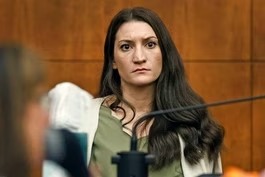
AMNA NAWAZ: The murder trial of Massachusetts mother Lindsay Clancy has brought renewed attention to mental health issues, and specifically a condition known as postpartum psychosis, a rare but severe mental health condition.
Our Stephanie Sy has more.
STEPHANIE SY: That's right, Amna.
Lindsay Clancy is on trial for killing her three children in 2023.
Her now ex-husband found the children strangled in the basement and Clancy injured from an apparent suicide attempt.
All the children were under the age of 5.
And Clancy is now paralyzed from the waist down.
Her defense lawyer says she was experiencing postpartum psychosis, which can cause delusions.
But prosecutors are charging that she acted intentionally.
SHANAN BUCKINGHAM, Massachusetts State's Attorney: This was a woman who acted intentionally, rationally, and swiftly to accomplish a very specific goal, to kill.
KEVIN REDDINGTON, Attorney For Lindsay Clancy: This is a woman that did not get the medication, did not get the medical treatment that she so deserved.
This was a woman that was suffering from psychosis at the time that she went down to that basement.
STEPHANIE SY: Postpartum depression is not uncommon, but postpartum psychosis affects only about one in 1,000 women.
For more, we're joined now by Dr.
Julia Riddle, a psychiatrist who focuses on reproductive mental health at the University of North Carolina Center for Women's Mood Disorders.
Dr.
Riddle, thank you so much for joining the "News Hour."
How much do we know about postpartum psychosis and who it is most likely to afflict?
DR.
JULIA RIDDLE, UNC Center for Women's Mood Disorders: Yes, thank you, Stephanie.
The truth is, we don't know enough.
We need so much more research and so much more attention.
But what we do know, which we have gotten from some registry studies, some Danish registry studies, as well as our own research, is that the people that are highest risk -- as you mentioned, so it's about one to two in 1,000 -- highest risk seems to be associated with bipolar disorder, because this is an affective disorder, which means a mood disorder.
So women with bipolar disorder or a history of postpartum psychosis are at the highest risk.
But it's not everybody with bipolar disorder, and there are women who their first episode with any mental health condition will be in the postpartum.
So other indicators for that may be a difficult delivery, losing a lot of sleep, OK, or having family members, so family members that have had postpartum psychosis or a family history of bipolar disorder, going back to that being the highest risk.
So we don't always know who they are, OK, and we don't always know exactly who to follow, but those are some of our indicators, which does make it a really difficult disease to prevent.
STEPHANIE SY: Describe the typical experience of a woman having an episode of postpartum psychosis.
DR.
JULIA RIDDLE: Yes, absolutely.
So, first and foremost, right, people never read the textbook, so I will do my best to describe this.
It is considered usually rapid, so very, very soon after delivery.
So, a woman gives birth, and usually it's within the first few weeks, family will notice a change.
They're acting odd.
They don't seem with us.
They're a little more detached, or they're more irritable and agitated.
So it often looks like confusion, an agitated state or a manic state, so extra energy, not sleeping being one of the most worrying signs.
So you tell them to go lay down and they cannot sleep.
You find them pacing.
You find them moving things in an odd way.
It doesn't quite make sense.
This often gets so normalized because, if it's the first child, who knows what it's supposed to be like?
So, irritability, excitability, or it can look like a deep and detached depression.
When it starts to get really scary, and we often talk about this in what we do, it's almost as if a vacancy comes over them.
And this is often when we see a loss of reality.
So when there these delusions start, delusions that the world is not safe, delusions that they have to do something to change things for themselves, this is when we start to really worry about thoughts of suicide in particular, and sometimes when some of these infanticide thoughts can come up.
So it can progress, but usually it's this rapid change in the way the woman behaves.
But often she's not sharing it.
So people are kind of watching and wondering.
STEPHANIE SY: It sounds terrifying, but isn't it also true that most women who have this do not exhibit violence?
DR.
JULIA RIDDLE: That is absolutely true.
And I really want to put a point on that, OK?
In the media right now, the number that's getting quoted is 4 percent.
So we're talking about one to two in 1,000 women after birth having postpartum psychosis and then 4 percent of that.
That's actually a misattribution of a citation.
What it is looking at with that, what that paper was looking at was actually only women with a depressed version of psychosis, so they got depressed, so depressed that they became psychotic.
And that was the group at 4 percent risk.
So we're not even talking about that one to two out of 1,000.
We're talking about a small, small, small group.
So it is rare.
This is a treatable illness.
When this gets recognized and treated, women get better, and the vast majority, the vast, vast majority are not violent.
STEPHANIE SY: During Lindsay Clancy's trial, a handwritten log she kept was presented, Dr.
Riddle.
She lists several psychiatric medications in this log and wrote at one point: "Awake all night with suicidal ideation."
She was apparently aware that she needed medical intervention.
How challenging is it for patients to find a psychiatrist who can properly diagnose and treat postpartum psychosis?
DR.
JULIA RIDDLE: Hard.
The answer is hard.
This is not part of psychiatric training, N.P.
training, P.A.
training, psychology, or social work training.
This is not something that is currently required as part of our education.
So I sit on the board for the National Curriculum on Reproductive Psychiatry, because we know people are hungry for this education, but it is not required.
So it is hard for a patient to know when they're seeing someone that has the appropriate training.
But it's also hard as a trainee or someone practicing to get these -- to get this training.
So if we're not finding the right diagnosis, we're not providing the right treatment, and that's a real problem.
STEPHANIE SY: Thankfully, these tragedies are very rare.
But what do you hope comes out of these discussions, not only on postpartum psychosis, but on postpartum mental health?
DR.
JULIA RIDDLE: Great question.
What I really hope for is better training for both -- for our professionals.
I also hope for better recognition, reduction of stigma, and really more investment in our research.
When we look at the research that goes into women's health, it is 6 percent of the investment.
Women deserve so much more, because, when we can get women and families better, right,we get mom better, we take care better of baby family, the whole family unit, and that has reverberations into the community and honestly into the economy.
So these things matter tremendously.
What I also want people to know is that these are treatable illnesses, whether it's postpartum depression, postpartum anxiety and OCD, or postpartum psychosis.
There are treatments and people do get better.
STEPHANIE SY: That is psychiatrist Julia Riddle with the University of North Carolina.
Thank you so much for sharing your expertise.
DR.
JULIA RIDDLE: Thank you.
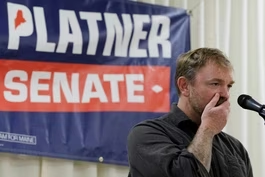
GEOFF BENNETT: After high-profile assault allegations forced Democrat Graham Platner out of Maine's Senate race last month, questions about politicians' conduct are once again in the spotlight.
This week, North Carolina Republican Congressman Chuck Edwards announced he won't seek reelection after the House Ethics Committee recommended he be censured, citing what it called persistent and appropriate conduct toward two young female staffers.
AMNA NAWAZ: And a separate deadline to drop out looms for Ohio Republican Max Miller.
He's facing domestic abuse allegations from his ex-wife and says he is staying in the race.
Liz Landers has more on the efforts some advocates are taking to hold politicians accountable.
LIZ LANDERS: After Platner ended his campaign, activists launched an effort to claw back campaign donations, ensuring donors' money wouldn't be used to cover any legal fees related to Platner's alleged misconduct.
The group behind the effort, Reckoning Action, says it's trying to keep campaign cash out of what it calls the hands of predators.
Now the group is working with a bipartisan group of lawmakers to create a federal ban on campaigns using legal fees for sexual misconduct investigations.
Reckoning Action's founder, Cheyenne Hunt, joins me now.
Cheyenne, thank you for joining the program.
CHEYENNE HUNT, Founder and Executive Director, Reckoning Action: Great to be here.
LIZ LANDERS: You have worked in a lot of different ways, working with lawmakers, working with victims, going to reporters.
Why did this donor refund push feel like the right next step?
CHEYENNE HUNT: Well, one of the things that we have learned in this work is that, when survivors come forward, the support that they need doesn't stop after they tell their stories.
If anything, it multiplies because they're incredibly vulnerable to retaliation.
And we have seen that some of these bad actors use their campaign funds to go after survivors, not only with attorneys and tying them up in legal battles, but also with private investigators that can be incredibly intimidating.
And that can send those survivors into a situation where they feel muzzled, even though they have come out and spoken their truth.
And so this was something that we felt like we had to do.
And that's also why we're so incredibly proud to be working with Congressman Khanna and Representative Anna Paulina Luna on this bill to close the loophole.
But until we're able to make it illegal for campaign funds to be used against survivors in this way, we had to do what we could and were willing to get kind of scrappy.
And that was why we sent out this message and tried to help ensure that Platner donors knew that they had a way to get their money back and ensure that that donation that was given to a candidate they believed in, in the service of democracy wasn't going to get turned on brave survivors who came out and told the truth.
LIZ LANDERS: As you mentioned, this is not hypothetical.
Former Congressman Eric Swalwell has already spent tens of thousands of dollars in campaign funds on his own legal defense after those misconduct allegations forced him out of the California governor's race.
How have women been impacted here in this legal effort?
CHEYENNE HUNT: Across the board, we see survivors who are really the front line of this work and they face incredible retaliation.
And it's been so difficult for us.
But part of the reason Reckoning Action was formed was to make this painful for these perpetrators and to dismantle the systems that produce and protect them.
LIZ LANDERS: Do you have a sense of how much money people have gotten back in those campaign donations after you have launched this effort?
CHEYENNE HUNT: It's hard to tell because of the way that the FEC filing disclosures work.
We know that many Swalwell donors have gotten tens of thousands of dollars back, it seems, at this point in refunds.
For Platner, we don't know yet.
We sent that text out just after the latest FEC filing deadline.
So we will know in a few months.
However, I can say that we got hundreds of hits on our landing page with the instructions to get your money back.
And so I can assume we have taken a pretty good chunk out of that war chest.
LIZ LANDERS: You mentioned those two congressional offices that you're working with, Congressman Ro Khanna and Congresswoman Anna Paulina Luna, on that bill to ban this practice altogether.
If it passes, how does this actually change things for survivors?
CHEYENNE HUNT: It ensures that campaign funds cannot be used to cover up misconduct and to silence and to muzzle survivors who are coming forward for the greater good.
And so it makes sure, one, that the money can't be used that way, and, two, that there's no way to hide if the money is being used that way.
It requires these candidates and their campaign teams to disclose what their legal funds are being used for, right?
We have seen candidates who use their legal funds and their attorneys' offices as a go-between to do things like hire private investigators.
And so it also makes sure that they can't get away with that either.
And we're bringing all of these really shady practices into the light.
LIZ LANDERS: You have spent this year mostly involved in cases on the Democratic side like Swalwell and Platner, but right now it is Republicans who are in the spotlight.
Congressman Chuck Edwards just dropped his reelection bid after the House Ethics Committee found that he had harassed two young staffers.
Congressman Max Miller is facing domestic abuse allegations that he denies, and he is refusing to step down.
And then Congressman Cory Mills is also still under investigation for allegedly assaulting a girlfriend and cyber-stalking another woman.
Speaker Mike Johnson has declined to publicly call on Miller or mills to step aside, saying that there is a process.
REP.
MIKE JOHNSON (R-LA): I mean, the allegations are serious.
I think Max is taking them seriously.
I think our colleagues are.
But, again, we have to allow this process to play out.
It's just begun.
LIZ LANDERS: That is a notably different approach than how your party handled Swalwell and Platner.
Do you think that Republicans are being held to a lower standard here?
CHEYENNE HUNT: Absolutely, they are.
I mean, I think that they are invoking this language that suggests that what we're talking about is a process in a court of law.
But we're not.
We're talking about the people that deserve to represent us in the highest offices in the land.
It is an entirely different standard.
And people who are comfortable with violence against women and people who are willing to sweep that under the rug for their own political agendas don't deserve to hold those seats of power.
LIZ LANDERS: Cheyenne Hunt, thank you for joining the "News Hour."
CHEYENNE HUNT: Thank you.
AMNA NAWAZ: Now to a new exhibition that reveals how three great 20th century painters shaped the course of their own careers while on summer retreats together.
Correspondent Jared Bowen of GBH Boston takes us to Cape Ann in Massachusetts for our arts and culture series, Canvas.
JARED BOWEN: They were three men escaping hot New York and off to chase summer at the seaside, the older seasoned painter and two young earnest ones, eager to learn from their mentor.
OLIVER BARKER, Director, Cape Ann Museum: It's about the artistic process, and it's about a friendship that was so important to three titans of American art.
JARED BOWEN: They were Milton Avery, Mark Rothko, and Adolph Gottlieb.
For successive summers in the 1930s and '40s, they came here to Cape Ann on the North Shore of Massachusetts.
In particular, they were drawn to Gloucester for its mix of natural beauty and the industrial grit of a fishing port.
It was also an artistic rite of passage, says Oliver Barker, director of the Cape Ann Museum.
OLIVER BARKER: Artists colonies were established here and is still very vibrant today.
1932 was the similar year, when the Avery invited Gottlieb and Rothko to come here.
By that point, Edward Hopper had come and gone through this city.
JARED BOWEN: The museum's new show Avery, Gottlieb & Rothko: By the Sea is the first to examine the artists' time together here.
While their New York kinship has been well-documented, this exhibition has been an excavation.
Nearly half the works have never been shown publicly, and they're a revelation, says curator Eliza Rathbone.
ELIZA RATHBONE, Chief Curator Emerita, The Phillips Collection: What's wonderful is, you can really feel them.
You're with them.
As Milton Avery's grandson said, this exhibition is as close to being there with them as we're going to get.
JARED BOWEN: So here we meet the men and the men meeting each other.
ELIZA RATHBONE: I love these two sketches by Gottlieb, one of Rothko and one of Avery, because he absolutely captures them doing what they love to do.
Rothko was a natural musician.
Gottlieb has Milton sketching because Avery was always sketching.
JARED BOWEN: Rothko described this as a golden time.
There was no rivalry.
ELIZA RATHBONE: Rothko said something wonderful later on, and maybe towards the end of his life.
He said, when we were young starting out, there were no galleries, there were no dealers, there were no collectors.
He said, we had nothing to lose and a vision to gain.
JARED BOWEN: Avery at 47 was 18 years older than the younger artists and had been coming to Cape Ann since the 1920s.
A decade later, Rothko and Gottlieb literally followed in his footsteps.
Here on holiday and far away from the grit of their New York lives and studios, they would regularly set out in the morning side by side to sketch or paint.
There was no imitation, but plenty of conversation.
ELIZA RATHBONE: We know they certainly got together every evening, pretty much, in the summertime.
They all share the same subjects, but they treat them differently.
JARED BOWEN: Including the wharves, the fishing, and of course, the beach, where Rathbone says Avery instilled in Rothko and Gottlieb the confidence to strip away the inessential.
In his watercolors, Rothko went even further, his bathers, like Cezanne before him, bask on a more ethereal beach.
ELIZA RATHBONE: There's a kind of intimacy which is perhaps unexpected.
And how does he do that?
How does he express so much feeling in works that are so spare?
JARED BOWEN: Whether Avery was painting the blazing beach sun or the Gloucester Harbor at night, reunited here for the first time with a study Rathbone discovered in Rothko's own collection, his artistic voice as the elder statesman remained consistent.
But the younger men evolved over the summers.
Gottlieb tread into seaside surrealism.
ELIZA RATHBONE: We have a series of these paintings of boxes on the beach that Gottlieb did where he puts these unrelated objects into the sections of the box.
And there's definitely a lot of surrealism in the ideas that lie behind these paintings.
JARED BOWEN: By the 1940s, Rothko's works also changed.
He began taking more wild, expressive turns, rooted in his appreciation for Greek mythology and the writings of Carl Jung and T.S.
Eliot.
As the younger men marched toward abstract expressionism, Avery's work settled into great studies of spareness.
The show ends in a gallery that doubles as a temple to these titans, a room filled with monumental late career work, the canvases that would solidify the legacy of each.
ELIZA RATHBONE: I'm just bowled over by the beauty of this room.
It almost makes me want to weep.
There's a peacefulness here and a kind of sense of fulfillment of all those very hardworking years that they spent, but years when they had nothing and came to the full realization of what they were about.
JARED BOWEN: Years when time by the ocean offered a break from regular life, where the was joy, and where a mentor delighted in encouraging his younger friends to take up the mantle of American art.
OLIVER BARKER: There's a wonderful statement that Mark Rothko made as a eulogy of sorts at the passing of Milton Avery in 1965.
He speaks about Milton Avery as a true poet, a poet that has withstood many different transitions and changes in fashion.
And, to me, there's a timelessness in that gallery.
JARED BOWEN: Where we now see how many a day at the beach helped change the tide of artistic ascent.
For the "PBS News Hour," I'm Jared Bowen in Gloucester, Massachusetts.
GEOFF BENNETT: Finally, tonight: How did American English become so distinctly American?
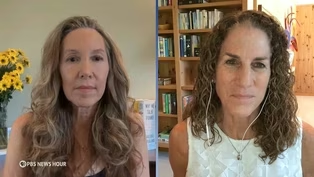
AMNA NAWAZ: Judy Woodruff explores that question and others in this week's "In Pursuit of Happiness" podcast with two linguists, Anne Curzan and Valerie Fridland.
JUDY WOODRUFF: I want to ask the two of you to take us back to that period and even before, Anne, and remind us what was it about the English language at the time of the Declaration, and even before, that was -- it was beginning to be different from British, or was it?
Was it all sounding British?
ANNE CURZAN, Linguist, University of Michigan: It's such a great question.
And I think that, when we look at the language of 1776, it can look really familiar because we can read the Declaration of Independence and the Constitution and understand them.
And so sometimes I will hear, well, English really hasn't changed since then.
And I say, oh, yes, it has.
And you can find all these things in the Declaration of Independence, for example, like a hath instead of a has.
And that's -- there's a reason when you study the history of English for that, or there's a reason that the spelling actually still looks British in the Declaration of Independence, because we had not yet had this American reform of spelling, which we can talk about.
So I'm going to let Valerie talk a little bit about sort of the sounds of the language in terms of what was happening in the United States as English had been brought to North America and where -- and it's really important for people to remember how many languages were already being spoken in North America.
So you have hundreds of Native American languages, along with French and Dutch and Spanish, all of these languages being spoken in the U.S.
as English arrives, and that's really important for understanding what happens to English as different settlers from different parts of England and then Scotland and Ireland come to the United States.
So, with that, Valerie, I have set you up... JUDY WOODRUFF: Yes.
ANNE CURZAN: ... to talk a little bit more about the sound.
JUDY WOODRUFF: It is astonishing to hear you say hundreds of Native American languages.
But fill this out for us, Valerie.
How were we sounding back then?
VALERIE FRIDLAND, Professor of Linguistics, University of Nevada: I get asked a lot, what would we have sounded like at the time of the revolution?
Would we have still sounded British?
That's actually a question that people want to know a lot.
And there are -- it's -- obviously, we didn't have iPhones back then.
It would have been super helpful, but we did have people that wrote more like they spoke.
So we do have some misspellings, particularly in the colonial period, that give us hints as to how people sounded.
We also had, as Anne referenced, a period of spelling reform following the revolution that was both part of this simplified spelling movement, which was English doesn't look like how it sounds, and can we make that less complicated?
Noah Webster was part of that.
So was Benjamin Franklin.
But, also, can we make American English different from British English in part by changing the way it is spelled?
So someone like Benjamin Franklin is very helpful for telling us how people sounded at that era because he actually made a phonetic alphabet... VALERIE FRIDLAND: ... to represent things as they were spoken and wrote that way, until he kind of gave it up, realizing that no one else was going to jump on his bandwagon.
But there were three main periods in how we sounded, and one would have been the very early colonial period, where it would have been very British for the British settlers, but also you had, as Anne referenced, a lot of other settlers.
But the basic answer is, yes, at the time of the revolution, it probably would have sounded more British than American to us.
There probably wasn't that big of a difference between the way that a lot of Southern British people spoke in the way they did in, for example, Philadelphia or Boston at that time.
But it would have sounded very different from both modern British speech and modern American speech, because many of the vowels were in flux at the time, and some of the consonant differences that we have now, like the way we flap the T to make it more D like in words like water or bottle, would not have yet happened.
So it would have been quite different from speech in either place today.
AMNA NAWAZ: And you can watch this full conversation and all episodes of "Pursuit of Happiness" on our YouTube page or wherever you get your podcasts.
And that is the "News Hour" for tonight.
I'm Amna Nawaz.
GEOFF BENNETT: And I'm Geoff Bennett.
For all of us here at the "News Hour," thanks for spending part of your evening with us.

FAA investigating jet takeoff during Marine One flight
Video has Closed Captions
Plane takeoff during Marine One flight renews concerns about D.C.'s busy airspace (5m 10s)
Greece uses satellite detection system to combat wildfires
Video has Closed Captions
Greece deploys satellite detection system to combat deadly wildfires (9m 10s)
Group targets campaign cash used for misconduct legal fees
Video has Closed Captions
Group pushes for ban on using campaign funds for legal fees in misconduct cases (6m 16s)

Head Start faces major changes under Trump proposal
Video has Closed Captions
A look at the major changes Head Start faces under Trump proposal (7m 5s)
How American English evolved from its British roots
Video has Closed Captions
How American English evolved from its British roots (4m 25s)

How summers by the sea shaped three great American painters
Video has Closed Captions
Exhibition reveals how summers by the sea shaped three great American painters (5m 59s)
Murder trial put postpartum psychosis in spotlight
Video has Closed Captions
What is postpartum psychosis? The condition at the center of Lindsay Clancy's murder trial (7m 36s)
News Wrap: Senate committee votes to hold Fauci in contempt
Video has Closed Captions
News Wrap: Senate committee votes to hold Fauci in contempt of Congress (6m 50s)
Providing Support for PBS.org
Learn Moreabout PBS online sponsorship New Episode
- News and Public Affairs

Today's top journalists discuss Washington's current political events and public affairs.

- News and Public Affairs

FRONTLINE is investigative journalism that questions, explains and changes our world.


 New Episode
 New Episode
 New Episode
 New Episode
 New Episode
 New Episode

 New Episode
Support for PBS provided by:
Major corporate funding for the PBS News Hour is provided by BDO, BNSF, Consumer Cellular, American Cruise Lines, and Raymond James. Funding for the PBS NewsHour Weekend is provided by...