
April 7, 2026 - PBS News Hour full episode
4/7/2026 | 56m 32sVideo has Closed Captions
April 7, 2026 - PBS News Hour full episode
April 7, 2026 - PBS News Hour full episode
Problems playing video? | Closed Captioning Feedback
Problems playing video? | Closed Captioning Feedback
Major corporate funding for the PBS News Hour is provided by BDO, BNSF, Consumer Cellular, American Cruise Lines, and Raymond James. Funding for the PBS NewsHour Weekend is provided by...
April 7, 2026 - PBS News Hour full episode
4/7/2026 | 56m 32sVideo has Closed Captions
April 7, 2026 - PBS News Hour full episode
Problems playing video? | Closed Captioning Feedback
How to Watch PBS News Hour
PBS News Hour is available to stream on pbs.org and the free PBS App, available on iPhone, Apple TV, Android TV, Android smartphones, Amazon Fire TV, Amazon Fire Tablet, Roku, Samsung Smart TV, and Vizio.
Providing Support for PBS.org
Learn Moreabout PBS online sponsorshipGEOFF BENNETT: Good evening.
I'm Geoff Bennett.
Amna is on assignment.
On the "News Hour" tonight: President Trump extends his self-imposed deadline after threatening to wipe out Iran's entire civilization.
The civilian death toll rises in Lebanon, a country cut in the wider war as Israel expands its airstrikes and ground operations.
MIRVAT ARNAOUT, Tyre, Lebanon, Resident (through translator): We don't know what to do.
We are so tired, especially us, those suffering from sickness.
We are exhausted.
We can't sleep because of the sound of the warplanes.
GEOFF BENNETT: And women in the U.S.
struggle to obtain treatment from menopause symptoms after a change in FDA labeling.
(BREAK) GEOFF BENNETT: Welcome to the "News Hour."
President Trump is backing off for now his threat to destroy Iran's civilian infrastructure and wipe out its civilization.
In a social media post, he said he has agreed to suspend the bombing and attack of Iran for two weeks, calling it a double-sided cease-fire.
That's if Iran immediately reopens the Strait of Hormuz.
And the president added that the U.S.
received a broad proposal from Iran that is -- quote -- "a workable basis on which to negotiate."
Nick Schifrin starts our coverage.
NICK SCHIFRIN: Today, after rockets rained onto Tehran and U.S.
and Israeli strikes smashed buildings and carcasses, President Trump provided a reprieve, accepting Pakistani Prime Minister Shehbaz Sharif's proposal for the president to delay his ultimatum by two weeks and for Iran to lift its choke hold over the Strait of Hormuz also for two weeks.
This morning, President Trump's ultimatum was his most severe yet: "A whole civilization will die tonight, never to be brought back again.
I don't want that to happen, but it probably will," calling tonight's original deadline one of the most important moments in the long and complex history of the world.
DONALD TRUMP, President of the United States: Every bridge in Iran will be decimated by 12:00 tomorrow night.
NICK SCHIFRIN: Yesterday, President Trump said, if Iran didn't reopen the strait and make a deal, he would launch a four-hour bombing mission beginning tonight at 8:00 p.m.
Eastern, dramatically expanding last week's strike on a bridge that a U.S.
official says was a planned Iranian resupply route.
Military officials told "PBS News Hour," if the president ordered the new campaign, they would target bridges and power plants that have connections to the Iranian military.
J.D.
VANCE, Vice President of the United States: There are still some things that we'd like to do, for example, on Iranian ability to manufacture weapons that we'd like to do a little bit more work on militarily, but, fundamentally, the military objectives of the United States have been completed.
NICK SCHIFRIN: Today, in Budapest, Vice President J.D.
Vance, on a visit designed to politically support Hungarian Prime Minister Viktor Orban's reelection, said U.S.
demands included Iran halting all support for regional proxies, including Hezbollah.
J.D.
VANCE: They have got to know we have got tools in our toolkit that we so far haven't decided to use.
The president of the United States can decide to use them and he will decide to use them if the Iranians don't change their course of conduct.
NICK SCHIFRIN: But, today, Iran continued to strike the U.S.'
Arab Gulf allies, targeting a Saudi petrochemical complex.
Israelis rushed to shelters as Iranian missiles targeted Tel Aviv and its suburbs.
And, today, Iran's president called for volunteers to protect the country's infrastructure.
He said 14 million young Iranians answered the call to create human chains around bridges and even the country's nuclear facilities.
AMIR-SAEID IRAVANI, Iranian Ambassador to the United Nations: There must be no doubt Iran will take all necessary measures to defend its people.
NICK SCHIFRIN: And tonight's pause does not change Iran's long-term public demands, laid out today by Iran's U.N.
ambassador, Amir-Saeid Iravani, which, at least in public, includes financial control of the Strait of Hormuz.
But the U.S.
and Israeli campaigns in Iran also continued today, including what a U.S.
official identified as naval mine and missile storage and other military targets struck on Kharg Island, through which Iran exports 90 percent of its oil.
Israel also targeted some of Iran's railway network.
And one strike even hit a Tehran synagogue and its irreplaceable handwritten copies of the Torah.
Before President Trump's pause, Israeli Prime Minister Benjamin Netanyahu said the campaign would continue.
BENJAMIN NETANYAHU, Israeli Prime Minister (through translator): I tell you constantly that we are crushing the terrorist regime in Iran, but we are doing so with even greater vigor and with increasing force.
NICK SCHIFRIN: But, tonight, a White House official tells me that Israel too has agreed to stop firing and to the president's cease-fire, Geoff, and so it does appear that, at least for two weeks, this war is now over.
GEOFF BENNETT: And, Nick, what are the implications of the president's announcement tonight beyond this two-week delay, this two-week cease-fire?
Is there sort of an infrastructure here for a longer-term peace?
NICK SCHIFRIN: So I think the president is saying there is.
So I think the first part of that is that the U.S.
is emphasizing, U.S.
officials are emphasizing tonight that Iran has to reopen the Strait of Hormuz.
So none of this works unless there's a reopening.
So, assuming for a second there is a reopening, the president is emphasizing tonight that Iran's 10-point plan that it has sent to the United States over the last week or so is a -- quote -- "workable agreement" and a workable basis on which to negotiate.
Here's the thing about that 10-point plan, Geoff.
It includes things like Iran will maintain financial control over the Strait of Hormuz, the U.S.
and Israel have to send reparations to Iran and that the U.S.
has to lift all sanctions on Iran.
None of that, at least publicly, assuming that it's still in there, has been acceptable to the United States, Israel or any of its allies.
And so the president is emphasizing that we got the job done, we hit our marks militarily, now's the time for long-term peace.
But Iran still maintains the ability to launch missiles and drones across the region.
And, at least publicly, Iran's demands for that long-term peace are unacceptable to the United States, to the Israel and their allies.
So there is a long way to go if this is going to become anything more than a two-week cease-fire before the war resumes.
GEOFF BENNETT: Nick Schifrin, thanks, as always, for that reporting.
Thank you.
GEOFF BENNETT: Let's shift our focus now to Tehran and special correspondent Reza Sayah, who's been following this precarious back-and-forth from the Iranian capital.
So, Reza, the news of a two-week cease-fire just came.
Have you heard any reaction yet?
REZA SAYAH: Yes, no official reaction from government officials, other than that they have accepted this proposal.
But I think, publicly, they're going to pour trade as a victory against the United States and Israel.
Just like Mr.
Trump on Monday and his secretary of war portrayed the recovery of the U.S.
fighter pilot as a huge victory and a show of U.S.
military might, I think Iran is going to portray disagreement as a win.
Remember, for Iran, survival was always victory.
And despite taking many losses, the destruction of military hardware, the destruction of industrial and economic infrastructure, the assassination of political military leaders, the loss of their supreme leader, they are still standing.
And, for them, this is a win.
And state media is reporting it as such.
I'm going to read you a couple of headlines that were just published a couple of minutes ago.
Fars News Agency writing "Trump Once Again Retreating."
Mehr News headline is "The Strength and Resistance of Iran Forced Trump to Accept a Cease-Fire."
So, certainly they're presenting it as a win.
But I think, moving forward, all eyes are going to be on the Strait of Hormuz.
The agreement says Iran must open it, and we will see if they open it and what they do beyond the two weeks.
GEOFF BENNETT: It's striking to hear you say that, for Iran, survival is victory.
How then did Iranian officials react to President Trump's threat earlier today to erase an entire civilization in Iran, as he threatened?
REZA SAYAH: Yes, I think the people who reacted negatively.
They were very concerned about what he meant.
When you have the leader of the free world, the president of the strongest country in the world threatening to erase your civilization, you wonder what he means.
The military leaders were more dismissive.
Their position is, if he's going to attack our infrastructure, we're going to do the same.
But I think that rhetoric is behind us right now.
And moving forward, we're going to see how this plays out and especially beyond these two weeks.
Remember, it was increasingly clear that Iran's hold of the Strait of Hormuz was a lever they never had before until this war, a lever with which they could wage war on the global economy in response to U.S.
and Israeli bombings and in many ways guarantee their security.
And I think it'll be very interesting to see two weeks from now.
This was their demand to keep a hold of the Strait of Hormuz, to change the protocol.
Will they stand firm next to that demand or forgo it?
That's going to be key moving forward.
GEOFF BENNETT: And, Reza Sayah, finally, do Iranians, based on your reporting and based on your conversations, do they think that this will lead to a lasting peace?
REZA SAYAH: I think it's too early.
I think my impression is, most Iranians are going to be relieved that seven weeks of being bombed is over, that they can take a breath, that they can rest.
But, in the past 47 years, they haven't been able to rest much.
It's been 47 years where they have faced a brutal government and pressure, sanctions, and two wars, facing the United States and Israel.
So I think they're going to be able to take a breath, exhale for a couple of weeks, and we will see what unfolds after this two-week cease-fire and if the peace is sustained or we're back to conflict and hostilities.
GEOFF BENNETT: Reza Sayah joining us tonight from Tehran.
Reza, our thanks to you.
GEOFF BENNETT: Well, for perspective now, we turn to Alan Eyre.
He served in the U.S.
government for four decades and was part of the Obama administration's negotiating team for the Iran nuclear deal, which President Trump pulled out of back in 2018.
He's now at the Middle East Institute.
And Miad Maleki was born and raised in Iran.
Until last year, he was associate director for sanction targeting with a focus on Iran in the U.S.
Treasury Department.
He's now a senior fellow at the Foundation for the Defense of Democracies.
Thank you both for being here.
Alan, we will start with you.
I think it might be helpful for our viewers to sort of reset the table.
Help us understand, what exactly has been agreed to and by whom?
ALAN EYRE, Middle East Institute: Well, I think what's been agreed to is cease-fire for two weeks.
And on the one hand, U.S.
and Israel have to obey, on the other hand, Iran.
It's not clear whether this extends to Israel stopping attacks in Lebanon, which is one of the 10 points that Israel had in its proposal.
Unclear.
But, to me, the key unknown variable is, how much does Iran let loose of its choke hold on the Strait of Hormuz, which has become the single most important piece of strategic leverage it has?
I'm, frankly, surprised that they agreed to this cease-fire.
And two weeks from now, we will see whether they're willing to relinquish it in perpetuity, which I would be surprised at.
GEOFF BENNETT: How realistic is this in the short term, do you think, Iran reopening the strait?
MIAD MALEKI, The Foundation for Defense of Democracies: I think it is.
I would disagree with -- and I would argue that they needed the cease-fire more than any other party to this conflict.
I mean, their economy is bankrupt.
They rely on the Strait of Hormuz more than any other nations in the Gulf.
So, I think they wanted a cease-fire.
I'm not surprised that they agreed to some sort of cease-fire.
We don't know what those 10 points are.
We have seen some reports that some of those 10 points are things that I don't think the U.S.
government is going to agree to, such as sanctions relief or some kind of a provision of financial incentives to Iran for the flow of commerce through the State of the Union.
It could be some watered-down version of the 10 points.
It could be a new set of 10 points that Iran proposed.
So we have to wait and see where those 10 points are.
But, at this point, again, I think the Iranian regime is coming out of this in a lose-lose kind of situation.
They accept the cease-fire.
They have to accept the reality of the domestic pressure, a broken economy, and a political situation that is very dire.
They have lost their top layers of leadership.
And it's unclear if they can actually communicate between different provinces with different parts of government.
And if they did not accept the cease-fire, then they're going to keep losing militarily and politically and economically.
GEOFF BENNETT: And, Alan, in the TRUTH Social post from President Trump this evening, he says: "We have already met and exceeded all military objectives."
What were those objectives?
And is his assessment widely shared?
ALAN EYRE: Prior to that, I'd like to point out one thing, and I could be wrong, but Iran's ships were still going through the Straits of Hormuz.
So they were still making money.
They were controlling the flow of traffic, but not stopping all of it.
So, economically, they weren't suffering that much.
They were in fact making more.
And your question was?
GEOFF BENNETT: When the president says, we have already met and exceeded our military objectives.
ALAN EYRE: Oh, yes.
He has.
I mean, Israel and the U.S.
have both said repeatedly, our goal was to deny Iran the ability to project power past its borders.
They have done that.
They have taken out the navy.
They have taken out the air force.
They have hurt much of Iran's defense industrial base, destroyed many of the petrochemical plants that made precursors, essential for rocket fuel, missile fuel, taken out the nuclear centers.
But what they didn't do, the unintended consequences, they allowed Iran to discover a new strategic lever.
And that's control of the strait.
So, in many ways, control of the strait has supplanted the latent threat of Iran going nuclear in terms of a possible future strategic deterrent.
GEOFF BENNETT: And the military might, in and of itself, isn't enough leverage to ensure that the strait stays open?
ALAN EYRE: Whose, the Western military might?
GEOFF BENNETT: Yes.
ALAN EYRE: No, it's not, because it takes relatively little to close the straits.
All you have to do is spook the insurance market.
And that's a fast attack craft and a guy holding an RPG, right?
It doesn't take a massive navy to threaten the Strait of Hormuz, to hit a ship.
So that's the problem.
All it takes is a couple of drones, which are cheap to make.
Iran has lots of them, or, even worse, as I said, someone in a fast attack craft, and you have so cowed the international insurance markets that they're not going to provide insurance, without which ships won't go through the strait.
GEOFF BENNETT: Miad, do you see a framework here for a lasting peace, something more durable?
MIAD MALEKI: I don't think you can see that with this regime.
And just kind of responding very quickly to your point, there's some limited number of tankers, Iranian tankers that moved through the Strait of Hormuz.
But the fact is, Iranian regime cannot repatriate any of this revenue that it generates from oil.
It's unclear if the oil that moves outside the Strait of Hormuz is actually being picked up by buyers.
There's now Venezuela oil in the market.
There's more Russian oil that is now available to some of the buyers, giving some of the relief that was provided recently.
So, back to your question, I think it's -- with this regime, a lasting peace or agreement is just not -- you're not going to see that.
I think they're -- especially given the fact that they're domestically under so much pressure, they're going to have to look for some kind of another conflict.
If you go back historically, in the '80s, Iran-Iraq war gave Iranian regime some kind of a few years of relief domestically to kind of operate in that state of war.
They have that right now.
With the ending of the strikes and the campaign, they're going to have to face a reality that, domestically, they're not really considered legitimate by the people.
They don't have the support domestically.
We can see how another round of protests in Iran and the regime might go back to posing threat to external adversaries.
GEOFF BENNETT: Well, to your point, as I understand it, the last line of the Iranian statement reads, "Our hand remains upon the trigger," which you would interpret in what way?
MIAD MALEKI: I think they're going to maintain control over the Strait of Hormuz.
They have had this for years.
That's not going to change.
They're not going to agree to any kind of deal that would push them away from what they're able to do in the Strait of Hormuz.
But, as I said, their import relies on the Strait of Hormuz.
Their export, getting oil out, depends on the Strait of Hormuz.
Regardless of if they can sell the oil or not, they have to get the oil out, so they can continue to extract oil.
So they really depend on the Strait of Hormuz.
They're going to continue to pose that threat.
GEOFF BENNETT: And, Alan, what fault lines remain at this point?
ALAN EYRE: Well, the fact that both sides' minimal demand of the other are so far apart, that it will take serious and sustained negotiations for any sort of chance of a solution.
And this is not something the U.S.
has really done, this administration, before.
They have a type of strategic attention deficit disorder.
They want to move on to something else.
So I just hope that they dedicate the people, the expertise and the time.
There was a recent story in the press that said that Mr.
Witkoff and Mr.
Kushner told President Trump, in essence, yes, we could probably reach a deal, but it would take a few months.
Well, that's great.
Let's dedicate those few months and get a deal.
GEOFF BENNETT: And, lastly, what do you make of Pakistan's role in all of this?
Why have they emerged as the key mediator?
ALAN EYRE: Well, there were seven countries trying to mediate.
There was Pakistan, Egypt, Turkey, Qatar and Oman.
That's five, sorry.
They did a great job.
I mean, to a large extent, any country that has the minimal mutual relations with the U.S.
and Iran would suffice.
Pakistan did the job.
I mean, what matters is partly who's mediating, but, more importantly, the message is being passed, not the tube they're being passed in.
So I commend Pakistan for doing a great job, but the key roles are not going to be whoever mediates.
And, ideally, I'd like no mediation.
I'd like both sides talking to each other.
That's what we did in the JCPOA, not two or three hours every couple of weeks, all day, every day, until you reach an agreement.
GEOFF BENNETT: Alan Eyre, Miad Maleki, thank you both for your insights and perspectives.
ALAN EYRE: Thank you.
GEOFF BENNETT: In the day's other headlines: Vice President J.D.
Vance is in Hungary today backing the Trump administration's support for Prime Minister Viktor Orban's reelection bid.
During a joint press conference, Vance praised Orban as a statesman and accused European Union officials of trying to sway the election against him.
The far right leader and close Trump ally is trailing in many polls ahead of Sunday's vote.
Vance's appearance was a break with most politicians, who avoid taking an active role in the political campaigns of other countries.
Later, the vice president began his address to a crowd in Budapest by calling President Trump, who offered his own praise for Orban via speakerphone.
J.D.
VANCE, Vice President of the United States: Mr.
President, you are on with about 5,000 Hungarian patriots, and I think they love you even more than they love Viktor Orban.
(CHEERING) DONALD TRUMP, President of the United States: Well, I can't believe that.
I can't believe that, because I love Hungary.
And I love that Viktor.
I will tell you, he's a fantastic man.
We have had a tremendous relationship.
GEOFF BENNETT: Vance's visit comes as Orban is seeking a fifth term in office.
He's facing a strong challenge from center-right candidate Peter Magyar, who has called the election a referendum on whether Hungary continues to align with Russia or with European democracies.
The American journalist kidnapped in Iraq last week, Shelly Kittleson, was reportedly released today.
The Associated Press and other outlets say the 49-year-old was freed this afternoon, but did not provide her current whereabouts.
Earlier in the day, the Iran-backed militia group Kataib Hezbollah said it would release Kittleson so long as she leaves Iraq immediately.
Closed-circuit footage shows the moment a person believed to be Kittleson was rushed into a car on a Baghdad street back on March 31.
Iraqi officials reportedly say she was freed in exchange for the release of militia members, though that has not been confirmed.
And Turkey officials say gunmen attacked a building in Istanbul today that houses the Israeli consulate.
(GUNSHOTS) GEOFF BENNETT: Eyewitness video shows one of the gunmen wearing a brown backpack exchanging gunfire with police.
One suspect was killed in the shoot-out and two others wounded.
Two police officers also suffered minor injuries.
Turkey's interior minister says at least one of the attackers was linked to a group that he said was -- quote -- "exploiting religion" without naming the organization.
The Islamic State Group has carried out attacks in Turkey in recent years.
An investigation is under way.
The British government is blocking the rapper formerly known as Kanye West from entering the U.K., citing his history of antisemitic statements.
The country's Home Office said his presence would not be conducive to the public good.
Ye, as he is now known, was scheduled to headline the Wireless music festival in London this summer.
Organizers now say the three-day event is canceled and that ticket holders will be refunded.
Last year, Australia canceled Ye's visa after he released a song promoting Nazism.
It all follows two sold-out shows of his in Los Angeles last week.
In Northwest Georgia, voters are selecting who will replace former Congresswoman Marjorie Taylor Greene in Congress.
The special election pits the Trump-backed Republican, Clay Fuller, against the Democrat, Shawn Harris.
The winner of today's election will serve out Greene's term in the heavily Republican district, but he will need to run again in a separate primary later this year to keep the seat.
Meantime, in Wisconsin, Democrats are hoping to increase their control of the state's Supreme Court in a race between two appeals court judges, the Republican-supported Maria Lazar and Chris Taylor, who's backed by the Democrats.
NASA and the White House released dazzling new images today taken by Artemis II astronauts as they made their journey around the moon.
Earthset, a spin on sunset, shows the Earth disappearing behind the moon's surface.
It's a nod to the famous Earthrise shot from the crew of the Apollo 8 back in the late 1960s.
And then there was this today, a solar eclipse with the sun slipping behind the moon, a view rarely seen by humans.
The photos were released as the astronauts returned home from their journey around the far side of the moon, during which they set a record for traveling further than any astronaut before.
And there was yet another first today.
WOMAN: Integrity, this is the International Space Station.
How do you hear?
GEOFF BENNETT: Houston's Mission Control arranged a radio link-up between the Artemis II astronauts and the crew at the International Space Station.
It was the first such moonship-to-spaceship radio link-up in history since the previous Apollo missions took place before the space station was built.
On Wall Street today, stocks ended mixed amid uncertainty over President Trump's Iran deadline.
The Dow Jones industrial average slipped 85 points on the day.
The Nasdaq managed a slight gain of about 20 points.
The S&P 500 also shook off earlier losses to end slightly higher.
Still to come on the "News Hour": what's becoming the signature injury among American soldiers in the war with Iran; heightened demand creates a shortage of hormone therapy used by women for menopause symptoms; and author Patrick Radden Keefe joins our PBS News podcast to discuss his newest true crime story.
On Easter Sunday, Israel carried out a fresh wave of airstrikes on Lebanon's capital, Beirut.
At least 11 people were killed across the country that day, with dozens more injured.
Israel says it's targeting the Iran-backed militant group Hezbollah.
The total death toll in Lebanon has reportedly now exceeded 1,500.
The southern city of Tyre also came under Israeli fire on Sunday.
Tyre, like much of Lebanon's south, has been placed under forced evacuation orders by the Israeli army.
Special correspondent Simona Foltyn and videographer Adrian Hartrick traveled to Tyre and have this report.
SIMONA FOLTYN: Sixty-three-year-old Mirvat Arnaout is living Through Israel's fifth war with Lebanon, but this is the closest it has felt to home.
MIRVAT ARNAOUT, Tyre, Lebanon, Resident (through translator): At 8:00 in the morning, our neighbors woke us up.
We got up, still dressed in our pajamas, and we left the house.
We went down to the seaside.
Then the strike came at 2:10 p.m.
You see the clock has stood still since then.
SIMONA FOLTYN: This is the airstrike on Tyre's old city that hit the building next to Mirvat's.
The blast was so powerful it blew a hole into her kitchen and bedroom.
When she came back home, she found pieces of shrapnel among her broken furniture.
MIRVAT ARNAOUT (through translator): We are shocked.
We don't know what to do.
We are so tired, especially us, those suffering from sickness.
We are exhausted.
We can't sleep because of the sound of the warplanes.
SIMONA FOLTYN: In a statement to the "News Hour," the IDF said it was targeting a Hezbollah weapons storage facility.
But this was a residential building.
Mirvat knows the two families who live there and says neither had links with the Shia militant group.
MIRVAT ARNAOUT (through translator): The building has two floors, the house of Shera Faddin (ph) on the house of Yunus (ph) on the ground floor.
I know them.
We are neighbors and close friends.
SIMONA FOLTYN: Tyre is a historic coastal city founded by the Phoenicians almost 5,000 years ago, its ancient ruins designated as a UNESCO World Heritage Site.
But now the tourist destination has earned a more sinister distinction.
It's among dozens of towns and villages in Southern Lebanon placed under forced evacuation orders by the Israeli army, which has told residents to flee.
Mirvat and her sister have decided to stay.
MIRVAT ARNAOUT (through translator): We were raised here.
We have aged here.
Our house and our land is here entire.
Lebanon is our country.
And now they want to occupy us?
SIMONA FOLTYN: That occupation has already begun.
IDF ground troops have advanced around five miles into Lebanese territory and have taken hills just south of Tyre, battling with Hezbollah fighters who are trying to slow their advance.
Last week, Israel's Defense Minister Israel Katz said the IDF will occupy Lebanon up to the Litani, a river that runs around 20 miles north of its border.
ISRAEL KATZ, Israeli Defense Minister (through translator): At the end of the operation, the IDF will establish itself in the security zone inside Lebanon on a defensive line against anti-tank missiles, and will maintain security control over the entire area up to the Litani.
SIMONA FOLTYN: That area accounts for almost 10 percent of Lebanon's territory and would include Tyre.
As part of these plans to occupy the south, Israel has destroyed at least seven bridges spanning the Litani.
This is the coastal highway, the main artery connecting Lebanon's south with the rest of the country.
That's a Lebanese army checkpoint right behind me, and in front of me is one of the bridges that was destroyed in an Israeli strike.
Now, Israel claims that the destruction of bridges like these serve to prevent Hezbollah fighters and weapons from reaching the border.
But, in reality, what it has done is to isolate the south and impede the movement of civilians.
Only one bridge is left to connect Tyre to the rest of the country.
The town's deputy mayor, Alwan Sharafeddine is preparing for the worst.
ALWAN SHARAFEDDINE, Deputy Mayor of Tyre, Lebanon (through translator): There's fear that if that last remaining bridge is targeted, we are headed towards a humanitarian catastrophe because our current provisions only last for about a week.
SIMONA FOLTYN: The flow of aid has been reduced to a trickle after Israel killed three U.N.
peacekeepers and 54 Lebanese first responders in the past month.
ALWAN SHARAFEDDINE (through translator): The problem is that the supply convoys that used to come from international agencies are not getting Israeli permission to cross.
If they don't receive Israeli assurances that they won't be struck, there won't be any aid coming.
SIMONA FOLTYN: Around 15 percent of Tyre's 60,000 residents remain, in addition to 17,000 people who have fled towns and villages that have already fallen into Israeli hands.
Some have found refuge in schools like these.
Khadija and Nami are from the border village of Blida, now occupied by the IDF.
They show me videos of their two houses, both of which were destroyed during the previous war back in 2024.
KHADIJA YOUSEF, Displaced from Blida (through translator): One house had three floors.
The other one had two.
Both are gone.
It's all messed up.
The furniture inside is gone.
I have nothing left.
SIMONA FOLTYN: When a cease-fire was signed at the end of 2024, the family hoped they could slowly rebuild.
NAMI DAHER, Displaced from Blida (through translator): I put up solar panels because there was no electricity.
I brought a water tank.
I had fixed up one room.
Things were going OK.
But then the war started again.
SIMONA FOLTYN: Many Shia Muslims in Lebanon's south support the resistance, which is what Hezbollah is called here.
With the Lebanese army withdrawing, they see the group as their only protector against Israel's invasion.
NAMI DAHER (through translator): The resistance is doing a good job and they won't stand down.
They won't let them occupy the country.
SIMONA FOLTYN: Do you have any hope that you can go back?
KHADIJA YOUSEF (through translator): God willing, we will go back and we will rebuild and make it more beautiful.
May God protect those young men.
NAMI DAHER (through translator): We want to go back to our land, even if it's destroyed, even if we have to set up a tent.
That's our goal.
SIMONA FOLTYN: But Israel has no intention to allow civilians like Nami and Khadija to return.
Defense Minister Katz has vowed to replicate Israel's Gaza doctrine in Lebanon.
ISRAEL KATZ (through translator): All houses in villages near the border in Lebanon will be destroyed, according to the model of Rafah and Beit Hanoun in Gaza, to remove once and for all the threats near the border to northern residents.
SIMONA FOLTYN: The IDF has already begun to make good on these promises.
It has detonated at least two border villages in what seems to be a scorched-earth policy aimed at punishing Shia Muslims and making their areas uninhabitable.
The war has uprooted more than a million people in Lebanon.
This Syrian family fled instability back home and has now been displaced again.
They found no space in government-run shelters.
BADRIA HASSAN KANAAN, Displaced From Syria (through translator): The house we were living in was destroyed.
There's no space for us.
They have registered us, but there's no space.
We are living by the grace of God.
SIMONA FOLTYN: The tarps offer little protection from the rain and cold, let alone from Israeli bombs.
But the family feels they have nowhere else to go.
BADRIA HASSAN KANAAN (through translator): Where in the north should we go?
They won't take us.
Should we go back to Syria?
There's no money.
SIMONA FOLTYN: Many of those left in Tyre are sick, elderly, or lack the means to leave.
But, for others, the decision to remain is a political statement underpinned by a desire to stay on their land until the end.
For the "PBS News Hour," I'm Simona Foltyn in Tyre, Southern Lebanon.
GEOFF BENNETT: And, tomorrow, we will have a report from Israel, where people have been marking the Passover and Easter holidays under the shadow of war.
More than 350 U.S.
service members have been injured since military action against Iran began in late February.
And U.S.
Central Command says the vast majority of those injuries are TBIs, or traumatic brain injuries.
Our Liz Landers is here with more.
LIZ LANDERS: Traumatic brain injuries have become the defining injury of post-9/11 conflicts in Iraq, Afghanistan, and now in Iran.
And while many service members are able to return to duty, the symptoms of TBI can often linger for years or even a lifetime.
Joining us now is Jayna Moceri-Brooks, who has studied combat-related traumatic brain injuries for years.
She's a professor at NYU in the College of Nursing.
Jayna, thank you so much for joining "News Hour."
JAYNA MOCERI-BROOKS, New York University: Thanks for having me.
LIZ LANDERS: Why have traumatic brain injuries for soldiers become more common, not just in this war with Iran, but also in the war on terror in the last 20 or so years?
JAYNA MOCERI-BROOKS: I think there's a number of factors for that.
One is that the type of warfare has changed, where it moved to the urban environment, where service members were experiencing a lot more IEDs and EFPs that caused the blast overpressure injury to their brains.
Also, we have such strong armor that I think previous service members would have not survived some of the blasts that our current service members have survived, and they have walked away alive, but with traumatic brain injuries from the blast.
LIZ LANDERS: TBI is sometimes called an invisible wound.
What are some of the effects or symptoms of traumatic brain injuries?
JAYNA MOCERI-BROOKS: So there's many wide-ranging effects, and they are somewhat individual to the person who experienced it.
But common symptoms include headaches, ringing in the ears, visual changes, sleep disturbances, impulse or memory challenges, difficulty concentrating.
There's a range of symptoms that are actually fairly from head to toe for these service members.
LIZ LANDERS: Why is it getting easier for the military and medical professionals to recognize and diagnose traumatic brain injuries?
JAYNA MOCERI-BROOKS: I think it's easier because, if we look at it through a neuroscience lens, instead of a psychological lens, then we can use a mechanism of injury to diagnose these injuries, which we do in emergency and trauma medicine all the time.
We know from science that being in or near a blast causes a concussion injury.
And so by mechanism alone we can diagnose these injuries.
LIZ LANDERS: You have championed the Purple Heart being awarded to service members with TBI.
Why is that so important, do you think?
JAYNA MOCERI-BROOKS: It's so important because my studies show that it actually lowers suicide risk to be given that official recognition of a combat injury.
And what I found through my study is that those who received the Purple Heart for their combat-related brain injury felt like the Purple Heart validated their uniquely invisible injury and helped them to receive care for their injury.
And, again, I found in my study that it lowered their suicide risk.
And we know that those with a combat-related traumatic brain injury are four times more likely to attempt suicide and have over double the suicide rate than those without a traumatic brain injury.
LIZ LANDERS: How can this Trump administration improve the TBI care that soldiers from this Iran war are receiving?
JAYNA MOCERI-BROOKS: I think this administration has a phenomenal opportunity to be the first to properly recognize, identify, document and treat these injuries to prevent suicide in the long term.
I think that they have an opportunity to provide early recognition through receipt of the Purple Heart and to ensure that these service members who come home have multidisciplinary care and a phased - - accelerated phased recovery plan for the years after the injury occurs to help them to heal from the injury.
LIZ LANDERS: Earlier, we spoke with Jim and Karee White from North Carolina about the reality of military families caring for returning veterans.
Their daughter, Kimmy, suffered a severe traumatic brain injury in 2014 while serving in Afghanistan and now requires full-time care.
I want to play some of that interview for you.
JIM WHITE, Military Family Member: That's a burden that will get carried quietly by families.
It'll change everything.
And - - but for us, it's been a duty.
It's been just another duty and it's been an honor to take care of our daughter.
And it's been -- for all the hardship, there's been many, many gifts that we have gotten as a result of it, the way our friends and neighbors have responded, the support we have gotten.
KAREE WHITE, Military Family Member; Service members don't choose a war.
They choose to serve their country.
That's the way we look at it.
And it's an act of faith, really, in the nation that we love to do that.
And I think the country has a lifelong obligation.
When we ask our sons and daughters to serve in harm's way, they have an obligation to stand behind them for the length of time it takes for those families that have sacrificed.
LIZ LANDERS: I think Jim and Karee demonstrate that, for every veteran that serves, there's a family behind them that supports them and also sacrifices as well.
What do those families experience?
And then also how can those families be supported?
JAYNA MOCERI-BROOKS: Yes, that's so true.
So, the families experience seeing firsthand the service' members challenges or continued symptoms from their traumatic brain injury in the rawest, most vulnerable state, and so they have really important insights to share and need to be listened to and heard and included in the care process and the care plan and the recovery plan through every aspect of it.
And I think they have important insights, that they should be brought into the visits and made sure that they're heard and being given the opportunity to share what they see behind closed doors.
LIZ LANDERS: What is your advice to some of those family members?
JAYNA MOCERI-BROOKS: My advice would be to -- to be and insert yourself in the process and to go with the service member to the office visits, to advocate for them to receive continued care and a multidisciplinary approach, to helping them through some of the symptoms that they're experiencing, and to not give up, to keep going, to keep advocating and to stick with them to make sure that they get the care that they need.
LIZ LANDERS: Jayna Moceri-Brooks, thank you so much for joining the "News Hour."
JAYNA MOCERI-BROOKS: Thanks for having me.
GEOFF BENNETT: More women are seeking treatment for symptoms of menopause and perimenopause, driving a shortage of estrogen patches, one of the most commonly used forms of hormone therapy.
As Stephanie Sy reports, manufacturers are struggling to keep up with demand, leaving many women to manage a range of difficult symptoms with little relief in sight.
STEPHANIE SY: Geoff, while there are multiple reasons for the shortage, rising demand is at least partly to blame.
The popularity of estrogen patches has been surging for several years.
And awareness has grown since last year, when the Food and Drug Administration lifted a 20-year-old black box warning on estrogen that overstated the risks of hormone therapy.
We spoke to women across the country who are impacted by the shortage.
Here's some of what they told us.
NICOLE STARK, Patient: Hi.
My name is Nicole Stark, and I have been on a HRT patch since April of 2025.
I had originally talked with my doctor, like I said, back in April.
She thought it was a good idea for me then to try something out as a very low dose.
The very first time I put that prescription through, no issue, totally fine.
She had put me through for a three-month trial, kind of, and I checked back in with her.
It was at that second, I guess, refill, or the first refill at that point that I kind of knew that something was going to be up.
TREVIA MANTZ, Patient: My name is Trevia Mantz, and I have only been using the patch for six months.
Because the patch is new, for me, missing was a problem, and I actually ended up missing two doses.
MICHELLE PEARLES, Patient: My name is Michelle Pearles.
I have been on the patch for less than one year.
When I started getting these particular patches, which are twice-weekly patches, there were delays in being able to get the medication, and I was not able to get three boxes at a time, which is what we're supposed to be getting pursuant to our insurance policy through Aetna.
Sometimes, I was able to get one box.
NICOLE STARK: So, as of right now, I have actually been without the patch for the last month.
The night sweats have been intense.
My irritability is definitely not in check.
I have been a far less pleasant person to be around, and I know that, but I can't stop it, and it's really unsettling.
TREVIA MANTZ: There was panic.
There was -- they - - when they said, oh, it's on back order, and then you have to wait, they're like oh, every day, every day.
But because I have a clotting disorder, I didn't have the option of creams or lotions, because you can't gauge the dosage as well.
MICHELLE PEARLES: So I called up Wegmans.
They were wonderful.
They were very helpful.
And they said, yes, we can get you this medication.
We can get you three boxes worth tomorrow.
But then they called me back and said, by the way, your insurance is not going to cover this.
NICOLE STARK: At this point, I think it's been pretty much weekly that I have checked back with my local pharmacy, and it's the same answer.
So - - and they just kind of throw up their hands of, we're not sure when, sorry, is their answer.
So I'm not sure what that's going to look like.
TREVIA MANTZ: What we ended up having to do was go with a different manufacturer, which, of course, requires different - - going through your insurance and prior authorization.
And then I was able to get the patches through them.
MICHELLE PEARLES: I still had to pay quite a bit more than I would have through my insurance.
It's a fair amount more.
It's a fair amount more.
And right now I'm a full-time student.
I'm not working.
So it is impacting us.
But my quality of life is worth this sacrifice for me at this time.
STEPHANIE SY: For more on this, we turn to Dr.
Lauren Streicher, a professor of obstetrics and gynecology at Northwestern University's Feinberg School of Medicine.
Dr.
Streicher, thanks for joining us on the "News Hour."
You heard all those women scrambling for these estrogen patches.
Give us a quick sense of how much we have seen demand surge overall for estrogen prescriptions and when the shortages became evident.
DR.
LAUREN STREICHER, Northwestern University's Feinberg School of Medicine: Well, first of all, I wouldn't call it a surge.
I would call it an explosion.
There has been an increase in estrogen prescriptions, 86 percent in the last five years, and 50 percent of those are for patches.
So while we haven't had the shortage until recently, it's really the perfect storm of having supply chain issues and tariffs.
And then you put on top of that so many women are suddenly getting prescriptions for patches they never had before.
STEPHANIE SY: We're going to get to the demand in a second, but the supply shortage has no clear end in sight.
What tips do you have for women who can't get their prescriptions filled?
DR.
LAUREN STREICHER: Well, they have a number of different options.
First of all, sometimes, it's as simple as trying a different pharmacy.
There are different distributors.
And sometimes maybe CVS has something that Walgreens doesn't.
So you do have to do a little bit of looking around, a little bit of footwork.
But the other thing that women are not considering that's critically important is that the patch is not the only form of hormone therapy.
Now, we talk about transdermal hormone therapy being preferable for many women, because the absorption through the skin means that it bypasses the liver and it doesn't have an increased risk of blood clots and some other cardiovascular issues.
And that's why a lot of women go the patch route.
But the patch is not the only transdermal estrogen.
We have transdermal creams and sprays and gels.
And all of them are equally safe.
So that would be my number one thing is, if you can't get your patch, that doesn't mean that you might not be able to use another transdermal option, not to mention that a lot of women are candidates for a pill, for an oral option.
A lot of women have been led to believe that the only option is the through-the skin option, which has advantages.
But there are also advantages to the pill for some women, and some women are perfectly good candidates.
So just exploring those kinds of options are useful.
And then if you are a patch person and you want to use that patch, then you can start to do some little tips and tricks, if you will.
You can get a patch that's half the dose and use two of them.
Maybe you can get a higher dose patch and cut that patch in half, but you need to be aware that you cannot cut every single patch.
STEPHANIE SY: Dr.
Streicher, the topic of menopause has become huge on social media, with Hollywood actresses and influencers openly talking about their symptoms and the benefits of hormone therapy.
Are these estrogen product shortages an unintended consequence of all that?
And how much is hype versus good health advice?
DR.
LAUREN STREICHER: Well, there's no question that everyone's talking about menopause, including influencers and celebrities.
And this is a good thing.
We want people to talk about menopause.
But along with that comes the other part, the fact that people are being talked into this idea that every single woman needs to take hormone therapy, no matter what their symptoms are, no matter what their goals are, no matter how old they are.
But the other thing that's happening is that we have a lot more doctors who are put in the position of needing to prescribe hormone therapy.
And on one hand, this is a good thing.
We want doctors to prescribe it to women that would benefit and that it's appropriate.
But you also have doctors that, quite frankly, are not menopause experts.
So maybe they only know about the patch and they tell everyone, the patch is what you should use.
The patch is safest.
Bioidentical is always best.
And that's not necessarily the case.
So it's a little problematic, because it's great that this has become such a topic of conversation.
But we also need to keep in mind that this is individualized therapy.
And if there was a doctor who prescribed the same blood pressure pill to every single patient that walked in the office, you would say, hmm, that's not a very good doctor.
Yet we have a lot of doctors that are prescribing the exact same hormone therapy to every woman who walks into their office.
And that's something that I'd like to see change.
STEPHANIE SY: The FDA reversed those broad warnings about hormone therapy last year.
But you have also suggested in your writing that the FDA's messaging about hormone therapy may be leading to undue demand.
Can you talk a little bit about that?
DR.
LAUREN STREICHER: Yes, some of the statements that were made by the representatives of the FDA, RFK and Dr.
Makary, really have not been shown scientifically to be true.
As an example, they talk about how, if women use hormone therapy, that it's going to prevent dementia down the road.
The science does not back that up.
They talked about how it's going to decrease cardiovascular disease.
The science does not necessarily back that up.
Again, it's individualized.
There are certain people that are at increased risk.
People who have hot flashes, for example, who are not sleeping are going to benefit from getting rid of those hot flashes and sleeping more, which in turn is going to reduce the risk of having dementia or cardiovascular disease down the road.
But we have women who are coming up to me and saying, I'm 65 years old, I missed the boat, I wasn't prescribed hormone therapy, and I feel like I'm doomed.
I'm doomed to die of premature, horrible death from dementia or cardiovascular disease.And nothing can be further from the truth.
So we have an awful lot of women who are asking for hormone therapy that not necessarily are going to benefit from hormone therapy.
STEPHANIE SY: Some really important information.
That is Dr.
Lauren Streicher joining us.
Thank you.
DR.
LAUREN STREICHER: Thank you.
GEOFF BENNETT: Patrick Radden Keefe is the author behind multiple nonfiction bestsellers.
"The New Yorker" staff writer's latest book, "London Falling," is about the mysterious 2019 death of teenager Zac Brettler and his secret life.
Keefe spoke to Amna Nawaz for the latest episode of our PBS News podcast "Settle In."
AMNA NAWAZ: There are so many complicated people in this book, right?
But by tracing back their family stories and unpacking them the way that you do, you're sort of forced to reckon with people as they are, right, full, complicated human beings with all the weight of their ancestors' decisions on their shoulders and everything ahead of them as well.
PATRICK RADDEN KEEFE, Author: Yes.
AMNA NAWAZ: For Zac in particular, though, what is it you hope people take away or understand about him?
Because there's a lot in there, right?
There are questions about why he did what he did that we will never know the answers to.
But what do you, as someone who's looked into this for so long, what do you take away from that?
PATRICK RADDEN KEEFE: I -- I mean, I the way that I write is not a -- I trained as a lawyer, but I'm not writing legal briefs.
The book's not an op-ed.
I don't have a... AMNA NAWAZ: You're not arguing a point.
PATRICK RADDEN KEEFE: I don't have an argument to make, per se.
However... (LAUGHTER) PATRICK RADDEN KEEFE: Part of what's interesting about Zac is, he's this incredibly distinctive personality.
He was a real sort of sui generis, unusual person who turns out to have been this amazingly talented, fabulous, who could kind of code switch and mix it up with people who work all the time with real Russian oligarchs and somehow trick them into thinking -- I mean, there are Russians who he convinced that he was Russian.
I don't know how he did it.
So, on the one hand, he's this very distinctive kid.
On the other hand I think that the siren song that pulled him into some of these dark places is one that many of us would recognize.
It's a culture that venerates wealth above all and venerates hustle, even when the hustle is illegal potentially and immoral and could end in catastrophe.
And I don't think that you -- I don't really touch this stuff in the book because I think it's implicit and you can kind of make these connections yourself.
But I think that, if you look around in our culture, in our political leadership, there are all kinds of examples of people who have chosen that kind of zero sum approach to life in which everything is about, I'm going to get mine, and it doesn't matter who I hurt along the way or what I might be risking in the process.
There's a kind of fire that's sort of motivating people, and there's an adulation I think in our culture of those "Wolf of Wall Street"-type characters.
And I think the problem for Zac was, he didn't see "The Wolf of Wall Street" as a cautionary tale.
He saw it as an instruction manual.
And I do not think he's alone in that regard.
I don't think it's a generational thing either.
I don't think it's just young people.
I think across the culture there's a lot of that out there.
And so on the one hand Zac's story is very, very distinctive.
It couldn't have happened to anyone else.
On the other hand there are aspects of this that I think speak to some kind of deeper ills in terms of where we are these days.
GEOFF BENNETT: And that is the "News Hour" for tonight.
I'm Geoff Bennett.
Thank you for spending part of your evening with us.
 New
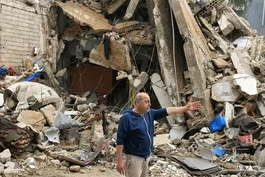
NewCivilians caught in path of Israeli invasion in southern Lebanon
Video has Closed Captions
Civilians caught in path of Israeli invasion in Lebanon (7m 57s)
 New
NewEstrogen patches face shortage as more seek hormone therapy
Video has Closed Captions
Estrogen patches face shortage as more women seek hormone therapy (9m 34s)
 New
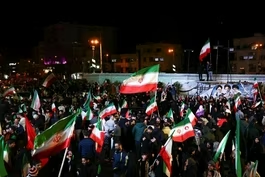
NewHow Iran is reacting as Trump pulls back from threats
Video has Closed Captions
How Iran is reacting as Trump pulls back from threat to wipe out civilization (4m 17s)
 New
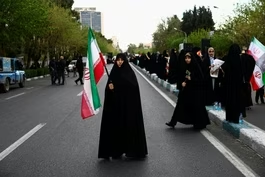
NewMideast experts weigh Iran's leverage in U.S. negotiations
Video has Closed Captions
Mideast experts weigh Iran regime’s leverage in negotiations with U.S. (8m 46s)
 New
NewNews Wrap: Vance backs Orbán in visit ahead of election
Video has Closed Captions
News Wrap: Vance backs Orbán in visit ahead of Hungarian elections (5m 32s)
 New
NewPatrick Radden Keefe joins Amna Nawaz on 'Settle In'
Video has Closed Captions
On 'Settle In,' Patrick Radden Keefe and Amna Nawaz discuss 'London Falling' (3m 38s)
 New
NewTBIs become defining injury for U.S. troops post-9/11
Video has Closed Captions
Traumatic brain injuries become defining injury for U.S. troops in post-9/11 conflicts (6m 52s)
 New
NewTrump backs down from threats to destroy Iran infrastructure
Video has Closed Captions
Trump agrees to 2-week ceasefire, backs down from threats to destroy Iran's infrastructure (5m 26s)
Providing Support for PBS.org
Learn Moreabout PBS online sponsorship
- News and Public Affairs

FRONTLINE is investigative journalism that questions, explains and changes our world.

- News and Public Affairs

Amanpour and Company features conversations with leaders and decision makers.
Urban Consulate Presents











Support for PBS provided by:
Major corporate funding for the PBS News Hour is provided by BDO, BNSF, Consumer Cellular, American Cruise Lines, and Raymond James. Funding for the PBS NewsHour Weekend is provided by...