
Analyzing the Supreme Court's mail-in voting decision
Clip: 9/15/2026 | 3m 42sVideo has Closed Captions
Analyzing the Supreme Court's mail-in voting decision and Trump's reaction
President Trump attacked the Supreme Court's decision blocking his effort to restrict mail-in voting with less than two months before Election Day. Amna Nawaz discussed the decision with News Hour Supreme Court analyst and SCOTUSblog co-founder Amy Howe.
Problems playing video? | Closed Captioning Feedback
Problems playing video? | Closed Captioning Feedback
Major corporate funding for the PBS News Hour is provided by BDO, BNSF, Consumer Cellular, American Cruise Lines, and Raymond James. Funding for the PBS NewsHour Weekend is provided by...
Analyzing the Supreme Court's mail-in voting decision
Clip: 9/15/2026 | 3m 42sVideo has Closed Captions
President Trump attacked the Supreme Court's decision blocking his effort to restrict mail-in voting with less than two months before Election Day. Amna Nawaz discussed the decision with News Hour Supreme Court analyst and SCOTUSblog co-founder Amy Howe.
Problems playing video? | Closed Captioning Feedback
Where to Watch PBS News Hour
PBS News Hour is available to stream on pbs.org and the PBS app.
Providing Support for PBS.org
Learn Moreabout PBS online sponsorshipAMNA NAWAZ: In the brief ruling, a majority of justices blocked the mail ballot plan from moving forward.
And only two, Justices Samuel Alito and Clarence Thomas, sided with the president.
Joining me now to discuss the decision is Amy Howe, "News Hour" Supreme Court analyst and co-founder of SCOTUSblog.
Good to see you, Amy.
AMY HOWE: Good to see you too.
AMNA NAWAZ: So it's a brief unsigned order.
What do we know about how the justices ruled here?
AMY HOWE: Not much is the answer.
It's one of these weird quirks of the emergency docket that, when you have a majority opinion or a majority order, the justices who joined that order don't necessarily -- don't sign their names, and they don't necessarily indicate if they don't agree with it.
So you can have justices who publicly note their dissent, as Justices Alito and Thomas did last night, but they don't have to.
So it could be 7-1, but there could have been one or more of the other justices who didn't agree, but just didn't say so.
AMNA NAWAZ: We saw Justice Brett Kavanaugh write a concurring opinion here, essentially saying, yes, the Postal Service has the right to do this, but it's too close to the election, so, no, they can't do it now.
What does that mean?
Does that leave the door open for the administration to try this again with more lead time before an election?
AMY HOWE: It probably does leave it open at least a crack, because you have Justice Kavanaugh saying there's a fair prospect that the administration could win on appeal, and then you have Justices Alito and Thomas saying in Justice Alito's dissent that the Postal Service has broad authority to issue rules like these, and the challengers probably aren't going to win on appeal.
And so that's three.
You need two more.
And when there is this kind of uncertainty about how the justices voted, and given the president's strong feelings about this issue, you likely are just -- are going to see the administration keep pushing forward.
AMNA NAWAZ: We saw those strong feelings on display.
We have seen the president before has a history of lashing out when the Supreme Court rules against him.
Today was no exception.
He posted multiple times berating the justices, including this post, in which he wrote: "This Supreme Court is bullied and cajoled by the radical left into making decisions that have set America back at least 100 years.
These are not the people I interviewed to serve on the United States Supreme Court.
They are merely a shell of their original selves."
Amy, it's worth pointing out the court has sided with the president on some issues like immigration and firing of agency officials, ruled against him on other issues like birthright citizenship.
What do you make of his reaction to today's ruling on this issue?
AMY HOWE: This is one of those issues, like birthright citizenship, like tariffs, where he's lashed out, I think because these are issues that are very important to him.
He has long believed without any real evidence that he's offered that there is rampant fraud in mail-in voting.
He's long been a proponent of tariffs.
He's felt very strongly at birth -- about birthright citizenship.
So he has been very successful before this Supreme Court on issues like immigration and on the emergency docket.
He had a string in 2025 of I think it was something like two dozen rulings in a row in favor of the Trump administration.
But these are issues that I think he feels very personally, and he takes these losses very personally, and he's lashing out.
And the justices, Justices Amy Barrett and Elena Kagan, testified before Congress about the threats to the judiciary and to the Supreme Court.
They were asking for more money for security.
And this kind of rhetoric isn't helpful.
AMNA NAWAZ: Amy Howe with SCOTUSblog, always good to see you.
Thank you for joining us.
AMY HOWE: Thanks for having me.
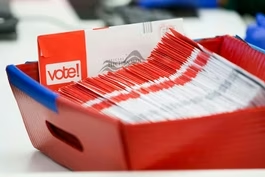
Election officials get mail-in voting clarity from court
Video has Closed Captions
Election officials get mail-in voting clarity after Supreme Court decision (4m 47s)

NATO shoots down drone as Russia continues to provoke Europe
Video has Closed Captions
NATO jets shoot down drone in Lithuania as Russia continues to provoke Europe (8m 41s)

News Wrap: Senate Democrats block crypto bill
Video has Closed Captions
News Wrap: Democrats block crypto bill, demand limits on Trump's investments (5m 26s)

Ocean at the front door: Coastal communities battle erosion
Video has Closed Captions
Ocean at the front door: East Coast communities race to protect homes from erosion (7m 15s)
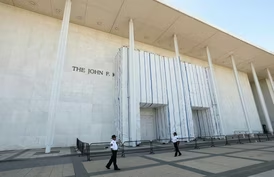
Trump-aligned Kennedy Center board votes to close
Video has Closed Captions
Kennedy Center board votes to close after judge blocks Trump's name from building (4m 32s)
Warner says U.S. can pursue safety without losing AI race
Video has Closed Captions
Sen. Mark Warner says U.S. can strengthen AI safety without losing race to China (9m 7s)
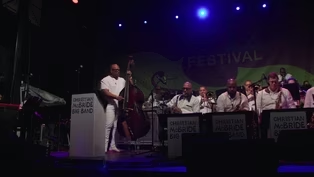
What makes Christian McBride the hardest-working man in jazz
Video has Closed Captions
What makes Christian McBride the hardest-working man in jazz (7m 56s)
Providing Support for PBS.org
Learn Moreabout PBS online sponsorship New Episode
- News and Public Affairs

FRONTLINE is investigative journalism that questions, explains and changes our world.
 New Episode
- News and Public Affairs

Today's top journalists discuss Washington's current political events and public affairs.
 New Episode
 New Episode
 New Episode
 New Episode
 New Episode


 New Episode
 New Episode
 New Episode
Support for PBS provided by:
Major corporate funding for the PBS News Hour is provided by BDO, BNSF, Consumer Cellular, American Cruise Lines, and Raymond James. Funding for the PBS NewsHour Weekend is provided by...