
Jury throws out Musk's lawsuit against OpenAI and Sam Altman
Clip: 5/18/2026 | 5m 54sVideo has Closed Captions
Jury throws out Musk's lawsuit against OpenAI and Sam Altman
A federal judge in California dismissed a lawsuit from Elon Musk against the maker of ChatGPT after a jury found that he exceeded the statute of limitations. Musk had claimed that OpenAI betrayed its original mission of developing artificial intelligence for the good of humanity when it added a for-profit arm. Geoff Bennett discussed more with Gerrit De Vynck of The Washington Post.
Problems playing video? | Closed Captioning Feedback
Problems playing video? | Closed Captioning Feedback
Major corporate funding for the PBS News Hour is provided by BDO, BNSF, Consumer Cellular, American Cruise Lines, and Raymond James. Funding for the PBS NewsHour Weekend is provided by...
Jury throws out Musk's lawsuit against OpenAI and Sam Altman
Clip: 5/18/2026 | 5m 54sVideo has Closed Captions
A federal judge in California dismissed a lawsuit from Elon Musk against the maker of ChatGPT after a jury found that he exceeded the statute of limitations. Musk had claimed that OpenAI betrayed its original mission of developing artificial intelligence for the good of humanity when it added a for-profit arm. Geoff Bennett discussed more with Gerrit De Vynck of The Washington Post.
Problems playing video? | Closed Captioning Feedback
How to Watch PBS News Hour
PBS News Hour is available to stream on pbs.org and the free PBS App, available on iPhone, Apple TV, Android TV, Android smartphones, Amazon Fire TV, Amazon Fire Tablet, Roku, Samsung Smart TV, LG TV, and Vizio.
Providing Support for PBS.org
Learn Moreabout PBS online sponsorshipGEOFF BENNETT: The trial pitting two of the world's biggest tech billionaires against each other has come to an end.
A federal judge in California today dismissed a lawsuit from Elon Musk against the maker of ChatGPT after a jury found that he exceeded the statute of limitations.
Musk claimed that OpenAI, which he co-founded, had betrayed its original mission of developing artificial intelligence for the good of humanity when it added a for-profit arm.
OpenAI's other co-founders, including Sam Altman, said that Musk knew of the company's plans all along.
In a social media post, Musk called the verdict a -- quote -- "terrible precedent" and vowed to appeal.
For more on this, we are joined now by Gerrit De Vynck.
He's a tech reporter for The Washington Post who covered the trial.
Gerrit, it's always good to see you.
So you have got these two tech titans, three weeks in court, and the case gets thrown out on statute of limitations grounds?
So Musk's team knew that this was going to be a hurdle, so why bring the case anyway?
GERRIT DE VYNCK, Tech Reporter, The Washington Post: Yes, I mean, it's interesting.
I mean, this definitely came up before the trial.
A lot of people are asking, wait, if this was statute of limitations, why did we even go to a trial?
And the judge ordered this trial because there was a fact discrepancy.
There was different opinions about when Elon Musk knew what about OpenAI's transition.
And it was a bit of an open question.
And a part of the trial was definitely trying to figure out, OK, did Elon Musk know that OpenAI had made certain steps towards becoming a for-profit, towards taking on investment from outside investors?
Elon Musk said that he was kind of sort of paying attention, but not really aware because he's very busy, even saying certain documents that have been sent to him, that he only read the first page and decided not to keep going.
And so that's really what the jury said.
So there was a trial here.
There was a trial saying, when did he know what?
And, of course, we talked about a lot of other things that did not actually come to play in the jury's decision.
But, yes, we're here on statute of limitations.
Elon Musk says he will appeal.
So maybe we will get another run at this.
GEOFF BENNETT: So, during the case, what was OpenAI's response to Elon Musk's argument?
GERRIT DE VYNCK: Yes, so Elon Musk's argument, if you go beyond the statute of limitations, a complicating factor was that OpenAI stole a charity, that this was a nonprofit, it was meant to be founded for the benefit of all humanity, and that you can't turn that into a for-profit, that then the people who are invested in it become fabulously wealthy, which is true in terms of some of the OpenAI investors, including some of its executives.
The company said, look, you were there when we had all these conversations about starting a for-profit arm, you agreed with it at the time, and the company is still controlled by a nonprofit board.
So there's really nothing here for you to complain about.
And so those are kind of the questions that we are not sure exactly how the jury would have ruled if they had gotten to them, but that's really what a lot of the trial was about.
GEOFF BENNETT: And what more did we learn about Sam Altman, especially from his former colleagues who questioned his trustworthiness?
GERRIT DE VYNCK: Yes, I mean, one of the really interesting things here is that, even though OpenAI walks away from this with a win, it was a pretty damaging and sort of embarrassing season for them, right?
I mean, we had a lot of details about fighting going on at this company early on when it was founded.
And we got a lot more details about the incident when Sam Altman back in 2023 was fired and then rehired five days later.
A lot of the former OpenAI board members, former OpenAI executives who worked very closely with Sam Altman reiterated their claims in court that he is manipulative, that he has shown a pattern of lying.
And so even though Sam Altman is still in this position, the people he works with now publicly support him, these are questions that have kind of swirled around him for many, many years.
And this trial definitely boosted those questions.
And I don't think that they're going away any time soon.
GEOFF BENNETT: Does this make it harder for OpenAI to go public?
GERRIT DE VYNCK: I think it will probably be a question that OpenAI's critics kind of throw at it.
What about Sam Altman?
Is he trustworthy?
But at the same time, Sam Altman has been the boss of this company when it's seen some of the most incredible growth of any company, I would say, in history.
And so I think the people who really run the show at OpenAI, its big investors, Microsoft, SoftBank, its current board members, they all support Sam Altman.
He's working for them.
He's making things work.
They're all making a lot of money.
And so I think, when this company goes public, it will be not as much of an issue as maybe people like Elon Musk wanted to be.
And the fact that he's now had his lawsuit thrown out is something that OpenAI can draw on and say, look, a judge signed off on our situation.
There's nothing nefarious going on here.
Why don't you guys just leave us alone and let us continue being the company that we are?
GEOFF BENNETT: And, Gerrit De, for people who might see this as a high-profile schoolyard fight, a well-funded schoolyard fight, certainly, why does this matter?
GERRIT DE VYNCK: Yes, I mean, I think it matters because we had these two extremely powerful men on the stand.
They were under oath and they were asked questions.
We had a lot of information brought up through discovery and through evidence that was presented in the trial about how OpenAI operates, how wealthy its leaders are.
We know detailed information about the personal investments of people like Sam Altman.
That all helps people like me, historians who are going to be writing this chapter about the A.I.
revolution really understand what happened here.
And I think this trial just brought a lot of transparency to one of the most important companies of our day.
And so I think, regardless of the outcome, that is definitely something that will benefit the public's understanding of the A.I.
revolution.
GEOFF BENNETT: Gerrit De Vynck of The Washington Post, thank you for sharing your reporting with us.
Always good to see you.
GERRIT DE VYNCK: Any time.

Bengali Muslims face persecution and displacement in India
Video has Closed Captions
Bengali Muslims in India face persecution and displacement amid citizenship disputes (9m 26s)

Doctor who survived Ebola shares concerns about new outbreak
Video has Closed Captions
Doctor who survived Ebola shares concerns about latest outbreak in Central Africa (7m 5s)
DOJ says $1.8B fund could compensate 'targeted' Trump allies
Video has Closed Captions
DOJ creates $1.8 billion fund that could compensate 'targeted' Trump allies (4m 34s)
News Wrap: Trump says he called off planned strike on Iran
Video has Closed Captions
News Wrap: Trump says he called off strike on Iran planned for Tuesday (4m 32s)
Tamara Keith and Amy Walter on Trump's grip on GOP primaries
Video has Closed Captions
Tamara Keith and Amy Walter on Trump's power in pushing out 'disloyal' Republicans (8m 56s)
Teenage gunmen open fire on Islamic center, police say
Video has Closed Captions
Teenage gunmen open fire on Islamic Center of San Diego, police say (1m 55s)
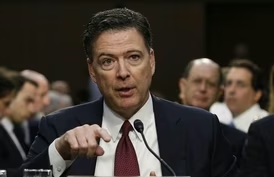
'There's an obsession there,' Comey says of Trump
Video has Closed Captions
'There's an obsession there,' Comey says of Trump after 2nd indictment (10m 1s)
Providing Support for PBS.org
Learn Moreabout PBS online sponsorship New Episode
- News and Public Affairs

Today's top journalists discuss Washington's current political events and public affairs.

- News and Public Affairs

FRONTLINE is investigative journalism that questions, explains and changes our world.
Urban Consulate Presents
 New Episode
 New Episode
 New Episode
 New Episode

 New Episode
 New Episode
 New Episode
 New Episode
Support for PBS provided by:
Major corporate funding for the PBS News Hour is provided by BDO, BNSF, Consumer Cellular, American Cruise Lines, and Raymond James. Funding for the PBS NewsHour Weekend is provided by...